
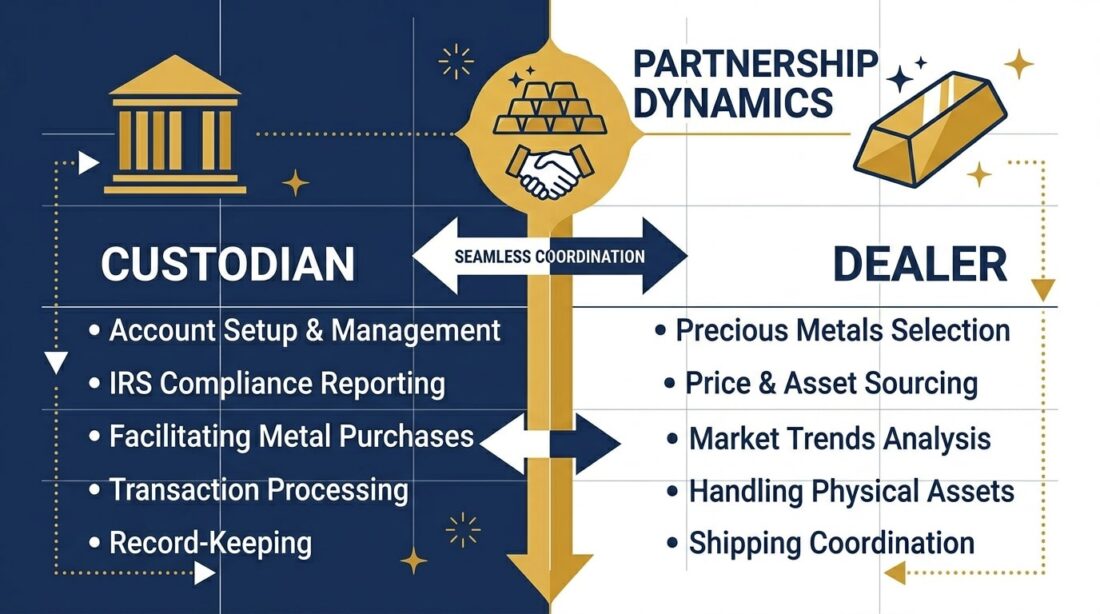
Who Are the Top-Rated Gold IRA Custodians for 2026? (Fee & Rating Comparison)
The top-rated gold IRA custodians for 2026 — based on IRS approval status, institutional credibility, fee transparency, and complaint resolution history — include Equity Trust Company, STRATA Trust Company, GoldStar Trust Company, and Advanta IRA. These are the non-bank trust companies that actually hold the physical metals inside your self-directed IRA, and they’re the institutions regulators and the IRS Approved Nonbank Trustees and Custodians list recognize as legally eligible to do so.
Here’s what most comparison articles don’t tell you upfront: a custodian and a gold IRA dealer are two separate things. The company you call to set up your account — the one helping you choose metals, explaining your options, and guiding you through the rollover — is the dealer. The custodian is the institution the IRS requires to hold your assets in trust. Both matter. But they play completely different roles, and confusing them is one of the most common mistakes people make when evaluating their options.
What separates a strong custodian from a weak one in 2026 comes down to four things: IRS non-bank trustee approval, BBB rating and complaint resolution history, fee transparency (annual custodian fees typically range from $100 to $250), and SSAE-18 audit compliance — the independent security standard that confirms your storage and custody operations are being conducted correctly.
This article breaks down how to evaluate each of those criteria, what the leading custodians look like on paper, how custodian fees work in practice, and what to watch for when a dealer claims they’re “handling the custodian for you.” By the end, you’ll know exactly what questions to ask — and which answers should give you pause.
Last Updated: April 14, 2026
- Understanding the Custodian’s Role in a Gold IRA
- How to Evaluate Top-Rated Gold IRA Custodians in 2026
- The Custodian-Dealer Triangle — And Where Conflict Hides
- What Happens After You Choose Your Custodian
- Frequently Asked Questions
- What is the difference between a gold IRA dealer and a custodian?
- Can I choose my own custodian, or does the dealer pick one for me?
- How much are standard annual custodial fees in 2026?
- Is my gold safer with a bank or a non-bank trust company?
- What happens to my gold if the custodian goes out of business?
- Are there any “No Fee” Gold IRA options in 2026?
- What is an SSAE-18 audit and why does it matter for my metals?
- The Right Custodian Isn’t the One With the Best Marketing
Understanding the Custodian’s Role in a Gold IRA
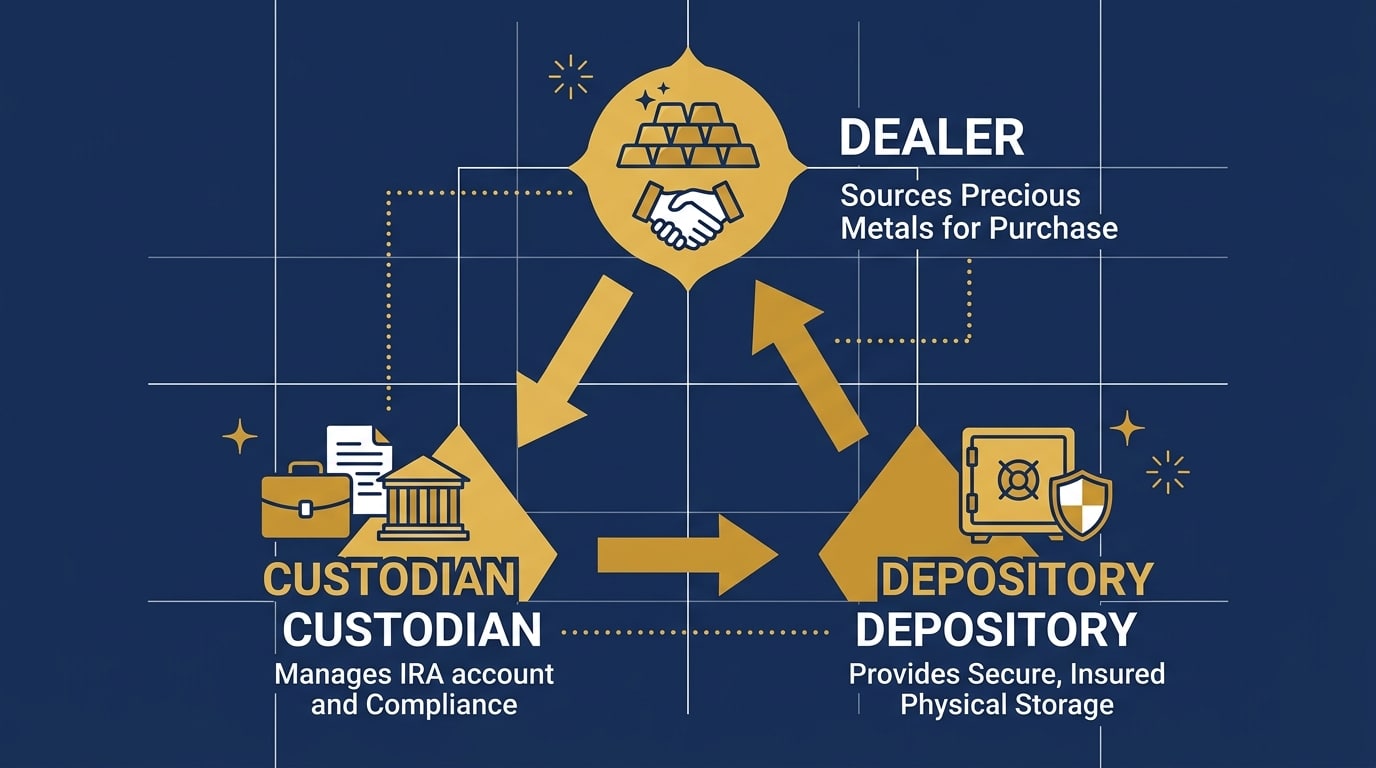
Most customers who reach us about a Precious Metals IRA have already done research. They’ve read the comparison articles. They’ve seen the names — Augusta, Goldco, American Hartford Gold. Those are dealers. The companies that source and sell the metals. The custodian is something else entirely, and mixing them up changes every evaluation you make after that.
A self-directed IRA that holds physical gold must, by law, have a qualified trustee or custodian — one that meets IRS requirements for non-bank trustees. That institution holds the assets, files the compliance paperwork, and keeps the account in good standing with the IRS year over year.
How the Dealer-Custodian Separation Protects You
Brighton Gold — the dealer — sources the metals, coordinates with your chosen custodian, and walks you through every stage of the process. We work with custodians on your behalf. We don’t replace them. And that separation isn’t a technicality — it’s the structure that protects you.
When the dealer and custodian are independent entities, no single party controls the full chain. Your metals are held in your name, at an IRS-approved depository, under the oversight of a regulated trustee. Not bundled into a dealer’s balance sheet. Not dependent on any single company staying solvent.
If you’re already thinking about understanding gold IRA storage rules — the custodian question and the depository question are closely connected. This article covers the custodian side.
What a Gold IRA Custodian Actually Does
The custodian’s job is administrative and compliance-focused — not guidance-based. They hold your IRA assets in trust, process contributions and distributions, maintain the account structure the IRS requires, and produce the documentation that keeps everything in order.
Here’s what that looks like in practice:
- Account establishment — The custodian sets up the self-directed IRA under your name and tax ID, establishes the account with the IRS, and creates the documentation trail that defines the account type (Traditional, Roth, SEP, SIMPLE).
- Funding and transfer processing — When you roll over a 401(k) or transfer an existing IRA, the custodian coordinates receipt of funds, ensures the transfer follows IRS rules to avoid a taxable event, and confirms the account is properly capitalized before a metals purchase can happen.
- Purchase and settlement — Once you and your dealer agree on a metals purchase, the custodian releases funds and receives confirmation of settlement before authorizing storage at your chosen IRS-approved depository.
- Annual account maintenance — Each year, the custodian files IRS Form 5498 (contributions and fair market value) and Form 1099-R (distributions). They produce required account statements and respond to IRS inquiries on your behalf.
- Distribution processing — When you’re ready to take distributions — as physical delivery or liquidation — the custodian manages the mechanics and withholds required taxes where applicable.
What the custodian does not do: tell you which metals to buy, weigh in on timing, or guide your broader financial picture. That’s not their role — and any custodian that presents itself as a financial professional offering guidance on those questions should raise a flag.
Why the Custodian Question Gets Overcomplicated — And Why That’s the Point
Most people don’t arrive at this decision feeling calm about it.
They’ve read articles full of terms like SSAE-18 compliance, commingled versus segregated storage, IRS-approved depository networks, non-bank trustee status, and annual fee schedules broken into setup fees, wire fees, and storage tiers. It sounds like a maze specifically designed to make you feel like you need someone else’s help to get through it.
That’s not an accident.
When the process feels overwhelming, customers defer to whoever is guiding them. That deferral opens the door for arrangements that benefit the dealer or custodian — not the customer. Premium coin products with elevated spreads. Storage arrangements where the dealer has a financial relationship with the facility. Custodian recommendations driven by incentive agreements rather than service quality. When you understand the structure, the leverage disappears.
Here’s the reality: choosing a gold IRA custodian is part of a three-step process. You open a self-directed account. You fund it — through a rollover, transfer, or new contribution. You purchase IRS-eligible metals, and they’re held in your name at an IRS-approved depository under your custodian’s oversight. That’s the whole structure. The paperwork exists to protect the tax-advantaged status of your account — not to protect the people profiting from your confusion.
Our job — and the right custodian’s job — is to make each of those steps feel exactly like what it is: straightforward.
How to Evaluate Top-Rated Gold IRA Custodians in 2026
Not every institution that calls itself a gold IRA custodian is operating at the same level. The difference shows up in three places: regulatory standing, complaint history, and fee transparency. Here’s how to evaluate each one before you sign anything.
Ratings and Institutional Credibility
Two things matter most when you’re assessing a custodian’s credibility: regulatory standing and complaint resolution history.
Regulatory standing means the custodian appears — by name — on the IRS Approved Nonbank Trustees and Custodians registry. That’s a short list. Not every company presenting itself as a “custodian” or “trustee” has cleared the IRS bar to legally hold retirement assets. Confirm it directly before you proceed. If the name isn’t on that list, the IRA structure doesn’t hold.
Complaint resolution history is where the BBB becomes useful — but not the way most people use it. A clean BBB profile with no complaints can mean a company is excellent. It can also mean they’re new enough that complaints haven’t accumulated yet. What matters more is the pattern: when complaints were filed, how were they handled? Were customers made whole? Did the same problem show up repeatedly? Platforms like Trustpilot and Consumer Affairs add supplementary context — particularly useful for spotting recurring service issues that don’t make it into formal BBB complaints.
SSAE-18 compliance rounds out the picture. SSAE 18 (Statement on Standards for Attestation Engagements No. 18) is an independent audit standard that evaluates a company’s internal controls — how they handle customer data, physical asset custody, and financial reporting. A custodian that’s completed an SSAE-18 audit has submitted to third-party verification of their processes. One that hasn’t — or won’t say — is asking you to take their word for it.
| Credibility Signal | What It Confirms | Where to Verify |
|---|---|---|
| IRS Non-Bank Trustee Status | Legal eligibility to hold retirement assets | IRS.gov approved trustee list |
| BBB Rating + Complaint Resolution | Real-world dispute handling and pattern of service | BBB.org business profile |
| SSAE-18 Audit Compliance | Independent verification of custody and financial controls | Custodian’s disclosed audit reports |
| Customer Review Sentiment | Service quality and responsiveness in practice | Trustpilot, Consumer Affairs |
Before you proceed with any custodian, get clear answers to these four questions:
- Is the name on the IRS non-bank trustee list? — Confirm directly at IRS.gov. Do not rely on the company’s own statement or a dealer’s assurance.
- What does the BBB complaint history actually show? — The pattern of resolution matters more than the rating number. A company with five resolved complaints tells you more than a company with zero.
- Has an SSAE-18 audit been completed? — Ask for confirmation and whether audit results are available for review. Vague answers are an answer.
- What do independent review platforms reflect? — Identify recurring service themes across Trustpilot and Consumer Affairs. Single negative reviews are noise. Repeated patterns are signal.
Fee Structures: What You Should Expect
Fee transparency is the single fastest way to separate a trustworthy custodian from one that isn’t.
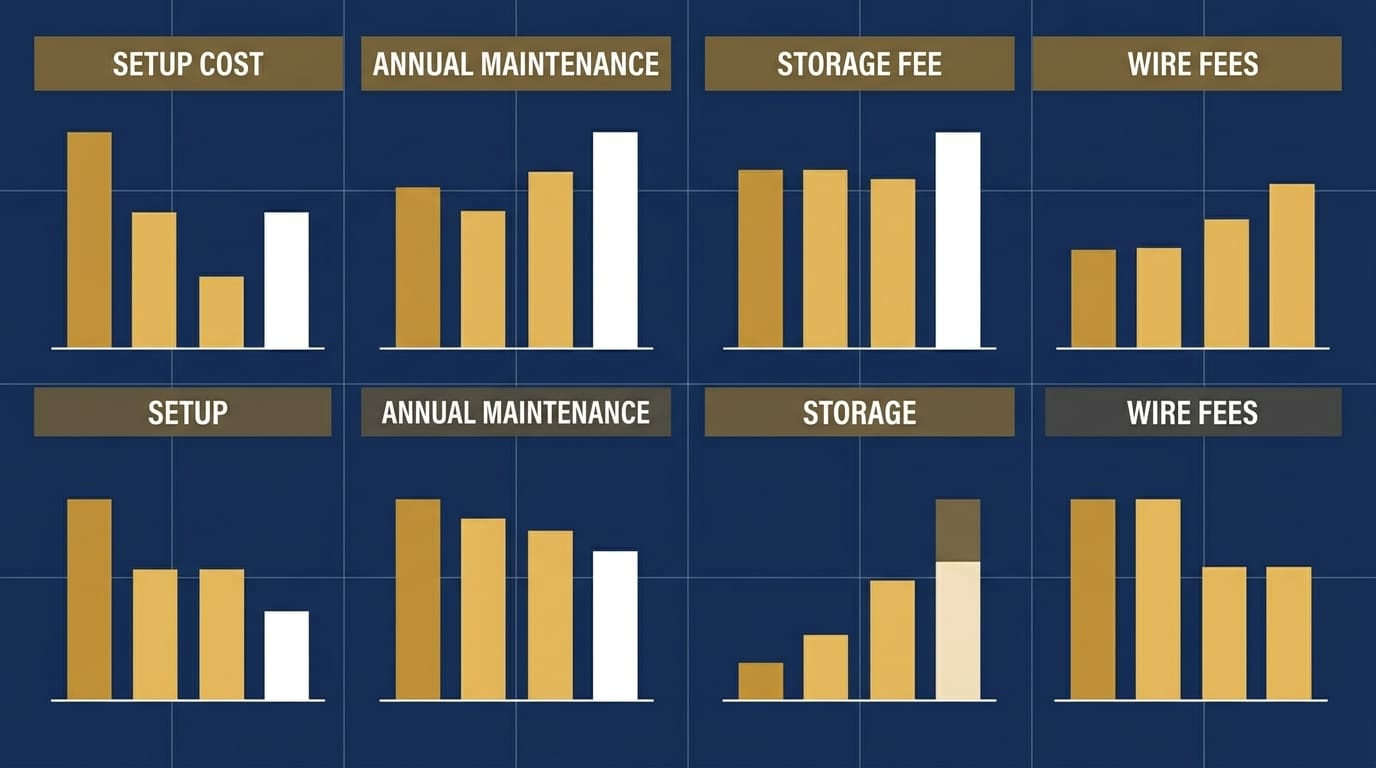
Most custodians charge across four categories: account setup, annual maintenance, storage, and transaction or wire processing. The dollar amounts vary — but the structure is consistent enough that you can build a real comparison once you know which questions to ask.
Annual custodial fees across the industry currently range from approximately $100 to $250 per year for maintenance, though some custodians use tiered pricing that scales with account value. Setup fees typically run between $50 and $75 for initial account establishment. Storage fees depend on the depository selected and whether you choose segregated or commingled storage — with segregated storage (where your metals are held separately, not pooled with other customers’ holdings) costing more but delivering a cleaner ownership record.
Wire transfer fees typically run $25 to $35 per transaction. Some custodians waive these under certain account size or activity thresholds — worth asking about directly.
Here’s the point most fee comparisons miss: the custodian fee is one layer of your total cost of ownership — not the whole picture. The dealer spread on your metals purchase is another layer. Depository storage is a third. An article focused only on custodian fees leaves you with an incomplete equation. For a full breakdown across all three categories, understanding gold IRA fee structures covers each line item in detail.
| Fee Type | Typical Range (2026) | Notes |
|---|---|---|
| Account Setup | $50–$75 | One-time, paid at account opening |
| Annual Maintenance | $100–$250 | Some custodians tier by account value |
| Segregated Storage | $150–$300/year | Metals held separately from other customers |
| Commingled Storage | $75–$150/year | Lower cost; metals pooled by type and weight |
| Wire Transfer | $25–$35 per transaction | May be waived at certain account levels |
Fee ranges above represent general industry benchmarks as of 2026. Confirm current fee schedules directly with each custodian before opening an account. Fees are subject to change.
Comparing the Leading IRS-Approved Custodians
The custodians below are among the most commonly referenced in the Precious Metals IRA space. All are recognized in the industry as IRS-approved non-bank trustees. Details below represent general public information — confirm current fee schedules and approval status directly with each institution.
| Custodian | IRS Non-Bank Trustee | Specialty | Annual Fee Range | Notes |
|---|---|---|---|---|
| Equity Trust Company | Confirmed | Broad SDIRA platform, large volume | Varies by tier | One of the largest SDIRA custodians by account count |
| STRATA Trust Company | Confirmed | Precious metals focus | $100–$200+ | Formerly Self Directed IRA Services |
| GoldStar Trust Company | Confirmed | Precious metals IRA specialist | Varies | Long-standing presence in the metals IRA space |
| Advanta IRA | Confirmed | SDIRA generalist | $150–$250 | Regional presence; known for service responsiveness |
Always verify IRS approval directly at the time of your research — the list is updated and custodians may be added or removed.
The Custodian-Dealer Triangle — And Where Conflict Hides
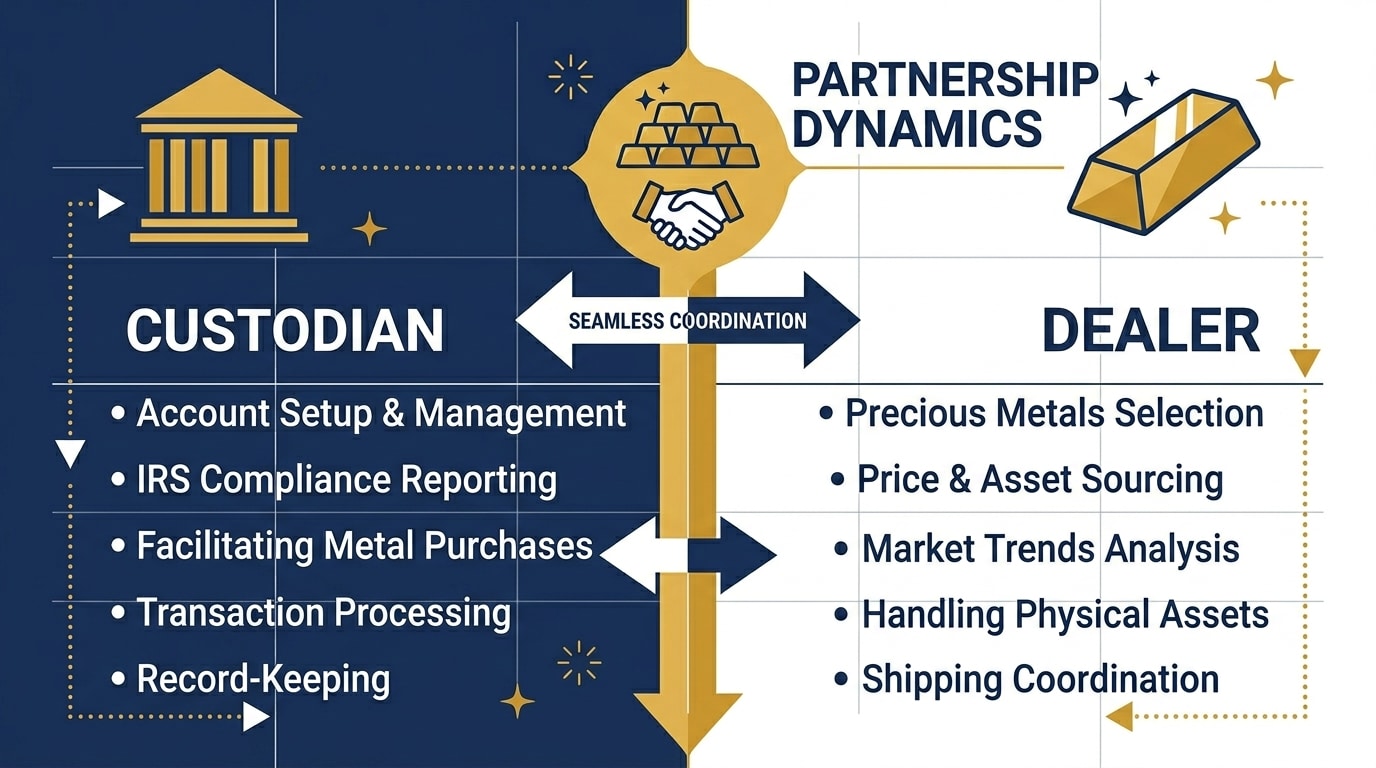
A Gold IRA involves three separate parties: the dealer, the custodian, and the depository. Most articles explain each one in isolation. What they don’t cover — and what matters most to you — is how those relationships interact, and where that interaction can quietly stop serving your interests.
| Entity | Role | What They Should Not Do |
|---|---|---|
| Dealer (e.g., Brighton Gold) | Sources metals, guides the acquisition process, coordinates with custodian | Hold your metals, provide financial guidance, serve as custodian |
| Custodian (e.g., Equity Trust, STRATA) | Holds IRA assets, handles IRS compliance, processes transfers | Recommend which metals to acquire, act as a dealer or depository |
| Depository (e.g., Brinks, Delaware Depository) | Stores physical metals in an IRS-approved secure facility | Give account guidance, sell metals |
When those roles are clearly separated and independently operated, the structure works the way it was designed to work. No single party controls the full chain. Your assets are protected across multiple independent institutions. The problem — and there is one — shows up when the lines between those roles blur.
Who Controls Which Custodian You Work With?
Before you agree to any custodian arrangement, there’s one question worth asking directly: Does your dealer have a financial relationship with the custodian they’re recommending?
Some dealers operate under preferred custodian arrangements — revenue-sharing agreements, joint marketing structures, or volume-based incentive programs. That’s not automatically a disqualifying arrangement. But it means the custodian recommendation you’re receiving may not be the one best suited to your account — it may be the one most profitable for the dealer.
Similarly, some custodians push specific coin products — typically premium or numismatic coins with elevated spreads — as part of their recommended purchase lists. The SEC’s custody rule (Rule 206(4)-2) was designed to govern how registered professionals handle client assets in custody situations. While its direct application to self-directed IRAs involves nuance, the principle it enforces is worth carrying into your evaluation: the entity holding your assets shouldn’t also be the entity profiting from what goes into them.
What you’re entitled to: the right to choose your own custodian. A dealer who won’t accommodate your preferred IRS-approved custodian is a dealer worth questioning. You own the account. The custodian works for your account — not for the dealer.
Brighton Gold’s concierge model is structured around this reality. We coordinate with your custodian. We don’t require you to use one we’ve arranged. That’s a structural commitment to your clarity and control — not marketing language.
For a closer look at the patterns that consistently show up in customer complaints and regulatory actions, identifying safe gold IRA practices covers the warning signs worth knowing before you sign.
“Free Silver” Offers and What’s Actually Baked In
“Free silver” doesn’t mean free. It means the cost moved.
Promotional offers that bundle silver into a Gold IRA transaction — framed as “up to $10,000 in free silver” or “bonus metals on qualified purchases” — are almost always recovered through markup elsewhere in the arrangement. The silver isn’t absorbed by the dealer. The cost shows up in the spread on your metals acquisition, in the custodian fee structure, or in both.
When you evaluate a Gold IRA arrangement on its headline offer, you’re evaluating the marketing. The full cost of a precious metals acquisition lives across multiple line items:
- The dealer’s spread on the metals acquired
- The custodian’s setup and annual fees
- Depository storage fees (segregated vs. commingled)
- Wire and transaction processing fees
- Any ongoing premium on “exclusive” or “special edition” coin products
Free silver is a retention mechanism — it creates commitment before the customer has evaluated the complete cost picture. For a closer look at how these patterns work and what to watch for, identifying safe gold IRA practices covers this and other signals worth understanding before any account is opened.
This Arrangement Isn’t for Everyone — And That’s Worth Saying Directly
One thing worth saying plainly.
If you’re evaluating custodians because you want to find the one most likely to produce the best price activity — or because you want a custodian who can tell you when gold prices are going to move in your favor — that’s not what custodians do. It’s not what dealers do either, not responsibly.
A Precious Metals IRA isn’t a trading account. The custodian holds assets. The metals inside may appreciate, depreciate, or remain unchanged. No custodian controls that, and no arrangement that implies otherwise should be trusted.
If your primary goal is short-term price activity — buying today and selling when the market moves — Brighton Gold isn’t the right fit. We don’t forecast prices. We don’t time the market. We work with owners who want to hold something real for the long haul — not customers who are treating a Precious Metals IRA as a catalyst for a trade.
If that’s not where you are right now, that’s a legitimate answer. Some financial situations don’t call for this structure. Evaluating institutional bias against gold covers those scenarios honestly, including the cases where a Precious Metals IRA genuinely isn’t the right move.
What Happens After You Choose Your Custodian

Choosing a custodian is the beginning of the process — not the end. What happens next, from account opening through your first metals acquisition and into ongoing ownership, is where most customers feel least prepared. Here’s exactly what that timeline looks like.
The Account Setup Timeline
Most Precious Metals IRA accounts are established within five to ten business days of submitting required documentation. The timeline depends on two things: how quickly your existing account holder releases the transfer, and how quickly you return custodian paperwork.
Here’s what the process typically involves:
- Step 1 — Custodian account application — You complete paperwork with your chosen custodian. This includes identity verification (government-issued ID, Social Security number), beneficiary designations, and account type selection (Traditional, Roth, SEP, SIMPLE).
- Step 2 — Funding request — If you’re executing a rollover or transfer, the custodian initiates the funding request to your existing account holder. Direct transfers are typically faster than 60-day rollovers and avoid the withholding rules that apply to indirect rollovers.
- Step 3 — Funds received and confirmed — Once the custodian confirms receipt and settlement, the account is ready for a metals acquisition. No acquisition can occur before funds clear — this is a compliance requirement, not an optional delay.
- Step 4 — Metals acquisition and settlement — You and your dealer finalize the metals selection. The custodian releases funds and receives confirmation of purchase and settlement. The metals are then shipped to your chosen IRS-approved depository.
- Step 5 — Depository confirmation — The depository confirms receipt and begins storing your metals in your name. Your custodian updates the account record accordingly.
For customers transferring from an existing IRA, the full process from application to confirmed storage typically completes in under two weeks. For a complete walkthrough of the mechanics, executing a precious metals IRA rollover covers each step in detail.
Day 1 Ownership Checklist
Once your account is live and your metals are confirmed at the depository, here’s what to verify before you consider setup complete.
| Item | What to Confirm | Who Provides It |
|---|---|---|
| Account statement | Your metals are listed by type, weight, and quantity | Custodian |
| Depository receipt | Physical confirmation your metals are in storage, in your name | Depository |
| IRS account type | Traditional, Roth, SEP, or SIMPLE — confirmed correctly | Custodian |
| Beneficiary designation | Correct beneficiaries listed; updated from prior accounts if rolled over | Custodian |
| Annual fee schedule | Written confirmation of custodian and storage fees going forward | Custodian |
| Dealer contact | A direct contact at your precious metals dealer for post-acquisition questions | Brighton Gold team |
| Fair market value tracking | A method for monitoring the current market value of your metals | Your choice — FMV resources are publicly available |
This is where the post-acquisition experience separates dealers. Some complete the sale and consider the relationship done. Brighton Gold’s concierge model includes support at every stage of ownership — before the acquisition, through the process, and after. The Learning Center at brightongold.com/learning-center/ is part of that ongoing structure.
Frequently Asked Questions
What is the difference between a gold IRA dealer and a custodian?
A gold IRA dealer — like Brighton Gold — is a precious metals company that sources, sells, and coordinates the acquisition of physical metals for IRA accounts. A custodian is a separate, IRS-approved institution that holds the IRA assets, maintains account compliance, and handles the administrative and reporting requirements of a self-directed retirement account. The dealer and the custodian are always separate entities. The dealer never holds your metals. The custodian never sells them to you. Understanding that separation is foundational to evaluating any Gold IRA arrangement correctly.
Most of the confusion in this space comes from companies that blur those lines — presenting themselves as both dealer and custodian, or as custodians who happen to also source the metals. When the roles are combined, the structure that’s supposed to protect you no longer does.
Can I choose my own custodian, or does the dealer pick one for me?
You choose your custodian. The IRA is your account — you have the right to select any IRS-approved non-bank trustee or custodian you qualify to work with. Some dealers have preferred custodian relationships and may recommend one or a short list — a recommendation grounded in actual service experience isn’t automatically problematic. But you’re not required to use that custodian, and a dealer who insists otherwise is worth questioning. Always confirm that the custodian you’re considering is on the IRS Approved Nonbank Trustees and Custodians list before you proceed.
Ask directly whether your dealer has any financial relationship — referral fee, volume agreement, or marketing arrangement — with the custodian they’re recommending. That context changes the weight you should give the recommendation.
For a deeper walkthrough of how to match a custodian to your specific ownership goals, how to choose a gold IRA custodian for long-term wealth preservation covers the full evaluation framework.
How much are standard annual custodial fees in 2026?
Annual custodian maintenance fees in 2026 typically range from $100 to $250 per year, depending on the custodian and account structure. Some custodians charge flat annual fees regardless of account value. Others use tiered pricing that increases with account size. On top of the maintenance fee, expect to see a one-time setup fee (typically $50–$75), storage fees for your depository (ranging from approximately $75–$300 annually depending on whether you select commingled or segregated storage), and wire or transaction fees of $25–$35 per transfer. The total cost of holding a Precious Metals IRA annually — custodian plus storage — typically falls in the $200–$600 range depending on your selections. Confirm the full fee schedule in writing with your chosen custodian before opening an account.
For a full look at what the complete annual cost of ownership looks like across all three layers — custodian, dealer spread, and storage — understanding the hidden costs in a gold IRA covers each line item.
Is my gold safer with a bank or a non-bank trust company?
The IRS allows both bank trustees and approved non-bank trustees to serve as custodians for self-directed IRAs. Most Precious Metals IRA custodians are non-bank trust companies — not banks — because the regulatory requirements for bank trustees are structured differently and most large banks don’t accommodate physical precious metals as IRA assets. Non-bank trustees on the IRS-approved list are regulated institutions subject to state-level trust regulations and IRS oversight. The safety of your metals is ultimately a function of the depository where they’re stored, not just the custodian — IRS-approved depositories carry insurance and are subject to independent audits. The custodian and depository together create the oversight structure that protects your assets.
What happens to my gold if the custodian goes out of business?
This is one of the most practical questions customers ask — and one of the most underexplored. The answer depends on how your metals are held. If you’ve selected segregated storage, your metals are held separately in your name at the depository. They’re not commingled with other customers’ assets and not on the custodian’s balance sheet. If the custodian becomes insolvent, a successor custodian can be appointed to assume the account — your metals remain in your name at the depository throughout. That’s the structural protection segregated storage provides. Commingled storage offers less clarity in that scenario, which is one reason many owners opt for segregated storage despite the higher annual cost. Ask your custodian directly how your metals are titled and held.
Are there any “No Fee” Gold IRA options in 2026?
Brighton Gold offers a No Fee Precious Metals IRA for the lifetime of the account on qualified purchases. That’s not a promotional offer — it’s a structural commitment. The custodian and storage fees that most competitors pass through to customers are absorbed as part of Brighton Gold’s model on qualifying account sizes and purchases. If you’ve seen “No Fee IRA” language elsewhere in the market, confirm exactly which fees are waived, for how long, and what the conditions are. In many cases, fees described as “waived” are recovered through higher product spreads at the point of acquisition — making the lifetime of the fee waiver irrelevant if the real cost lives in the initial transaction. Understanding gold IRA fee structures explains how to compare total cost of ownership across different dealer and custodian arrangements.
What is an SSAE-18 audit and why does it matter for my metals?
SSAE-18 (Statement on Standards for Attestation Engagements No. 18) is an independent audit standard that evaluates a service organization’s internal controls — including how they handle data security, financial reporting, and in the case of a custodian or depository, physical asset custody. A completed SSAE-18 audit means an independent third party has examined and validated the organization’s processes. For a custodian or depository holding your retirement assets, it’s meaningful third-party confirmation that the institution’s internal controls are functioning as claimed. Ask any custodian you’re evaluating whether they’ve completed an SSAE-18 audit and whether results are available for review.
The Right Custodian Isn’t the One With the Best Marketing
Most customers think they’re making one decision when they set out to evaluate gold IRA custodians. They’re actually making two.
The first: which dealer do you want guiding the acquisition process? The second: which IRS-approved custodian will hold your account? Most comparison articles blend these together. Most of them don’t serve you as a result.
What actually matters — IRS approval status, verified directly. Fee schedule, in writing, before you sign. SSAE-18 audit confirmation. Complaint resolution history, reviewed independently of whatever the company says about itself. Dealer and custodian operating as separate, independent entities. No single point of control over your assets. Storage in your name, at a regulated facility, not commingled with a balance sheet you can’t see.
That’s the structure. When it’s clean, it does what it’s supposed to do — hold something real, in your name, outside the paper financial system, with clarity you can verify at any point. Precious metals may appreciate, depreciate, or remain unchanged. What a well-structured account gives you is ownership — clear, documented, and yours regardless of what happens around it.
If that picture still makes sense for your situation, the next step is a conversation. Not a pitch. A walkthrough of what the process actually looks like and whether the No Fee IRA is a fit for where you are right now.
Custodian evaluation is the part of this process most people hand off without asking enough questions.
A complimentary consultation with Brighton Gold is built around exactly this: how the custodian and dealer relationship is supposed to work, what the full cost structure looks like for your specific situation, and whether Brighton’s No Fee Precious Metals IRA fits what you’re trying to accomplish as an owner.
You’ve put in the research. This is where it gets concrete.
Most customers leave that conversation with more clarity than they expected — and the custodian question, which felt like the most complicated part, usually turns out to be the most straightforward piece of the whole picture.