
How Do I Take Physical Distributions from My Gold IRA?
Taking a physical distribution from a Gold IRA means requesting an in-kind distribution — your custodian authorizes the release of your actual metals from the depository, and they’re delivered directly to you.
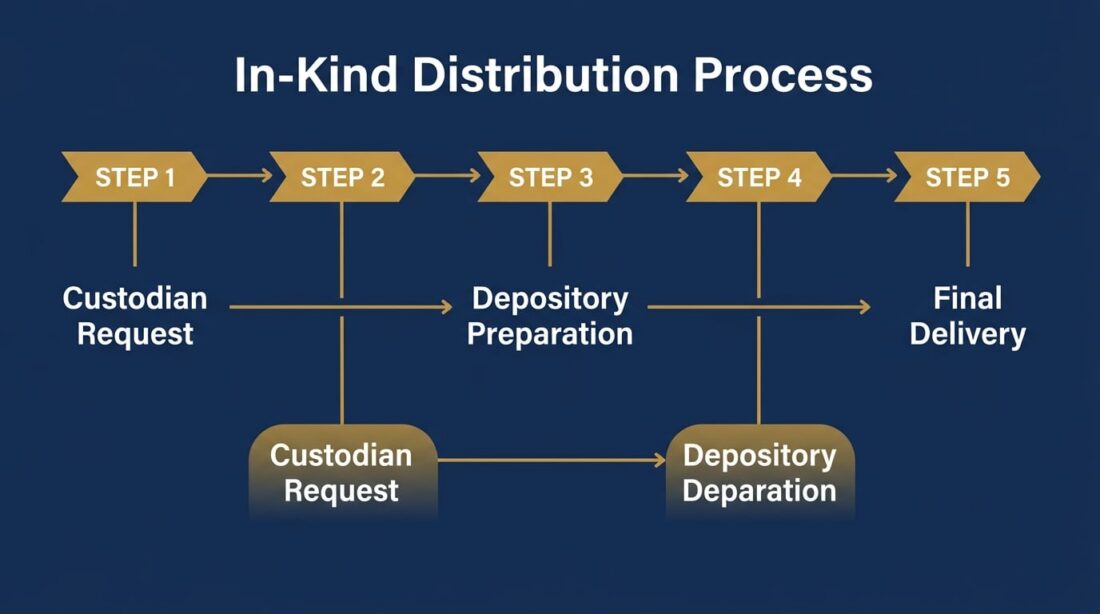
The process involves five steps. First, you submit a distribution request to your custodian specifying physical delivery rather than cash. Your custodian then calculates the Fair Market Value (FMV) of the metals on the release date. A Form 1099-R is generated and reported to the IRS — the FMV is what becomes taxable income for that year. The depository packages your metals for out-shipment. Finally, your gold is delivered via insured carrier with an adult signature required at delivery.
Physical distributions are taxed as ordinary income in the year they occur — not at capital gains rates. The FMV on the release date also resets as your new personal cost basis for those metals once they’re in your possession. If you later sell them as personal property, you’ll owe taxes only on appreciation above that FMV baseline.
Timing matters. If you’re 73 or older, in-kind distributions count toward your Required Minimum Distribution (RMD) — per the SECURE Act 2.0, which moved the RMD starting age to 73 for distributions beginning in 2023. If you’re under 59½, the standard 10% early withdrawal penalty applies, the same as it would for a cash distribution.
The delivery timeline is typically 7–14 business days from request submission to arrival — covering custodian processing, IRS documentation, depository preparation, and insured transit.
Most owners who’ve held physical metals for years expect this to be complicated. It isn’t — but the steps need to happen in the right order. This article walks through each one.
Physical Delivery or Cash — You Have a Choice
Most Gold IRA owners reach this stage with the same assumption: that “distribution” means a wire transfer. You request a withdrawal, the custodian sells the metals, and cash shows up in your bank account a few days later.
Nobody told them it doesn’t have to work that way.
The precious metals IRA structure exists because customers want tangible ownership — something real, held in their name, outside the traditional financial system. An in-kind physical distribution is how that ownership completes itself. It’s not a workaround. It’s a documented, IRS-recognized distribution type — available to every Gold IRA owner who knows to ask for it.
Why the Industry Defaults to Cash
Cash liquidation is faster — for the custodian. Not for you.
When you request a cash distribution, the custodian sells your metals at spot price, wires the proceeds, and closes the file. No depository coordination. No transit logistics. No out-shipment insurance documentation. Clean, efficient, done — from their side of the desk.
From yours — if you opened a Gold IRA specifically because you wanted something tangible — that’s exactly the wrong outcome.
The default toward cash isn’t a policy designed with the owner’s interest in mind. It’s an operational preference. And most customers never push back because the in-kind delivery option is buried in custodian agreements, disclosed only in the fine print — when it’s disclosed at all.
That’s the friction worth naming. Custodians engineer their systems around what’s easiest for their operations. Physical delivery requires active coordination between three parties: the custodian, the depository, and a licensed carrier. That takes more effort. In this industry, effort has a habit of becoming the customer’s problem — framed as a limitation they didn’t know existed.
Physical in-kind distributions are fully legitimate under IRS Publication 590-B. The option exists. You’re entitled to use it. Knowing that — and asking for it by name — is the difference between taking possession of what you built and walking away with a wire transfer instead.
What “In-Kind” Actually Means
In-kind means you get the metals — not a check for what they’re worth.
The specific coins or bars allocated to your IRA account at the depository are packaged and shipped directly to you. No sale. No conversion. Ownership transfers from the IRA account to your personal possession — and the metal moves from institutional custody to your hands.
- Distribution request (in writing) — You notify your custodian that you want physical delivery, not cash. That single choice changes every step that follows — from how the depository prepares the shipment to how the transaction is reported.
- FMV valuation (the taxable event) — Your custodian calculates the Fair Market Value of your metals on the release date. That figure is reported to the IRS and becomes taxable ordinary income in the distribution year.
- Physical transfer (possession complete) — The specific coins or bars in your account are packaged and cleared for out-shipment. Nothing is sold. Nothing is converted. Ownership moves from the IRA to you.
The IRS still requires valuation and reporting at the time of distribution. We’ll cover that in detail in the next section. But the physical reality is straightforward: your gold leaves the vault and comes home.
For owners who opened a Gold IRA specifically to build something real and tangible, this is the step that completes it. Before committing to either path, understanding gold IRA distribution options gives you the full picture of what’s available at this stage.
The custodian relationship and account structure you established when setting up a Gold IRA from the beginning determines whether physical delivery is cleanly supported — and how smoothly this process runs when you get here.
The 5-Step In-Kind Distribution Process
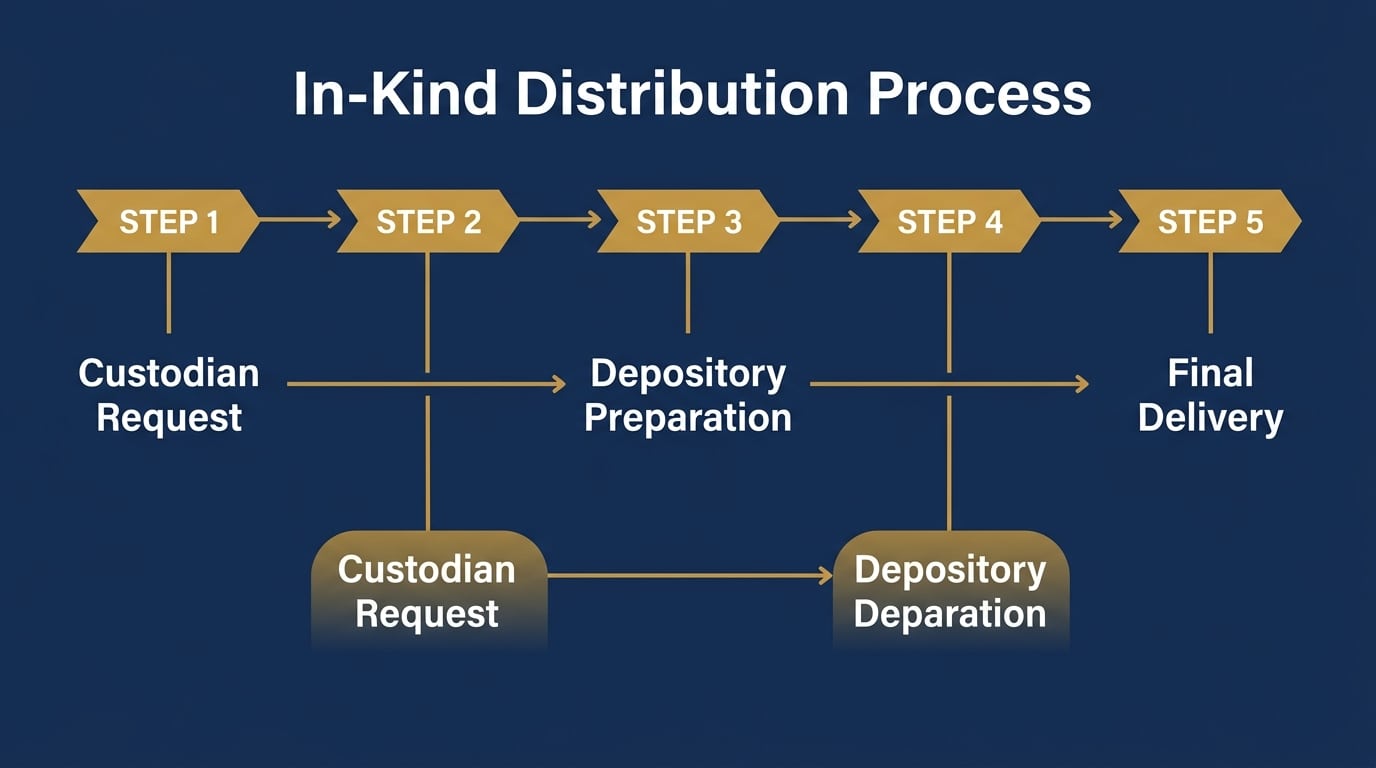
Five steps. Each one serves a specific purpose. Each one happens in order.
What makes this process feel complicated is not knowing what triggers what — submitting paperwork out of sequence, not knowing what to expect between steps, or discovering midway that the address on file is outdated. Understand the sequence upfront and the timeline becomes predictable.
Steps 1–3: Request, Valuation, and Reporting
Before submitting your request, confirm three things:
- Delivery type specified (physical, not cash) — This has to be explicit in the paperwork. Not all custodian forms make the distinction obvious. Ask for in-kind physical delivery by name and confirm it’s noted in writing.
- Metal specification confirmed (type, weight, quantity) — If your account holds multiple coin types or bar weights, identify exactly what you want released. Vague requests slow down the depository step.
- Shipping address verified (current and correct) — Confirm this before the request goes in. An address correction after a shipment is initiated is the hardest problem to fix on a short timeline.
Step 1 — The Distribution Request
Start with your custodian. Call them or use their online portal. Submit a formal distribution request that specifically states physical delivery — not cash liquidation. That distinction has to be explicit.
Some custodians have a dedicated in-kind distribution form. Others route it through a standard distribution form with a delivery-type field. Either way, get it in writing. And identify the specific metals you want released — if your account holds multiple coin types or bar weights, you name them here.
Step 2 — Fair Market Value Determination
Once the request is in, your custodian calculates the FMV of the metals on the release date. That’s spot price at the time of authorization — and it drives everything that follows.
FMV is what gets reported to the IRS. It’s what’s taxed as ordinary income in the distribution year. It’s also your new personal cost basis once the metals are in your possession — something we’ll return to when we get to the tax section. Some owners track spot price carefully around the valuation date. FMVgold.com is one resource for pulling that data if the timing matters to you.
Step 3 — IRS Form 1099-R
Your custodian generates a Form 1099-R for the distribution year. Per IRS Form 1099-R instructions, this form reports the FMV of the distributed metals to the IRS — not a cash amount, but a dollar-equivalent value reflecting spot price on the release date.
That form goes to you and to the IRS. Your CPA needs it at year-end. Any questions about how the distribution affects your specific tax picture belong in that conversation — not with your precious metals dealer.
Steps 4–5: Depository Release and Insured Delivery
Step 4 — Depository Preparation
With valuation confirmed and paperwork signed, your custodian authorizes the depository to release the metals. A facility like Delaware Depository prepares an out-shipment — pulling your specific coins or bars from allocated storage, verifying quantities against account records, and packaging them for high-value transit.
The exterior packaging carries no branding and no markings that indicate contents. That’s standard protocol for precious metals shipments — not a special accommodation you have to request.
Step 5 — Insured Carrier Delivery
The packaged metals transfer to a licensed carrier for delivery to your address on file. Transit insurance on high-value shipments typically covers $100,000 or more per package — exact coverage depends on the depository’s carrier arrangement.
An adult signature is required at delivery. You or a named recipient must be present. Most owners receive a tracking number once the shipment enters transit.
From request submission to delivery at your door — the typical timeline is 7–14 business days. High-demand periods, particularly near year-end, can stretch that window. Plan accordingly.
| Step | Action | Who’s Responsible | Typical Timeline |
|---|---|---|---|
| 1 | Submit Distribution Request | Owner → Custodian | Day 1–2 |
| 2 | FMV Valuation | Custodian | Day 2–4 |
| 3 | Form 1099-R Generated | Custodian | Within tax year |
| 4 | Depository Preparation | Depository | Day 4–8 |
| 5 | Insured Carrier Delivery | Carrier | Day 8–14 |
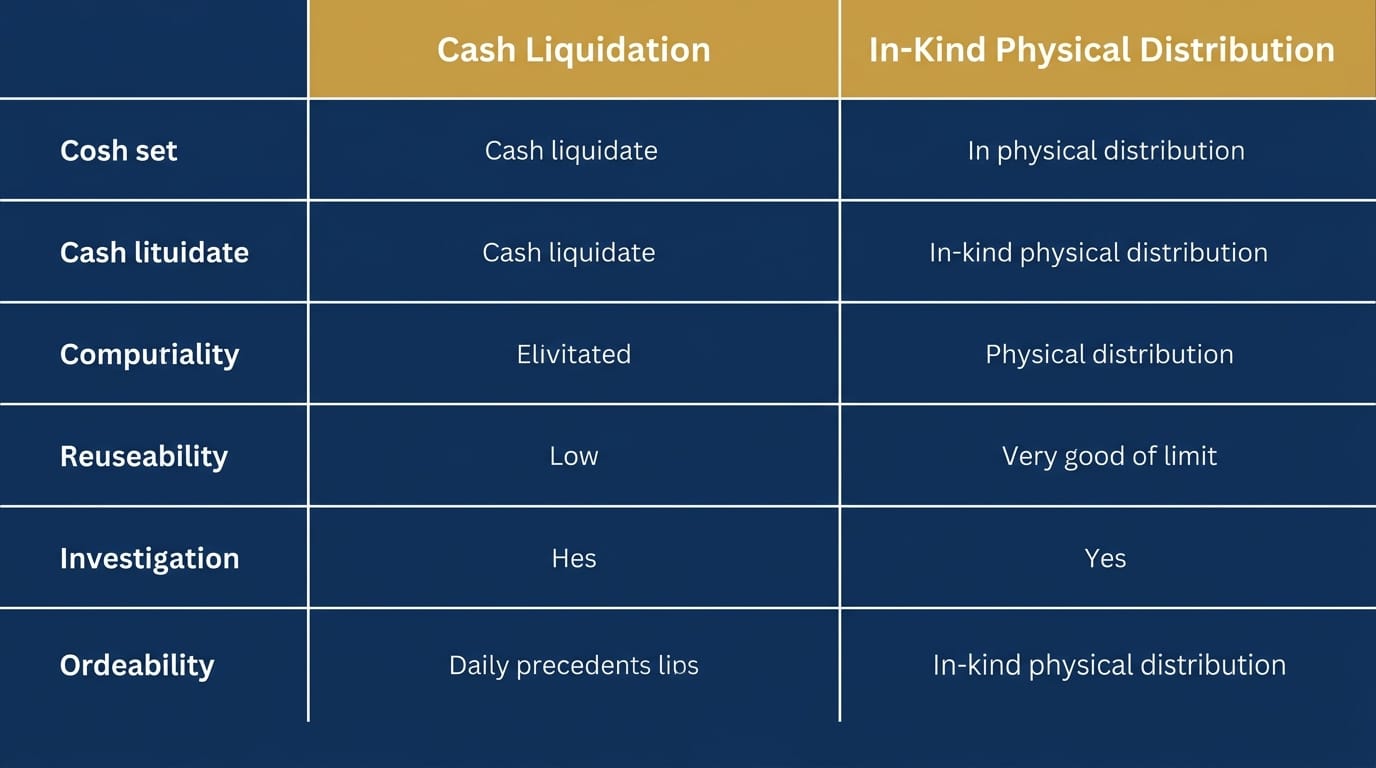
| Factor | Cash Liquidation | In-Kind Distribution |
|---|---|---|
| What you receive | Wire transfer in USD | Physical metals delivered to your address |
| Tax treatment | Ordinary income on cash amount | Ordinary income on FMV at release date |
| Cost basis | None — cash has no forward basis | FMV on release date becomes your new personal cost basis |
| Typical timeline | 3–5 business days | 7–14 business days |
| Metals re-acquisition | Must repurchase separately | Metals are already in your possession |
| IRS Reporting | Form 1099-R | Form 1099-R |
Tax Treatment and RMD Logistics
This is the section most owners slow down on — and where the most persistent misconceptions live.
The rules are clear. They’re just not what most people expect going in.
Ordinary Income, Fair Market Value, and Your New Cost Basis
Here’s what catches people off guard: physical distributions from a traditional Gold IRA are taxed as ordinary income — at your marginal federal rate for the year the distribution occurs.
Not capital gains. Not a special rate for precious metals. Ordinary income — the same rate that applies to a paycheck or a pension.
That’s true whether you take cash or physical metals. The IRA wrapper determines the tax treatment, not the form of the distribution. When you contributed pre-tax dollars and let growth accumulate tax-deferred, the IRS waited. At distribution, they collect.
The taxable figure is the FMV on the release date. If spot gold is at $3,200 per ounce when your distribution is authorized and you’re taking 10 ounces, that’s $32,000 of taxable ordinary income for that year — regardless of what you originally paid for those metals inside the IRA.
- Ordinary income rate (not capital gains) — Your marginal federal rate applies in the year of distribution — not a special rate for metals, not a long-term gains rate. The IRA wrapper governs, not the asset class inside it.
- FMV on release date (the taxable figure) — Spot price on the day your custodian authorizes the release is what gets reported to the IRS. What you originally paid for those metals inside the IRA is irrelevant to this calculation.
- Cost basis reset (what happens post-distribution) — That same FMV becomes your new personal cost basis for the metals in possession. Future gains — if you later sell them as personal property — are measured from that baseline forward.
Here’s what most articles don’t cover: that FMV also becomes your new cost basis for the metals in your personal possession. The IRA’s original acquisition cost is irrelevant — the basis clock resets at distribution.
Precious metals may appreciate, depreciate, or remain unchanged. Planning a distribution with your CPA before you submit the paperwork — not after — is how you stay in control of the outcome.
Required Minimum Distributions at Age 73
The SECURE Act 2.0 moved the RMD starting age to 73 for distributions beginning in 2023. Under IRS Publication 590-B, in-kind distributions of physical metals satisfy the RMD requirement. You don’t have to liquidate to comply.
The FMV of the metals released applies against your annual RMD calculation. Your custodian calculates your RMD based on your prior year-end account value. If the FMV meets or exceeds that amount, the requirement is satisfied for the year.
What this means in practice: owners ready to start taking possession of their metals can structure in-kind distributions to align with RMD requirements — meeting the IRS obligation and moving metals into personal possession at the same time. Two things accomplished in one transaction.
If the FMV of your distribution falls short of the RMD amount, an additional distribution — in metal or in cash — covers the remainder. Your custodian confirms the RMD figure. Your CPA handles the planning around it.
Distributions Before Age 59½
Any distribution before age 59½ — in-kind or cash — triggers the 10% early withdrawal penalty on top of ordinary income tax.
The penalty applies to the FMV at distribution — not your original acquisition cost inside the IRA. If the account has grown substantially since you opened it, that penalty base is higher than most owners initially calculate.
Exceptions exist under IRS Publication 590-B — disability, certain unreimbursed medical expenses, a limited set of other qualifying circumstances. A desire to take personal possession of your metals, however understandable, isn’t one of them.
Under 59½ and thinking about this? Run the full cost picture with your CPA before anything is submitted.
| Owner Age | Ordinary Income Tax | 10% Early Withdrawal Penalty | RMD Required |
|---|---|---|---|
| Under 59½ | Yes | Yes | No |
| 59½ to 72 | Yes | No | No |
| 73 and older | Yes | No | Yes |
Receiving and Storing Your Gold at Home

Step five gets the metals to your door. Everything after that is yours to manage — and a few things are worth knowing before the package arrives.
What to Expect During Transit
Your shipment arrives via insured carrier. Nothing on the exterior signals what’s inside — no labels, no branding, no indication of value.
Owners who spent time identifying safe gold IRA practices during the accumulation phase will recognize the same care carrying through into transit. Depository-to-door shipments are treated as high-security deliveries throughout the chain — not routed as standard parcels.
Adult signature required at delivery. Confirm your shipping address with the custodian before submitting the request — an address correction after a shipment is initiated is one of the harder problems to unwind on a short timeline.
The Day Your Gold Arrives
Inspect the exterior packaging before signing. Open it somewhere secure.
- Inspect before signing (exterior packaging) — Check the condition of the outer packaging before putting your name on the delivery receipt. Note anything unusual and document it before opening.
- Cross-reference the contents (against distribution paperwork) — Coin type, weight, and quantity should match exactly what you specified in your request.
- Record the FMV (cost basis documentation) — The FMV from your Form 1099-R is your personal cost basis for these metals. Keep that record — it matters if you ever sell them as personal property.
What’s inside reflects exactly what you specified in your distribution request. For owners beginning to think about future acquisitions outside the IRA structure, choosing IRS-approved gold coins for personal purchase is often the next question that surfaces at this stage.
Once the metals are in your possession, storage, security, and insurance become your responsibility. The shift from depository-managed custody to personally held metals is the transition most owners are least practically prepared for — even when the financial planning was solid.
This Is a Long-Term Owner’s Move — Not a Trader’s
Worth saying plainly — and without softening it.
If you’re taking a physical distribution because you think prices are about to move and you want to sell quickly after the metals arrive, Brighton Gold isn’t the right resource for that plan. We don’t provide price forecasts. We don’t time the market. And we can’t validate market-timing decisions — because no one honestly can.
Physical in-kind distributions are a long-term owner’s move. They’re built for customers who’ve spent years accumulating a position in physical metals and are now ready to bring what they built home — people who wanted something tangible, something they could hold and pass down, and who’ve reached the stage where possession is the point.
If you’re looking for short-term trading guidance or someone to tell you what gold will do next quarter, that’s a different service entirely. We work with customers who want clarity and a straightforward process. Not urgency. Not predictions.
If that’s where you are, we’re worth a conversation. If it’s not, we’d rather be honest with you now — that’s more useful than a pitch that doesn’t fit.
Personal Storage Considerations
The storage rules that governed the IRA phase — approved depositories, segregated vs. commingled storage, annual custodian fees — no longer apply once metals are in your personal possession. Understanding gold IRA storage rules is part of the accumulation phase. Personal storage is unregulated. The discipline is entirely yours.
Our Learning Center has additional resources for owners making this transition — what to consider in storage solutions, how to document what you hold, and what to think through before the metals arrive.
| Item | What to Know |
|---|---|
| Home safe | Choose a UL-rated valuables safe bolted to the floor or wall — anchor and weight matter more than size |
| Personal property insurance | Standard homeowners policies often exclude high-value metals — a scheduled rider or separate floater policy is typically required |
| Home inventory | Document coin type, quantity, weight, FMV on distribution date, storage location, and acquisition documentation |
| Private vaulting | Many owners who prefer not to hold metals at home use private non-IRA vaults as a post-distribution option |
| Estate documentation | If these metals are part of your legacy plan, your attorney and estate documents should reflect what you hold and where it’s stored |
Frequently Asked Questions
Can I take my Gold IRA Required Minimum Distribution in physical coins instead of cash?
Yes. An in-kind distribution of physical metals satisfies your RMD requirement the same way a cash distribution would. The Fair Market Value of the metals on the release date is applied against your annual RMD calculation.
The FMV must meet or exceed your calculated RMD for the year. If it falls short, an additional distribution — in metal or in cash — covers the remainder.
Your custodian can confirm your RMD amount before you submit the distribution request. Your CPA or tax professional should review the timing, particularly if the distribution will push your adjusted gross income in ways that affect Medicare premiums or Social Security taxation.
What does it cost to have gold shipped from a depository to my home?
Shipping costs vary by custodian, depository, and shipment value. Some custodians charge a flat fee for out-shipment preparation. Others pass the carrier cost through directly.
Transit insurance is typically included for high-value shipments — but the coverage limit and per-package maximum vary by arrangement. Ask your custodian for a written fee schedule before you submit the request.
Most fee schedules don’t capture what it costs to navigate a custodian that doesn’t support physical delivery cleanly — the delays, the runarounds, the calls that go nowhere. That friction is real. It’s worth factoring into how you evaluate your current custodial relationship.
What is the tax rate on a physical gold distribution?
Physical distributions from a traditional Gold IRA are taxed as ordinary income — at your marginal federal income tax rate for the year the distribution occurs. There is no capital gains treatment for metals distributed from an IRA, regardless of how long the metals were held inside the account.
This is one of the most consistently misunderstood points in the Gold IRA space. Precious metals held personally for more than a year can qualify for long-term capital gains rates when sold. But once metals enter an IRA, IRA distribution rules govern — and distributions are ordinary income.
Talk to your CPA before scheduling large distributions. The FMV — and its effect on your adjusted gross income — can have downstream consequences for Medicare premiums, Social Security benefit taxation, and your overall tax bracket for the year. Brighton Gold does not provide tax advice — that line is one we hold firmly. The FMV figure and the Form 1099-R are what we can give you. The tax strategy belongs with a licensed tax professional.
How long does it take to receive my gold after I submit the paperwork?
The typical timeline is 7–14 business days from request submission to delivery. That window covers custodian processing (1–3 days), depository preparation (3–5 days), and insured transit (2–4 days depending on destination).
High-demand periods — particularly Q4, when RMD distributions concentrate — can extend that window. Submitting your request early in Q4 rather than waiting until mid-December significantly reduces the risk of delays.
Address verification and paperwork completeness affect timing more than any other single factor. An incomplete distribution form or an unverified shipping address are the two most common sources of avoidable delays. Confirm both before submitting.
Does the IRS know I took physical possession of my gold?
Yes. Your custodian files Form 1099-R with the IRS in the distribution year. Per IRS Form 1099-R instructions, the form reports the Fair Market Value of the distributed metals as taxable income — whether you received cash or physical metals.
There’s no version of this transaction that goes unreported. That’s not a concern — it’s simply how IRAs work. The IRS deferred taxes during the accumulation phase; they collect at distribution. A physical in-kind distribution is treated identically to a cash distribution for reporting purposes.
The 1099-R goes to both you and the IRS. Include it with your annual return. Your CPA handles the return preparation.
Can I take physical delivery from my Gold IRA before age 59½?
Technically, yes — but the 10% early withdrawal penalty applies alongside ordinary income tax. Combined, the tax cost of an early distribution can be significant, and it’s worth calculating before you submit the request.
The penalty applies to the FMV of the metals at the time of distribution — not your original acquisition cost inside the IRA. If the account has grown substantially since you opened it, the penalty base is larger than most owners initially expect.
Narrow exceptions exist under IRS Publication 590-B — disability, certain unreimbursed medical expenses, and a limited set of other qualifying circumstances. A desire to take personal possession of your metals, however understandable, isn’t among them.
If you’re under 59½ and considering this, your CPA should run the full cost picture before anything is submitted. Executing a precious metals IRA distribution at the wrong time — without the right planning — turns a straightforward process into an expensive one.
What’s the difference between a physical distribution and an IRA rollover?
A rollover moves metals from one IRA custodian to another — or from one qualified account type into a new self-directed IRA. Ownership stays inside an IRA wrapper. Executed correctly, no taxable event occurs.
A physical distribution ends the IRA’s ownership of those specific metals. You take personal possession. The transaction is taxable. The metals leave institutional custody and move into your hands.
For owners satisfied with the IRA structure but looking to change custodians or consolidate accounts, a rollover or direct transfer is the right path. For owners who want to hold the metals themselves, a physical distribution is the right path. These are two different goals — and confusing them creates real planning errors.
If you previously completed executing a precious metals IRA rollover to establish your current account, a physical distribution is the natural next stage — not an alternative to what you did before, but a continuation of it.
What should I do in the year I take a physical distribution to stay prepared at tax time?
Three things matter most. First, confirm the FMV with your custodian on or near the distribution release date — this is the number that drives everything else.
- Form 1099-R (tax documentation) — Get a copy to your CPA well before tax season. This form reports the distribution to the IRS and is required for your annual return — don’t wait until April to locate it.
- Personal records file (cost basis trail) — Document coin type, quantity, FMV, and date received. If you ever sell the metals as personal property, that documentation is your cost basis record.
The annual IRA reporting and maintenance cycle that preceded this — including custodian statements, annual account valuations, and RMD tracking — feeds directly into what the distribution year looks like from a documentation standpoint. Staying current on those annual Gold IRA maintenance requirements throughout your accumulation years makes the distribution year far simpler to navigate.
Conclusion
The process for taking physical possession of your Gold IRA metals is legitimate, documented, and far more straightforward than most owners expect.
The reason it doesn’t feel that way is because the industry doesn’t benefit from making it feel easy. Cash liquidation is faster for custodians. It’s their default — not because it’s better for you, but because it’s better for their operations. Owners who built a Gold IRA specifically because they wanted something real and tangible don’t have to accept that default. They just have to know they can ask for something different.
Physical gold and silver exist outside the paper financial system — and that distinction matters most at the precise moment you’re ready to bring what you’ve built home. The five steps in this article aren’t complicated once you understand the sequence. The timeline is real but manageable. The tax treatment is predictable when you plan it properly. And for owners who’ve spent years building toward this stage, the outcome is what they came for from the beginning.
Precious metals may appreciate, depreciate, or remain unchanged. What doesn’t change is that physical ownership is real — something you hold, store, and pass on — that isn’t dependent on a bank’s solvency or a financial system’s continued functioning. That’s the part that stays with you.
Knowing what physical delivery actually looks like — before you submit the paperwork — is what separates a smooth process from a slow one.
Brighton Gold offers a complimentary consultation to walk you through your distribution options. What the out-shipment process looks like. How the No Fee Precious Metals IRA for the lifetime of the account works at the distribution stage. Whether your current custodian setup supports physical delivery — and what your options are if it doesn’t.
No commitment. No pressure. Just a clear picture of what the transition to personal possession actually involves.
If you’ve been tracking through the annual Gold IRA maintenance and reporting cycle and are ready to move into the distribution phase, the window to plan thoughtfully is open. Not because there’s a deadline — because clarity before the paperwork makes every step that follows easier.