
What Are the Best Gold Coins to Buy for Wealth Preservation?
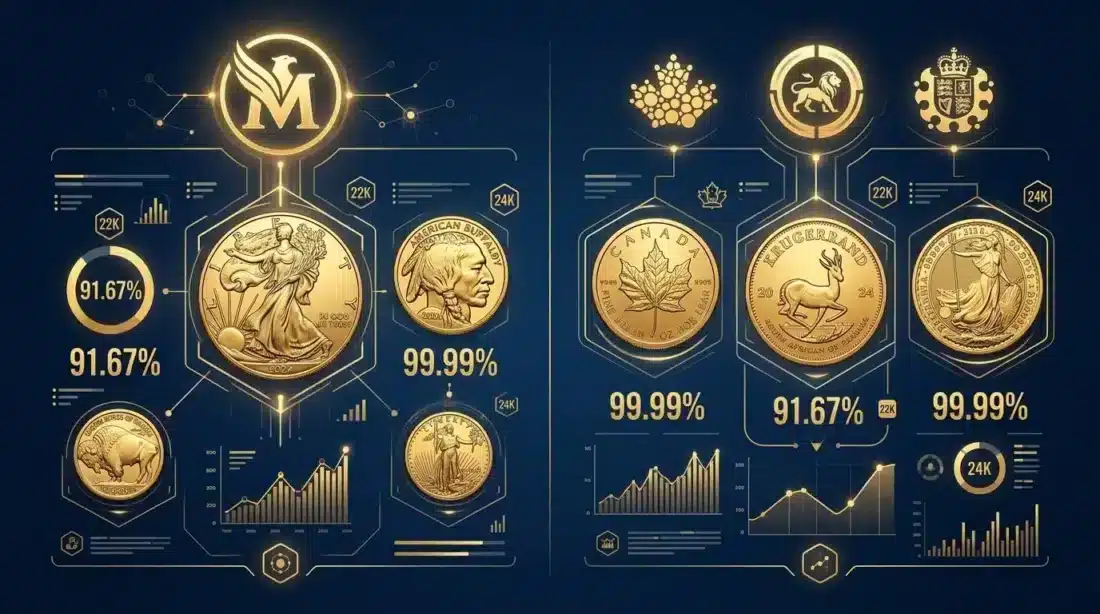
The best gold coins for wealth preservation are sovereign-minted bullion from recognized government mints. The American Gold Eagle and American Gold Buffalo lead that category for U.S. purchasers. These coins combine verifiable purity, global liquidity, and eligibility for retirement accounts under Internal Revenue Code guidelines requiring a minimum fineness of .995. The American Gold Eagle is minted in a 22-karat gold alloy — 91.67% gold — with added silver and copper for durability. The American Gold Buffalo contains one troy ounce of .9999 fine, 24-karat gold. Both are designed for long-term ownership, not short-term speculation.
Other widely recognized options include the Canadian Gold Maple Leaf (which achieved .9999 purity in 1979) and the Austrian Gold Philharmonic. The defining characteristic of these coins isn’t potential price appreciation. It’s provenance. Purity standards are enforced by government mints. Acceptance exists in both private transactions and custodial retirement accounts. Premiums on gold coins range from a small percentage over spot price for common bullion to significant markups for rare or numismatic coins. Clarity on what category of coin you’re acquiring matters.
For wealth preservation, bullion coins are preferred over numismatic coins. Their value tracks the underlying metal — not subjective collector demand. Tax treatment is also part of the equation. Most precious metals bullion coins, when sold for a profit, are taxed as a long-term capital gain if held for more than one year.
The best gold coin for any individual owner depends on three factors. Whether the coin will be held in a retirement account. How the owner prioritizes purity over durability. Whether the owner values U.S. Mint provenance or is open to foreign sovereign alternatives. The question isn’t what gold coin will go up the most. It’s which coin can be held with confidence — regardless of what happens next.
- Why U.S.-Minted Gold Coins Lead for Conservative Purchasers
- The American Gold Eagle — The Standard
- Foreign-Minted Alternatives — Canadian Maple Leaf, Australian Kangaroo
- What You’re Actually Paying For — Premiums, Spreads, and Hidden Costs
- IRA Eligibility — Which Coins Qualify and Why It Matters
- Frequently Asked Questions
- What is the difference between bullion coins and numismatic coins for wealth preservation?
- Why are gold coins from the U.S. Mint often recommended over coins from other countries?
- How are gold coins taxed when I eventually decide to sell them?
- What are the most common mistakes people make when buying gold coins for the first time?
- Can I include gold coins in my retirement account, and which specific coins are IRA-eligible?
- How do I safely store my physical gold coins after purchase?
- The Bottom Line
Why U.S.-Minted Gold Coins Lead for Conservative Purchasers
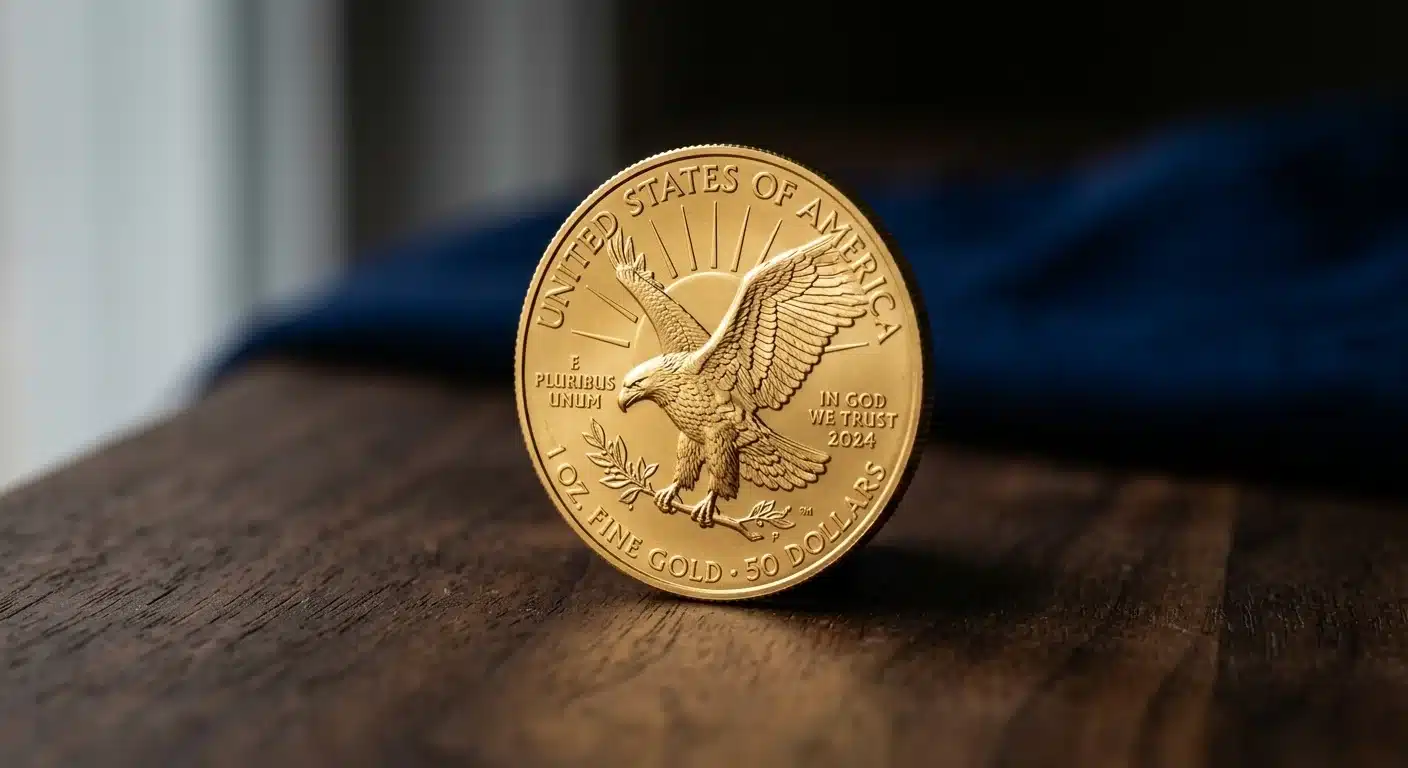
Conservative purchasers don’t buy U.S.-minted gold coins because they’re cheap. They buy them because they’re clear. When you hold an American Gold Eagle or Buffalo, there’s zero ambiguity about what you own. The U.S. Mint’s reputation answers every question before it’s asked.
Foreign sovereign coins — the Canadian Maple Leaf, Austrian Philharmonic, Australian Kangaroo — are legitimate. Widely recognized. But for purchasers who value simplicity and domestic provenance, why U.S.-Minted Gold Coins are preferred comes down to trust in a single institution. When you’re holding something meant to outlast currency itself, institutional trust isn’t a checkbox. It’s the foundation.
The American Gold Eagle isn’t the purest gold coin available. It’s not the cheapest per ounce. What it is: the most liquid, most recognized, and most requested bullion coin among serious owners in the U.S. market. Decades of consistent minting and IRA acceptance built that trust — not marketing.
Durability Over Maximum Purity
The Eagle’s 22-karat alloy — 91.67% gold, 3% silver, 5.33% copper — is deliberate. Not a compromise. Pure 24-karat gold is soft. It scratches, dents, wears with handling. The alloy hardens the coin without diluting its one-troy-ounce gold content. That’s engineering for owners who plan to hold for decades.
If you’re holding these coins for decades — passing them down, storing them in a vault, moving them between custodians — durability isn’t a nice-to-have. It’s the difference between a coin that looks the same in 2045 and one that doesn’t. The U.S. Mint official specifications reflect that thinking.
The American Gold Buffalo — minted in .9999 fine, 24-karat gold — serves purchasers who prioritize maximum purity. It’s softer. More prone to surface wear. But it contains no alloy metals. Both the Eagle and the Buffalo hold one troy ounce of gold. The choice between them isn’t value. It’s what you want to handle and how you plan to store it.
Liquidity and Recognition
Liquidity is the test most purchasers ignore until they need it. Can you sell this coin quickly, at a fair price, to a reputable dealer or custodian? With an American Gold Eagle, the answer is yes. With a lesser-known foreign mint or a non-sovereign round, the answer is maybe.
Recognition drives liquidity. Dealers don’t need to verify, assay, or research an Eagle — they know it. That instant recognition translates to tighter bid-ask spreads and faster transactions when it’s time to convert back to cash or transfer ownership. It’s the same reason serious owners don’t buy off-brand bars from unknown refiners.
If you’re acquiring gold to hold outside the traditional financial system, you want the asset everyone already trusts. The American Gold Eagle is that asset. It’s not the only option — but it’s the standard for a reason.
| Coin | Purity | Alloy Composition | Durability Rating |
|---|---|---|---|
| American Gold Eagle | 91.67% gold | 22-karat gold alloy (91.67% gold, 3% silver, 5.33% copper) | High — alloy increases resistance to scratching and wear |
| American Gold Buffalo | .9999 fine, 24-karat gold | Pure gold, no alloy metals | Lower — soft metal prone to surface wear and scratching |
The American Gold Eagle — The Standard

The most recognized name in U.S. bullion didn’t earn that reputation by accident.
The American Gold Eagle was the U.S. Mint’s answer to a straightforward question: what does a serious owner need in a gold coin? Not maximum purity. Not the lowest premium. Trust — the kind that comes from holding something backed by the federal government, stamped with a design everyone recognizes, and built to survive decades of handling without degrading.
That’s why the Eagle is minted in a 22-karat gold alloy — 91.67% gold, with small amounts of silver and copper added for durability.
It’s not diluted. It’s engineered.
Every one-ounce coin contains exactly one troy ounce of pure gold. But the alloy means it won’t scratch, dent, or wear the way softer metals do. That’s not a compromise. That’s design for long-term ownership.
For conservative purchasers who want clarity over complexity, the Eagle delivers both. It’s IRA-approved. It’s liquid. And it’s built on the principle that real ownership shouldn’t require a magnifying glass and a prayer every time you open the safe.
Brighton Gold works with customers who understand that distinction — people who aren’t chasing the next price spike, but building something they can hold onto regardless of what happens next.
If that sounds like where you are, the Eagle is worth the conversation. Explore how it compares to other formats in our guide to Gold Coins vs. Gold Bars.
When .9999 Fine Gold Matters
Some purchasers want the highest purity number they can get.
That’s understandable — but it’s not always the practical choice.
The American Gold Buffalo was the U.S. Mint’s first offering of .9999 fine, 24-karat gold. It’s pure. It’s beautiful. And it’s softer than the Eagle.
The Canadian Gold Maple Leaf, first issued in 1979, was the world’s first bullion coin to hit .9999 purity. That milestone mattered for collectors and institutions.
But for owners who plan to hold, move, and occasionally handle their metals over the long haul, purity alone doesn’t answer the durability question.
Maximum purity is a feature. Durability is a function.
The question isn’t what gold coin will go up the most — it’s which coin you can hold with confidence, regardless of what happens next.
That distinction separates speculative trades from real ownership.
The Scratch Factor
Here’s what most articles won’t tell you: soft gold scratches.
Not catastrophically. Not in a way that destroys value overnight. But enough that a drawer full of 24-karat coins handled over twenty years will show wear.
The Eagle’s alloy solves that problem before it starts.
It’s a small thing — until it’s not.
Conservative purchasers don’t want to worry about whether opening the safe too many times will cost them money. They want to know the thing they’re holding will still look and feel like what they bought, a decade from now.
The Eagle was designed for that. The Buffalo and the Maple Leaf weren’t.
| Coin Name | Country | Purity | First Minted | IRA Eligible |
|---|---|---|---|---|
| Canadian Gold Maple Leaf | Canada | .9999 fine (24-karat) | 1979 | Yes |
Foreign-Minted Alternatives — Canadian Maple Leaf, Australian Kangaroo
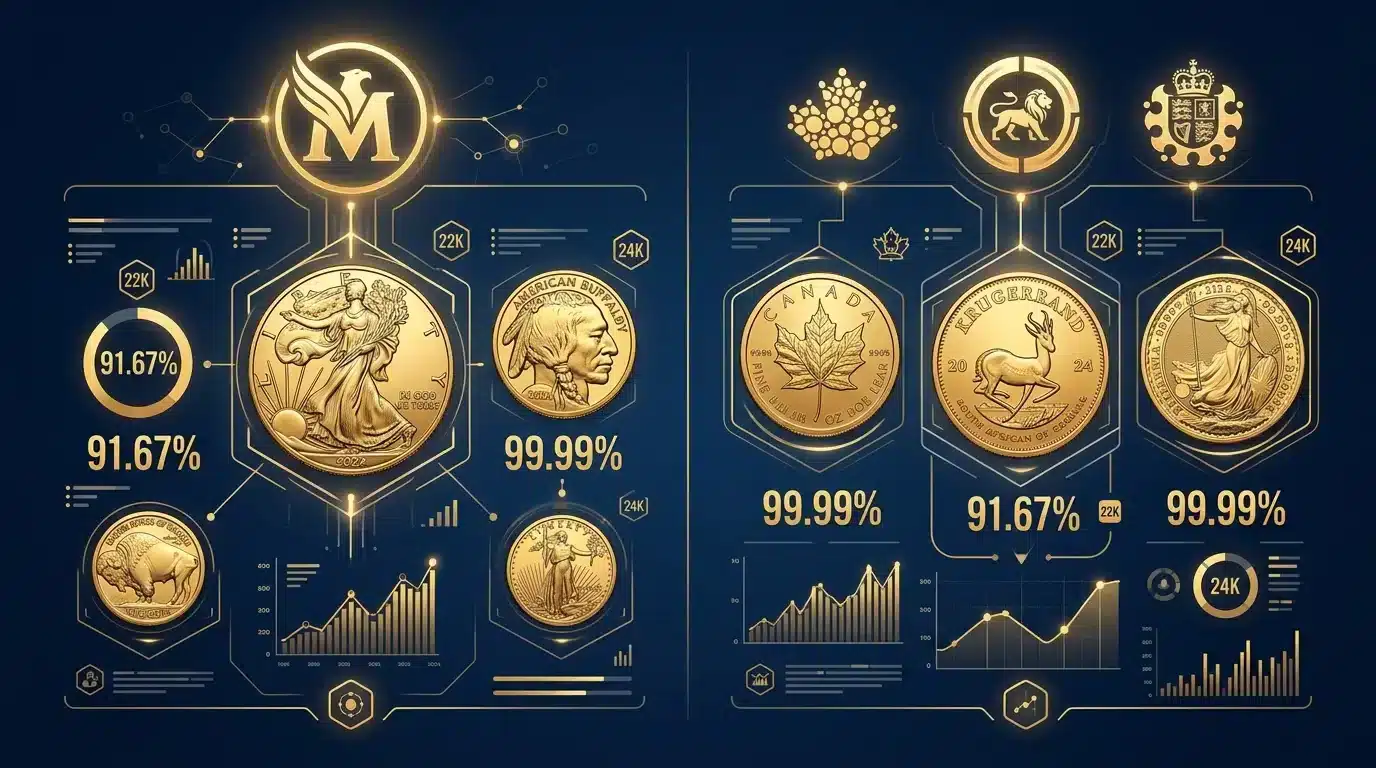
Not every serious owner needs a U.S. coin — but the reasons to look elsewhere should be clear.
Foreign-minted coins from Canada, Australia, and other sovereign mints aren’t knockoffs. They’re legitimate. Recognized globally. Legal tender in their home countries. Produced by institutions with decades of credibility.
The question isn’t whether they’re real — it’s whether they’re the right fit for a conservative purchaser focused on long-term ownership in the U.S. market. Provenance matters. Liquidity matters. And the ability to hold something without second-guessing its resale acceptance matters more than most articles admit.
The Canadian Gold Maple Leaf
The Canadian Gold Maple Leaf hit the market in 1979 — the first bullion coin in the world to reach .9999 fine gold. That’s still the bar for purchasers who put purity at the top of the list.
It’s minted by the Royal Canadian Mint. Recognized globally. And the purity of the Canadian Gold Maple Leaf makes it IRA-eligible under the same standards as the Eagle. If you want the highest purity in a government-backed coin, the Maple Leaf delivers that without compromise.
The trade-off: softer metal. Higher purity means less durability — the Maple Leaf scratches easier than the American Eagle’s 22-karat alloy. That doesn’t touch the gold content. But if you’re handling or storing coins long-term without capsules, it’s something to think about.
The Australian Kangaroo
The Australian Kangaroo, minted by the Perth Mint, is another high-purity option that’s respected internationally. It’s IRA-eligible. Widely available. Carries the same government backing as other sovereign coins.
The difference for most conservative purchasers: recognition and resale familiarity in the U.S. market. The American Eagle and even the Maple Leaf are known everywhere — dealers, pawn shops, custodians. The Kangaroo is legitimate. But it’s not the first coin a U.S. buyer thinks of when they’re ready to sell. That gap in default familiarity is small — but it’s real.
| Feature | American Eagle | Canadian Maple Leaf | Australian Kangaroo |
|---|---|---|---|
| Durability | High — alloy composition resists scratching and surface wear from handling | Low — pure gold is soft; shows wear and scratches easily | Low — pure gold is soft; shows wear and scratches easily |
| U.S. Market Liquidity | Highest — instant recognition, tightest bid-ask spreads, most dealers hold inventory | Very High — widely recognized, globally liquid, standard foreign alternative | Moderate — recognized by dealers but not default inventory; slightly wider spreads |
| IRA Eligibility | Yes — approved by all major custodians without independent assay | Yes — approved by all major custodians without independent assay | Yes — approved by all major custodians without independent assay |
| Best For | Conservative U.S. purchasers prioritizing domestic provenance, durability, and instant liquidity | Purchasers who prioritize maximum purity and global recognition over U.S. Mint provenance | Long-term holders comfortable with slightly lower U.S. market recognition in exchange for Perth Mint provenance |
What You’re Actually Paying For — Premiums, Spreads, and Hidden Costs
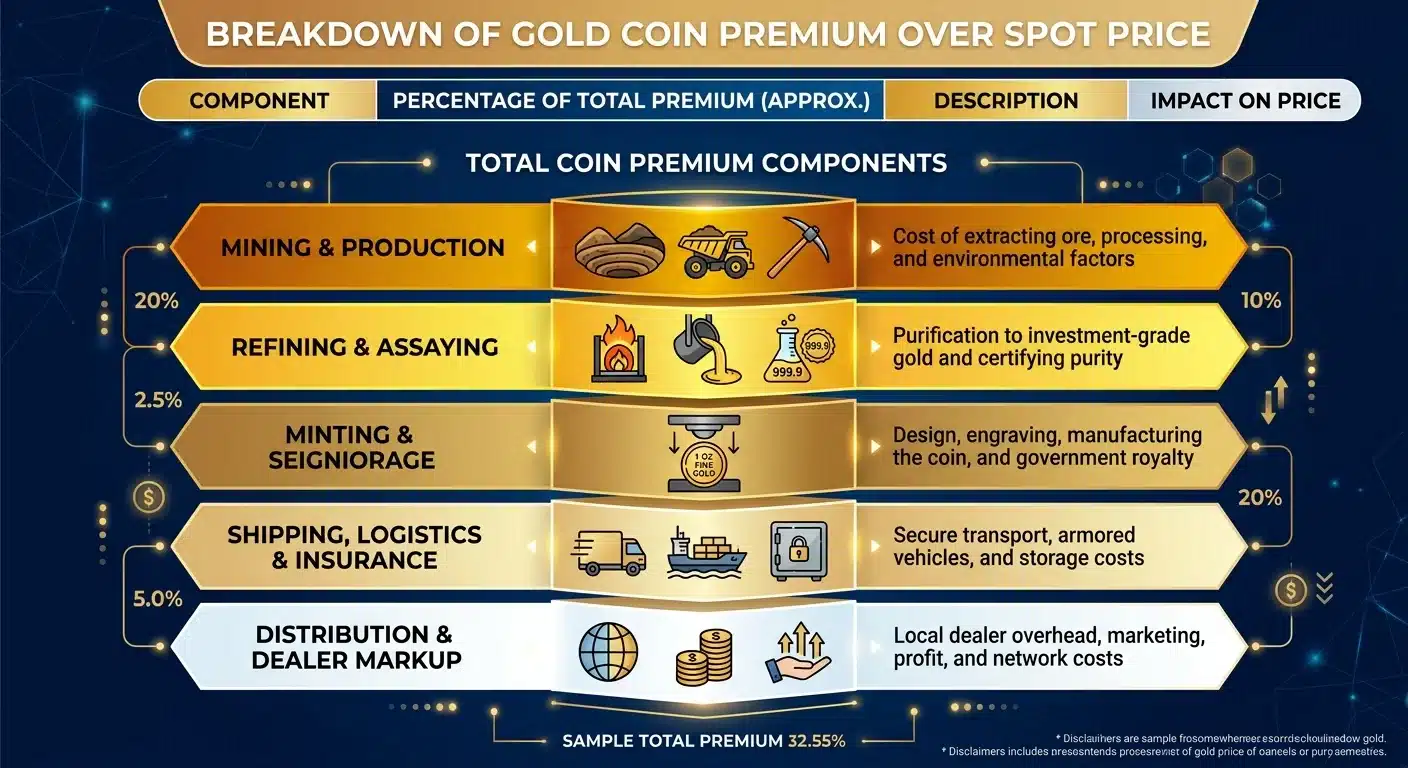
The coin’s spot-price component is the same everywhere — the premium is where the real decision lives.
When you buy a gold coin, you’re paying two things. The intrinsic value of the gold itself — the spot price. And the premium — the markup that covers minting, distribution, dealer margin, and market demand.
That premium isn’t negotiable the way most purchasers think.
It’s a function of the coin you choose, the dealer you work with, and the transparency (or lack of it) in the transaction.
Premiums on gold coins can range from a small percentage over the spot price for common bullion to significant markups for rare or numismatic coins.
The difference between a 3% premium on an American Gold Eagle and a 40% markup on a “limited edition” coin marketed as a collectible isn’t just cost.
It’s intent.
One is a transaction designed for metal ownership. The other is a sales pitch disguised as wealth preservation.
How Premiums Work
The premium on a standard bullion coin — an American Gold Eagle, a Canadian Gold Maple Leaf, an Austrian Philharmonic — reflects the actual cost of producing and distributing a sovereign-minted product.
It’s transparent. Predictable. Comparable across dealers.
That’s why serious purchasers can call three dealers, get three quotes, and make an informed decision without feeling like they’re playing a guessing game.
Premiums fluctuate with market demand, mint production schedules, and dealer inventory levels. During periods of high demand — economic uncertainty, currency instability, geopolitical tension — premiums rise.
That’s not price gouging. That’s supply and demand.
The key is knowing what the baseline premium should be, so you can spot when a dealer is padding the markup beyond what the market justifies.
Brighton Gold doesn’t hide premiums in fine print or bury them in complex pricing structures.
The premium is stated upfront. The spot price is current. The total cost is clear before the transaction.
That’s what a concierge-level precious metals experience looks like — no games, no bait-and-switch, no “call for pricing” pressure tactics.
The Numismatic Trap
Here’s where most first-time purchasers get burned.
They’re sold a “rare” or “collectible” coin with a massive premium, told it’s a better wealth preservation tool because of its scarcity or historical significance.
That’s the numismatic trap — and it’s designed to benefit the seller, not the owner.
Numismatic coins — graded, slabbed, and marketed for their rarity — carry premiums that have nothing to do with the gold content.
You’re paying for collector appeal, not metal.
If the goal is wealth preservation, that premium is dead weight. When you sell, you’re hoping the next buyer cares about the same grading nuances and historical details you paid for. If they don’t, you’re stuck with a coin worth its melt value and a premium you’ll never recover.
The FTC warnings about high-pressure sales tactics exist for a reason.
Dealers who push numismatic coins on first-time purchasers aren’t offering premium products — they’re exploiting the gap between what sounds rare and what actually holds value.
If someone’s telling you a coin is “guaranteed to appreciate” because of its collectibility, you’re not talking to a precious metals dealer. You’re talking to a salesperson.
| Cost Component | Bullion Coin | Numismatic Coin |
|---|---|---|
| Premium over spot | Small, predictable percentage reflecting minting and distribution costs | Large, unpredictable markup based on claimed rarity and collector appeal |
| Transparency | Quoted upfront, comparable across dealers, tied to current market conditions | Often buried in complex pricing, varies wildly by dealer, changes based on sales pitch |
| What you’re paying for | The gold content and the cost to produce a sovereign-minted coin | The grade, the slab, the story — not the metal |
| Resale expectation | Premium recoverable if market conditions are stable and coin is in good condition | Premium rarely recoverable unless next buyer values same collector factors |
| Who benefits | Owner acquires metal at fair market rate with minimal markup friction | Dealer captures margin on collector appeal that may never materialize for owner |
IRA Eligibility — Which Coins Qualify and Why It Matters

Not every gold coin can sit inside a retirement account — and the rules are specific.
The list of coins you can hold in a self-directed IRA isn’t up for negotiation. The Internal Revenue Code sets the standard. Custodians enforce it. And dealers who know what they’re doing make sure you’re buying coins that won’t create a compliance headache down the road.
Most purchasers don’t find out their coins aren’t IRA-eligible until they try to roll them in. By then, the transaction’s already done.
The difference between a coin that qualifies and one that doesn’t isn’t subjective. It’s metallurgical. The IRS requirements for IRA-approved metals draw a bright line — worth understanding before the purchase, not after.
The .995 Fineness Threshold
For a gold coin to sit inside an IRA, it needs a minimum fineness of .995. The Internal Revenue Code draws that line. It’s not a suggestion. It’s the floor.
The American Gold Eagle clears it at 91.67% gold. The American Gold Buffalo and Canadian Gold Maple Leaf sit well above at .9999 purity. The Austrian Philharmonic, the Australian Kangaroo, and the South African Krugerrand all meet or exceed .995.
If the coin’s minted by a recognized sovereign mint and carries the right fineness, it’s eligible.
Here’s what trips up first-time IRA purchasers: collectible coins, proof coins marketed for their rarity, and foreign coins minted below the .995 threshold don’t qualify — no matter how much gold they contain or how compelling the sales pitch. If a dealer’s pushing a “rare” coin for your IRA without discussing fineness and IRS approval, you’re not being guided. You’re being sold.
Approved Sovereign Mints
The IRS doesn’t approve coins one at a time. It approves sovereign mints — governments with recognized legal tender coinage programs.
That’s the U.S. Mint, the Royal Canadian Mint, the Austrian Mint, the Perth Mint, and a handful of others with established bullion programs. If the coin’s minted by one of those institutions and meets the fineness threshold, it’s IRA-eligible.
What doesn’t qualify: privately minted rounds, bars from non-approved refiners, and coins from mints the IRS doesn’t recognize.
That distinction matters because a lot of gold products look like sovereign-minted coins but aren’t. A one-ounce gold round from a private mint might carry the same weight and purity as an American Gold Eagle, but it won’t clear the IRA eligibility test. The difference is legal tender status — and that’s something you can’t retrofit after the fact.
Brighton Gold’s team walks purchasers through IRA eligibility before the transaction — not after.
If you’re setting up a Precious Metals IRA or rolling existing funds into physical gold, the coins you choose have to meet the standard. That’s why our educational learning center exists — so you’re never guessing which coins qualify and which ones don’t.
| Coin | Fineness | IRA Eligible | Mint Type |
|---|---|---|---|
| American Gold Eagle | .9167 (22-karat) | Yes | U.S. Mint |
Frequently Asked Questions
These questions come up in nearly every conversation we have about gold coin ownership.
Most purchasers aren’t asking because they’re confused.
They’re asking because the industry’s spent decades making simple transactions feel complicated — and they’re looking for someone who’ll cut through the noise without a sales pitch.
What is the difference between bullion coins and numismatic coins for wealth preservation?
Bullion coins are minted for their metal content. Numismatic coins are marketed for rarity, condition, and collector appeal.
If you’re focused on wealth preservation, bullion is the answer. You’re paying for gold — not a grading service’s opinion about scratches or a dealer’s story about historical significance. When you sell bullion, the buyer cares about weight and purity. When you sell a numismatic coin, you’re hoping the next buyer values the same subjective details you paid a premium for.
That premium — the gap between melt value and purchase price — is where numismatic coins become a gamble. Premiums on bullion coins range from a small percentage over spot to moderate markups. Premiums on numismatics can hit 30%, 40%, or higher, with zero guarantee you’ll recover that markup. If the goal is holding real metal for the long haul, numismatic premiums are dead weight.
Why are gold coins from the U.S. Mint often recommended over coins from other countries?
Two reasons: liquidity and legal tender status.
U.S.-minted coins like the American Gold Eagle and American Gold Buffalo are recognized everywhere. You can walk into nearly any precious metals dealer in the country, set one on the counter, and get a quote on the spot. That’s not true for every foreign coin — even high-quality ones. The Canadian Gold Maple Leaf comes close, but the depth of the U.S. market for American Eagles is unmatched.
Legal tender status matters too. U.S.-minted coins are backed by the U.S. government, carry a face value, and meet IRA eligibility standards without question. Foreign coins can be just as pure and just as well-made, but custodians and dealers in the U.S. are more familiar with American products. That familiarity translates to smoother transactions — when you’re acquiring and when you’re selling.
How are gold coins taxed when I eventually decide to sell them?
The sale of most precious metals bullion coins is reported to the IRS and taxed as a long-term capital gain if held for more than one year.
That’s not unique to gold coins. It’s how physical metals are treated under the tax code. If you sell at a profit, the gain is taxable. If you sell at a loss, you can report that loss. The key word is “profit” — if you paid $2,000 for a coin and sell it for $1,950, there’s no taxable gain.
Here’s what trips people up: dealers are required to report certain transactions to the IRS. That doesn’t mean you owe taxes — it means the transaction is documented. Whether you owe anything depends on your cost basis, your holding period, and your overall tax situation. That’s a conversation for your CPA, not your precious metals dealer. Brighton Gold doesn’t provide tax advice. We can tell you what gets reported. What you owe is between you and your tax professional.
What are the most common mistakes people make when buying gold coins for the first time?
Three mistakes dominate: paying too much for numismatic premiums, skipping the dealer comparison step, and making the purchase based on urgency instead of clarity.
The numismatic trap is the biggest. A first-time purchaser gets sold a “rare” coin with a 35% premium, told it’s a better wealth preservation tool because of scarcity. That premium rarely comes back. When they sell, the next buyer sees gold content — not collector value.
The second mistake is calling one dealer, getting one quote, and assuming that’s the market. Premiums vary. A dealer charging 8% over spot on an American Gold Eagle when another charges 4% isn’t offering a premium product — they’re offering a premium price. Three calls, three quotes, and you’ll know what the real market looks like.
The third mistake is buying because someone said “now’s the time” or “prices are about to spike.” No one knows where gold’s headed next week. If the only reason you’re moving forward is because a dealer manufactured urgency, you’re not making a decision — you’re reacting to a sales tactic.
Can I include gold coins in my retirement account, and which specific coins are IRA-eligible?
Yes — but only coins that meet IRS fineness and sovereign mint requirements.
For a gold coin to be held in an IRA, it must have a minimum fineness of .995. The American Gold Eagle qualifies at 91.67% gold. The American Gold Buffalo and Canadian Gold Maple Leaf exceed that threshold at .9999 purity. The Austrian Philharmonic, Australian Kangaroo, and South African Krugerrand all meet the standard.
What doesn’t qualify: numismatic coins marketed for rarity, proof coins below the fineness threshold, and privately minted rounds that aren’t legal tender. The IRS approves sovereign mints — not individual products. If the coin’s minted by a recognized government and meets the fineness requirement, it’s eligible. If it’s not, it doesn’t matter how much gold it contains or how compelling the sales pitch sounds.
Brighton Gold walks purchasers through IRA eligibility before the transaction. If you’re setting up a Precious Metals IRA or rolling existing funds into physical gold, the coins you choose have to clear the standard. That’s not something you want to figure out after the fact.
How do I safely store my physical gold coins after purchase?
You’ve got two options: home storage or third-party vaulting.
Home storage gives you direct access. You own it, you hold it, and it’s in your control. The trade-off is responsibility — safes, insurance, and the risk that comes with keeping high-value assets on your property. If you’re comfortable with that, home storage works. If you’re not, it’s a risk that doesn’t go away just because the safe is bolted down.
Third-party vaulting — secure, insured storage at an approved depository — is the alternative. Your coins are held in a facility built for precious metals, segregated in your name, and fully insured. You don’t have physical access, but you also don’t have the liability of storing tens of thousands of dollars’ worth of gold at home. For purchasers holding metals inside an IRA, third-party storage isn’t optional — it’s required by the IRS.
Brighton Gold doesn’t push one option over the other. We walk you through both, explain the trade-offs, and help you figure out what fits your situation. Some purchasers want everything at home. Some prefer the peace of mind that comes with professional vaulting. Both are legitimate — and the right answer depends on what lets you sleep at night.
The Bottom Line
The question is not what gold coin will go up the most — it is which coin you can hold with confidence, regardless of what happens next.
That’s the distinction most dealers won’t draw for you.
For conservative purchasers focused on wealth preservation, the best gold coins are U.S.-minted bullion like the American Gold Eagle. Not because they’re guaranteed to appreciate. Not because they’re exotic or rare. Because they’re recognized, liquid, and built for long-term ownership — not short-term speculation.
The American Gold Buffalo offers .9999 purity if that matters to you. The Canadian Gold Maple Leaf delivers global recognition at the same fineness. The Australian Kangaroo sits in the same category with slightly less U.S. market depth. All three are legitimate sovereign-minted options. None of them require you to chase premiums you’ll never recover or bet on collector appeal that may not exist when you need to sell.
What separates a good transaction from a bad one isn’t the coin itself — it’s the process. The clarity. The absence of pressure. The confidence that the person on the other end of the call isn’t selling you what benefits them most.
Brighton Gold doesn’t forecast prices, time the market, or make guarantees about what gold will do next year. What we do is walk you through the process — one step at a time — so you understand what you’re acquiring, what it costs, and how it fits where you are. No urgency language. No “before it’s too late” pressure. Just the clearest picture we can give you of whether this makes sense for your situation.
If you’re ready to buy gold, the No Fee Precious Metals IRA is worth a conversation. If you’re still weighing your options, that’s fine too. The question is not what gold coin will go up the most — it is which coin you can hold with confidence, regardless of what happens next.
You’ve covered the mechanics. The purity standards. The IRA rules. The premium calculations. But here’s what it comes down to: the question isn’t which coin will go up the most. It’s which coin you can hold with confidence — regardless of what happens next. If you’re ready to figure out whether that coin fits where you are, the No Fee Precious Metals IRA is worth a conversation. No pressure. No urgency. Just clarity on what the process actually looks like and whether it makes sense for your situation.