

Why Is Physical Gold Ownership the Foundation of Financial Privacy?
Physical gold ownership is the foundation of financial privacy because it exists completely outside the digital financial system.
Every digital transaction leaves a permanent record. Banks track it. Governments access it. Algorithms flag it. Physical gold breaks that chain. When you own it, you hold a tangible asset no bank controls, no government agency monitors in real time, and no third party can freeze without your consent. Unlike stocks, bonds, or mutual funds — registered in your name and held by a broker — physical gold has no registration and no custodian. It’s yours. In your possession. Unlinked to any ledger.
The privacy advantage is structural. Financial institutions are required by the Bank Secrecy Act to report cash transactions exceeding $10,000 to the IRS. Central Bank Digital Currencies — CBDCs currently under development by central banks worldwide — could enable direct government surveillance of all financial transactions. Every purchase. Every transfer. Every movement tracked and stored. Physical gold doesn’t participate in that system. The purchase of common bullion coins, such as American Gold Eagles, is not a reportable event for dealers at the time of transaction. Once you own it, it sits outside the system.
That doesn’t mean gold ownership is invisible to all oversight. Selling specific products in certain quantities triggers reporting requirements on Form 1099-B. But the act of holding physical metal is fundamentally private. No one is watching. No algorithm is flagging. No database is updating. You own something real. That ownership exists on your terms.
Last Updated: May 26, 2026
- • What Financial Privacy Actually Means in Practice
- • How Gold Purchases Work in Practice
- • Storage and Privacy
- • What Digital Money Can’t Replicate
- • Frequently Asked Questions
- • Are all physical gold purchases private and non-reportable?
- • How does owning gold protect my privacy from digital surveillance like CBDCs?
- • What’s the difference in privacy between storing gold at home versus in a depository?
- • Isn’t cryptocurrency a better option for financial privacy than gold?
- • If I sell my gold, does that transaction have to be reported?
- • Does the government know when I buy gold from a dealer?
- • What is the most private way to purchase physical gold?
- • The Bottom Line
What Financial Privacy Actually Means in Practice

Most people hear “financial privacy” and think secrecy — hiding assets, dodging taxes, operating in the shadows.
That’s not this.
Financial privacy is the ability to conduct lawful transactions without those transactions being automatically monitored, aggregated, and analyzed by third parties. It’s the difference between buying something with cash at a farmers market and swiping a card that generates a permanent record tied to your name, address, and spending history. One leaves a trail. The other doesn’t.
The modern banking system creates a ledger for everything. Every deposit. Every withdrawal. Every transfer between accounts. Financial institutions are required by the reporting requirements under the Bank Secrecy Act to report cash transactions exceeding $10,000 to the IRS using Form 8300. That reporting obligation isn’t optional — it’s baked into the infrastructure. And with the development of Central Bank Digital Currencies (CBDCs), that surveillance capability expands to cover every transaction — down to the penny — creating an unprecedented threat to financial privacy and surveillance. Physical gold exists outside that ledger entirely.
Gold Exists Outside the Ledger
Here’s the thing — when you hold physical gold, you’re holding something that doesn’t require permission to own, transfer, or store. There’s no account to open. No custodian to approve your withdrawal. No system administrator with the ability to freeze your access.
Every digital transaction leaves a permanent record. Physical gold breaks the ledger entirely by existing outside the system that creates it. A bar of gold in your safe doesn’t generate a database entry. It doesn’t ping a server. It doesn’t show up on a balance sheet managed by someone else. That’s the foundation of privacy — not invisibility, but independence from the infrastructure of surveillance.
And that matters more today than it has in decades.
The financial system is moving toward greater centralization, greater digitization, and greater oversight. Physical gold moves in the opposite direction — toward decentralization, tangibility, and ownership that exists on your terms.
The Difference Between Anonymous and Private
There’s a common misconception that privacy and anonymity are the same thing.
They’re not.
Anonymity means no one knows who you are. Privacy means no one is watching what you do. Physical gold ownership is private — not anonymous. When you purchase gold from a dealer, that transaction is documented. If you sell specific products in certain quantities, the dealer files a form with the IRS. But once the transaction is complete and you take possession, the holding itself is private. No third party is tracking where you store it, how long you hold it, or what you do with it.
Contrast that with a digital asset held in a brokerage account. The brokerage knows you own it. The IRS receives statements about it. The platform hosting it has the technical ability to restrict, freeze, or monitor your access to it. That’s the difference. Privacy isn’t about hiding — it’s about owning something that doesn’t require constant third-party involvement to remain yours.
| Asset Type | Third-Party Custody | Transaction Ledger | Freeze Risk |
|---|---|---|---|
| Physical Gold (held personally) | None — you hold it directly | No permanent digital record of ownership after purchase | None — no third party can freeze what they don’t control |
| Bank Account / Savings | Bank controls access and holds funds | Every transaction recorded and reported under Bank Secrecy Act thresholds | High — accounts can be frozen by court order, regulatory action, or bank policy |
| Stocks / Bonds / Mutual Funds | Brokerage holds and registers assets in your name | All transactions tracked and reported to IRS annually | Moderate — platform can restrict trading or access during volatility or regulatory events |
| Central Bank Digital Currency (CBDC) | Central bank issues and controls currency directly | Every transaction visible to issuing authority in real time | Highest — programmable money enables transaction-level restrictions and surveillance |
| Cryptocurrency (exchange-held) | Exchange custodies private keys | All on-chain transactions publicly visible; exchange reports to IRS | High — exchanges can freeze accounts, restrict withdrawals, or comply with government requests |
| Cryptocurrency (self-custodied wallet) | You control private keys | All transactions recorded on public blockchain permanently | Low custodial risk, but transactions remain permanently visible and traceable |
How Gold Purchases Work in Practice

So how does this work when you’re actually buying gold?
Simpler than you think.
Every digital transaction creates a permanent, traceable record. Physical gold breaks that ledger entirely.
No account number. No routing information. No third-party custodian with reporting obligations. You’re holding something that doesn’t generate a database entry every time it moves.
What Triggers Reporting
Most gold purchases don’t trigger any reporting at all. The purchase of common bullion coins — like American Eagle coins produced by the U.S. Mint — is not a reportable event for dealers at the time of transaction.
That means when you buy standard bullion, the dealer doesn’t file paperwork with the IRS documenting your purchase. No form. No registration. No automatic notification to a government database.
It’s a private transaction.
The reporting structure exists — but it’s event-driven, not automatic. And the triggering events are narrower than most buyers assume.
Cash Purchases and Form 8300
Financial institutions are required by the Bank Secrecy Act to report cash transactions exceeding $10,000 to the IRS using IRS Form 8300 for cash transactions. That’s not optional. It’s baked into the infrastructure.
But here’s the critical distinction — this applies to cash, not to other payment methods. A wire transfer, a check, or a credit card purchase doesn’t trigger Form 8300 reporting, even if the amount is well above that threshold.
So if you prefer direct cash purchases with home delivery, understand the threshold clearly. Above that amount, Form 8300 is filed. Below it, the purchase remains private.
Dealer Reporting on Sales (Not Purchases)
The initial purchase is typically a private transaction. What triggers reporting is the sale — and even then, only for specific product types and quantities.
While the sale of specific gold bars and coins in certain quantities must be reported by a dealer on Form 1099-B, most individual bullion coin transactions fall outside that scope.
What does that mean in practice?
You can acquire physical gold quietly. You can hold it for years. And when you eventually sell it — if you sell it — only certain product categories trigger dealer reporting, and only if you’re selling in quantity.
| Transaction Type | Reporting Trigger | Form Required | Who Reports |
|---|---|---|---|
| Purchase of American Gold Eagles (common bullion) | None — no reporting trigger at purchase | None | Not applicable |
| Cash payment exceeding threshold | Single transaction or series of related cash payments over $10,000 | IRS Form 8300 | Dealer reports to IRS |
| Initial purchase (non-cash payment methods) | None — wire, check, or ACH do not trigger reporting | None | Not applicable |
| Sale of specific gold bars and coins in certain quantities | Sale (not purchase) of reportable products in threshold quantities | Form 1099-B | Dealer reports to IRS |
Storage and Privacy
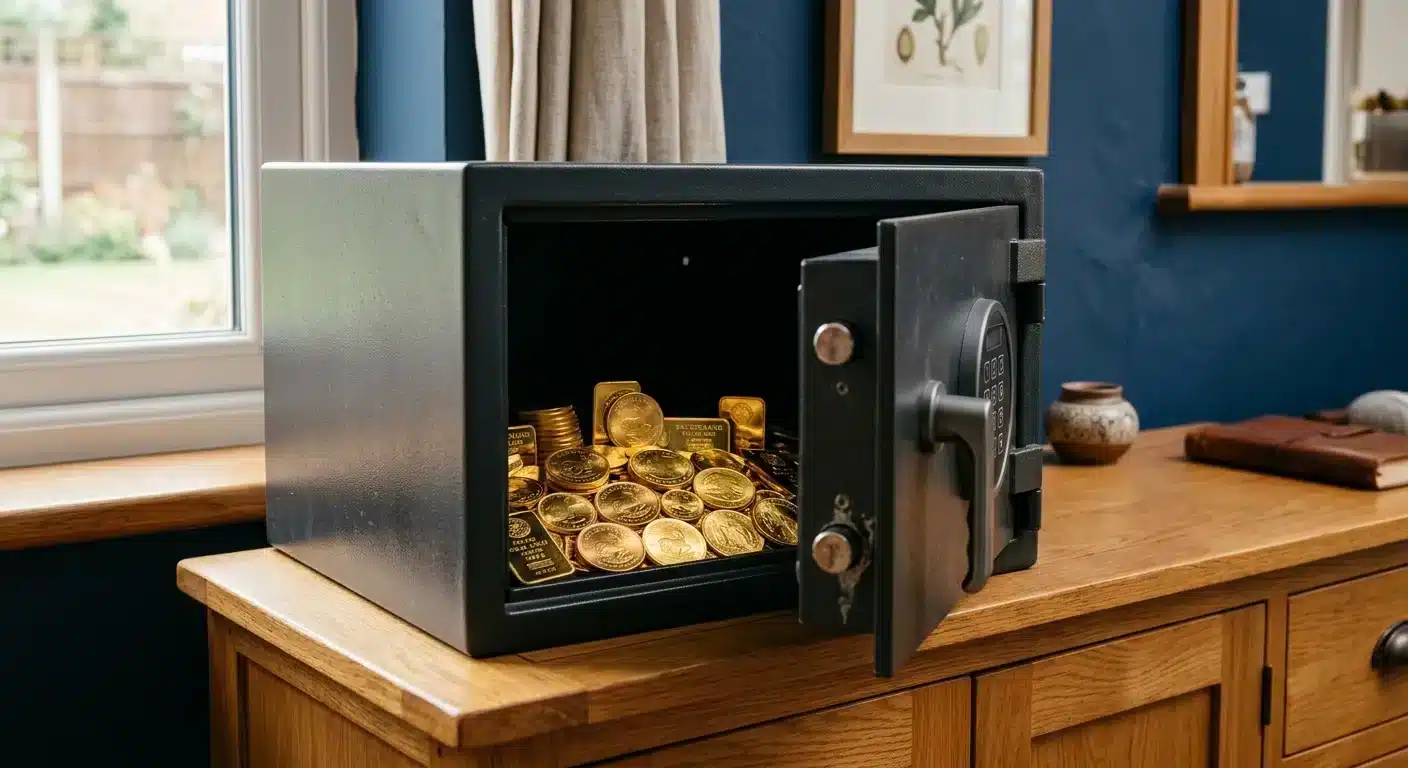
Where you keep your gold affects more than security — it changes your privacy posture entirely.
The decision between home storage and depository storage isn’t about convenience. It’s about who has visibility into your holdings — and what digital footprint your ownership creates.
One method keeps your metals completely off the grid. The other brings a layer of institutional oversight back into the equation. Not in a way that negates privacy. But in a way that reintroduces a third party into the picture.
And that distinction matters if financial privacy is the reason you’re holding gold in the first place.
Home Storage
Home storage is the most private option — and it’s not close.
When you store physical gold at home, no third party knows where it is. No one knows how much you have. No one knows how long you’ve held it.
There’s no account statement. No storage agreement with your name on it. No custodian logging your balance every quarter. The metal sits in your safe, your vault, or wherever you’ve decided to keep it — and that location is yours to control.
Unlike stocks, bonds, or mutual funds, which are registered in your name and held by a broker, personally owned physical gold has no such registration or third-party custodian. Every digital transaction leaves a permanent record. Physical gold breaks the ledger entirely by existing outside the system that creates it.
Home storage takes that principle one step further by eliminating the storage record too.
The trade-off is obvious — you’re responsible for security, insurance, and safeguarding the metals yourself.
If someone breaks into your home, there’s no FDIC protection. If a fire destroys your safe, the loss is yours to absorb unless you’ve insured it separately.
But for customers who value privacy above all else, that trade-off is worth it. Home storage keeps your holdings completely outside the view of financial institutions, storage companies, and the digital infrastructure that connects them. For many, that’s the entire point of owning best gold coins to buy for wealth preservation in the first place.
Depository Storage
Depository storage reintroduces a third party — but it doesn’t eliminate privacy.
When you store gold in a depository, the facility knows you’re a customer. They know what you’re storing and how much of it. There’s an account in your name. There’s a storage agreement. There’s a digital record of when you deposited the metals and when you might withdraw them.
That’s a layer of visibility that doesn’t exist with home storage.
But here’s what matters — the depository isn’t a financial institution subject to the same reporting requirements as a bank. The metals aren’t tracked by the IRS unless you sell them and the sale crosses a reporting threshold. The depository itself doesn’t file a 1099 just because you’re storing gold.
They’re holding a tangible asset on your behalf. Not managing a securities account.
So depository storage is more private than a brokerage account, less private than home storage. It’s a middle ground — offering professional security, insurance, and liquidity without turning your holdings into a fully digitized, third-party-managed asset.
For customers who want the privacy benefits of physical ownership but don’t want the logistical responsibility of home security, depository storage is the compromise.
The gold is still yours. It’s still tangible. It’s still outside the banking system. But someone else is watching over it — and that means someone else knows it exists.
| Storage Method | Privacy Level | Third-Party Record | Access Speed |
|---|---|---|---|
| Home Storage | Highest — no third-party visibility, no account records, no storage agreement in your name | None — you control the location and no entity logs your holdings | Immediate — physical access whenever you need it |
| Depository Storage | Moderate — facility knows you’re a customer and tracks what you store, but not subject to bank reporting rules | Storage agreement and account record exist with the depository, though metals remain outside the banking system | Fast — typically same-day or next-day withdrawal with proper notice |
| Bank Safety Deposit Box | Low — bank knows you rent the box and may log access; contents are private but the relationship is not | Rental agreement on file; bank has record of your visits and box number | Limited — access restricted to bank hours and branch availability |
| Brokerage or ETF (paper gold) | None — fully tracked, registered, and visible to financial institutions and regulatory agencies | Full account registration, quarterly statements, IRS reporting on gains, complete digital footprint | Instant liquidation — but you never held the physical metal, only a claim on it |
What Digital Money Can’t Replicate

Every digital transaction — from a debit card swipe to a wire transfer — creates a permanent record.
That’s not a flaw in the system.
That’s the system working exactly as designed.
The invisible ledger exists because every swipe, transfer, and click gets logged somewhere. Physical gold breaks that ledger entirely. No bank holds it. No clearinghouse routes it. No database tracks it. You own it outright — and when it changes hands, there’s no third party recording the transaction. That’s not a feature you toggle on. That’s what the asset is.
CBDCs and Programmable Surveillance
The Federal Reserve and other central banks are actively researching Central Bank Digital Currencies — programmable money that could enable direct government surveillance of all financial transactions.
That’s not speculation.
That’s the stated technical capability.
When money is programmable, so are the rules. Spending limits. Geographic restrictions. Expiration dates. Transaction-level monitoring. CBDCs hand governments the ability to see every purchase, freeze accounts instantly, and enforce policy at the point of sale. Not after a court order. Not through a subpoena. Right there at the register.
Physical gold sits entirely outside that architecture. It’s not programmable. It’s not connected. It doesn’t depend on infrastructure that can be updated, restricted, or shut down. That’s not a weakness — that’s the point of holding something real. If you’re looking to understand how to buy gold in a way that prioritizes privacy, the Federal Reserve’s research on CBDCs makes the contrast clear.
Cryptocurrency: Pseudo-Anonymous, Not Private
The privacy conversation often turns to cryptocurrency. But the comparison misses the foundational difference. Cryptocurrency transactions are recorded on a public ledger. Every wallet address. Every transfer. Every timestamp. Pseudo-anonymous, yes. Private, no.
And the moment you convert crypto to dollars through a regulated exchange, the pseudo-anonymity evaporates. Exchanges report to the IRS. Wallets get subpoenaed. Blockchain forensics firms exist specifically to trace transactions that were supposed to be untraceable. The ledger is public. The forensics are institutional. The privacy claim doesn’t survive contact with the real world.
Unlike stocks, bonds, or mutual funds — which are registered in your name and held by a broker — personally owned physical gold has no such registration or third-party custodian. You own it outright. No intermediary. No ledger entry. No counterparty risk. That’s a different category of privacy entirely — and it’s one that no digital asset can replicate, no matter how sophisticated the encryption or how decentralized the protocol.
| Asset Class | Transaction Privacy | Government Access | Offline Capability |
|---|---|---|---|
| Physical Gold | No transaction record once owned — no ledger, no blockchain, no log of transfers | Cannot be frozen, tracked, or programmed remotely — exists entirely outside digital infrastructure | Fully functional offline — no internet, no electricity, no third-party system required |
| Central Bank Digital Currency (CBDC) | Every transaction recorded and visible to the issuing authority in real time | Direct government visibility and programmable control — spending restrictions, expiration, and freeze capability built in | Requires digital infrastructure — cannot function without connectivity and central authority approval |
| Cryptocurrency (Bitcoin, etc.) | Pseudo-anonymous — all transactions permanently recorded on a public blockchain, traceable through forensics | No direct government control of the ledger, but wallet addresses can be traced and linked to identities via exchanges | Requires internet and node access — offline ownership not possible; the asset exists only as ledger entries |
| Bank Deposits / Digital Payments | Every transaction logged, monitored, and reportable under financial surveillance regulations | Subject to account freezes, seizure, and bail-in provisions — held by third-party institutions | Entirely dependent on banking infrastructure — no offline access or independent ownership |
Frequently Asked Questions
The basics are covered. Now here are the edge cases.
These are the questions customers ask once they understand how privacy works — the ones that live at the boundary between private ownership and mandatory reporting. Most center on one concern: where does the privacy end, and where does the paper trail begin?
The answers are simpler than the industry makes them.
Are all physical gold purchases private and non-reportable?
No — and that’s the first thing worth clarifying.
When you buy common bullion coins like American Gold Eagles, the dealer doesn’t file a report with the IRS. The purchase isn’t a reportable event. The transaction stays between you and the seller.
But cash transactions over $10,000 trigger reporting under the Bank Secrecy Act — no matter what you’re buying. That’s not a gold rule. That’s a cash rule.
So the purchase itself is private. The payment method determines whether a report gets filed.
How does owning gold protect my privacy from digital surveillance like CBDCs?
Central Bank Digital Currencies represent a different model of money — programmable, traceable, and controlled at the transaction level.
Every CBDC transaction would live on a government-visible ledger. Spending limits. Transaction approvals. Account freezes. All technically possible with a digital currency.
Physical gold exists outside that ledger entirely.
It’s not held by a bank. It’s not tracked by a digital wallet. It doesn’t need network access or permission. That’s the structural difference between a tangible asset you hold and a digital token someone else administers.
What’s the difference in privacy between storing gold at home versus in a depository?
Home storage gives you direct physical control — no intermediary, no third-party records, no account statements.
Depository storage introduces a custodian. That custodian keeps records of what you hold. Those records live in their system, and depending on jurisdiction and legal process, they can be accessed.
Neither is wrong.
The trade-off is control versus security infrastructure. Home storage maximizes privacy. Depository storage maximizes physical security and insurance coverage. Brighton Gold works with customers in both scenarios. What matters is that you understand the difference before you decide.
Isn’t cryptocurrency a better option for financial privacy than gold?
Cryptocurrency isn’t private by default — it’s pseudonymous, and that’s not the same thing.
Every transaction on most public blockchains is permanently recorded and visible. Wallet addresses can be traced, linked, and in many cases identified through exchange records or on-chain analysis.
And the rules are tightening. Exchanges now report to the IRS. Wallet providers comply with Know Your Customer rules. The anonymity narrative doesn’t match the compliance reality.
Physical gold doesn’t live on a blockchain.
There’s no wallet to trace. No exchange to subpoena. No transaction history to reconstruct. If privacy is the goal, the asset that exists entirely offline has a structural advantage over the one that records every movement on a public ledger.
If I sell my gold, does that transaction have to be reported?
It depends on what you’re selling and to whom.
The sale of specific gold bars and coins in certain quantities must be reported by a dealer on Form 1099-B. The initial purchase is typically private. That means the reporting obligation sits with the dealer when you sell back to them — and only for specific products and amounts.
Not every sale triggers a form.
But here’s what matters: the sale is a taxable event no matter whether a form gets filed. You’re responsible for reporting capital gains on your tax return. The 1099-B is a reporting mechanism — it doesn’t create the tax obligation, it documents it.
Brighton Gold doesn’t provide tax advice. Your CPA or tax professional should review your situation before any sale.
Does the government know when I buy gold from a dealer?
Not through the dealer, no — unless a reporting threshold is crossed.
The purchase of common bullion coins is not a reportable event. Dealers don’t file a form with the IRS when you buy.
The exception: cash transactions over $10,000. At that threshold, dealers are required to file Form 8300 under the Bank Secrecy Act. That’s a cash reporting rule — not specific to gold.
So the government doesn’t know what you bought unless the transaction structure triggers a report. And for most purchases — within normal transaction limits — there’s no filing requirement.
What is the most private way to purchase physical gold?
The most private way is the simplest: buy common bullion products with payment methods that don’t trigger reporting thresholds.
That means buying American Gold Eagles or similar coins in amounts that stay under the cash reporting limit. The transaction stays between you and the dealer.
And then the question becomes: where do you hold it?
Home storage maximizes privacy. Depository storage introduces a custodian record. Brighton Gold walks customers through both. We don’t overcomplicate it. We explain the mechanics, the thresholds, and the trade-offs — so you can make the decision that fits where you are.
The Bottom Line
Privacy isn’t about conspiracy or paranoia. It’s about control.
The ability to hold wealth in a form that doesn’t require permission, doesn’t leave a digital trail, and doesn’t depend on the solvency or cooperation of a third party. That’s what physical gold delivers — and it’s what no other asset class can replicate at the same level. Not stocks. Not bonds. Not cryptocurrency. Not even cash, which can be frozen, devalued, or phased out by central bank decree.
Physical gold ownership is the foundation of financial privacy because it is the only tangible, non-digital store of value that exists completely outside the increasingly surveilled banking system.
That distinction matters more today than it has in decades.
The invisible ledger — every digital transaction leaves a permanent record. Physical gold breaks the ledger entirely by existing outside the system that creates it.
When you own gold, there’s no account statement tracking your balance. No broker logging your transactions. No blockchain broadcasting your holdings to the world.
The metal exists. You control it.
And that ownership is as private as the steps you take to keep it that way. That’s not evasion — it’s choosing to hold an asset that doesn’t require institutional oversight to function. For customers who’ve spent decades building what they have, that level of independence is worth more than any speculative return.
Brighton Gold doesn’t make this process complicated.
We don’t use fear-based urgency. We don’t forecast prices or promise protection. What we do is walk you through the mechanics of acquiring and holding physical metals in a way that makes sense for your situation — without the noise, without the pressure, and without pretending that complexity signals expertise.
Precious metals may appreciate, depreciate, or remain unchanged. What doesn’t change is that once you own them, they’re yours — held outside the banking system, immune to digital surveillance, and under your control.
If that sounds like where you want to be, we’re here to help you get there.
You’ve covered the ground here. The mechanics of how non-reportable transactions work. What home storage delivers versus what a depository introduces. How the invisible ledger protects wealth that no algorithm can freeze. The next step — if this still makes sense for where you are — is a conversation. Brighton Gold offers a complimentary consultation to walk you through your options. How the No Fee IRA works. Whether you qualify. What physical ownership looks like for your situation — and whether it’s time to act on it. No pressure. No commitment. Just the clearest picture we can give you of whether this fits.