

Why Are U.S.-Minted Gold Coins Preferred by Conservative Purchasers?
Conservative purchasers prefer U.S.-minted gold coins because provenance matters.
The American Gold Eagle and American Gold Buffalo aren’t just recognized. They’re backed by the United States Government, which guarantees their weight, content, and purity. That government assurance removes the authentication risk that comes with foreign alternatives or privately minted rounds.
These coins qualify for placement in a self-directed IRA because they meet the IRS minimum fineness requirement. The American Gold Eagle is a 22-karat coin with a composition of 91.67% gold, but it still contains its full stated weight in pure gold—typically one troy ounce. The American Gold Buffalo, first minted in 2006, is .9999 fine, making it the first 24-karat gold coin ever produced by the U.S. Mint for the public.
Beyond purity, U.S. coins carry legal tender status under 31 U.S. Code § 5112. They hold a recognized legal position that foreign coins don’t.
And because the American Gold Eagle is among the most liquid and widely traded gold bullion coins in the world, owners can buy and sell without friction.
For customers who value simplicity, provenance, and long-term holding power, U.S.-minted coins deliver all three.
They’re not the cheapest option.
They’re the clearest one.
- What U.S.-Minted Gold Coins Actually Are
- Why 22-Karat Works Better Than 24-Karat for Ownership
- IRA Approval and Legal Tender Status
- Liquidity and Recognition in the Global Market
- Frequently Asked Questions
- Why is the American Gold Eagle coin only 22-karat instead of 24-karat?
- Can any U.S.-minted gold coin be placed in a Precious Metals IRA?
- Are U.S. gold coins more expensive than gold bars of the same weight?
- How can I be certain a U.S. gold coin is authentic and not a counterfeit?
- What does it mean for a gold coin to have ‘legal tender’ status?
- The Foundation of Long-Term Wealth Protection
What U.S.-Minted Gold Coins Actually Are
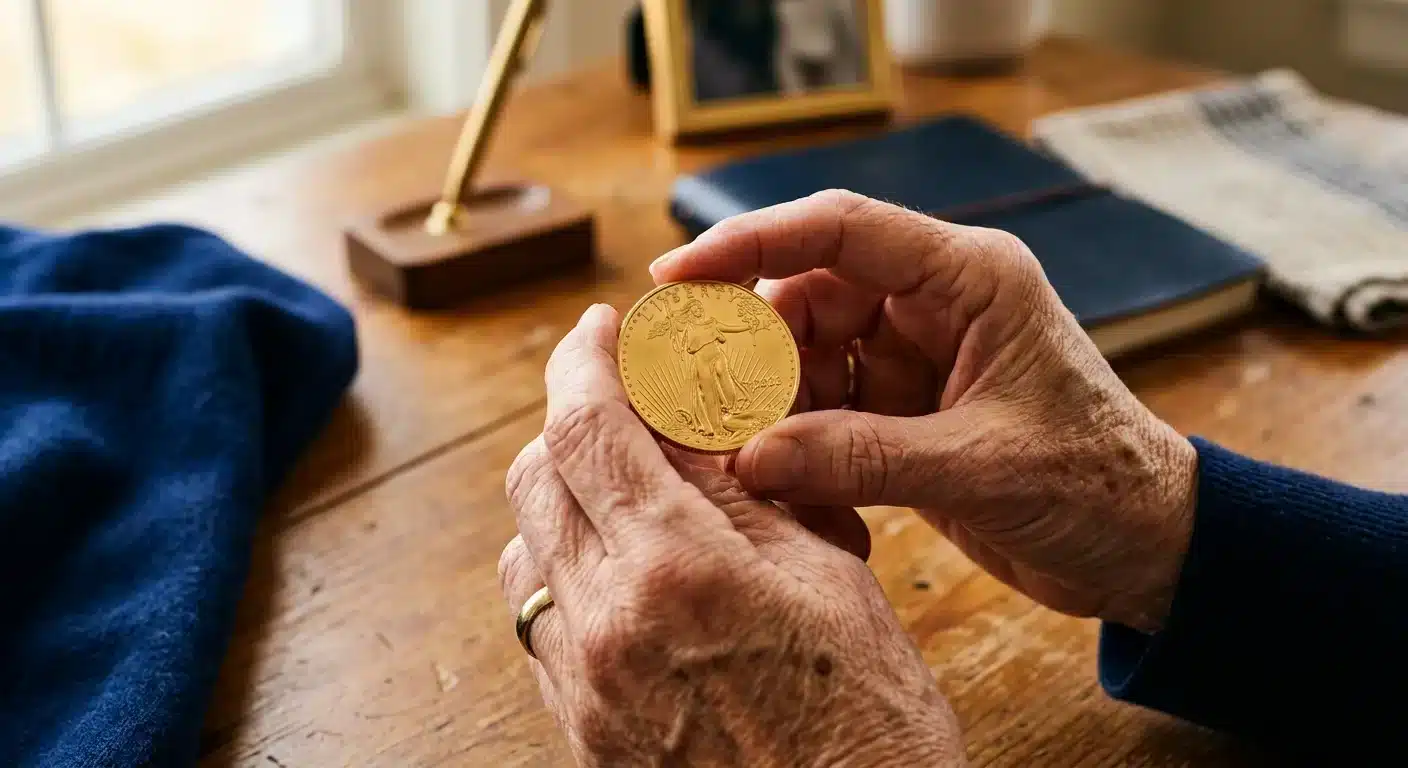
U.S.-minted gold coins are physical bullion products produced by the United States Mint.
Not collectibles. Not commemoratives. Not numismatic rarities.
They’re standardized units of precious metal designed for ownership—with specifications set by federal law and production overseen by the Treasury.
The two most common U.S. gold coins are the American Gold Eagle and the American Gold Buffalo.
Both are legal tender. Both are recognized globally.
Both are purchased for the same reason: to hold something real.
What separates these coins from every other form of physical gold—bars, rounds, foreign coins—is provenance. The documented origin. The verifiable chain of custody that starts at the U.S. Mint and ends with you. That’s the invisible thread conservative purchasers care about. Not the metal itself—the certainty of where it came from.
Government-Backed Authenticity
When you purchase an American Gold Eagle, the weight, content, and purity are guaranteed by the U.S. Government. That guarantee isn’t marketing language. It’s a legal commitment backed by the full faith and credit of the United States.
Authenticity anxiety is real.
Counterfeit gold exists. Tungsten-filled bars exist. Coins that claim one purity but deliver another exist.
The government guarantee eliminates that friction entirely. You’re not trusting a private mint’s reputation or a third-party assay. You’re trusting the institution that prints the currency.
Purity That Doesn’t Require a Lab Test
The American Gold Eagle is a 22-karat coin, with a composition of 91.67% gold. But here’s what most explanations skip: even though it’s alloyed with copper and silver for durability, each coin still contains its full stated weight in pure gold—one troy ounce in the one-ounce version.
You don’t need a lab test to verify what you own.
The specifications are public. The standards are federal. The composition is documented on the U.S. Mint’s website.
That clarity is what conservative purchasers pay for—not the gold itself, but the certainty that comes with it.
| Coin Name | Purity (Karat) | Gold Content (1 oz coin) | Minting Authority |
|---|---|---|---|
| American Gold Eagle | 22-karat (91.67% gold, alloyed with copper and silver) | 1 troy ounce pure gold | United States Mint |
| American Gold Buffalo | 24-karat (.9999 fine — purest U.S. Mint gold coin) | 1 troy ounce pure gold | United States Mint |
| American Gold Eagle (Fractional) | 22-karat (same alloy composition as 1 oz version) | Available in 1/2 oz, 1/4 oz, and 1/10 oz pure gold | United States Mint |
| First Spouse Gold Coin | 24-karat (.9999 fine) | 1/2 troy ounce pure gold | United States Mint |
| American Liberty Gold Coin | 24-karat (.9999 fine) | 1 troy ounce pure gold (high-relief, limited annual mintage) | United States Mint |
Why 22-Karat Works Better Than 24-Karat for Ownership
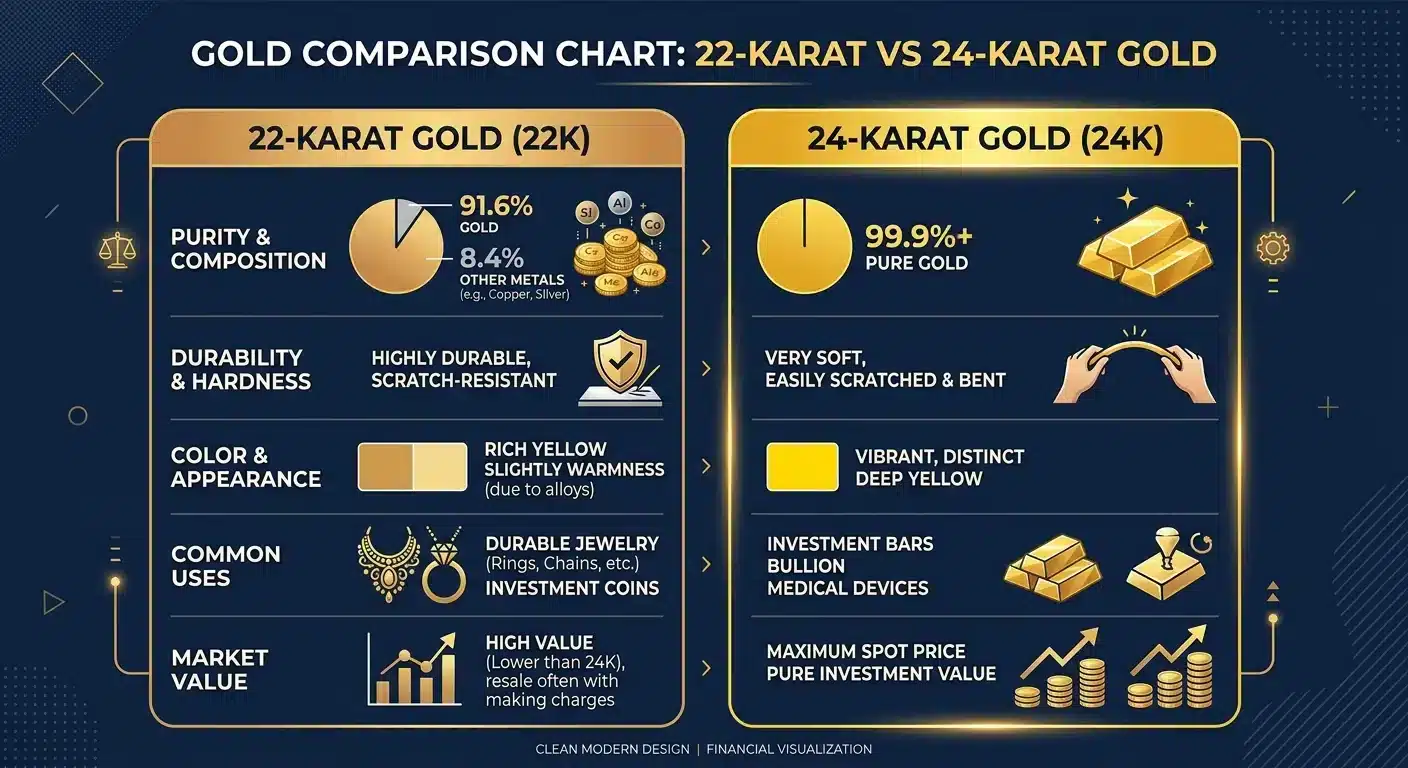
The American Gold Eagle’s 22-karat composition isn’t a compromise.
It’s a design choice that prioritizes decades of ownership over purity optics.
Pure gold is soft. Soft enough that a 24-karat coin scratches, dents, and warps with normal handling.
If you’re holding physical metal for years—or passing it down—that softness isn’t a feature. It’s a problem.
The 22-karat alloy fixes that without sacrificing gold content.
Durability Over Decades of Handling
When you hold a coin for decades, you’re not keeping it in a museum case.
You’re storing it. Moving it. Checking it.
Every time it’s handled, pure gold picks up marks. That’s not theory—it’s material physics.
The American Gold Eagle blends copper and silver into its 91.67% gold composition to increase hardness. That alloying doesn’t dilute value—it protects it.
A scratched coin doesn’t lose gold content. But it loses buyer confidence at resale.
Durability preserves the metal and the transaction.
The Full Weight Guarantee
Here’s what conservative purchasers miss most often: even though the Eagle is a 22-karat coin, each one still contains its full stated weight in pure gold.
A one-ounce American Gold Eagle contains one troy ounce of pure gold. The alloy weight sits on top of that guarantee—it doesn’t replace it.
So you’re not buying 91.67% of an ounce. You’re buying a full ounce with a government-backed composition standard that ensures the coin survives the life you’re going to give it.
Conservative purchasers don’t want fragility. They want clarity and control—and the 22-karat structure delivers both.
IRA Approval and Legal Tender Status

Two legal distinctions separate U.S.-minted gold coins from foreign alternatives.
IRA eligibility and legal tender status.
Both trace to federal law—not dealer preference, not marketing spin, not what the industry decided sounded good. When the goal is long-term ownership in a retirement account or direct possession, those distinctions aren’t window dressing. They’re load-bearing.
The American Gold Eagle and American Gold Buffalo are both approved for inclusion in Precious Metals IRAs because they meet the IRS minimum fineness requirement.
That approval isn’t discretionary. It’s codified.
As long as the coin meets specific fineness requirements, it’s eligible for placement in a self-directed IRA without a separate purity verification or third-party assay. You’re not proving anything. You’re citing a standard that already exists.
And because these coins are minted by the U.S. government, they’re also designated as legal tender under 31 U.S. Code § 5112.
That legal tender status doesn’t mean you’ll use a one-ounce Gold Eagle to buy groceries. It means the coin holds a recognized legal position inside the U.S. monetary system—a position that private rounds and foreign-minted coins don’t have.
That’s not a technicality. That’s a foundation.
IRA Approval Isn’t Automatic
Not every gold coin qualifies for an IRA.
The IRS holds a clear standard: the coin must meet a minimum fineness threshold. U.S. coins like the American Eagle and Buffalo meet that standard automatically because their specifications are set by the same federal code that governs IRA rules.
Foreign coins can qualify too—if they hit the fineness mark. But the burden of proof shifts to the custodian and the dealer. With U.S. coins, there’s no gray area.
Here’s the provenance thread again.
When you roll over a 401(k) into a Precious Metals IRA, the custodian doesn’t test your coins for purity. They verify eligibility by checking the product against the IRS list.
U.S.-minted coins are pre-approved. That eliminates the friction that comes with lesser-known mints or private refiners. You’re not asking permission. You’re following a documented path that’s been cleared since the law was written.
The Legal Tender Difference
Legal tender status is misunderstood more often than not.
It doesn’t mean a gold coin functions as circulating currency. What it means is that the coin is officially recognized by the U.S. government as a valid monetary instrument under 31 U.S. Code § 5112.
That designation gives the coin a legal standing that bars, rounds, and privately minted bullion products don’t carry—even if they contain the same amount of gold.
That legal standing doesn’t add an ounce of metal.
But it adds something conservative purchasers value more: legitimacy.
A coin with legal tender status sits inside the U.S. monetary framework. A private round sits outside it. When the priority is control, clarity, and a verifiable chain of custody, that distinction isn’t trivial—it’s foundational.
| Gold Product Type | IRA Eligible? | Legal Tender Status | Liquidity Level |
|---|---|---|---|
| American Gold Eagle (U.S. Mint) | Yes — meets IRS fineness requirement automatically | Legal tender under 31 U.S. Code § 5112 | Highest — globally recognized, widely traded |
| American Gold Buffalo (U.S. Mint) | Yes — meets IRS fineness requirement automatically | Legal tender under 31 U.S. Code § 5112 | High — recognized globally, strong demand |
| Foreign government-minted coins (e.g., Canadian Maple Leaf, South African Krugerrand) | Yes — if fineness meets IRS threshold | Legal tender in country of origin, not in U.S. | Moderate to high — varies by coin recognition |
| Private mint rounds | No — do not meet IRS collectibles exemption | Not legal tender | Lower — depend on private mint reputation |
| Gold bars from recognized refiners | Yes — if fineness and weight meet IRS standards | Not legal tender | Moderate — require assay or verification at resale |
Liquidity and Recognition in the Global Market

Provenance isn’t just about knowing where a coin came from.
It’s about knowing the rest of the world recognizes that origin too.
The American Gold Eagle is one of the world’s most recognizable bullion coins. That liquidity isn’t an accident. It’s the result of decades of global recognition, standardized specifications, and trust in a U.S. government-backed product.
When you own something the entire market already knows, you don’t explain what you’re selling.
You name it.
Liquidity When It Counts
Liquidity matters most when you need it.
Not when the market is calm and buyers are plentiful—but when conditions tighten and everyone else is scrambling to convert holdings into cash.
The American Gold Eagle doesn’t need authentication before a dealer makes an offer. It’s one of the world’s most recognizable bullion coins, and that recognition translates into immediate market acceptance.
You’re not negotiating credibility.
You’re transacting on a known standard.
Compare that to a privately minted round or a lesser-known foreign coin. Even if the gold content is identical, the buyer has to verify authenticity, check the mint’s reputation, and price in the uncertainty. That friction costs time and money—and in a tight market, it costs opportunity.
Conservative purchasers who prioritize control don’t want to discover that friction at the worst possible moment.
They eliminate it by holding a coin the market already trusts.
The American Gold Buffalo Alternative
The American Gold Buffalo, first minted in 2006, is .9999 fine—the first 24-karat gold coin from the U.S. Mint. Where the Eagle prioritizes durability through alloying, the Buffalo prioritizes purity. Both are U.S.-minted. Both carry the same government guarantee. Both are IRA-approved.
The choice between them comes down to whether you value hardness or pure gold.
Here’s what doesn’t change: the Buffalo carries the same liquidity advantage as the Eagle. It’s a U.S. Mint product with documented provenance, federal specifications, and global recognition. For customers weighing Gold coins vs. gold bars or exploring physical gold ownership the foundation of financial privacy, the Buffalo offers the same clarity and control as the Eagle—just with a different composition standard.
You’re still holding something the market knows. You’re still avoiding the verification friction that comes with alternatives.
And you’re still making a choice grounded in provenance, not speculation.
| Coin Type | First Minted | Fineness | Global Recognition |
|---|---|---|---|
| American Gold Eagle | 1986 | .9167 fine (22-karat) — alloyed for durability; full gold content preserved | Longest-running U.S. bullion coin; most widely traded gold coin in the world by volume |
| American Gold Buffalo | 2006 | .9999 fine (24-karat) — first 24-karat coin issued by the U.S. Mint | U.S. Mint product with documented provenance, federal specifications, and global recognition |
Frequently Asked Questions
The questions below aren’t trivia.
They’re the decision gates that separate someone who’s ready from someone who’s still stuck in research mode.
Cost, authenticity, what happens after you own it—these are the questions that determine whether you move forward or stay paralyzed.
Why is the American Gold Eagle coin only 22-karat instead of 24-karat?
The American Gold Eagle is 22-karat because durability beats purity optics.
24-karat gold is soft. It scratches, dents, and degrades with normal handling.
The Eagle is alloyed with copper and silver, bringing the composition to 91.67% gold. But here’s what trips people up: each coin still contains its full stated weight in pure gold. A one-ounce coin delivers one troy ounce of pure gold—you’re not losing metal.
You’re gaining a coin that survives decades of ownership. For anyone planning to hold rather than flip, that’s the point.
Can any U.S.-minted gold coin be placed in a Precious Metals IRA?
No—not every U.S. gold coin qualifies.
The IRS sets a minimum fineness standard. U.S. coins that meet it are automatically eligible. Commemorative and numismatic coins typically aren’t.
The American Gold Eagle and American Gold Buffalo both qualify. The distinction comes down to whether the coin is bullion or collectible.
Your custodian verifies eligibility during the rollover. But with U.S. Mint bullion, you’re working from a pre-approved list—no ambiguity, no negotiation.
Are U.S. gold coins more expensive than gold bars of the same weight?
Yes—U.S. coins carry a higher premium over spot price than bars.
That premium reflects minting cost, the government guarantee, and the global recognition that comes with a U.S. Mint product. Bars are cheaper per ounce upfront.
But liquidity shifts the math. A U.S. coin sells faster and requires no assay—the buyer knows what they’re getting.
The premium you pay at purchase is the friction you avoid at sale. Conservative owners accept that tradeoff. Speculators don’t.
How can I be certain a U.S. gold coin is authentic and not a counterfeit?
U.S.-minted coins are hard to counterfeit well.
The weight, content, and purity are guaranteed by the United States Government. Every authentic coin carries precise dimensions and design details. Dealers verify authenticity using electronic testing, visual inspection, and weight measurement.
Counterfeiters can fake appearance—they can’t fake density and composition.
When you purchase through a reputable dealer, you’re not taking that risk alone. The dealer’s reputation depends on product integrity. Brighton Gold works only with verified sources.
What does it mean for a gold coin to have ‘legal tender’ status?
Legal tender status means the coin is officially recognized under 31 U.S. Code § 5112.
The U.S. government designates it as legal tender—not because you’ll spend it at a grocery store, but because it sits inside the U.S. monetary system. Bars and private rounds don’t carry that designation.
That legal standing gives the coin documented legitimacy. It matters when you’re moving it into an IRA or selling it.
Legal tender status doesn’t add gold. It adds clarity.
The Foundation of Long-Term Wealth Protection
The preference for U.S.-minted coins isn’t a trend. It’s a reflection of the values that drive conservative ownership in the first place.
Provenance. Purity standards backed by federal law. Liquidity that doesn’t require explanation. IRA eligibility that’s automatic, not negotiated. Legal tender status that places the coin inside the U.S. monetary system, not outside it.
These aren’t marketing features. They’re structural advantages that eliminate friction at every stage of ownership—from the first purchase to the final transaction.
Conservative purchasers don’t buy gold to chase price movements. They buy it to hold something real. Something they control. Something that doesn’t depend on a bank’s solvency or a government’s promises.
U.S.-minted coins deliver that clarity better than any alternative because the provenance is documented, the standards are federal, and the market already knows what it’s looking at.
Here’s what that means in practice.
When you open a Precious Metals IRA with an American Gold Eagle or Buffalo, you’re not waiting for verification. The coins are pre-approved.
When you store them, you’re holding metal whose weight, content, and purity are guaranteed by the U.S. government. When you sell, you’re transacting on a globally recognized standard that doesn’t require assay, authentication, or negotiation.
That’s the difference between owning a coin with provenance and owning a piece of bullion that the buyer has to verify before making an offer.
One path is clear. The other introduces uncertainty at the exact moment you need confidence most.
The conservative approach isn’t to hope the market accepts what you’re selling. It’s to hold something the market already trusts.
Brighton Gold works with customers who value that clarity.
The No Fee Precious Metals IRA for the lifetime of the account on qualified purchases isn’t a promotion—it’s a structural commitment to long-term ownership. The concierge experience isn’t about selling more metal. It’s about walking you through the process so you understand what you’re holding, why it matters, and what happens next.
Precious metals don’t appreciate, depreciate, or remain unchanged based on how you feel about them. They respond to market conditions like any tangible asset.
But the decision to hold U.S.-minted coins instead of alternatives is a decision for control, simplicity, and trust—values that don’t shift with the news cycle.
If you’re ready to explore what that looks like in your situation, a complimentary consultation gives you a direct conversation about whether a Precious Metals IRA or direct cash purchase fits where you are.
No pressure. No urgency language. Just the clearest picture we can give you of what you’re actually acquiring—and why provenance is the foundation that makes everything else work.
You’ve covered the ground here. Provenance. Purity. Legal standing. The question now—if this still makes sense for your situation—is a simple conversation. We offer a complimentary consultation to walk you through your options. Whether you’re considering a Precious Metals IRA or a direct cash purchase for delivery, we’ll show you what U.S.-minted coins actually deliver—and why conservative purchasers who value control choose them. No pressure. No obligation. Just the clearest picture we can give you of whether this fits where you are.