

Gold Coins vs. Gold Bars: Which Is Best for New Owners?
Gold coins and gold bars are both physical gold — but they’re not interchangeable.
Coins are building blocks you can rearrange and move as needed. Bars are the foundation stone that anchors wealth in place.
Coins — like the American Gold Eagle — are government-minted. They carry official backing and trade in smaller denominations. That makes them easier to sell in portions. Bars are purchased by weight. They carry lower premiums per ounce, especially in larger sizes. Less manufacturing overhead. Tighter spreads. More metal for the money.
The difference isn’t cosmetic. It’s strategic.
Coins offer liquidity and flexibility. They’re highly recognizable and easily divisible — you can move portions of your holdings without liquidating everything at once. Bars offer efficiency. You’re paying for weight, not detailed designs or numismatic features. If you’re scaling into larger positions over time — or if storage space and cost-per-ounce matter most — bars deliver.
But if you want the flexibility to sell in increments, the universal recognition of government backing, and the confidence that comes with holding something instantly verifiable — coins are the standard.
Both are legitimate paths to physical ownership. Both qualify for inclusion in a self-directed IRA, provided they meet specific purity requirements. And both serve the same underlying purpose — holding tangible wealth outside the financial system.
What matters is understanding the trade-offs before you purchase. Not after.
- What Are Gold Coins and Gold Bars?
- Liquidity and Resale: Which Is Easier to Sell?
- Premiums Over Spot Price: What You’re Really Paying
- Storage and Security Considerations
- IRA Eligibility: What Qualifies for Retirement Accounts?
- Frequently Asked Questions
- Are gold coins or gold bars more liquid when it’s time to sell?
- What are the key differences in storing gold coins versus gold bars?
- Why do gold coins usually have higher premiums than gold bars of the same weight?
- Can I hold both government-minted coins and certified bars in a Precious Metals IRA?
- How can a new owner verify the authenticity of a gold coin versus a gold bar?
- For a first-time purchase, is it better to buy several small coins or one larger bar?
- Where This Leaves You
What Are Gold Coins and Gold Bars?

Most people skip straight to price comparisons. That’s a mistake. The form you choose — coin or bar — changes how you store it, sell it, and pass it on.
Coins are building blocks. Bars are foundation stones.
Coins give you divisible, flexible pieces. You can rearrange them. You can move them as needed. Bars anchor wealth in place — efficient, solid, purpose-built for holding significant weight without the overhead of elaborate design.
Government-Minted Coins
National governments mint gold coins. They carry official backing, detailed designs, and a face value — though that face value is symbolic, far below what the metal’s actually worth.
The American Gold Eagle is guaranteed by the United States Government for its weight, content, and purity. That’s not marketing. It’s a legal commitment. It makes the coin instantly recognizable and universally accepted — no question of authenticity, no need for additional verification in most transactions.
Other government-minted coins include the Canadian Gold Maple Leaf, the Austrian Gold Philharmonic, and the South African Krugerrand. All share the same core advantage — sovereign backing and global liquidity.
For IRA eligibility, coins must meet a minimum fineness of .9999. The American Gold Eagle is a notable exception. That exception exists because the Eagle’s durability and recognition outweigh its slightly lower fineness in the eyes of the IRS.
Certified Bars and Rounds
Bars — sometimes called ingots — are produced by private refineries and mints. They’re sold strictly by weight and purity. No elaborate story. No symbolic face value.
Bars carry no elaborate designs. No face value. No government backing.
What they do carry is a lower premium over spot price — especially in larger sizes. The manufacturing process is simpler. The overhead is minimal. To qualify for IRA inclusion, bars must meet a minimum fineness of .995 — slightly lower than coins, but still well within institutional standards.
Rounds — privately minted discs that look like coins but lack government backing — fall into this same category. They’re priced like bars. They trade by weight. They offer the same efficiency.
The trade-off is recognition.
A bar or round from a reputable refinery is perfectly legitimate. But it doesn’t carry the instant global trust of a U.S. Mint bullion product. That difference shows up most clearly when it’s time to sell.
Liquidity and Resale: Which Is Easier to Sell?

Owning is one thing.
Selling when you need to is another — and that’s where the two forms diverge sharply.
Liquidity isn’t about whether you can sell. Both coins and bars have markets.
It’s about how quickly, how cleanly, and at what cost you convert metal back into cash — or move portions of your holding without selling everything.
That’s where recognition, divisibility, and buyer confidence matter. And that’s where coins hold a structural advantage most new owners don’t see until they need it.
Why Coins Are More Liquid
Government-minted coins like the American Gold Eagle or Canadian Gold Maple Leaf are highly recognizable and easily divisible, making them very liquid.
Walk into a dealer with a one-ounce Eagle, and the transaction is straightforward — weight, content, and purity are guaranteed by the issuing government. No additional assay required in most cases. No questions about provenance or authenticity.
Divisibility is the other half. If you need to raise a specific amount of cash — say, enough to cover an unexpected expense — you can sell two coins and keep eight. You can scale your exit.
Bars don’t offer that.
Selling half a ten-ounce bar means selling the entire bar and taking whatever the dealer offers. You can’t physically divide it. The best gold coins for wealth preservation aren’t just recognized — they’re built to be moved in pieces, not all at once.
That’s the building-block advantage.
Coins let you rearrange your holdings as circumstances change — selling some, keeping others, adding more when it makes sense. Bars lock you into all-or-nothing decisions.
For most new owners focused on long-term flexibility, that difference isn’t trivial.
When Bars Make Sense for Resale
But bars shine when the goal is straightforward — sell the entire position at once and get the tightest spread. If you’re holding a ten-ounce bar and you’re ready to liquidate all ten ounces, the lower premium you paid on the way in translates to tighter bid-ask spreads on the way out.
You’re not paying for divisibility or design, so the dealer isn’t discounting for it.
For owners who plan to hold until a single, defined exit point — and who aren’t concerned with partial sales along the way — bars offer clean, efficient liquidity when the time comes.
The trade-off is recognition.
A bar from a reputable refinery is perfectly legitimate, but the dealer may request an independent assay to verify weight and purity before making an offer. That adds time, and sometimes cost. Coins bypass that step entirely.
For a deeper look at how these key differences for investors play out in practice, the structural advantages of coins become clear — especially for owners who value optionality over absolute efficiency.
| Product Type | Recognition Level | Divisibility | Typical Resale Speed |
|---|---|---|---|
| Government-Minted Coins (e.g., American Gold Eagle, Canadian Maple Leaf) | Highest — sovereign backing and global recognition make authenticity instantly verifiable | Highly divisible — sold in standard denominations (1 oz, 1/2 oz, 1/4 oz, 1/10 oz) allowing partial sales | Fastest — dealers accept without additional assay in most cases; transaction completes quickly |
| Certified Bars from Major Refineries (e.g., PAMP Suisse, Valcambi) | High — well-known refiners carry strong reputations, but not government-backed | Limited — bars sold as single units; partial sales require liquidating the entire bar | Fast to moderate — may require independent assay depending on dealer and bar size |
| Generic Bars and Rounds from Lesser-Known Mints | Moderate — recognition depends on refiner reputation and dealer familiarity | Limited — sold as complete units with no option for incremental liquidation | Moderate to slow — independent assay often required, adding time and cost to resale |
| Large-Format Bars (10 oz, 1 kilo, or larger) | Moderate to high (if from reputable refinery) — size commands institutional trust but limits retail buyer pool | None — large bars cannot be divided; owner must sell entire bar at once | Moderate — fewer buyers in retail market; institutional buyers move faster but may negotiate tighter spreads |
Premiums Over Spot Price: What You’re Really Paying
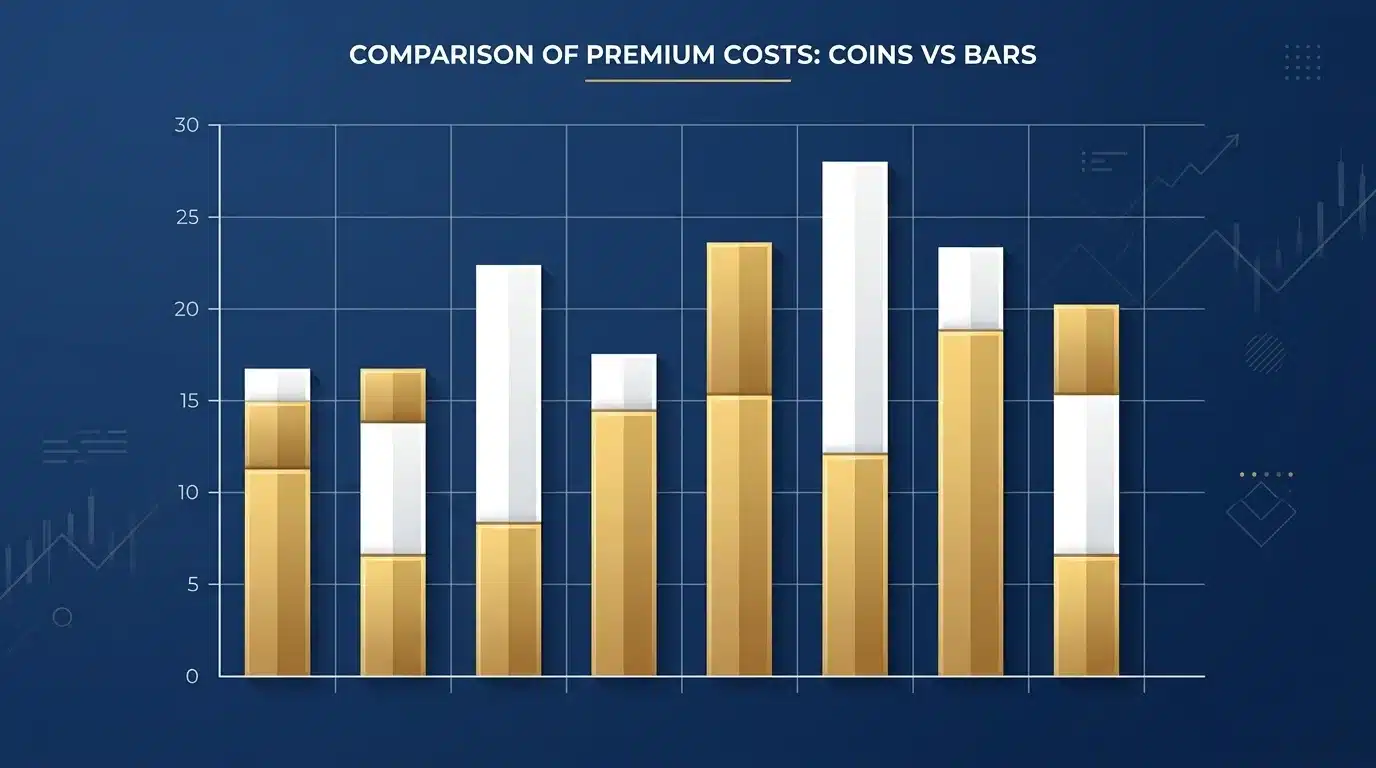
The price you see isn’t the price you pay — and understanding why that gap exists is half the decision.
Every piece of physical gold trades at a premium over the spot price — the current market price for an ounce of pure gold.
That premium covers minting, refining, distribution, and dealer margin. It’s not hidden. It’s the cost of turning raw metal into a product you can hold, store, and resell.
But the premium isn’t uniform. Coins carry higher premiums over the spot price than bars — and most new owners don’t know why that difference exists, or whether it’s worth paying.
Why Coins Carry Higher Premiums
Gold coins carry a higher premium over spot price than bars for three reasons: detailed designs, government backing, and higher manufacturing costs.
That’s not markup for its own sake.
It’s the cost of producing a product with sovereign guarantees, fine detail, and universal recognition.
A one-ounce American Gold Eagle costs more per ounce than a one-ounce bar from a private refinery — not because the gold is different, but because the Eagle carries U.S. government certification and a minting process built for durability and fraud resistance.
The detailed design isn’t decoration. It’s a security feature.
It makes the coin harder to counterfeit and easier to verify at a glance.
For new owners who prioritize liquidity and resale confidence, that premium isn’t wasted money.
It’s the price of optionality — the ability to sell quickly, in smaller increments, without requiring an independent assay or raising questions about authenticity.
The premium you pay on the way in translates directly to speed and trust on the way out. That’s the trade-off most new owners don’t see until they try to sell.
How Bar Premiums Compare
Bars trade at lower premiums because the manufacturing process is simpler and the product is sold by weight alone — no detailed designs, no government backing, no face value.
Larger bars drive the premium down further. A ten-ounce or one-kilo bar has a lower premium per ounce than smaller bars or one-ounce coins.
Refining costs don’t scale linearly. Spreading those costs across more ounces drives the per-ounce premium down.
That efficiency matters when the goal is to hold significant weight at the tightest spread to spot price.
If you’re comfortable with the all-or-nothing resale structure, bars deliver the most metal for the money.
The premium savings on a ten-ounce bar versus ten one-ounce coins can add up when repeated across a larger position.
The trade-off is flexibility.
A bar is a single unit. You can’t divide it, and you can’t sell half of it.
When acquiring physical metals, the question isn’t whether bars are cheaper — they are. The question is whether that upfront savings outweighs the structural limitations on resale.
For some owners, it does. For others, the building-block flexibility of coins is worth every dollar of the premium.
| Product Form | Typical Premium Range | What Drives the Premium |
|---|---|---|
| Government-Minted Coins (e.g., American Gold Eagle, Canadian Maple Leaf) | 4%–8% over spot per ounce | Sovereign backing, detailed minting, face value designation, and global recognition — manufacturing cost and demand premium are both higher |
| Private Mint / Generic Rounds | 2%–5% over spot per ounce | No government backing or face value; lower design complexity reduces minting cost, but recognition premium is absent |
| 1 oz Bars (Major Refineries) | 2%–4% over spot per ounce | Simple manufacturing, sold by weight alone — no design premium; refiner reputation (e.g., PAMP Suisse, Valcambi) adds slight margin |
| 10 oz Bars | 1%–2.5% over spot per ounce | Refining costs spread across more ounces; fewer transactions per total weight reduces dealer overhead — efficiency drives the premium down |
| 1 Kilo Bars (32.15 oz) | 0.5%–1.5% over spot per ounce | Institutional-scale efficiency; lowest per-ounce cost available in retail — premium nearly collapses, but divisibility disappears entirely |
Storage and Security Considerations

Once you own it, you have to put it somewhere — and the two forms don’t store the same way.
Coins and bars don’t occupy the same space per ounce. They don’t protect the same way against physical damage. And they don’t divide the same way when you’re splitting a holding across multiple secure locations.
That’s not a minor consideration.
For new owners building a position over time — adding ounces every few months, holding for years or decades — the way metal stacks, stores, and stays accessible affects everything from home safe capacity to vault logistics to estate planning. The building-block versus foundation-stone metaphor shows up here in physical form.
Coins take up more space than bars of equivalent weight — the shape, the protective packaging, the way they stack. Bars pack tighter.
But coins divide easier. And that difference changes how you think about splitting a holding between a home safe, a bank deposit box, and a professional vault.
If control, access, and flexibility matter more than raw storage efficiency, coins win. If the goal is to store the maximum weight in the minimum footprint — and you’re comfortable with the all-or-nothing structure — bars deliver.
Home Storage: Coins vs. Bars
Home storage is the most direct form of control. No third party. No access restrictions. No questions about who holds the metal.
It’s also the form that puts the most responsibility on the owner.
Fire, theft, flood, and simple human error are real risks. Coins and bars don’t insure themselves. And most homeowner policies cap precious metals coverage at levels far below what serious owners hold. That gap forces a choice — accept the exposure, buy a rider, or split the holding across multiple locations.
Coins offer a structural advantage in home storage — they’re easier to divide. Ten one-ounce coins fit into multiple small hiding spots. A safe. A drawer. A deposit box. A ten-ounce bar fits in one place. And if that place is compromised, the entire position is gone.
Divisibility isn’t just about selling.
It’s about not putting all your metal in one physical location. For owners who split holdings between home and vault — or who plan to move portions of a position over time — coins act like the building blocks they are. You can rearrange them. Bars anchor in place.
Bars are easier to stack, inventory, and store in high-security home safes designed for weight and volume. A hundred ounces in ten-ounce bars takes up half the space of a hundred ounces in one-ounce coins. And that efficiency matters when safe capacity is the limiting factor.
The trade-off is the same one that runs through every other dimension of this decision — flexibility versus efficiency.
Bars maximize storage density. Coins maximize optionality. Neither approach is wrong. The question is which trade-off fits the owner’s long-term plan — and Brighton Gold’s concierge service exists to walk new owners through exactly that question before anything is purchased.
Vaulted Storage and Depository Options
Vaulted storage — either through a private depository or as part of a Precious Metals IRA — removes the home-security burden entirely. The metal is held in a segregated account. Insured. Audited. Accessible on request.
For owners who don’t want the liability of home storage or who are holding significant weight, professional vault services offer institutional-grade security without the need to manage it personally.
The cost is an annual storage fee — typically a fraction of a percent of the holding’s value. That fee is the price of removing physical possession risk. And for many owners, especially those holding IRA metals, it’s not optional.
Coins and bars store identically in a vault. Both are inventoried by weight, serial number, and purity. Both sit in the same segregated space. The divisibility advantage coins offer in home storage disappears in a depository setting — you’re not physically moving the metal yourself.
What remains is premium efficiency.
If the entire holding is going into a vault from day one — and the owner has no plans to take physical delivery of portions over time — bars deliver the same security at a lower upfront cost. That’s the foundation-stone logic applied to vaulted holdings. If you’re locking it in place for the long haul, pay for the metal, not the minting.
| Storage Method | Best Suited For | Key Considerations |
|---|---|---|
| Home Safe | Owners who want direct physical control and immediate access without third-party involvement | Requires secure safe rated for weight and fire protection. Homeowner insurance typically caps precious metals coverage well below actual value — consider a rider or accept the exposure. Coins offer better divisibility across multiple hiding spots; bars maximize storage density in limited safe space. |
| Bank Safety Deposit Box | Owners seeking off-site security with no annual percentage-based fees, willing to accept limited access hours | No insurance provided by the bank — metal is stored at owner’s risk. Access restricted to bank hours. Coins fit easily in smaller boxes; bars require larger boxes or multiple trips. No custodial reporting, so this option is not IRA-compatible. |
| Private Depository (Non-IRA) | Owners holding significant weight who want institutional-grade security, full insurance, and audit trails without managing physical possession | Annual storage fee — typically a small percentage of holding value or a flat rate per ounce. Metal is segregated, insured, and auditable. Both coins and bars store identically in this setting. Some depositories allow partial withdrawals; others require full account liquidation. |
| IRA-Approved Depository | Owners rolling retirement funds into a Precious Metals IRA who need IRS-compliant storage and custodial reporting | Mandatory for IRA holdings — no home storage permitted under IRS rules. Custodian manages the depository relationship. Coins and bars both eligible if they meet IRS purity standards. Storage fees and custodian fees apply annually. Bars deliver tighter spread to spot; coins offer easier partial distributions when required minimum distributions begin. |
IRA Eligibility: What Qualifies for Retirement Accounts?
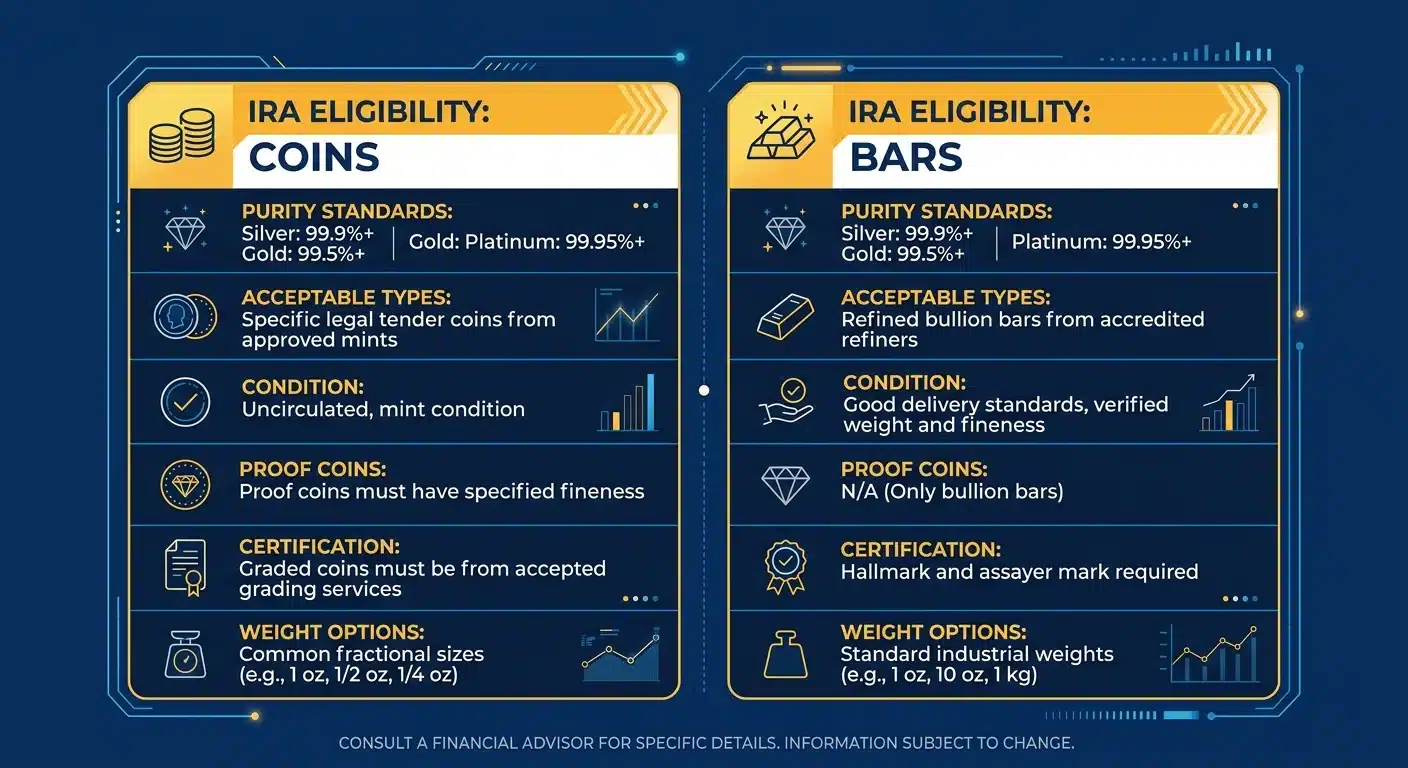
If you’re holding metals inside a retirement account, the IRS has specific rules.
Not every coin or bar qualifies.
The regulatory line is drawn at purity. Gold bars must meet a minimum fineness requirement of .995, and gold coins must be at least .9999 fine — with one important exception we’ll cover below.
These aren’t arbitrary numbers.
They’re the IRS standard for what constitutes IRA-eligible gold, and they apply whether you’re rolling over a 401(k) or opening a new self-directed account. The line is clear. Either the metal meets the threshold or it doesn’t qualify — no gray area, no workarounds.
Purity Requirements for Coins and Bars
So what does that mean when you’re actually buying?
Bars need to hit .995 purity. Most certified bullion bars already clear that — it’s the industry baseline. Coins face a higher bar — .9999 fine — because the IRS treats minted products differently than cast weight.
Why the gap? Coins carry government backing and legal tender status. The IRS holds them to a stricter manufacturing threshold. Bars trade by weight alone, so the .995 purity standard is lower.
Both qualify. Both serve the same purpose inside a retirement account.
The difference is structure — and what that structure allows you to do down the road. Bars are efficient, straightforward, meeting the baseline standard. Coins are smaller, more divisible, but held to a stricter manufacturing threshold because they carry government backing and legal tender status.
Most global demand for physical gold comes from owners who get this distinction.
They’re not chasing numismatic premiums or collectible value. They’re acquiring metals that qualify — cleanly, legally, without complications down the road. That’s the foundation of the decision. Not speculation. Not timing. Just ownership that meets the regulatory threshold and stays there.
Why the American Gold Eagle Is the Exception
The American Gold Eagle is the one coin that doesn’t have to meet the .9999 standard. It’s the exception — and it’s the reason why conservative purchasers prefer U.S.-minted gold coins.
The Eagle contains a full troy ounce of pure gold, but it’s alloyed with a small amount of silver and copper to increase durability. That makes the coin more resilient to handling and storage wear — which matters when you’re holding something for decades, not days.
The alloy doesn’t dilute the gold content. It protects it.
The U.S. Mint guarantees the weight, content, and purity of every American Eagle it produces. That government backing is why the IRS carved out the exception — and why first-time owners often start here.
It’s a known quantity.
No guesswork. No ambiguity. And no question about whether it qualifies for the retirement account you’re funding.
Frequently Asked Questions
You’ve done the research. Now here’s what most new owners actually ask when it’s time to act.
The answers below address the real concerns that surface after the research is done — when the decision moves from theory to transaction.
Are gold coins or gold bars more liquid when it’s time to sell?
Government-minted coins like the American Gold Eagle or Canadian Gold Maple Leaf are highly recognizable and easily divisible, making them very liquid.
Bars — especially larger ones — can be harder to move quickly unless you’re working with an established dealer who handles bulk transactions.
The question isn’t which is more liquid in absolute terms. It’s which form matches the way you expect to hold and eventually move your metals — and whether you value flexibility over efficiency.
What are the key differences in storing gold coins versus gold bars?
Coins stack cleanly. They take up less space per ounce when stored in tubes or protective cases.
Bars — particularly larger ones — require more deliberate storage planning because of their size and weight.
Both need secure, climate-controlled environments if held at home. Both qualify for professional vaulted storage if that’s your preference.
The real difference is portability. Coins are easier to move, count, and verify without specialized equipment.
Why do gold coins usually have higher premiums than gold bars of the same weight?
Gold coins typically command a higher premium over gold’s spot price than bars because of factors like detailed designs, government backing, and higher manufacturing costs.
You’re paying for the minting process, the guarantee, and the recognizability — all of which contribute to liquidity and trust.
Larger gold bars generally have a lower premium per ounce than smaller bars or one-ounce coins, which is why some owners prefer them for bulk acquisitions where divisibility isn’t the priority.
The premium isn’t waste. It’s the cost of the features that make coins easier to own, verify, and eventually sell.
Can I hold both government-minted coins and certified bars in a Precious Metals IRA?
Yes — as long as both meet IRS fineness requirements.
Government-minted coins and certified bars from approved refiners both qualify for a self-directed Precious Metals IRA.
You’re not locked into one form or the other. Most customers hold a mix based on how they plan to use the metals over time — coins for flexibility, bars for efficiency.
Brighton Gold walks you through what qualifies and what doesn’t before anything is acquired. No guesswork. No surprises after the fact.
How can a new owner verify the authenticity of a gold coin versus a gold bar?
Government-minted coins carry intrinsic authentication — the U.S. Mint guarantees the weight, content, and purity of every American Eagle.
Bars from LBMA-accredited refiners include serial numbers, assay certificates, and tamper-evident packaging.
For both, reputable dealers provide documentation and, when appropriate, third-party verification before delivery.
The answer isn’t that one is easier to verify than the other. It’s that working with a trusted source eliminates the authentication question entirely.
For a first-time purchase, is it better to buy several small coins or one larger bar?
Several small coins give you divisibility and flexibility — you can move or liquidate part of your holdings without touching the entire position.
One larger bar gives you a lower premium per ounce and more efficient storage, but you sacrifice the ability to sell in smaller increments.
For a first-time purchase, most customers lean toward coins. They’re easier to understand, easier to verify, and easier to move if circumstances change.
The right answer depends on how you plan to hold the metals — and that’s a conversation worth having before the transaction, not after.
Where This Leaves You
You’ve covered the mechanics — purity, premiums, divisibility, storage, IRA eligibility.
Now the question isn’t what coins and bars are. It’s which one fits where you are.
Need liquidity — the ability to sell a portion without moving your entire position? Coins deliver that flexibility. No splitting bars. No negotiating partial sales.
Want to store the maximum amount of gold at the lowest upfront cost, and you’re comfortable locking that weight in place for the long haul? Bars give you more metal per dollar and fewer moving parts to track.
Neither choice is wrong. But one aligns with your timeline, your storage plan, and your exit strategy better than the other — and that alignment is the decision.
This is where the building blocks versus a foundation stone framing pays off.
Coins are the flexible, divisible building blocks you can rearrange as your situation changes — sell a few, move a few to a different vault, gift a few, take physical delivery of a few.
Bars are the foundation stone that anchors your position in place with maximum efficiency and minimum premium overhead.
Both forms hold the same intrinsic value. Both preserve wealth outside the banking system. The difference is how much optionality you’re paying for upfront — and whether that optionality is something you’ll actually use, or whether it’s friction you don’t need.
The instinct for new owners is often to split the difference — buy some coins, buy some bars, hedge the decision.
That’s not wrong. But it’s also not a strategy. It’s a default. And defaults cost you clarity.
Brighton Gold’s approach is the opposite of the industry default.
No pressure. No fear-based urgency. No assumption that the cheapest option or the most complicated product is automatically the right fit.
What we offer is a complimentary consultation that walks you through your actual situation — what you’re holding now, what you’re trying to protect, how long you’re planning to hold, and whether your storage and liquidity needs favor coins, bars, or a deliberate combination of both.
The conversation is specific. The guidance is clear. And the decision is yours.
If you’re ready to buy gold — whether coins, bars, or both — the clearest next step is a simple conversation about what fits.
Most customers leave that consultation with more clarity than they expected.
That’s the point. You’ve done the research. Now it comes down to building blocks versus a foundation stone — and which one serves the wealth you’re protecting.
You’ve done the research. You understand the trade-offs — liquidity versus premium, divisibility versus storage efficiency, fractional flexibility versus lower cost per ounce. But knowing the mechanics isn’t the same as knowing what fits your situation. That’s where Brighton Gold’s complimentary consultation comes in. We walk you through what you’re holding now, what you’re trying to protect, and whether coins, bars, or a deliberate combination of both makes sense for your timeline and storage plan. No scripts. No pressure. Just a clear-eyed conversation about what works — and what doesn’t — for the way you intend to hold physical metals. Learn About the No Fee IRA The decision matters. Make it with the full picture.