

Why Should You Avoid Foreign-Minted Gold Coins for Wealth Preservation?
Foreign-minted gold coins — Krugerrands, Maple Leafs, Sovereigns — create complications U.S.-minted coins don’t.
The distinction shows up when you sell.
Certain foreign gold coins trigger IRS reporting through Form 1099-B once sales exceed 25 one-ounce coins. American Gold Eagles are exempt from dealer reporting — no matter how many you sell. This isn’t paperwork minutiae. It’s a structural difference in how your ownership gets documented and tracked.
Beyond reporting, foreign coins face recognition gaps in the U.S. market. A Krugerrand or Maple Leaf holds value abroad. American buyers prioritize what they know — and what carries the U.S. Government’s guarantee. That guarantee backs weight and purity with legal force. Foreign coins don’t carry that backing in U.S. hands. Counterfeiting remains an issue with popular foreign coins like the Krugerrand. U.S. Mint products eliminate the authentication burden through provenance and instant recognizability.
Liquidity — how fast you convert your holdings to cash — favors U.S.-minted coins. American Gold Eagles are recognized instantly by domestic dealers. They command tighter bid-ask spreads. They move faster. Foreign coins require extra verification steps, carry wider spreads, and sometimes trigger hesitation from buyers who don’t know their specs.
The question isn’t whether foreign coins hold value. The question is whether they hold value as efficiently and predictably as U.S. coins when you need to move — whether they open the door to liquidity without friction.
For conservative Americans holding physical gold to preserve wealth — not speculate — the clearest path has the fewest obstacles. U.S.-minted coins remove reporting complexity. They maximize domestic liquidity. They eliminate authentication concerns foreign alternatives introduce. That simplicity is the strategy.
- Why Recognition and Liquidity Matter More Than Purity
- The Tax Reporting Gap You Don’t Hear About
- Provenance and Counterfeit Risk
- What Simplicity Actually Buys You
- Frequently Asked Questions
- What are the direct tax reporting differences when selling foreign vs. U.S. gold coins?
- Are foreign gold coins like Krugerrands or Maple Leafs less pure than American Gold Eagles?
- Why do some dealers offer a lower buyback price for foreign-minted gold?
- Is it significantly harder to sell a foreign gold coin in the United States?
- Besides reporting requirements, what makes the American Gold Eagle a simpler choice for wealth preservation?
- Are any foreign gold coins as widely recognized and accepted as U.S. coins in America?
- Where This Leaves You
Why Recognition and Liquidity Matter More Than Purity
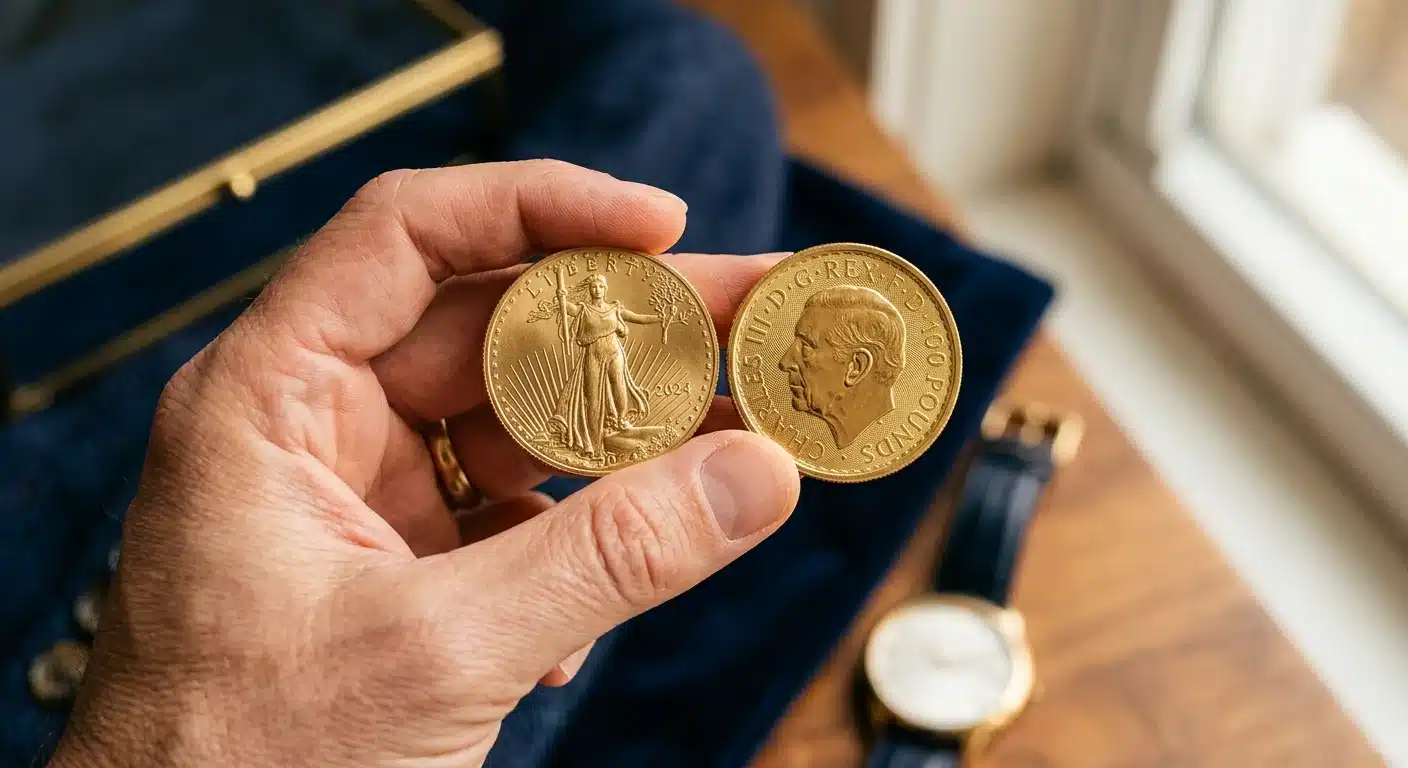
Here’s the question most dealers won’t ask upfront: when you go to sell, will the buyer recognize what you’re holding — or will they need to verify it first?
Purity matters. Recognition matters more.
A 24-karat Maple Leaf and a 22-karat American Gold Eagle both deliver one troy ounce of pure gold. The Eagle uses an alloy of gold with silver and copper — more durable, same gold content. The difference in fineness isn’t a difference in value. It’s a difference in how fast a dealer moves your coin and how confidently they price it.
U.S.-minted coins open the door smoothly. Foreign coins — even well-known ones — add friction.
That friction shows up in dealer hesitation, wider spreads, and longer transaction times. The U.S. Government guarantees that American Eagle Gold Bullion Coins contain the stated amount of actual gold weight in troy ounces. Foreign governments offer similar guarantees to their own citizens. But in the U.S. market, only one guarantee carries the weight of domestic institutional backing — and that’s the one dealers trust without a second thought.
Dealer Familiarity
Dealers buy what they can resell fast. American Gold Eagles move through inventory faster than Krugerrands or Sovereigns because domestic buyers recognize them instantly.
No authentication step. No cross-referencing the official specifications for American Eagle Gold Bullion Coins to confirm weight and purity — the dealer already knows.
Foreign coins require verification — even when they’re legitimate. That extra step costs the dealer time and introduces doubt.
Doubt doesn’t kill the deal. But it does reduce the offer. When a dealer isn’t sure how fast they can flip a coin, they price in that uncertainty by lowering what they’ll pay you. U.S.-minted gold coins eliminate that variable.
Resale Spread
The bid-ask spread — the difference between what a dealer will pay you and what they’ll sell the same coin for — tells you everything about liquidity.
American Gold Eagles carry tighter spreads because they’re liquid. Dealers know they can sell them fast at predictable margins. Foreign coins carry wider spreads because the buyer pool is smaller and the authentication burden is higher.
That spread gap compounds over time — especially if you’re holding a meaningful quantity. Selling 20 Maple Leafs instead of 20 Eagles can cost you several percentage points in realized value, simply because the dealer’s risk and effort are higher.
This isn’t about the intrinsic value of the gold itself. It’s about the efficiency of the market you’re selling into.
Conservative owners who prioritize simplicity and control don’t want to negotiate spreads or justify provenance every time they transact. They want the cleanest exit — and U.S.-minted coins deliver that without resistance.
| Coin | Purity | U.S. Dealer Recognition | Typical Resale Spread |
|---|---|---|---|
| American Gold Eagle (U.S. Mint) | .9167 fine (22-karat) — full gold content guaranteed by federal law | Highest — recognized on sight by virtually all U.S. dealers; no authentication step required in most transactions | Tightest — high liquidity and fast inventory turnover keep bid-ask spreads narrow |
| American Gold Buffalo (U.S. Mint) | .9999 fine (24-karat) — first 24-karat coin issued by the U.S. Mint | High — widely recognized; U.S. government backing eliminates most authentication friction | Tight — strong domestic demand and clean provenance support efficient dealer pricing |
| Canadian Maple Leaf | .9999 fine (24-karat) | Moderate — known among experienced dealers but requires verification in many U.S. transactions; not universally stocked | Wider — verification burden and smaller domestic buyer pool push spreads higher than U.S.-minted coins |
| South African Krugerrand | .9167 fine (22-karat) | Moderate — recognized internationally but flagged as a frequent counterfeit target; authentication often required | Wider — authentication friction, counterfeit risk, and narrower U.S. buyer pool all contribute to less favorable dealer offers |
| British Sovereign | .9167 fine (22-karat) — contains 0.2354 troy oz of gold; not a full-ounce coin | Low to moderate — limited U.S. dealer familiarity; non-standard weight requires extra calculation and slows transactions | Widest among common foreign coins — non-standard size, lower recognition, and smaller buyer pool compress realized value |
The Tax Reporting Gap You Don’t Hear About

Here’s what catches people off guard: when you sell certain foreign gold coins — Krugerrands, Maple Leafs — your dealer reports the transaction to the IRS on Form 1099-B once sales exceed 25 one-ounce coins in a year.
That’s not optional. It’s required.
American Gold Eagles are specifically exempt from dealer reporting, regardless of the quantity sold.
That exemption isn’t a loophole. It’s a structural difference in how U.S.-minted coins are treated under reportable transactions on Form 1099-B rules — and it matters if you value financial privacy.
No threshold. No tracking. No 1099-B filed by the dealer when you sell Eagles.
This isn’t about avoiding taxes — you still owe capital gains on any profit, regardless of whether a 1099-B is filed.
This is about documentation.
Every 1099-B filed creates a record linking your name to a specific transaction — a record that exists in IRS systems and can be cross-referenced against your returns. For conservative Americans who hold physical gold precisely to maintain control and privacy, that paper trail is the opposite of what they’re trying to achieve.
What Form 1099-B Actually Means for You
Form 1099-B is the dealer’s record of your sale filed directly with the IRS.
When it’s filed, your name is on it. The coin type is on it. The transaction amount is on it.
And the IRS knows you sold — before you file your return.
The 25-coin threshold isn’t a one-time trip wire. It’s cumulative.
Once you cross it in a calendar year — whether in a single sale or across multiple transactions — every additional sale of that coin type gets reported too.
Sell thirty Krugerrands across three transactions? All thirty create a paper trail.
American Gold Eagles don’t trigger this. No threshold. No accumulation. No 1099-B filed by the dealer — ever.
You still owe capital gains on any profit — that doesn’t change under IRS rules on collectibles. The law applies whether you sell Eagles or Krugerrands.
But without a 1099-B on file, the IRS doesn’t have a preexisting record of your sale sitting in their system waiting to be cross-checked.
For owners who chose physical gold specifically to hold something outside the banking system — one less institutional tracking point matters.
Why Most Articles Don’t Tell You This
Most articles on gold gloss over reporting rules. Or bury them at the bottom in a disclaimer.
That’s not an accident.
Dealers selling high-margin foreign coins don’t benefit from advertising that those coins create a paper trail U.S. coins don’t. And writers focused on purity percentages miss the real question: what does simplicity look like when you sell?
The reporting gap isn’t classified information. It’s just not emphasized — because emphasizing it would push more buyers toward U.S.-minted coins, which carry lower dealer margins.
Brighton Gold doesn’t duck this conversation.
For conservative Americans holding physical gold to preserve wealth and maintain privacy, the tax reporting difference isn’t a footnote. It’s a strategic advantage — and one of the clearest reasons to choose U.S. coins over foreign alternatives from the start.
| Coin Type | Form 1099-B Reporting Threshold | Dealer Reporting Requirement |
|---|---|---|
| American Gold Eagle (1 oz) | No threshold — exempt from reporting | Exempt from Form 1099-B reporting regardless of quantity |
| South African Krugerrand (1 oz) | 25 one-ounce coins per year | Sales exceeding 25 one-ounce coins must be reported on Form 1099-B |
| Canadian Maple Leaf (1 oz) | 25 one-ounce coins per year | Sales exceeding 25 one-ounce coins must be reported on Form 1099-B |
Provenance and Counterfeit Risk
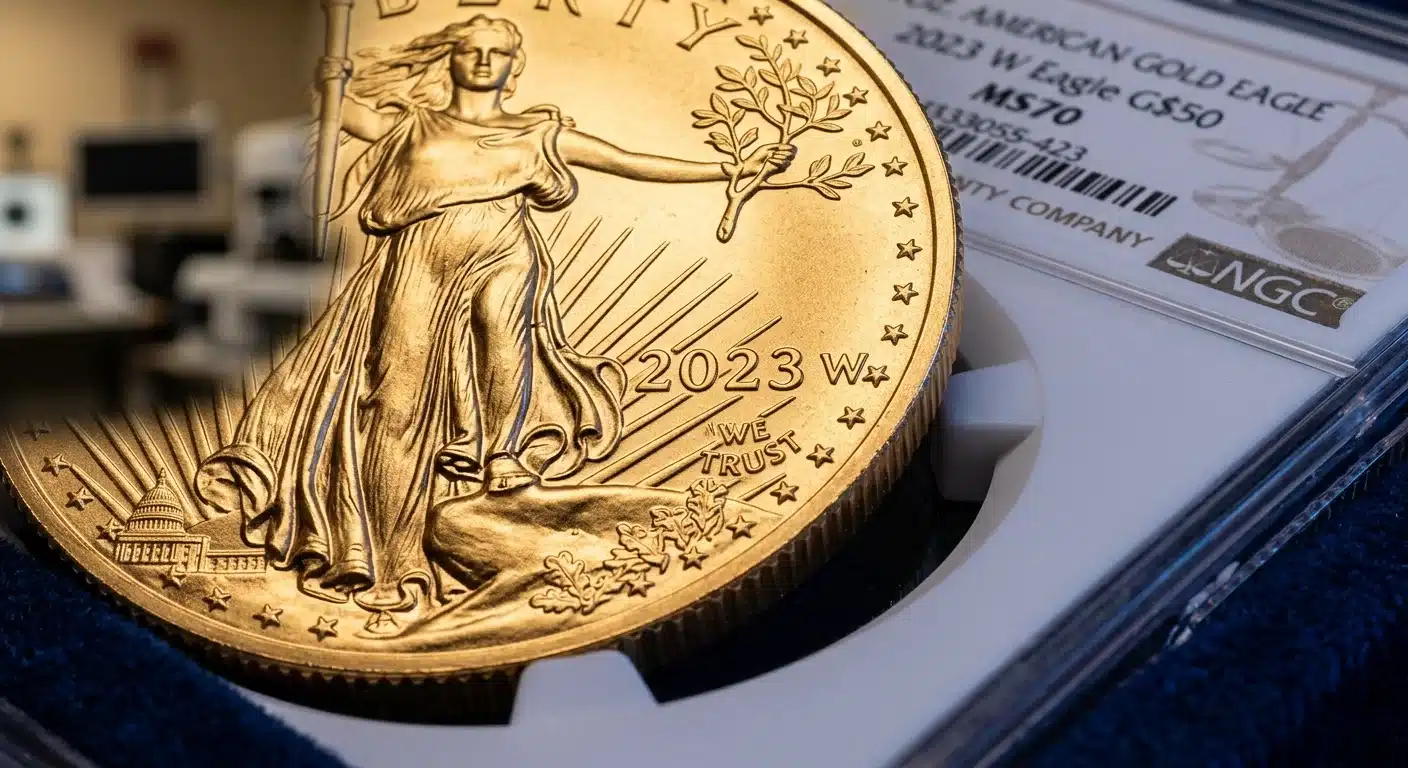
Reporting complexity is one friction point — authenticity is another.
Counterfeiting of popular foreign coins like the Krugerrand remains a persistent issue in the precious metals market. That’s not speculation — authentication experts see sophisticated fakes cycle through dealers and private sales every year. American Gold Eagles carry provenance that foreign alternatives can’t replicate. That provenance eliminates the authentication burden before it starts.
Government Guarantee
The United States Government guarantees that American Eagle Gold Bullion Coins contain the stated amount of actual gold weight in troy ounces. That guarantee is backed by the U.S. government’s guarantee — a legal commitment, not a marketing phrase. The one-ounce American Gold Eagle has a legal tender face value of $50. That reinforces its status as an official U.S. product with institutional backing that extends beyond the gold content itself.
Foreign governments issue similar guarantees for their own coins — but those guarantees are only as strong as the institutional trust the U.S. market places in them. A South African guarantee means less to an American dealer than a U.S. Mint guarantee. Not because the gold is different — because the provenance is.
When you hand a dealer an American Gold Eagle, they don’t question its authenticity. When you hand them a Krugerrand or a Sovereign, they might — and that hesitation shows up in the offer. The government guarantee built into U.S. coins removes that friction. No verification step. No doubt. No discounted offer to account for authentication risk.
Market Prevalence of Counterfeits
Counterfeiters target high-volume foreign coins because the authentication standards vary — and because the market for those coins includes buyers who don’t know what to look for. Krugerrands, Maple Leafs, and Sovereigns all face the risk of sophisticated counterfeits that can pass casual inspection. Some fakes are good enough to fool non-expert buyers. A few are good enough to fool dealers who don’t take the time to verify.
American Gold Eagles are counterfeited less — not because they’re impossible to fake, but because the U.S. Mint’s security features and the coin’s domestic familiarity make fakes easier to catch. Dealers who handle Eagles every day know the weight, the sound, the edge detail. They spot irregularities instantly. Foreign coins don’t carry that same level of daily familiarity in U.S. markets — and that gap is exactly what counterfeiters exploit.
The provenance question is simple: do you want to own something that dealers trust on sight — or something they need to verify before they’ll make an offer? U.S.-minted coins open the door smoothly. Foreign coins add resistance — and that resistance costs you time, confidence, and money every time you transact. For conservative Americans holding gold to preserve wealth and maintain control, eliminating that resistance isn’t a luxury. It’s the strategy.
| Coin | Government Backing | Counterfeit Prevalence | Authentication Complexity |
|---|---|---|---|
| American Gold Eagle | U.S. Government guarantee — legal tender status and purity backed by federal law | Low — sophisticated fakes are rare; security features and market familiarity make counterfeits easier to detect | Minimal — dealers recognize on sight; no verification step required in most transactions |
| South African Krugerrand | South African government guarantee — recognized internationally but carries less institutional weight in U.S. markets | Persistent issue — documented as a frequent counterfeit target due to high global volume and varying authentication standards | Moderate to high — dealers often require verification; authentication burden slows transactions and can reduce offers |
| Canadian Maple Leaf | Canadian government guarantee — widely respected but still subject to dealer verification in U.S. transactions | Moderate — counterfeits exist and can pass casual inspection; authentication expertise required | Moderate — verification adds friction; dealers less familiar with daily handling in U.S. markets |
What Simplicity Actually Buys You

Reporting, liquidity, provenance — these aren’t separate issues.
They’re all symptoms of the same root question: how much friction are you willing to accept?
Foreign-minted coins force you to deal with all three. Wider bid-ask spreads eat into your return. Dealer reporting thresholds create a paper trail you didn’t ask for. Authentication questions slow the transaction and discount the offer.
U.S.-minted coins eliminate every one of those variables — not because American Gold Eagles or Krugerrands or Sovereigns contain different gold, but because the U.S. market already knows how to handle American product. Dealers trust the U.S. Government’s guarantee on sight. No 1099-B. No verification. Zero friction.
Simplicity is the real asset.
When you hold American Gold Eagles instead of Krugerrands or Sovereigns, you’re not just holding gold. You’re holding the cleanest path to liquidity, the strongest provenance in U.S. markets, and the fewest institutional touch points.
That’s what simplicity buys you. Not convenience. Control.
The Cost of Explanation
Here’s what most articles won’t tell you: every time you transact with a foreign-minted coin, you’re explaining.
Explaining why you chose it. Explaining its purity. Explaining its provenance. Explaining why the dealer should pay you the same rate they’d pay for an American Eagle — even though their risk is higher and their resale timeline is longer.
That explanation costs you. Not just in time — in the offer itself.
U.S.-minted coins don’t require explanation.
The dealer sees an American Gold Eagle. They know its purity is guaranteed by the U.S. Government. They know it’s exempt from reporting. They know they can resell it tomorrow if they need to.
The transaction happens at the tightest possible spread — because there’s nothing to negotiate and nothing to verify. That’s the benefit of choosing Gold Coins vs. Gold Bars the right way from the start. Simplicity compounds every time you touch your holdings.
What No Reporting Burden Means Long-Term
The reporting exemption isn’t just about avoiding a Form 1099-B in the year you sell.
It’s about what that exemption preserves over the long haul. Privacy. Flexibility. And the ability to transact without creating institutional records that follow you indefinitely.
When you sell foreign coins above the threshold, you’re not just reporting that transaction. You’re building a profile in IRS systems — one that links your name to specific quantities, specific coin types, and specific transaction dates.
Every Form 1099-B filed adds another data point. Every data point narrows the gap between what the government knows about your holdings and what you’d prefer to keep private.
American Gold Eagles bypass that entirely. No threshold. No accumulation. No record filed by the dealer — regardless of how much you sell or how often you sell it.
That distinction matters most when you’re holding physical gold for the long term — not to flip it, but to preserve wealth across decades or pass it down to the next generation.
Conservative Americans who choose the process of acquiring physical precious metals aren’t speculating on price. They’re securing control. And control means minimizing the number of institutional touch points between you and your wealth.
American Gold Eagles deliver that. Foreign coins don’t.
Frequently Asked Questions
Most customers who ask about foreign-minted gold aren’t asking about purity or weight — they’re asking whether saving a few dollars upfront is worth the friction when they sell.
Here’s what that friction actually costs you.
What are the direct tax reporting differences when selling foreign vs. U.S. gold coins?
Sell Krugerrands or Maple Leafs, and dealers report the transaction to the IRS on Form 1099-B once sales exceed 25 one-ounce coins in a year. That’s not optional. It’s required.
American Gold Eagle coins are exempt from dealer reporting on Form 1099-B — no threshold, no tracking, no 1099-B filed.
You still owe capital gains tax on any profit. That obligation doesn’t change. But without a 1099-B on file, the IRS doesn’t have a record of your transaction to cross-check against your return.
For owners who hold physical gold to preserve privacy and control, that’s not a loophole. That’s the entire point.
Are foreign gold coins like Krugerrands or Maple Leafs less pure than American Gold Eagles?
No — and the purity gap most people cite isn’t the advantage they think it is.
American Gold Eagles are 22-karat gold, an alloy that includes small amounts of silver and copper to increase durability. Some foreign coins use 24-karat gold — which sounds better until you realize those coins scratch, dent, and wear more easily over time.
If you’re holding for decades, durability beats purity on paper. The Eagles deliver one troy ounce of pure gold content — same as a 24-karat coin — but they hold up better under handling and storage.
That’s not a compromise. That’s better engineering.
Why do some dealers offer a lower buyback price for foreign-minted gold?
Because liquidity in the U.S. market is driven by recognition — and foreign-minted coins don’t move as quickly.
When a dealer has to verify authenticity, assess condition, and find a smaller buyer pool, they price in that friction. The buyback spread reflects the real cost of reselling something that takes longer to move.
Counterfeiting of popular foreign coins like the Krugerrand remains a persistent issue — which means dealers spend more time and resources verifying what you’re selling. That verification cost gets passed to you in the form of a lower offer.
American Gold Eagles don’t require verification. Dealers trust them on sight. That trust translates directly into tighter spreads and faster transactions.
Is it significantly harder to sell a foreign gold coin in the United States?
Not impossible — but slower.
The buyer pool for foreign-minted gold in the United States is smaller. The transaction takes longer because dealers have to authenticate, price, and find a buyer comfortable with a non-U.S. product.
If you’re holding gold for control and peace of mind, the last thing you want is to discover — when you need liquidity — that your asset requires extra steps, extra verification, and extra time to convert back to cash.
U.S.-minted coins eliminate that delay. The buyer pool is deeper. The transaction is faster. The exit is cleaner.
Besides reporting requirements, what makes the American Gold Eagle a simpler choice for wealth preservation?
Simplicity compounds over time.
U.S.-minted coins are easier to authenticate. Easier to sell. Easier to store in IRA-approved depositories. Easier to pass down to family members who may not have your level of familiarity with precious metals.
Every layer of complexity you remove today is one less thing your heirs have to work through tomorrow. And that’s not a small consideration when the goal is legacy — not speculation.
The American Eagle is the simplest coin to own because it’s the simplest coin to sell. That simplicity protects you now and protects the people you leave it to later.
Are any foreign gold coins as widely recognized and accepted as U.S. coins in America?
Some are well-known — the Canadian Maple Leaf and the South African Krugerrand are probably the two most recognizable foreign coins in the U.S. market.
But recognition isn’t the same as preference. And preference drives liquidity.
Conservative wealth preservationists overwhelmingly choose U.S.-minted products when given the full picture. That preference creates the deepest, most reliable market for resale.
Recognition matters. But market depth matters more.
Where This Leaves You
The friction points are documented. The gaps are named. The decision comes down to one question: do you want the path that requires explanation — or the one that doesn’t?
Foreign-minted gold coins get you to ownership. But they force you into wider spreads, authentication questions, and dealer reporting thresholds every time you transact.
American Gold Eagles eliminate that friction entirely.
Tighter bid-ask spreads. No 1099-B reporting regardless of quantity. Provenance that dealers trust on sight.
That’s not a minor convenience. That’s the difference between holding gold that works with the U.S. financial system and holding gold that works against it.
Foreign coins are the key that opens the door — but it sticks, it grinds, and you’re never sure it’ll turn smoothly when you need it most.
U.S.-minted coins open the door to liquidity smoothly, reliably, and without resistance.
For conservative Americans holding physical gold to preserve wealth and maintain control, that simplicity is the entire point. This isn’t about patriotism. It’s not about rejecting foreign products on principle.
It’s about recognizing that the U.S. market — the market where you’ll buy, hold, and eventually sell — is built to handle U.S. coins with zero friction.
Every foreign alternative introduces variables you don’t need and costs you don’t benefit from. The question isn’t whether foreign coins contain real gold. The question is whether they deliver the liquidity, privacy, and simplicity you’re holding gold to secure in the first place.
Brighton Gold works with customers who want the clearest path to ownership — not the cheapest premium, not the widest selection, but the simplest strategy that maximizes liquidity and minimizes institutional tracking.
That path starts with U.S.-minted coins. When you’re ready to buy gold, that decision — U.S. or foreign — determines everything that follows.
If you’re still weighing your options — or if you’ve been holding foreign coins and wondering whether it’s worth making the switch — a complimentary consultation with Brighton Gold gives you a direct conversation about what fits your situation.
No pressure. No pitch. Just the clearest picture we can give you of what simplicity actually looks like when you’re holding something real — and how U.S.-minted coins open the door to liquidity smoothly, reliably, and without resistance.
If you’re ready to hold gold that doesn’t create friction when it’s time to sell — Brighton Gold offers a complimentary consultation to walk you through your options. Whether you’re acquiring U.S.-minted gold coins for the first time, rolling retirement savings into a No Fee Precious Metals IRA, or moving away from foreign holdings to American Eagles — the conversation is the same. No pressure. Just clarity.