

What to Expect During the Gold Purchasing and Delivery Process?
The gold purchasing and delivery process starts when you finalize your order and ends when the metal is in your hands — or confirmed in a vault you control. For reputable dealers, the entire process is typically completed in under two weeks. It includes order confirmation, product sourcing (the U.S. Mint does not sell bullion coins directly to the public), secure packaging, fully insured shipment via methods like USPS Registered Mail, and delivery confirmation. But here’s what most dealers won’t tell you: the window between signing and holding is a black box. What happens inside that window — who handles your order, how it’s tracked, when you’ll receive updates, what support you get — separates a transactional dealer from a concierge-level partner.
Most buyers don’t ask what happens between payment and delivery. They assume it’s standard. It isn’t. Some dealers go silent the moment payment clears. Others manufacture urgency to force immediate decisions, then vanish once the sale closes. The best experience is one where every step is explained before it happens. You know what’s being shipped. You know how it’s insured. You know when it will arrive. You know who to contact if something changes. That clarity — not speed, not pressure, not complexity — is what makes the process work.
For IRA purchases, there’s an additional layer. The metal must meet IRS eligibility requirements (minimum fineness of .995). You coordinate with your custodian. Delivery goes to an approved depository instead of your home. Whether you’re buying for delivery or for an IRA, the fundamentals stay the same. You’re not just acquiring an asset. You’re beginning a relationship with a dealer who will either support you through every stage of ownership — or disappear the moment the transaction clears.
- The Purchase Decision and Initial Consultation
- What Happens Before Your Order Ships
- How Your Gold Is Packaged and Shipped
- What Happens After Delivery
- Frequently Asked Questions
- How long does it typically take to receive physical gold after a purchase is finalized?
- Is the delivery of my gold fully insured against loss, damage, or theft?
- What are the typical shipping, handling, and insurance fees associated with gold delivery?
- How is physical gold packaged to ensure a secure and discreet delivery?
- Will I receive a tracking number to monitor my shipment?
- Do I need to be present to sign for the delivery of my precious metals?
- What should I do immediately upon receiving my gold shipment?
- What This Process Tells You About Your Dealer
The Purchase Decision and Initial Consultation

Before anything ships, the process of buying gold begins with clarity. A conversation that establishes what you’re acquiring, why, and what happens next.
Most dealers treat the initial consultation as a sales call.
Urgency framing. Price forecasts. Implied scarcity.
The Federal Trade Commission warns consumers about sellers who use high-pressure tactics to push them into immediate purchasing decisions. That approach attracts the wrong buyer. It sets the wrong expectation. A transaction driven by pressure doesn’t build the foundation for confident, long-term ownership.
A real consultation asks what you’re trying to protect. How you want to hold it. What support you’ll need after the purchase.
It explains the process before you commit — funding timelines, payment options, verification steps, delivery logistics. It doesn’t manufacture urgency. It doesn’t forecast prices. It doesn’t present complexity as credibility.
A true concierge experience starts here — with a clear picture of what happens between now and the moment you hold the metal.
Funding Your Purchase
So you’ve decided what to acquire. Now you fund it.
For cash purchases, funding is straightforward — wire transfer or check.
Wires clear same-day. Checks take longer, and dealers won’t ship until funds clear. That’s not a trust issue. It’s risk management.
For IRA purchases, funding involves your custodian.
You initiate a rollover or transfer from an existing retirement account. The custodian coordinates with the dealer to confirm available funds. Timelines vary — some custodians process requests in days, others take a week or more.
The dealer doesn’t control that window. But a good dealer stays in communication with both you and the custodian so you know where things stand.
Choosing Your Payment Method
Payment method affects speed, security, and how quickly your order moves into fulfillment.
Wire transfers are the fastest option. Funds clear same-day. The dealer can begin sourcing and packaging your order immediately.
Personal checks are accepted by some dealers, but they require a hold period — several business days — before the purchase is finalized. That delay isn’t arbitrary. It’s a safeguard against insufficient funds and fraud.
Credit cards and financing options exist in the market. But they’re rare for physical metals and come with higher fees.
Most serious buyers use wires or checks. The method you choose determines how quickly you move from purchase decision to shipment — and that matters when you’re ready to hold something real.
Verification and Processing Time
Once funding clears, the dealer verifies your order details, confirms product availability, and locks in your pricing.
Processing time varies by dealer and order size. For standard purchases of U.S.-minted coins, a reputable dealer can finalize verification and begin packaging within one to three business days. Larger orders or custom requests take longer.
The entire process — from order confirmation to delivery — is typically completed in under two weeks.
What separates a good dealer from a transactional one is communication during this window. You shouldn’t have to chase updates. You should receive them automatically — order confirmed, product sourced, shipment prepared, tracking issued.
That transparency is what turns the black box into a predictable, supported experience.
| Payment Method | Typical Settlement Time | Verification Requirement |
|---|---|---|
| Wire Transfer | Same-day clearance in most cases | Dealer confirms funds before sourcing product; immediate fulfillment begins once verified |
| Personal Check | Several business days hold period | Funds must fully clear before the purchase is finalized; dealer does not ship until check clears to guard against insufficient funds |
| IRA Rollover / Transfer | Varies by custodian — days to over a week | Custodian coordinates with dealer to confirm available funds; dealer and custodian communicate to track progress through each stage |
| Credit Card / Financing | Immediate authorization, higher processing fees | Rare for physical metals; used primarily for smaller purchases; fees often offset speed advantage |
What Happens Before Your Order Ships
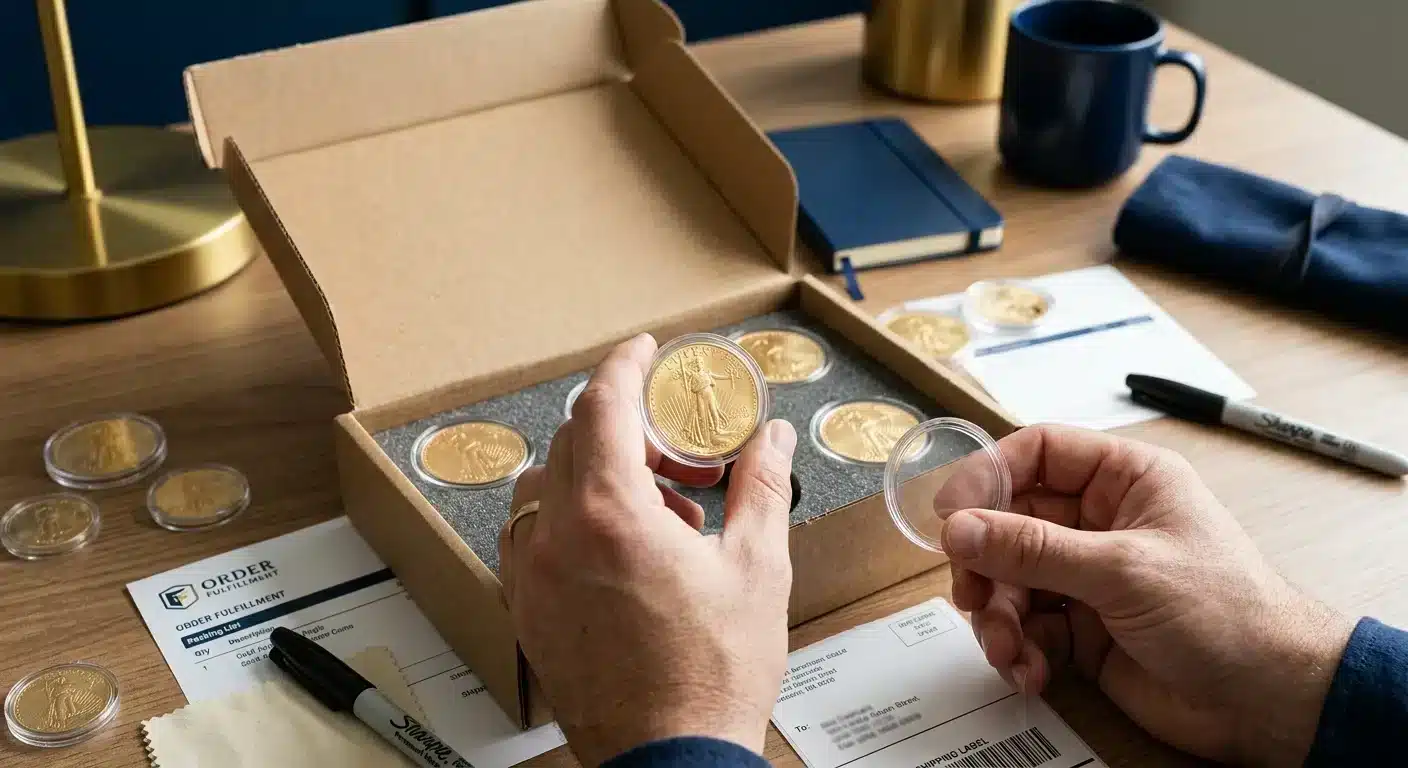
Here’s where the industry’s black box starts.
Most dealers treat the post-purchase window as a silence zone. You sign. You wait. You wonder.
That opacity isn’t an oversight. It’s a feature of the transactional model.
Between the moment you finalize your purchase and the moment your shipment leaves the facility, several steps happen. Most dealers don’t explain them.
Brighton Gold walks you through every one. Not because you need permission — because you deserve to know what’s happening with what you own.
Packaging Standards for Precious Metals
Your gold doesn’t ship in a cardboard box with bubble wrap.
Packaging for high-value precious metals follows a strict protocol. Tamper-evident seals. Unmarked exterior. Reinforced inner containers designed to prevent damage or unauthorized access.
The goal isn’t to make the package look expensive.
It’s to make it invisible.
Nothing on the outside identifies the contents. Nothing signals value.
That’s not paranoia. That’s protocol.
Carrier Selection and Insurance Coverage
Not all carriers handle precious metals the same way.
Shipments containing high-value precious metals are fully insured and sent via secure methods like USPS Registered Mail or specialized carriers. These services require signature confirmation, chain-of-custody documentation, and direct delivery to the recipient.
No porch drops. No substitutions. No workarounds.
Insurance isn’t optional. It’s embedded.
Your metals are protected from the moment they leave the facility until the moment you sign.
If a dealer won’t tell you which carrier they’re using or what the insurance limits are, you’re working with someone who treats delivery as your problem.
That’s a red flag. The CFTC warnings on precious metals fraud exist because too many customers ignored them.
Tracking Your Shipment
The moment your shipment leaves the facility, you get a tracking number.
Not a vague ‘it’s on the way’ email. A specific tracking number tied to a secure carrier with real-time updates.
That visibility isn’t a courtesy. It’s a baseline.
You should know where your gold is, when it’s scheduled to arrive, and what happens if delivery fails. If you don’t have that information, you’re working with a dealer who sees you as a transaction — not an owner.
| Shipping Method | Typical Transit Time | Insurance Coverage | Signature Required |
|---|---|---|---|
| USPS Registered Mail | Slower than standard mail — logged at every touchpoint for security | Full declared value of shipment | Yes — every delivery |
| Private Specialized Carriers | Faster than Registered Mail — premium tracking and handling | Full declared value of shipment | Yes — every delivery |
| Standard Priority Mail (NOT recommended for precious metals) | Fast but minimal chain-of-custody documentation | Limited coverage — rarely matches full value | Depends on sender selection |
| Uninsured Shipping (red flag — avoid dealers who offer this) | Speed irrelevant — exposes buyer to total loss risk | None | No guarantee |
How Your Gold Is Packaged and Shipped

Packaging and carrier selection aren’t cosmetic.
They’re security decisions.
You’ve read about discreet packaging and insured carriers. Now here’s what happens when the shipment arrives.
Delivery day is the moment the black box opens.
Everything you were told about security, insurance, and chain of custody gets tested in the thirty seconds between the carrier handing you the package and you walking it inside.
Most customers assume the hard part is over once tracking shows “out for delivery.”
It isn’t.
The final handoff — signature, inspection, documentation — is where you protect yourself. And it’s where a concierge dealer proves they didn’t just process a transaction and disappear.
Delivery Day: What You Need to Know
You won’t receive your precious metals shipment without being home.
Signature confirmation is mandatory for high-value deliveries — no exceptions. The carrier won’t leave the package on your porch. They won’t hand it to a neighbor.
They’ll attempt delivery, and if you’re not there to sign, they’ll take it back to the facility and schedule a redelivery or hold it for pickup.
That requirement isn’t an inconvenience. It’s a security feature.
You want someone accountable at every handoff. The moment you sign, the shipment transfers from the carrier’s liability to yours.
That signature is your acknowledgment that you received a package — not that its contents are correct or undamaged, just that you took possession. Verification comes next.
If you miss the delivery, don’t panic.
Contact the carrier immediately. Reschedule or arrange for pickup at the distribution center. Don’t let the package sit in limbo for days.
A good dealer monitors delivery status and reaches out if they see a failed attempt. You shouldn’t have to chase that information yourself.
Signature Requirements
When the carrier asks for your signature, you’re confirming receipt of a package — nothing more.
You’re not confirming the contents are accurate, undamaged, or complete. That’s why you inspect immediately, before the carrier leaves.
Some customers think signing means they’ve accepted everything and waived the right to dispute.
That’s not how it works.
The signature establishes chain of custody. The inspection — documented within minutes of delivery — establishes condition. If something’s wrong, you need proof it was wrong when it arrived, not hours later after you’ve moved the package three times and opened it in the kitchen.
The timeline matters.
Inspecting Your Delivery Immediately
Here’s what you do the moment the package is in your hands.
Before you sign, look at the outer packaging. Check for tears, punctures, water damage, or signs the box was opened and resealed. Look for the tamper-evident seals or holographic tape the dealer applied.
If anything looks compromised, document it immediately — photos, notes, timestamp. Then note the damage on the delivery receipt before you sign.
Once you’ve signed and the carrier leaves, open the package in a secure location.
Verify the contents match your order confirmation exactly. For coins like the Gold American Eagle — which contains one troy ounce of gold and is minted in 22-karat gold alloy — check the quantity, denomination, and packaging.
If your order included IRA-approved U.S.-minted coins, confirm the specifications match what was promised. If anything’s missing, damaged, or incorrect, contact your dealer immediately. Don’t wait. Don’t assume it’ll resolve itself.
A reputable dealer stands behind every shipment.
They’ll walk you through next steps if there’s a discrepancy — refund, replacement, or insurance claim. But they can’t help you if you don’t document the issue at delivery.
That thirty-second window when you inspect the package isn’t paranoia. It’s the moment you confirm that everything you were told about security, insurance, and transparency wasn’t just marketing. It was the process — delivered.
| Delivery Checkpoint | What to Verify | Why It Matters |
|---|---|---|
| Outer packaging condition | Check for tears, punctures, water damage, or signs of resealing before signing | Establishes whether the package was compromised during transit — documentation at this stage protects your claim if contents are damaged |
| Tamper-evident seals | Confirm holographic tape or serialized seals are intact and unbroken | Broken seals indicate potential tampering — you document this before opening to preserve chain of custody |
| Signature and delivery receipt | Note any visible damage on the carrier’s delivery receipt before signing | Your signature confirms receipt of a package — not acceptance of its contents — but damage noted at signing strengthens your position if a dispute arises |
| Contents verification immediately after opening | Match the quantity, product specifications, and condition against your order confirmation | Discrepancies reported within minutes of delivery carry far more weight than claims made hours or days later — timeline proves the issue existed at handoff |
What Happens After Delivery

Most dealers treat delivery as the finish line.
The box arrives. The transaction closes. You’re on your own.
That’s the black box again — the gap between holding something real and understanding what happens next.
Brighton Gold doesn’t treat delivery as the end. Ownership doesn’t end when you open the package. It begins there. And what comes next — verification, storage decisions, ongoing support — is where the relationship proves itself.
Verifying Your Purchase
Open the package and confirm what you received matches what you ordered.
Every shipment includes documentation — packing slip, certificate of authenticity if applicable, detailed invoice. You’ll need those for resale, insurance, and your own peace of mind.
For IRA-eligible products, the specs aren’t suggestions.
Gold American Eagles contain one troy ounce of gold and are minted in 22-karat alloy. Bullion intended for an IRA must meet a minimum fineness of 99.5% — a standard defined by the IRS, not the dealer. You’re not checking because you don’t trust the dealer. You’re checking because it’s your retirement account.
If something doesn’t match your order, contact your dealer immediately.
Brighton Gold provides a cancellation window and clear return terms for unused merchandise. That transparency isn’t standard. Most competitors avoid spelling out return policies until you’ve already got a problem.
Secure Storage Considerations
Now comes the question most people don’t ask until the gold is sitting on their kitchen table: where does it go?
Home storage is one option. A home safe, properly rated and discreetly installed, works for customers comfortable with the responsibility. But that comfort isn’t universal.
If you’re holding significant value, live in a high-risk area, or don’t want the liability, secure vaulted storage is worth considering.
Vaulted storage separates physical possession from legal ownership — you still own the metal, it’s just held in a professional facility with full insurance and audit trails.
The decision isn’t binary.
Some customers keep a portion at home and vault the rest. The point is that you make the storage decision with guidance, not guesswork.
Ongoing Support and Documentation
Here’s what separates a transactional relationship from a concierge one: what happens six months after delivery.
You’ll have questions. The market moves. Your financial situation changes. You need to understand how to sell your physical gold when you need liquidity. That’s not a one-time conversation.
Brighton Gold provides ongoing support — not because it generates another sale, but because informed owners make better decisions and stay in the relationship longer.
Keep your purchase documentation organized. Retain certificates, receipts, and any third-party authentication paperwork. If you’re holding for an IRA, make sure you understand the IRS requirements for IRA-eligible gold. The rules don’t change, but how they apply to your specific situation can.
And if you’re ever uncertain about next steps, the FTC consumer advice on precious metals is a solid reference for understanding your rights and spotting red flags.
The best dealers don’t hide behind complexity. They help you see through it.
| Storage Option | Security Level | Accessibility | Typical Cost Structure |
|---|---|---|---|
| Home Safe (Fireproof, Bolted) | Moderate — protects against fire and casual theft but vulnerable to targeted break-ins | Immediate — access any time without third-party approval | One-time purchase of safe plus potential insurance rider |
| Bank Safe-Deposit Box | High — bank vault security with restricted access protocols | Limited — access only during bank hours; no weekend or holiday retrieval | Annual rental fee; contents typically not insured by bank |
| IRA Custodial Storage (Required for IRA-Held Metals) | Highest — IRS-compliant depository with segregated or allocated storage | Restricted — no personal possession until distribution; custodian manages access | Annual custodian and storage fees; varies by custodian and account size |
Frequently Asked Questions
The questions customers ask most often? They’re the gaps other dealers never fill.
The space between signing and holding — that’s where clarity matters.
Here’s what you need to know before the call.
How long does it typically take to receive physical gold after a purchase is finalized?
Under two weeks, typically. That window covers order confirmation, processing, secure packaging, and shipment. The clock starts when your transaction is finalized — not when you first call. Most customers receive their metals sooner than they expect.
Is the delivery of my gold fully insured against loss, damage, or theft?
Yes. Shipments containing high-value precious metals are fully insured. They’re sent via secure methods — USPS Registered Mail or specialized carriers. You’re covered from the moment it leaves the vault. If something happens in transit, the loss isn’t yours.
What are the typical shipping, handling, and insurance fees associated with gold delivery?
Reputable dealers build those costs into transparent pricing. You won’t see surprise fees at checkout. Shipping, handling, and insurance are disclosed upfront — before you commit. If a dealer waits until after you’ve signed, that’s a red flag.
How is physical gold packaged to ensure a secure and discreet delivery?
Discreetly. The outer packaging doesn’t advertise what’s inside. No logos. No labels that signal precious metals. Inside, your coins or bars are sealed in protective materials — often individual capsules or sleeves. The goal is security and anonymity from door to storage.
Will I receive a tracking number to monitor my shipment?
Yes. Once your shipment is dispatched, you’ll receive tracking information. You’ll know when it leaves, where it is, and when it’s expected. No guessing. No calling back. The information comes to you.
Do I need to be present to sign for the delivery of my precious metals?
In most cases, yes. High-value shipments require an adult signature. That’s a security measure, not friction. If you can’t be present, you can arrange delivery to a secure location or authorize someone you trust. The carrier won’t leave precious metals on a doorstep.
What should I do immediately upon receiving my gold shipment?
Inspect the package immediately. Check the seals and outer condition before you sign. Once inside, verify the contents against your order confirmation. Count. Weigh if you can. Photograph everything. If anything’s wrong — damaged packaging, missing items, incorrect product — document it and contact the dealer right away. That first inspection is your safeguard.
What This Process Tells You About Your Dealer
How a dealer handles purchase and delivery tells you everything about whether they want your business once or your trust long-term.
The timeline matters — under two weeks with a reputable dealer — but only if you understand it before you commit. Did you get tracking without asking? Is packaging discreet and secure? Is insurance automatic, not optional?
Does your first question after delivery get treated like an interruption or part of the relationship?
The Federal Trade Commission warns about sellers using high-pressure tactics to force immediate decisions. Those dealers aren’t interested in clarity. They’re interested in closing.
The black box we described earlier — the gap between signing and holding — doesn’t exist because dealers don’t know what’s happening.
It exists because they benefit from your uncertainty.
A customer who doesn’t know when metals ship, how they’re packaged, or what happens if something goes wrong won’t ask hard questions. A customer who accepts vague answers will tolerate a transactional relationship.
And transactional relationships cost less to operate than concierge ones.
But they don’t serve you. They serve margin.
Brighton Gold starts with the assumption that you deserve to know exactly what’s happening at every step.
Not because we’re required to tell you. Because confident ownership requires it.
You should know when your order enters processing, when the metals are pulled and verified, when they ship, and what carrier handles delivery. You should know what packaging to expect, what insurance covers, and what to do if anything looks wrong when the box arrives.
You should receive documentation that supports the entire lifecycle of ownership — purchase records, specifications, cost basis tracking, and guidance on storage and eventual resale.
That’s not customer service. That’s the foundation of a relationship built to last beyond the delivery signature.
The decision to Buy Gold isn’t just about the metal. It’s about the process that delivers it.
From order confirmation to the moment you open the package, the process is the proof.
If a dealer makes it predictable, you’re working with someone who values clarity over control. If they make it opaque, you’re working with someone who benefits from confusion.
And if they disappear the moment you sign for the package, you weren’t building a relationship.
You were completing a transaction.
You just walked through what happens when the process is done right. If you’re still unclear on timing, insurance, or what the first 48 hours of ownership actually look like — that’s exactly what Brighton Gold’s complimentary consultation covers. We walk you through your options, including how the No Fee Precious Metals IRA works and whether you qualify. No pressure. No urgency. Just the conversation that turns questions into confident decisions.