
How Do I Test the Authenticity of Physical Gold at Home?
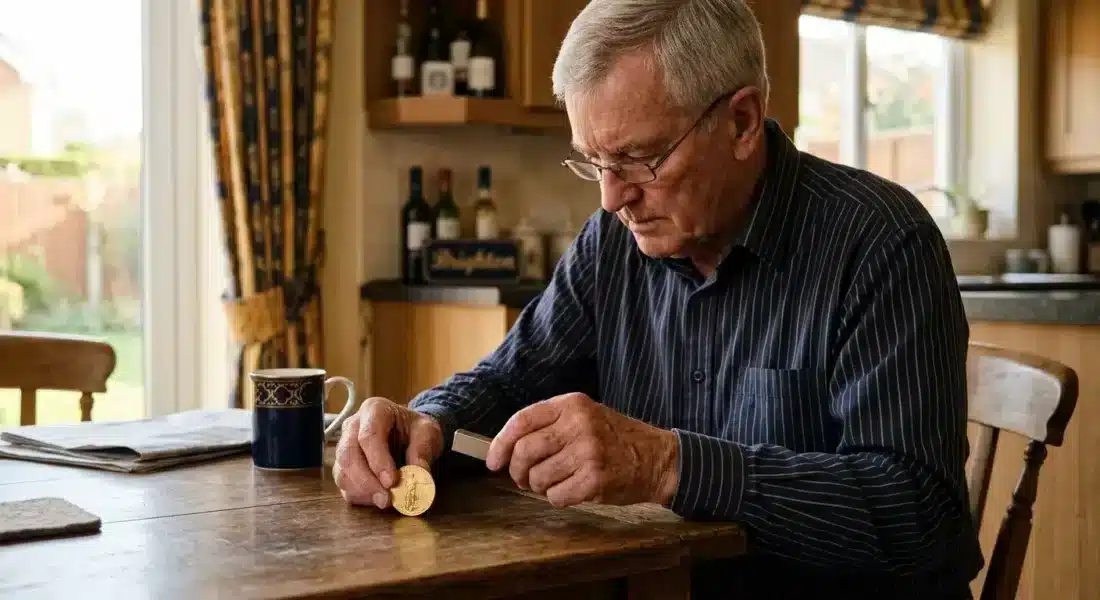
You can verify physical gold at home with simple, non-destructive tests — no lab required. The magnet test is the fastest. Real gold won’t stick to a magnet because gold is a diamagnetic metal. The density test is the most dependable. Pure gold has a density of 19.3 g/cm³. You weigh the piece. You measure water displacement. You calculate. Visual inspection works when you know the specs. A one-ounce American Gold Eagle measures exactly 32.70 mm in diameter and 2.87 mm in thickness. Weight verification closes the loop. Products match published specs down to the fraction of an ounce.
These methods work because gold’s physical properties are documented and hard to replicate. 24 karat gold is 99.9% pure. Bars meet the London Good Delivery Standard — a minimum fineness of 995.0 parts per thousand. But sophisticated counterfeits exist. Tungsten cores are the favorite trick. Tungsten’s density is 19.25 g/cm³ — nearly identical to gold’s. A tungsten-filled bar can pass basic tests if the faker knows what they’re doing.
That’s why at-home testing should be confirmation, not investigation.
If you’re buying U.S.-minted products from a transparent dealer, these tests give you peace of mind — not a reason to panic. The real verification happened before you took delivery. It happened when you chose a partner whose process is built on clarity and whose reputation is backed by accreditation, not urgency.
- Why Testing Your Gold Matters
- Non-Destructive Tests You Can Perform at Home
- Tests to Avoid at Home
- What to Do If You Suspect Your Gold Is Fake
- Frequently Asked Questions
- What is the most reliable non-destructive test for gold at home?
- Can common household magnets be used to test gold authenticity?
- Are gold testing acid kits safe for beginners to use at home?
- What should I do immediately if I suspect my gold coin is fake?
- Why shouldn’t I ever use the bite test on my gold coins or bars?
- Where Peace of Mind Really Starts
Why Testing Your Gold Matters
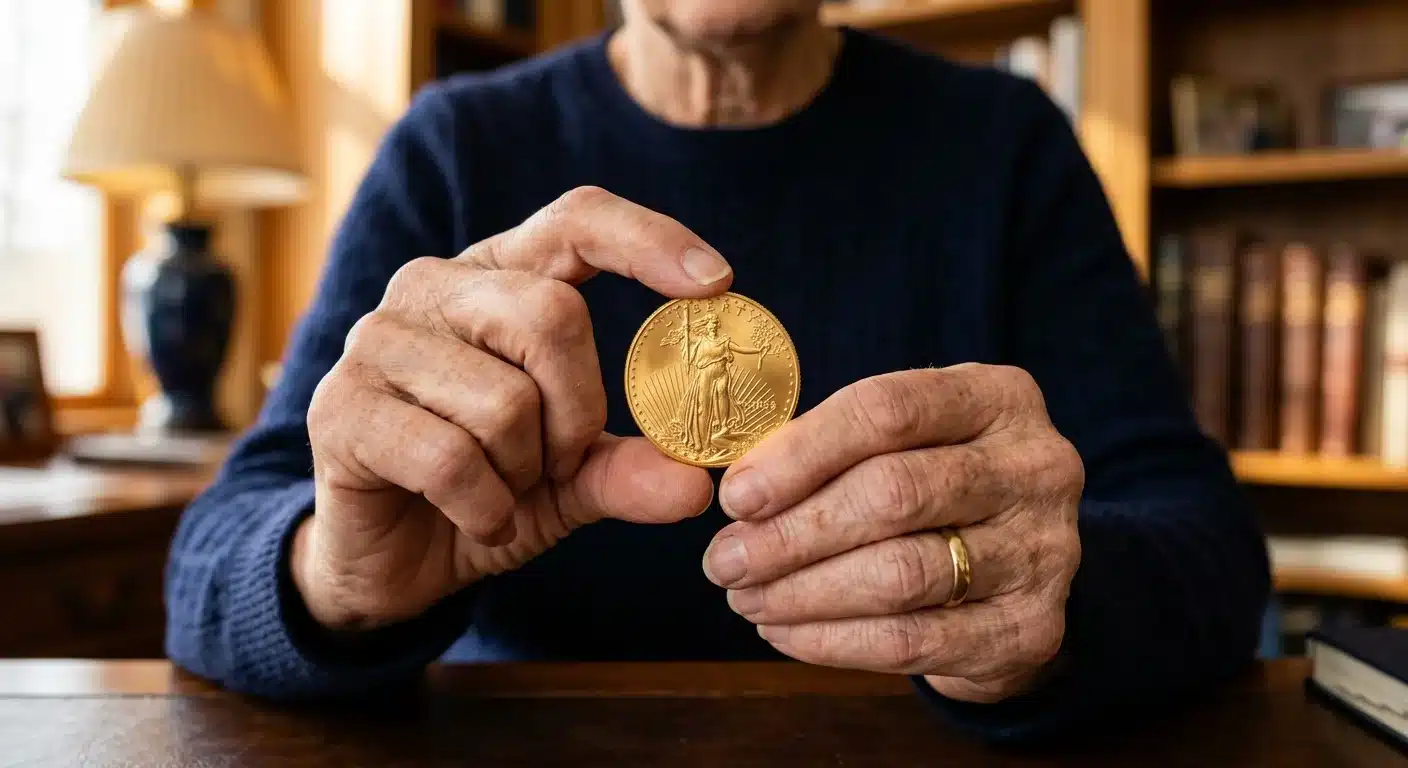
Most customers who ask about testing aren’t worried about the gold they bought from a reputable dealer.
They’re worried about the coin they inherited. The bar they bought from a private seller. The gift someone handed them with no paperwork.
That’s when verification stops being optional.
The counterfeit market is real — and it’s gotten smarter.
Simple gold-plated lead bars? Easy to catch. Tungsten-core fakes with gold plating? Not even close. Tungsten clocks in at 19.25 g/cm³ — nearly identical to pure gold. A well-made counterfeit can pass basic weight and size checks without raising a flag.
Testing matters. Not because you should doubt every piece you own — but because knowing how to verify authenticity gives you confidence when the source isn’t certain. It turns uncertainty into clarity.
The Role of Counterfeit Gold
Counterfeit gold comes in two flavors: crude and sophisticated.
Crude fakes are gold-plated base metals — lead, copper, brass. A magnet test or a visual inspection of wear on the plating will catch most of them.
Sophisticated fakes use tungsten cores. Tungsten’s density — 19.25 g/cm³ — matches gold’s so closely that basic density tests won’t reveal the fraud.
These sophisticated counterfeits show up in common scams in the physical gold market — private sales, estate liquidations, even some smaller dealers.
The fakes are almost always bars, not coins. Replicating the fine detail and edge reeding of a U.S.-minted coin is far harder than casting a generic bar with convincing weight and dimensions.
The best defense isn’t becoming an expert in counterfeit detection.
It’s knowing that 24 karat gold is 99.9% pure — and that legitimate products carry verifiable hallmarks, serial numbers, and assay certificates from recognized mints and refiners.
When you start with a trusted source, counterfeits shrink from a constant threat to a distant edge case.
When Testing Becomes Necessary
Testing becomes necessary when the provenance of your gold is unclear.
Inherited pieces. Private sales. Gifts. Purchases from unfamiliar dealers.
If you can’t trace the chain of custody back to a recognized mint or accredited dealer, verification isn’t paranoia. It’s due diligence.
Testing also makes sense if you’re planning to resell — especially to a dealer or refiner who will conduct their own assay.
Running your own tests first tells you whether what you’re holding will pass professional scrutiny. And whether the resale value you’re expecting is realistic.
That clarity protects you from disappointment and from sellers who might try to lowball a legitimate piece by exploiting your uncertainty.
Non-Destructive Tests You Can Perform at Home
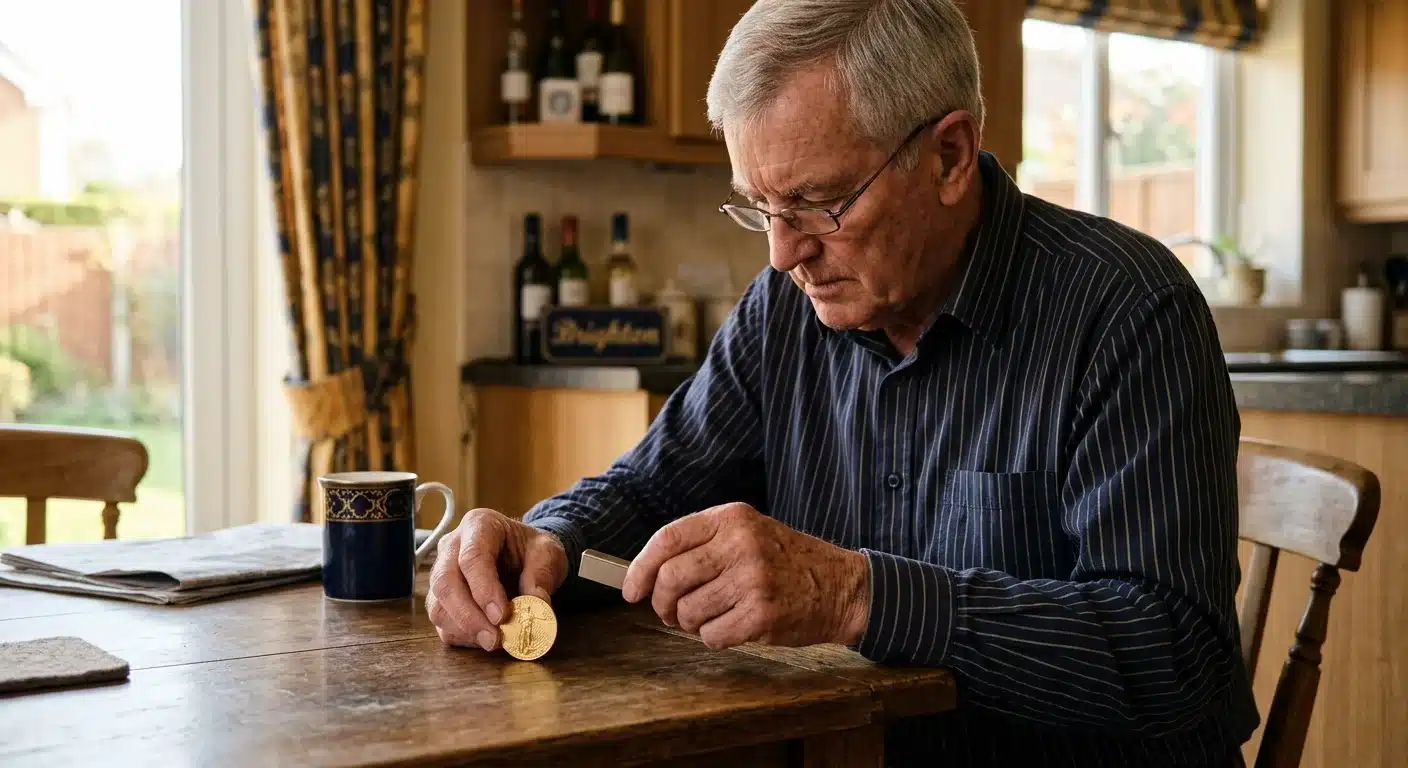
These methods don’t scratch your gold. They don’t require acid. They don’t alter the surface.
They’re built on the physical properties of gold — measurable, well-documented characteristics that counterfeiters can’t replicate perfectly.
Every test has limits. None is foolproof on its own. But when you run three or four and they all line up, you’ve moved from uncertainty to confidence. And if you started with a reputable source, these tests aren’t interrogation — they’re confirmation.
The Magnet Test
Gold isn’t magnetic. It’s a diamagnetic metal — technically repelled by a magnetic field, though the repulsion is too slight to notice without lab equipment.
What matters is simpler: if a strong magnet attracts your gold, it isn’t gold.
Run a strong neodymium magnet along the surface. Real gold won’t stick. It won’t pull toward the magnet. It won’t react at all.
If the piece jumps toward the magnet or clings to it, you’re holding a base metal — iron, nickel, or a ferromagnetic alloy underneath a thin gold plating.
The magnet test is fast. It requires no calculation. It works on any piece regardless of size.
It’s also the easiest test to pass for a sophisticated fake — tungsten and lead aren’t magnetic either. That’s why the magnet test is a good starting point, but never the only test you run.
The Density Test
Pure gold has a density of 19.3 grams per cubic centimeter. That’s one of the highest densities of any metal — and a physical constant counterfeiters can’t easily match.
The density test measures weight and volume, then calculates whether the ratio lines up with what pure gold should be.
Here’s how it works. Weigh your gold piece on a precise digital scale. Measure its volume by submerging it in water and recording the displacement — the difference in water level before and after.
Divide the weight in grams by the volume in cubic centimeters. If the result is close to 19.3 g/cm³, you’re holding real gold.
The challenge is precision. A few drops of water. A scale off by a tenth of a gram. Small errors throw the calculation off.
And if your gold is an alloy rather than pure 24 karat, the density drops by design. That makes interpretation harder without a reference chart.
That said, the density test is one of the most reliable non-destructive methods available. It doesn’t require specialized equipment beyond a scale and a graduated cylinder. And it reveals counterfeits made from metals with significantly different densities.
If your result is far from the expected range, you’ve learned something without damaging the piece.
The Size and Weight Verification
Every U.S.-minted gold product has published specifications for weight, diameter, and thickness. A one-ounce American Gold Eagle coin should measure 32.70 mm in diameter and 2.87 mm in thickness.
Those dimensions aren’t approximate — they’re exact, enforced by the U.S. Mint.
Measure your coin or bar with a digital caliper and a precision scale. Compare the results to the official weight and diameter specifications for that product.
If the measurements match within a tiny tolerance, that’s strong evidence of authenticity. If they’re off by more than a fraction of a millimeter or a fraction of a gram, you’re holding something that wasn’t minted to the correct standard.
This test works best on coins — tighter tolerances, more detailed specifications than generic bars. It’s also a test counterfeiters often get wrong.
Either they’re working from poor measurements, or they’re trying to match weight and size simultaneously while using a core metal that doesn’t have the same density as gold. Small discrepancies add up.
The Ping Test
Gold has a distinct acoustic signature. Strike a gold coin gently — with another coin, a pen, even your fingernail — and it produces a high-pitched, clear ringing sound that sustains for a second or two before fading.
The tone is pure. Almost bell-like. Base metals produce a dull thud or a short, flat sound that dies immediately.
The ping test isn’t precise. It doesn’t give you a number or a measurement — just a sound. And unless you’ve heard the sound of real gold before, you won’t have a reference point to judge against.
That makes it less useful as a standalone test and more useful as a quick confirmation when combined with the magnet test or the density test.
Still, it’s worth doing. Five seconds. No tools. Completely non-destructive. If the sound is wrong — if it thuds instead of rings — you’ve identified a problem without waiting for lab results or risking damage to the piece.
| Test Method | What It Checks | Equipment Needed | Reliability |
|---|---|---|---|
| Magnet Test | Whether the metal is ferromagnetic (iron, nickel, steel) | Strong neodymium magnet | Good for eliminating crude fakes; useless against tungsten or lead cores |
| Density (Water Displacement) Test | Whether the weight-to-volume ratio matches pure gold | Digital scale, graduated cylinder or measuring cup, water | High reliability if measurements are precise; reveals most non-gold cores |
| Size and Weight Verification | Whether dimensions and weight match published mint specifications | Digital caliper, precision scale, official mint spec sheet | Very high for coins; counterfeiters often miss tolerances by fractions of a millimeter |
| Ping (Acoustic) Test | Whether the sound signature matches the pure tone of real gold | None — strike gently with another coin or pen | Low as a standalone test; useful as quick confirmation alongside other methods |
| Coin Type | Diameter (mm) | Thickness (mm) | Weight (troy oz) |
|---|
Tests to Avoid at Home
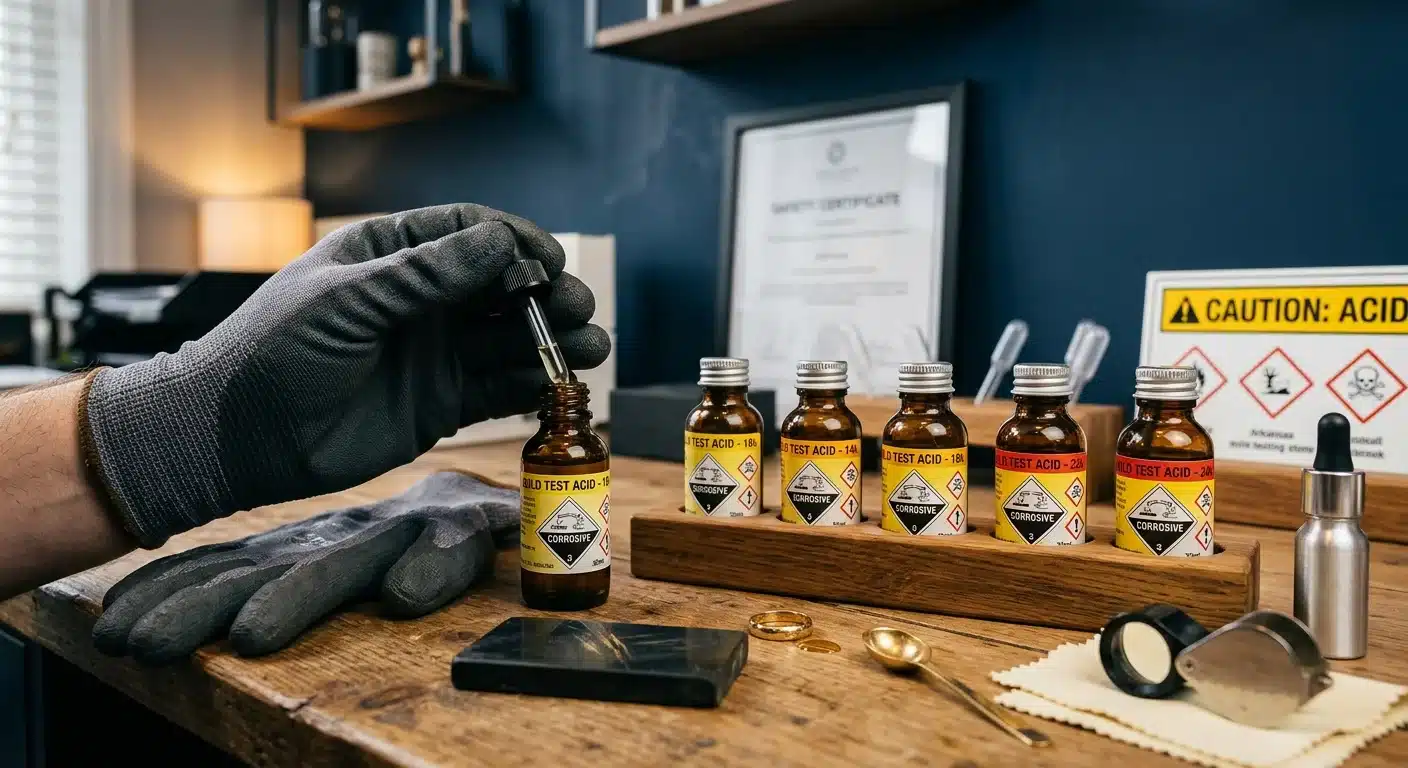
Not every test you’ll find online is worth doing. Some are based on myths. Others sound scientific but require training you don’t have — and when done wrong, they wreck your gold or hand you false confidence.
The tests below are unreliable, risky, or destructive. Skip them.
The Bite Test
You’ve seen it in movies. Someone bites down on a gold coin to check if it’s real. The idea is that gold is soft enough to leave a tooth mark, while harder metals won’t dent. It’s folklore.
Here’s the problem: lead is softer than gold. So are some brass and copper alloys. If you bite down on a gold-plated lead coin, you’ll leave a mark — and you’ll think it’s real. The bite test doesn’t distinguish between gold and other soft metals.
It also risks chipping a tooth. 24 karat gold is 99.9% pure, but most modern coins are alloyed with copper or silver to improve durability. That makes them harder to bite. The bite test isn’t just unreliable — it’s unnecessary and a waste of time when better methods exist.
Acid Tests Without Training
Acid testing is a legitimate professional method. Jewelers and refiners use it to verify gold content. A small drop of nitric acid or aqua regia is applied to a scratch on the surface. The reaction — or lack of one — reveals purity.
But it’s destructive. You have to scratch the surface to expose fresh metal. The acid leaves a permanent mark or discoloration. If you’re testing a collectible coin, that scratch reduces its resale value. Apply too much acid or leave it on too long, and you’ve damaged the piece beyond the test area.
Acid testing also requires experience to read the results. Different karats produce different reactions. If you’re not trained to interpret the color change or timing, you’ll misread what you’re seeing. The kits are cheap and easy to buy — that doesn’t mean they’re safe or practical for someone testing gold at home for the first time. Leave acid testing to professionals who understand the chemistry and can absorb the risk of a false read or a damaged piece.
What to Do If You Suspect Your Gold Is Fake
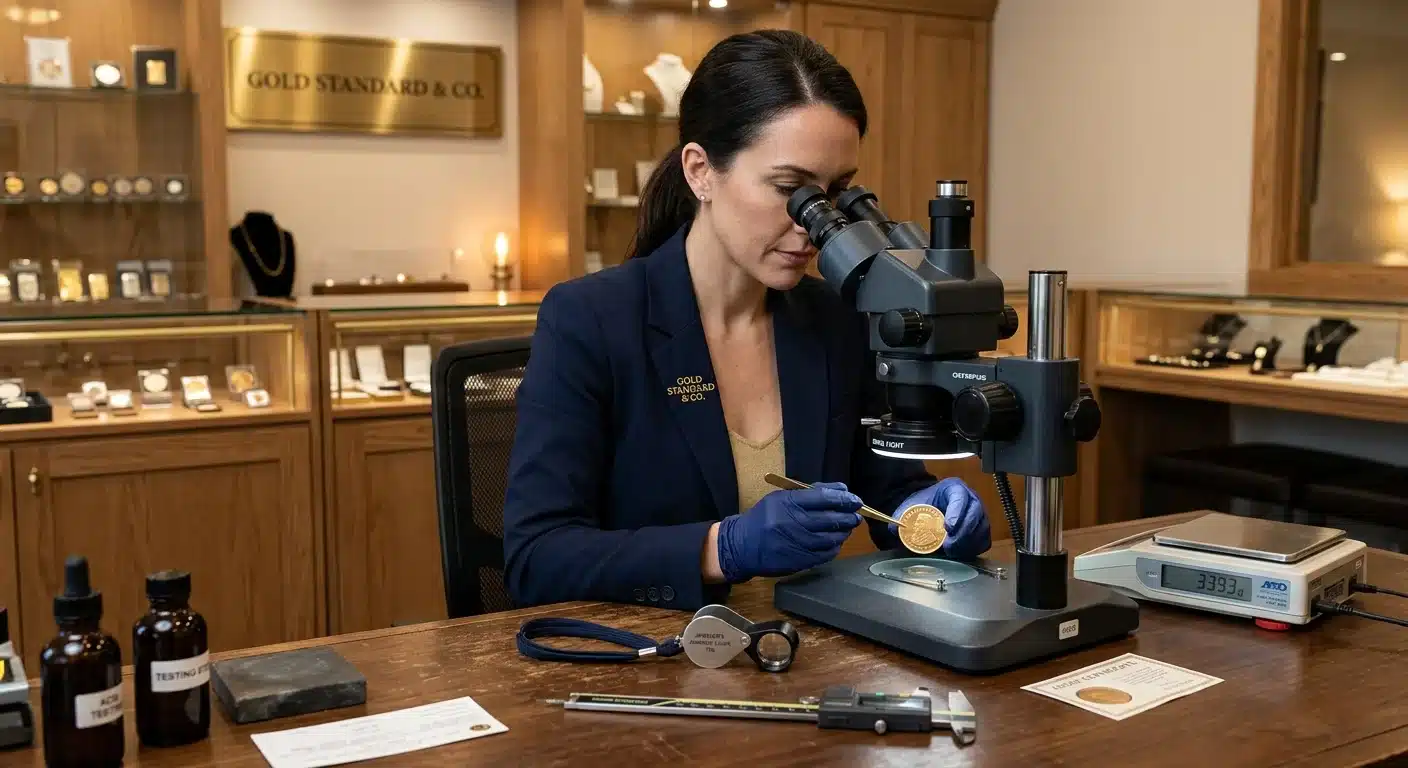
Your magnet pulls the coin. The density’s off. The dimensions don’t match. You’ve hit a decision point.
Don’t panic. Don’t ignore it, either.
The next step isn’t more testing at home until you convince yourself it’s real. The next step is professional verification — and if the piece turns out to be counterfeit, documentation and reporting. Here’s how that process works. And what it protects you from beyond the immediate loss.
Professional Verification Options
A professional assay or X-ray fluorescence (XRF) scan gives you a definitive answer. Assayers test gold using methods far more precise than anything you can do at home — fire assay detects gold content down to parts per thousand. XRF scanners analyze the metal’s elemental composition without damaging the surface.
Both are non-destructive when performed correctly. Both produce results you can trust.
Most coin shops, refiners, and established bullion dealers offer testing services for a small fee or at no cost if you’re a customer. Bring the piece in. Explain your concern. Ask them to run a verification test.
If the piece is legitimate, you’ve paid for peace of mind and learned something about the testing process. If it’s fake, you’ve confirmed it before you tried to sell it — or worse, bought more from the same source.
One caution: choose the verifier carefully.
If you’re testing gold you bought from a dealer, don’t bring it back to that same dealer for verification. That’s a conflict of interest. Find an independent third party with no stake in the outcome — a local refiner, a jeweler who works with the London Bullion Market Association (LBMA), or a bullion dealer you didn’t purchase from.
Independence is the point. You’re looking for an honest read, not reassurance.
Reporting and Documentation
Professional testing confirms the gold is counterfeit. Document everything.
Take photos of the piece from multiple angles — front, back, edge detail, any markings or stamps. Write down where you bought it, when, how much you paid, and what the seller told you about its authenticity. Keep copies of any receipts, certificates, or correspondence.
That documentation becomes your evidence if you need to file a complaint, pursue a refund, or report the seller to authorities.
Report the counterfeit to the U.S. Secret Service if the fake involves U.S. currency or U.S.-minted coins — they investigate counterfeiting as a federal crime. If you bought online, report the seller to the platform and to the Federal Trade Commission. If you bought from a local shop, report them to your state attorney general’s consumer protection division and to the Better Business Bureau.
These reports create a paper trail that protects the next person. And increase the chance the seller faces consequences.
Reporting isn’t just about getting your money back.
It’s about stopping the seller from doing this to someone else. Every complaint filed, every case documented, every fraudulent seller flagged — that’s one less source of counterfeit gold circulating in the market.
It’s the same reason you buy gold from a trusted source in the first place. The entire ecosystem depends on accountability. And that accountability starts with customers who refuse to stay quiet when they’ve been misled.
| Verification Method | Cost Range | Turnaround Time | What It Reveals |
|---|---|---|---|
| Professional Assay (Fire Assay) | Moderate to high — often several hundred dollars depending on the refiner and piece size | Several days to two weeks | Precise gold content down to parts per thousand — the industry standard for bullion verification |
| X-Ray Fluorescence (XRF) Scan | Low to moderate — sometimes complimentary at established dealers or coin shops | Immediate — results in minutes | Elemental composition and purity without damaging the surface — fast and non-destructive |
| Independent Jeweler or Refiner Inspection | Low — often complimentary or a nominal service fee | Same day or within hours | Visual and basic physical verification — density, weight, dimensions, and surface authenticity markers |
| Third-Party Grading Service (PCGS, NGC for coins) | Moderate — grading fees plus shipping and insurance | Two to four weeks depending on service tier | Authentication, grading, and encapsulation — adds resale value and provides permanent certification |
Frequently Asked Questions
You know the methods now. The magnet test. The dimensional check. The density calculation.
But you’ve still got questions.
The edge cases. The ‘what if I bought this five years ago’ scenarios. The practical worries that don’t fit a step-by-step guide.
Here’s where those get answered.
What is the most reliable non-destructive test for gold at home?
The dimensional check.
Measure the diameter and thickness against the official specs from the U.S. Mint. Done.
You need a digital caliper. Takes thirty seconds. Doesn’t scratch anything. Doesn’t need chemistry knowledge. Yes or no.
Most fakes fail here.
Replicating a U.S.-minted coin to within hundredths of a millimeter is harder than it looks. The counterfeiters get close. They don’t get exact. And exact is what the caliper measures.
The density test is more thorough — but you’re doing math with a graduated cylinder. The ping test is faster — but you need a trained ear. The dimensional check is the simplest method that actually works for someone holding a coin and wondering if it’s real.
Can common household magnets be used to test gold authenticity?
Yes — but only as a first filter, not the final answer.
Gold is diamagnetic. It won’t stick to a magnet. If you hold a refrigerator magnet near your coin and it pulls or sticks, it’s not pure gold. Fast. Easy. Catches junk immediately.
The catch?
A fake plated in real gold over a non-magnetic core — tungsten, for example, with a density of 19.25 g/cm³ nearly identical to gold’s — won’t react to the magnet either.
The magnet test tells you what it isn’t. It doesn’t confirm what it is.
Use it as a screen. Then follow up with the dimensional or density test if it passes.
Are gold testing acid kits safe for beginners to use at home?
Safe? Yes, if you wear gloves and work in a ventilated space.
Practical for beginners? No.
Acid testing is destructive. You scratch the surface to expose fresh metal. The acid leaves a permanent mark. If you’re testing a collectible coin or a bar you plan to resell, that scratch costs you value. If it’s numismatic or sentimental, you’ve damaged it for a result you could’ve gotten without touching the surface.
Acid kits also take experience to read.
Different purities produce different color reactions. If you’re not trained to interpret the timing or the shade, you’ll misread it. The test works in the hands of jewelers and refiners who run it every week and know the chemistry. For someone testing gold for the first time, it’s not beginner-friendly.
Start with the non-destructive methods. Leave the acid for someone who’s done this a hundred times.
What should I do immediately if I suspect my gold coin is fake?
Stop testing at home. Take it to a professional — an independent refiner, a jeweler, or a bullion dealer you didn’t buy from.
Don’t take it back to the seller.
That’s a conflict of interest. You want an honest read, not reassurance. Most coin shops and refiners offer XRF scanning or fire assay for a small fee or free if you’re a customer. Both are non-destructive when done right. Both give you a definitive answer.
If the pro confirms it’s fake, document everything.
Photos from multiple angles. Write down where you bought it, when, how much, what the seller said. Keep receipts and certificates. Then report them — to the U.S. Secret Service if it’s a U.S.-minted coin, to the FTC if you bought online, and to your state attorney general’s consumer protection division.
Reporting isn’t just about your money. It’s about stopping them from doing this to the next person.
Why shouldn’t I ever use the bite test on my gold coins or bars?
Because it doesn’t work, it risks your tooth, and it proves nothing.
The bite test assumes gold is soft enough to dent under pressure. The problem? Lead is softer than gold. Brass and copper alloys dent too. Bite a gold-plated lead coin and you’ll leave a mark — and think it’s real.
It doesn’t distinguish between gold and other soft metals.
And it ignores alloy composition. Pure gold is 24 karat, but most modern coins are minted with copper or silver for durability — which makes them harder to bite. You’re not testing gold. You’re testing whether your tooth can dent a random alloy.
The bite test is a movie prop.
Use the magnet test, the dimensional check, or the density test. Faster. Safer. Actually useful.
Where Peace of Mind Really Starts
You’ve covered the magnet test, the density test, the dimensional check, the ping test — all non-destructive, all capable of catching common counterfeits.
That’s valuable knowledge.
But here’s what most articles won’t tell you.
If you’re testing gold you already own because you’re worried it might be fake, something went wrong earlier in the process. The anxiety you’re feeling isn’t about the test. It’s about the source.
Real peace of mind doesn’t come from mastering at-home tests.
It comes from never needing to use them in the first place.
That starts with how you acquire the gold — who you buy from, what you’re buying, and whether the process itself is built on transparency or built to hide behind complexity. U.S.-minted products carry tight tolerances, published specifications, and a provenance you can verify. A concierge partner walks you through what you’re purchasing, shows you the documentation, and answers every question before you commit.
When those two elements align — legitimate product and legitimate process — testing becomes confirmation, not investigation.
You’re not looking for problems. You’re verifying what you already know to be true.
Brighton Gold’s approach is built around that clarity.
Every customer who acquires physical gold through our process knows exactly what they’re holding, where it came from, and what the specifications are before it ships. The No Fee Precious Metals IRA isn’t just a cost structure — it’s a commitment to long-term support that includes answering the questions most dealers won’t take the time to explain.
If you’re still not sure where to start, or if you want to understand how U.S.-minted coins compare to other options in the market, a complimentary consultation gives you a direct conversation with someone who won’t pressure you into a decision you’re not ready to make.
The tests in this article work. They’ll catch fakes. They’ll give you confidence in what you already own.
But the best test is the one you never have to run — because you started with the right partner and the right product from the beginning.
You know how to test what you own. Here’s the question that matters — where did it come from? And who explained what you were buying before you took delivery? If you’re ready to hold something real without opening the safe and wondering every time, a complimentary consultation is the place to start. No pressure. No guesswork. Just clear answers so you can move forward with confidence.