
Gold IRA vs. Physical Gold: Which Is Better for Retirement Protection?
Deciding between a Gold IRA and physical gold isn’t really a question about which one is “real” gold. Both are. The question is what role you want precious metals to play in how you protect your retirement wealth — and which structure actually fits that role.
A Gold IRA holds IRS-approved physical metals in a qualifying depository on your behalf, inside a tax-advantaged retirement account. You own the metals. You just don’t store them yourself. The structure delivers tax-deferred growth in a Traditional IRA or tax-free distributions in a Roth IRA — but it requires an IRS-approved custodian, IRS-approved metals, and IRS-approved storage.
Physical gold held personally — coins or bullion you buy, store, and control yourself — gives you direct, immediate access to what you own. No custodian. No account structure. No annual fees. But profits on that gold are classified by the IRS as “collectibles,” subject to a tax rate of up to 28% on long-term gains. That’s a higher rate than most long-term capital gains. And everything that happens to it — theft, loss, market fluctuation — is yours to manage.
Central bank demand for physical gold reached approximately 900 tonnes in recent annual cycles, according to the World Gold Council — a clear signal that large-scale institutional buyers treat physical gold as a serious long-term holding. Retirement-aged Americans have good company in taking precious metals ownership seriously.
Most retirees aren’t choosing one option and ignoring the other. They’re trying to figure out where each one fits. This guide walks through how both structures work, what the IRS requires, and how to think through the decision without pressure or guesswork.
Here’s what this article covers:
- How a Gold IRA is structured and what the IRS actually requires
- How physical gold outside an IRA is taxed and managed
- A full side-by-side comparison of tax treatment, storage, liquidity, and cost
- Who each option is — and isn’t — designed for
- A decision checklist to help identify which path fits your situation
What This Choice Actually Comes Down To

Most people ask this question because they don’t fully trust the answer they’ve already been given.
They’ve read that a Gold IRA is “real gold.” They’ve also heard — from somewhere — that if you can’t hold it yourself, it doesn’t really count. Those two ideas don’t sit comfortably together. So they go looking for clarity.
Here’s what’s actually in front of you: a choice between tax-advantaged custody and direct personal possession. Two different structures. Two different trade-offs. Neither is automatically better. The right one depends on your tax situation, what you actually need access to, and what you’re trying to protect against.
The part most gold articles skip — worth naming directly — is that plenty of people in this industry benefit from making you feel like an IRA isn’t “real” ownership. If you can’t hold it, the pitch goes, you don’t really own it. That framing is designed to move product. It isn’t designed to help you make a better decision.
Establishing a precious metals IRA gives you legal title to physical metals held in your name at an IRS-approved facility. Not a paper promise. Not a futures contract. Not exposure to a fund. The metal exists. You own it. What you don’t control is where it sits — and for most retirement-scale positions, that distinction matters a lot less than the tax structure does. Central bank demand for physical gold has held near 900 tonnes in recent annual cycles, per the World Gold Council — which is why the question of custody structure isn’t trivial for any serious long-term holder.
The “Can I Touch It?” Question
There’s a reason customers keep asking whether they can hold IRA gold at home. It’s not really a logistics question. It’s a question about trust — specifically, whether handing custody to any institution means giving up real control.
We understand the instinct. The IRS has a clear answer.
IRS Publication 590-A governs Individual Retirement Arrangements — and it’s unambiguous. Metals held inside a Precious Metals IRA must be stored with an IRS-approved custodian at a qualifying depository. Storing them at home — even temporarily, even briefly — triggers a taxable distribution. The full value of what was moved becomes ordinary income in that tax year. If you’re under 59½, add a 10% early withdrawal penalty on top of that.
The U.S. Tax Court settled the practical question in McNulty v. Commissioner. The ruling didn’t turn on how secure the home storage was. It didn’t examine the quality of the safe or the sophistication of the LLC structure involved. It ruled on one question: whether the structure was legally permissible. It wasn’t.
What a Gold IRA actually gives you is institutional custody — Class 3 vault storage, professional insurance coverage — with you as the named account holder and legal owner of every ounce inside it.
Why the Industry Makes This Harder Than It Needs To Be
The “home storage Gold IRA” is one of the more persistent — and expensive — approaches in this space. The premise: set up a self-directed IRA, form an LLC, store the metals at home, and preserve IRA tax treatment. That premise has no support in current IRS guidance or tax court precedent.
Here’s how the pitch typically works. A promoter suggests that a checkbook-control LLC gives you legal authority to hold the metals personally. On paper, the LLC owns them. In practice, you’re functioning as your own custodian — and the IRS has consistently treated that arrangement as a prohibited transaction.
McNulty is the clearest statement of the IRS’s position. The court didn’t evaluate whether the home storage was “secure enough.” It asked whether the structure was legally permissible. It wasn’t.
What this arrangement actually costs:
- The entire IRA balance becomes ordinary income in the year of the distribution
- A 10% early withdrawal penalty applies for account holders under 59½
- Interest and penalties can stack on top of the unpaid taxes
- The tax-advantaged structure is gone permanently — there’s no reversing it
This isn’t a technicality to navigate around. It’s a disqualifying structure. Any arrangement promising home storage inside a tax-advantaged IRA should be reviewed by a CPA or tax attorney before anything is signed. Brighton Gold doesn’t offer home storage IRA arrangements — and we’d caution against working with any provider that does.
How a Gold IRA Works — and What the IRS Requires
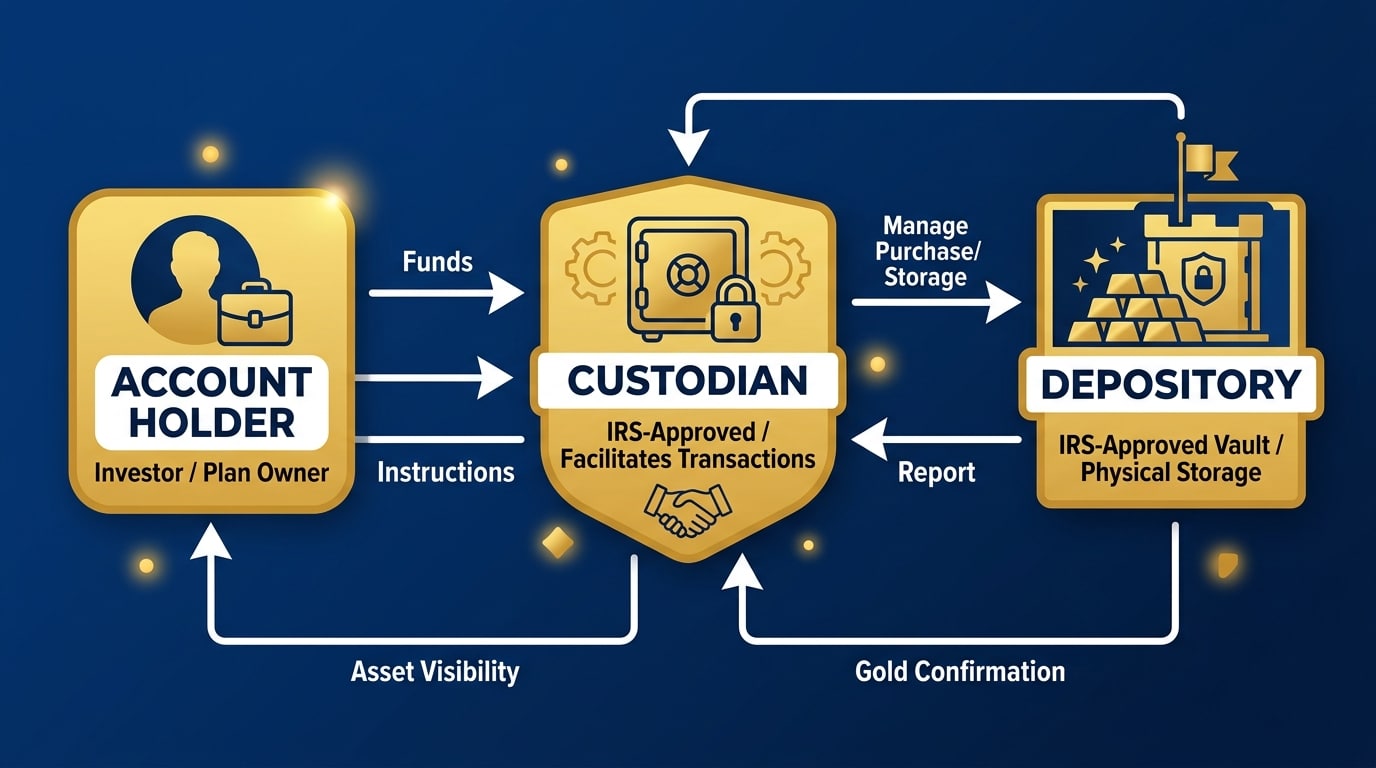
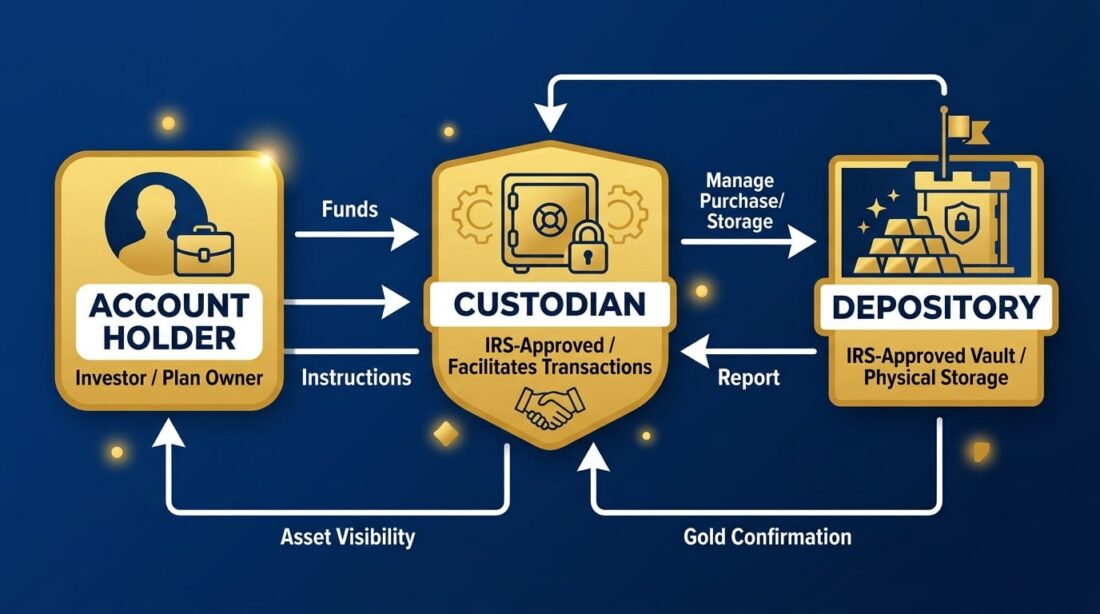
Most of the confusion around Gold IRAs comes from the same place: people assume the process is more complicated than it is. The structure itself isn’t novel. It works like any Individual Retirement Account — contributions or rollovers fund it, a custodian administers it, the IRS sets the rules for what goes inside.
What makes it different is that the “assets” are physical metal — coins, rounds, or bullion — stored in a Class 3 depository in the account holder’s name. That’s the line between tangible ownership vs. digital exposure — and it’s the distinction worth understanding before choosing between these two structures.
The IRS Rules That Define What Qualifies
Not everything gold qualifies. IRS Publication 590-A outlines the requirements — and they’re specific enough that verification before acquisition matters.
- Purity standard: Gold must be at least .995 fine. The one statutory exception is the Gold American Eagle — Congress approved it at .9167 fine, and it qualifies fully
- Approved mints: U.S. Mint products — the Gold American Eagle, Gold Buffalo, and American Gold Eagle proof coins — are IRS-approved. Certain foreign-minted coins also qualify, but that requires verification before any purchase is made
- No numismatic coins: Rare or collectible coins, even gold ones, don’t qualify under IRC Section 408(m). Purity and liquidity are the standard. Collector value is irrelevant to the IRS
This is why choosing IRS-approved gold coins before any purchase matters. Placing non-qualifying metals into an IRA — or storing qualifying metals incorrectly — triggers the same taxable distribution problem as home storage.
| IRS Requirement | Gold IRA | Personal Physical Gold |
|---|---|---|
| Purity standard (.995 fine minimum) | Required | Not required |
| IRS-approved custodian | Required | Not required |
| Qualifying depository storage | Required | Not required |
| IRS-approved coin or bullion only | Required | No restriction |
| Taxable distribution if rules broken | Yes — triggers immediately | N/A |
What Institutional Custody Actually Looks Like
IRA metals are held at an IRS-approved depository — not at a bank, not at the dealer’s facility. Institutions like Delaware Depository or Brinks maintain Class 3 vault standards, carry full insurance coverage, and offer both segregated and allocated storage.
Segregated means your specific metals are identified and held separately from other account holders’ positions. Allocated means the depository tracks your ownership in a pool of metals with matching specifications.
Either way, you’re the legal owner. The custodian administers the account. The depository holds the metal. Three separate entities. Three separate roles. That structure is what the IRS requires.
Understanding gold IRA storage rules in detail before selecting a custodian is time well spent. Not every custodian offers segregated storage — and that distinction matters when you’re thinking about how an eventual distribution will work.
The In-Kind Distribution Path
Here’s what most customers don’t hear until they ask directly: when you’re ready to take a distribution, you don’t have to sell the metals first.
You can take an in-kind distribution — the physical metals ship directly to you from the depository. At that point, the gold you held inside a tax-advantaged account becomes physical gold in your personal possession.
For Traditional IRA holders, the fair market value on the distribution date is taxable as ordinary income and reported on a 1099-R. For Roth holders with qualified distributions, it’s tax-free. Either way, the metals are now yours — to hold, store, or sell at your discretion.
Customers who want personal possession eventually — not now — have a clear path to get there. A guide to executing a precious metals IRA distribution walks through what the actual process involves.
RMDs are part of this picture too. IRS Publication 590-B governs Required Minimum Distribution rules. In 2026, the RMD age for most account holders is 73. If you’re approaching that threshold with a Traditional Gold IRA, understanding how RMDs interact with your metals position matters — before distributions are required, not after. Roth Gold IRAs carry no RMD requirement during the account holder’s lifetime.
| Distribution Type | Traditional Gold IRA | Roth Gold IRA |
|---|---|---|
| Cash distribution | Taxed as ordinary income | Tax-free on qualified distributions |
| In-kind distribution | Taxed at fair market value as ordinary income | Tax-free on qualified distributions |
| Required Minimum Distributions | Age 73 under 2026 rules | None during account holder’s lifetime |
| Early withdrawal (under 59½) | 10% penalty applies | Contributions penalty-free; earnings subject to rules |
What Physical Gold Outside an IRA Actually Costs
Buying gold outright and holding it yourself is straightforward in concept. No account setup. No custodian. No annual fees. You acquire it, you own it, you decide what happens to it.
What surprises most customers is what that simplicity costs in other ways — specifically in taxes and carrying costs that don’t show up at the point of purchase.
The 28% Collectibles Tax Most Buyers Miss
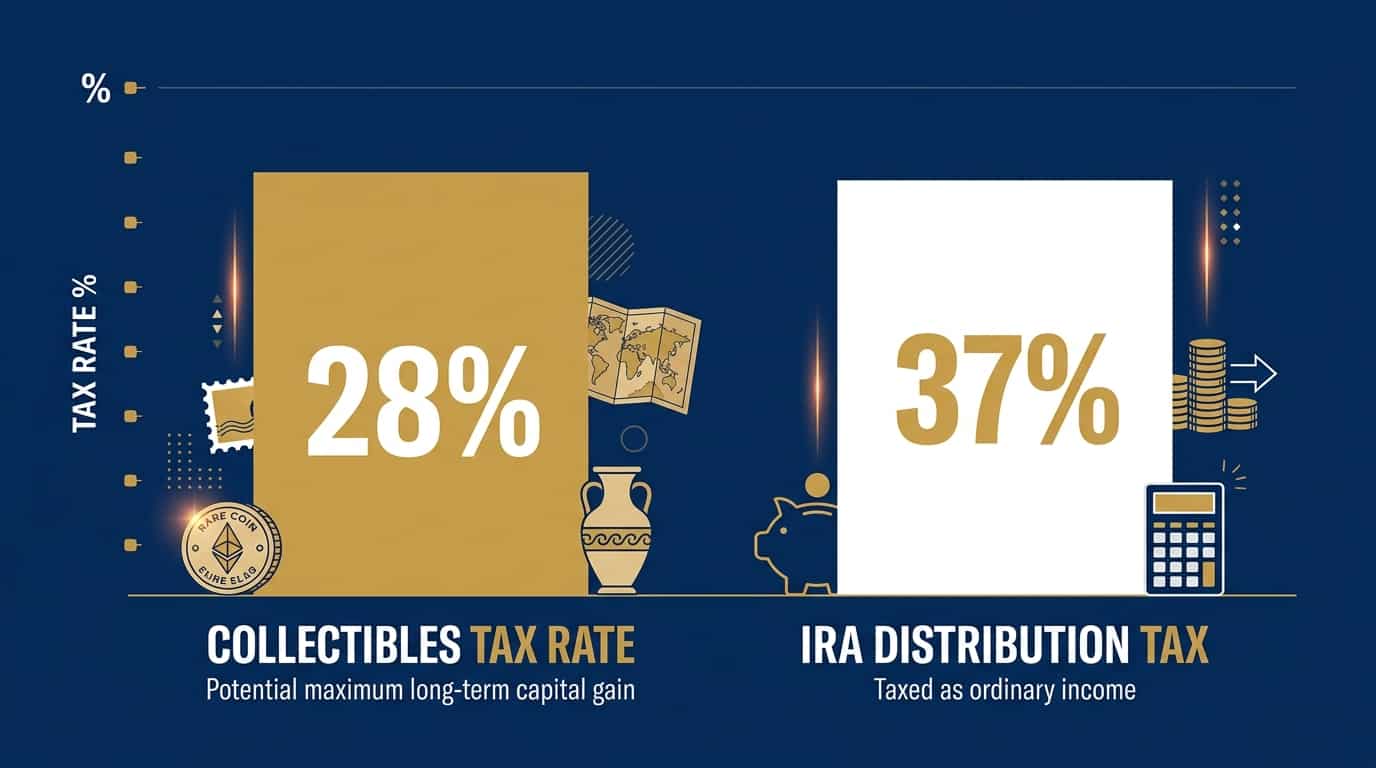
Gold held outside a retirement account is classified as a “collectible” by the IRS — not as a standard capital asset. That’s not a minor distinction.
Most long-term capital gains — on assets held more than a year — are taxed at 0%, 15%, or 20% depending on your bracket. Long-term gains on collectibles, including physical gold and silver, are taxed at up to 28%. If you’re in a high enough bracket, that rate applies regardless.
Short-term gains — metals held under a year — are taxed as ordinary income. For a retired American drawing Social Security, pension income, and IRA distributions simultaneously, that rate can reach 22%, 24%, or higher without much effort.
This is the detail most gold conversations skip. The tax on the eventual gain doesn’t show up at purchase. It shows up when you sell — and it affects what you actually net.
- Short-term gains (held under 1 year): Taxed as ordinary income — up to 37% depending on bracket
- Long-term gains (held over 1 year): Taxed at up to 28% collectibles rate
- Traditional IRA distribution: Taxed as ordinary income at distribution — no collectibles treatment
- Roth IRA distribution (qualified): Tax-free — no collectibles rate, no ordinary income treatment
Storage, Insurance, and the Risk Equation
When you hold physical gold at home, you carry the full risk of it.
Standard homeowner’s and renter’s insurance policies typically cap precious metals coverage at somewhere between $1,000 and $2,500 — without a separate rider. For customers holding any real quantity of gold, that coverage gap is significant. A dedicated rider or specialized policy closes it, but it comes with its own annual cost.
Home safes are not Class 3 vaults. A residential safe slows someone down. A commercial-grade depository stops them. Residential security systems aren’t designed around the specific threat of known high-value metal storage.
Private vaulting is a legitimate middle option — professional third-party storage without the IRA structure. These facilities carry full insurance, offer segregated positions, and are often more accessible than IRA-held metals. They don’t deliver the tax advantages of a retirement account. But for customers who want institutional-grade security without the IRA framework, it’s a real choice.
| Cost Factor | Gold IRA | Physical Gold — Home | Physical Gold — Private Vault |
|---|---|---|---|
| Annual custodian / storage fees | Yes — varies by provider | None | Yes — varies by facility |
| Insurance coverage | Institutional — included | Homeowner’s rider — additional cost | Institutional — included |
| Purchase premium at acquisition | Dealer spread over spot | Dealer spread over spot | Dealer spread over spot |
| Tax on long-term gains | Ordinary income (Traditional) / Tax-free (Roth) | Up to 28% collectibles rate | Up to 28% collectibles rate |
| IRS compliance structure required | Yes | No | No |
Who Physical Gold Outside an IRA Is — and Isn’t — For
One thing worth saying plainly: personal possession of physical gold is the right structure for some customers. It genuinely isn’t for others.
If you’re approaching this as a trade — buying now with the expectation of selling when the price moves — precious metals probably aren’t the right vehicle for that goal. Gold prices fluctuate. Precious metals may appreciate, depreciate, or remain unchanged. We say that every time — not as a disclaimer, but because customers who buy expecting a specific price outcome tend to end up disappointed. That disappointment doesn’t resolve cleanly.
If you want a forecast or a guarantee that buying now will pay off, Brighton Gold isn’t the right fit. We don’t make that pitch. No one can make it honestly.
Physical gold outside an IRA fits customers who:
- Want immediate, unconditional access to what they own — no account structure, no distribution procedures
- Are holding a portion of their wealth outside any retirement account for liquidity or privacy reasons
- Have already maximized retirement account options and want to hold additional metals outside that framework
- Understand the tax treatment and have factored it into their broader picture with a CPA
It isn’t designed for customers who want:
- Tax-deferred or tax-free growth on a significant long-term retirement position
- Institutional security — a qualified, insured, Class 3 depository — behind what they’re holding
- A retirement-structured holding with IRS-recognized protections and a clear in-kind distribution path
For customers still weighing the cost question, understanding gold IRA fee structures before comparing options is the practical first step — especially when a No Fee IRA changes the long-term math considerably.
Gold IRA vs. Physical Gold: The Full Comparison
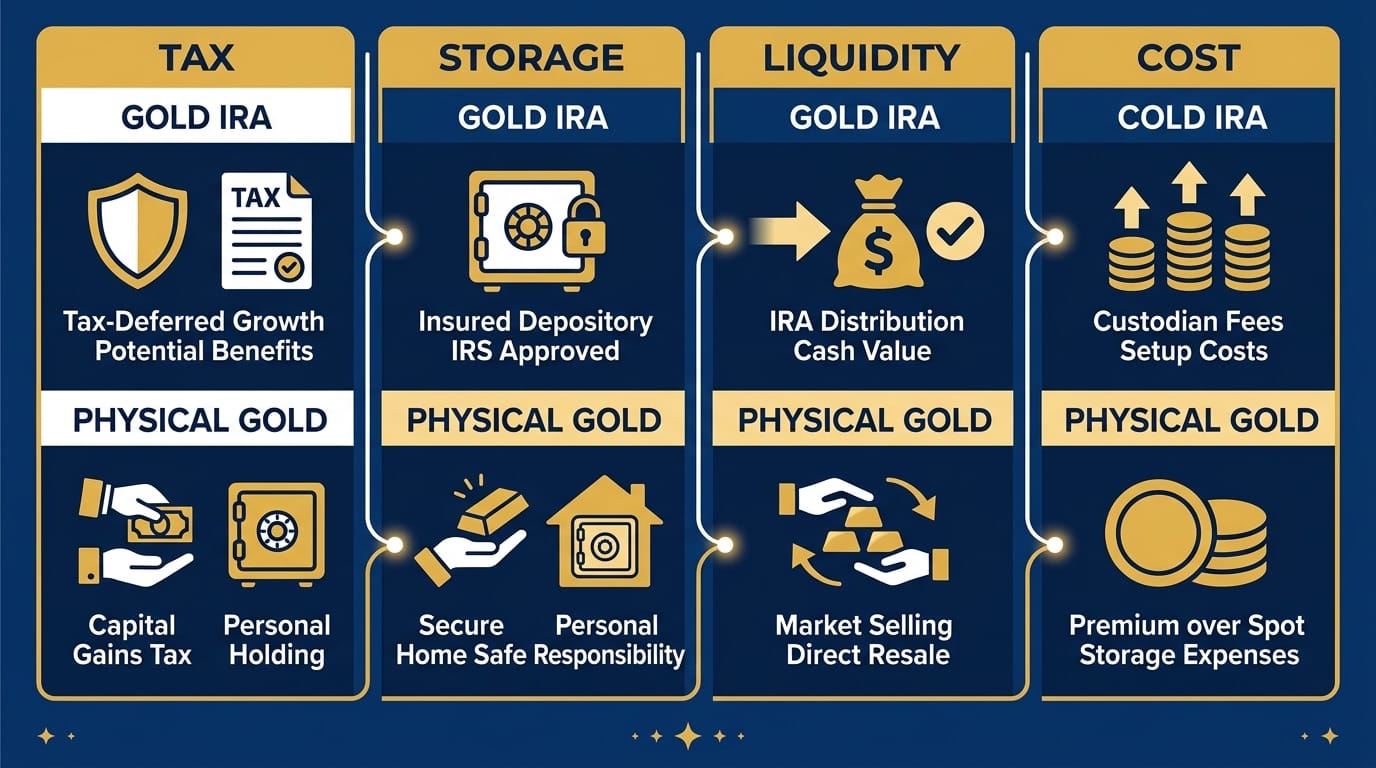
Here’s everything side by side — tax treatment, storage, liquidity, and cost. The four variables that actually drive this decision for retirement-focused customers.
Side-by-Side: Tax, Storage, Liquidity, and Cost
| Factor | Gold IRA — Traditional | Gold IRA — Roth | Physical Gold — Personal |
|---|---|---|---|
| Tax treatment on gains | Deferred — taxed as ordinary income at distribution | Tax-free on qualified distributions | Up to 28% collectibles rate on long-term gains |
| Storage requirement | IRS-approved Class 3 depository — mandatory | IRS-approved Class 3 depository — mandatory | Home, private vault, or bank safe deposit box |
| Annual fees | Custodian + storage fees — varies by provider | Custodian + storage fees — varies by provider | None unless using private vault |
| Liquidity | In-kind or cash distribution at any time | Tax-free qualified distributions at any time | Immediate — sell or access without any account structure |
| RMD requirement | Yes — age 73 under 2026 rules | No — not during account holder’s lifetime | No |
| Early access (under 59½) | 10% penalty — exceptions apply | Contributions penalty-free; earnings subject to rules | No restriction — no account structure |
| IRS compliance | Custodian, approved metals, approved storage — all required | Same requirements as Traditional | None — purchase and hold freely |
| Home storage permitted | No — prohibited; McNulty v. Commissioner precedent | No — same prohibition | Yes — at owner’s discretion |
The 2026 Decision Checklist
The objection we hear most often sounds something like this: “What if the government restricts access? What if the depository fails? What if I need my gold and can’t get to it?”
These aren’t unreasonable concerns. They deserve a direct answer.
IRA-held metals are titled in your name — not the custodian’s. If a custodian becomes insolvent, it doesn’t erase your ownership. The metals are segregated assets — not on the custodian’s balance sheet. That’s a structural protection most people don’t know exists until they look for it.
Identifying safe gold IRA practices means knowing what to evaluate before you commit to a custodian — insurance structure, depository relationship, regulatory standing. These vary by provider. The selection decision matters more than most sales conversations let on.
And if immediate, unmediated access is the core concern — if you want something reachable without any intermediary at all — that’s a valid reason to hold some physical gold personally. It’s not a reason to avoid a Gold IRA entirely. Most customers who work through this with us end up holding both, intentionally, for different purposes.
Use this checklist to see where your situation actually lands:
| Situation | Gold IRA | Physical Gold |
|---|---|---|
| Primary goal is tax-deferred or tax-free long-term growth | ✓ | |
| Want immediate access to metals without account procedures | ✓ | |
| Significant retirement savings to protect over 10+ years | ✓ | |
| Emergency liquidity is the primary purpose of this holding | ✓ | |
| Want professional institutional custody and full insurance | ✓ | |
| Already maximized retirement accounts — want additional holdings | ✓ | |
| Want in-kind distribution path (IRA → physical possession later) | ✓ | |
| Want no account structure, no custodian, no compliance requirements | ✓ |
A few things worth keeping in mind as you use it:
- IRA-held metals are legally titled in your name — not the custodian’s
- Custodian insolvency does not erase your ownership of segregated assets
- Most customers hold both structures intentionally — for different purposes
- The in-kind distribution path means IRA gold can become physical possession on your own timeline
The mechanics of establishing a precious metals IRA are simpler than most customers expect. If the process has felt opaque, that’s where to start.
Choosing the right Gold IRA custodian matters more than most conversations acknowledge. Custodian fees, storage type, segregated vs. allocated holding, and the in-kind distribution process vary significantly across providers — and these aren’t details to sort out after you’ve committed.
Why a No Fee IRA for life is a different kind of offer — not a promotional rate, but a structural commitment — is worth understanding before comparing custodians on fee schedules alone. Over a long holding period, that math is meaningful.
Frequently Asked Questions
Can I move my physical gold into a Gold IRA?
No. The IRS requires that metals inside a Gold IRA be purchased through a custodian using new funds — either a contribution, a rollover from an existing retirement account, or a transfer from another IRA.
Physical gold you already own cannot be contributed in-kind. The IRS treats that as a prohibited transaction, and there is no workaround. What you hold personally and what your IRA holds are two entirely separate positions. A rollover or transfer moves cash into the custodian’s hands — the custodian then purchases IRS-approved metals and places them directly into the depository. Your existing physical holdings stay where they are.
Which has higher fees: a Gold IRA or buying physical gold?
The answer depends on time horizon — and what you actually count.
Physical gold held personally carries no annual fees. But the one-time acquisition cost (dealer premium over spot price), ongoing carrying costs (safe, insurance rider, or private vault fees), and the eventual tax on gains — up to 28% collectibles rate — are all real costs that don’t show up on day one. Understanding gold IRA fee structures in detail before committing to a provider is the right move. Custodian fees vary significantly, and that variation compounds over a 10- or 20-year holding period.
Brighton Gold’s No Fee Precious Metals IRA for the lifetime of the account removes the annual fee variable entirely for qualified purchasers. A complimentary consultation covers whether that structure applies to your situation.
Is physical gold taxed differently than a Gold IRA in 2026?
Yes — significantly.
Physical gold held outside a retirement account is classified as a “collectible” by the IRS. Long-term capital gains on collectibles — held more than one year — are taxed at up to 28%. Short-term gains are taxed as ordinary income.
A Traditional Gold IRA defers all taxes until distribution, at which point the full distribution value is taxed as ordinary income. A Roth Gold IRA allows qualified distributions — including in-kind distributions — completely tax-free.
The difference between the 28% collectibles rate and Roth’s tax-free treatment is one of the most consequential factors in this decision for customers holding significant amounts over long periods. A CPA or tax professional should be part of any large precious metals decision — Brighton Gold does not provide financial, tax, or legal advice.
Can I store Gold IRA metals at home if I have a high-security safe?
No. The McNulty v. Commissioner ruling is unambiguous on this point: storing IRA metals at home — regardless of the security measures in place — constitutes a taxable distribution.
Some promoters have marketed “home storage Gold IRAs” using LLC structures designed to give the account holder direct custody of their IRA metals. The IRS and the tax court have consistently treated these as prohibited transactions. The result: the entire balance is treated as a distribution, taxed as ordinary income, and potentially subject to the 10% early withdrawal penalty for account holders under 59½.
Understanding gold IRA storage rules — including exactly why the LLC structure doesn’t change the outcome — is worth the time before making any storage-related decision.
What is the in-kind distribution process for a Gold IRA?
An in-kind distribution means your IRA metals are shipped directly to you rather than being liquidated for cash.
The process works like this: you notify your custodian of the request. They coordinate with the depository to arrange shipment of the metals to an address you specify. The fair market value of the metals on the distribution date is treated as ordinary income for Traditional IRA holders and reported on a 1099-R. After the distribution, the metals are personal property — no longer inside a retirement account. Executing a precious metals IRA distribution involves coordination between the custodian, the depository, and in some cases the original dealer. Understanding the steps in advance makes the process straightforward when the time comes.
How much of my retirement savings should be in a Gold IRA vs. physical gold?
Brighton Gold doesn’t provide financial, tax, or legal advice — and this is the question where that boundary matters most.
What we can say: most customers who work with us hold the majority of their precious metals position inside a Gold IRA, with a smaller physical holding for direct access and liquidity. The IRA position serves the long-term, tax-advantaged purpose. The physical holding is the accessible reserve — nothing between them and what they own. The specific allocation, and whether a Precious Metals IRA makes sense for a given situation at all, is a question for a licensed financial planner or CPA. Precious metals may appreciate, depreciate, or remain unchanged. The decision should be made with clear information — not under urgency or pressure.
The Right Call for Most Retirees
Here’s where we come down after walking through all of it.
For most retirement-focused customers — customers who want meaningful precious metals exposure with real institutional protection and genuine tax efficiency — a Gold IRA is the right primary structure.
The tax advantage alone changes the math. A Roth Gold IRA, in particular, where qualified distributions are completely tax-free, is a structure that’s difficult to replicate through personal possession. The 28% collectibles rate on personally held gold doesn’t disappear. It compounds quietly over a holding period and reduces what you actually net when it matters. That’s a real cost, and it’s one of the least-discussed trade-offs in this comparison.
That doesn’t mean physical gold has no role. For customers who want a reserve they can reach immediately — no account, no custodian, no procedures between them and their metals — a physical holding alongside a Gold IRA is a practical and deliberate choice. These two structures aren’t in competition. They serve different purposes, and customers who hold both typically do so with intention.
What we’d push back on directly is the premise that “real” ownership requires personal possession at all times. A Gold IRA holds real, physical, IRS-recognized gold — held in your name, owned by you, available for in-kind distribution whenever you choose. The distinction isn’t ownership vs. paper. It’s custody structure. And for a long-term retirement position, custody structure is exactly where the tax advantage lives.
Establishing a precious metals IRA is simpler than the industry makes it feel. What makes it feel complicated is unfamiliar terminology, pressure from the wrong providers, and a shortage of plain-language information. That’s what we’re here to provide.
If you’ve worked through this comparison and you’re not yet sure which structure fits your situation, that’s exactly what a complimentary consultation is designed to figure out.
Most customers who contact Brighton Gold have already done the research. They understand the tax difference. They know what a Gold IRA is. What they want is a direct conversation about what fits their specific picture — what they’re holding, what they’re trying to protect, and whether the No Fee Precious Metals IRA for the lifetime of the account makes sense for where they are.
That’s the conversation. No obligation. No pressure. Just the clearest answer we can give you about whether this fits.
The gap between a 28% collectibles rate and tax-free Roth distributions doesn’t shrink while you wait. The right structure — confirmed, in place, working for you — is the clearest advantage on the table. The Brighton Gold learning center has additional resources if you want to keep building context first.