

Gold Buffalo vs. Gold Eagle: Which Should I Choose for My IRA in 2026?
If you’ve been looking at U.S.-minted gold coins for your IRA, you’ve probably run into the same two names—the American Gold Eagle and the American Gold Buffalo.
Both come from the U.S. Mint. Both are fully approved for retirement accounts. And both contain exactly one troy ounce of pure gold.
So what’s actually different?
The Gold Buffalo is 24-karat—99.99% pure gold. It’s the first .9999 fine coin the U.S. Mint has ever produced.
The Gold Eagle is 22-karat—91.67% gold, with small amounts of silver and copper mixed in for durability. It’s been around since 1986 and it’s one of the most widely recognized gold coins in the world.
Neither coin is “better.” They serve different purposes—and the right choice depends on what matters most to you.
And in 2026, both carry a special dual date—”1776 ~ 2026″—along with a Liberty Bell privy mark honoring America’s Semiquincentennial. That one-year-only detail makes either coin historically significant.
Whether you’re choosing IRS-approved gold coins for the first time or establishing a precious metals IRA through a rollover, this comparison can give you real clarity about your decision—and real peace of mind once you’ve made it.
America’s Two Gold Coins: Where They Came From
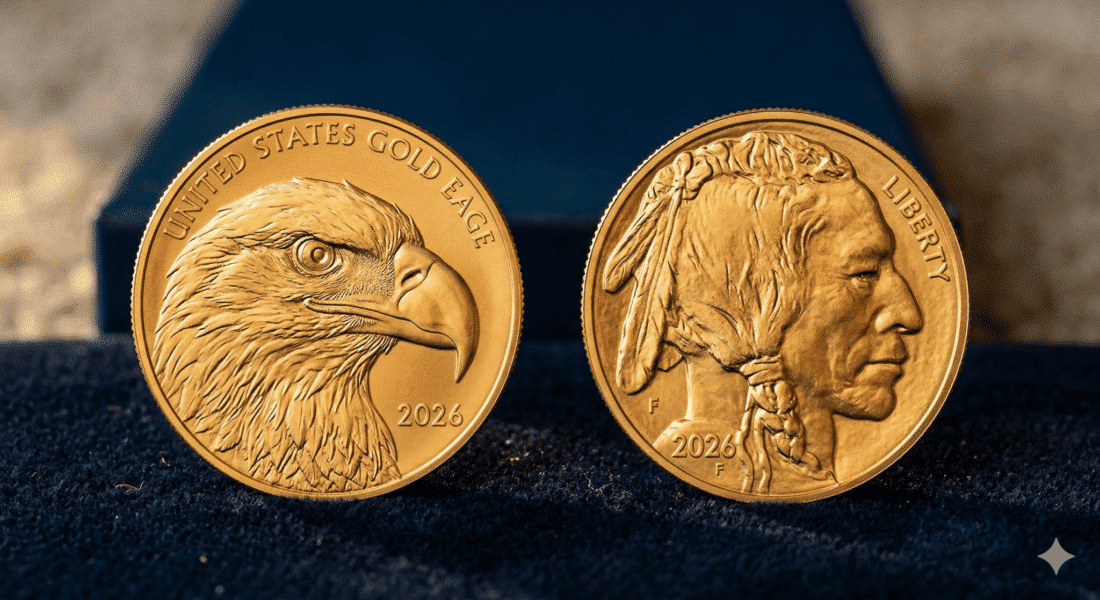
These are the two most popular gold bullion coins in the country. Both carry the full backing of the United States government for weight, content, and purity.
But they were designed for different reasons. And those differences matter when you’re deciding what belongs in your IRA.
The American Gold Eagle
The Gold Eagle was born from the Gold Bullion Coin Act of 1985. President Reagan signed it into law, and the first coins hit the market in 1986.
Congress chose a 22-karat alloy for the coin—91.67% gold. The rest? A small blend of copper (5.33%) and silver (3%).
Why mix in other metals? Because the alloy makes the coin harder and more scratch-resistant. It was designed to hold up in the real world.
Now—does that alloy reduce how much gold you’re actually getting?
Not at all. Every 1-ounce Gold Eagle still holds exactly 31.1035 grams of pure gold. The coin just weighs a little more overall—about 33.93 grams total—because of those added metals.
- Design — The front of the coin features Augustus Saint-Gaudens’ famous Lady Liberty—a design that dates all the way back to 1907. The Mint updated the back in 2021 with a close-up portrait of a bald eagle by artist Jennie Norris. It’s a striking, modern look on a coin with deep American roots.
- Sizes available — This is a big advantage for the Eagle. You can get it in four sizes: 1 oz ($50 face value), 1/2 oz ($25), 1/4 oz ($10), and 1/10 oz ($5). That kind of flexibility matters if you want to add gold to your IRA a little at a time.
- Track record — Nearly 40 years of continuous production. Dealers everywhere on the planet know this coin, trust this coin, and trade this coin without hesitation. That kind of recognition doesn’t happen overnight—and it carries real weight when it’s time to sell.
The American Gold Buffalo
The Gold Buffalo came along 20 years later—first minted in 2006 under the Presidential $1 Coin Act of 2005.
Why did the Mint create it? Simple. The U.S. didn’t have a 24-karat gold bullion coin. Other countries did—like Canada with its Gold Maple Leaf. The Buffalo filled that gap.
At 99.99% pure gold, the Buffalo is as close to pure as modern technology allows. No alloy. No silver. No copper. Just gold.
- Design — Both sides of the coin come from James Earle Fraser’s famous 1913 “Buffalo Nickel.” The front features a Native American chief. The back depicts an American bison. It’s one of the most recognized coin designs in U.S. history—and it gives the Buffalo a timeless, distinctly American feel.
- Sizes available — This is where the Buffalo has a limitation. It’s only produced in 1-ounce form. Fractional sizes were minted briefly in 2008, but those are extremely rare now and carry steep collector premiums. If you want smaller denominations? The Eagle is your path.
- Mintage levels — The Mint produces far fewer Buffalos than Eagles each year. Between 2006 and 2023, average annual Eagle mintages were roughly three times higher. That smaller supply has fueled growing demand—and higher premiums.
So which one sounds more like you?
Purity vs. Durability: What Matters More for Your Goals?

This is the first question most people ask. And it’s the right one.
But purity and durability are two different goals. Neither one is automatically “better.” The right answer depends on what you value most.
Why Purity Matters
The Gold Buffalo’s 24-karat composition means you’re holding a coin that’s virtually 100% gold. For many owners, that simplicity is the whole appeal.
And it’s not just a personal preference—it’s a global standard.
The London Bullion Market Association (LBMA) sets the worldwide benchmark for gold trading. Their Good Delivery standard requires a minimum fineness of .995 for gold bars. The Buffalo exceeds that at .9999.
What does that mean for you?
- No guesswork — There are no alloy metals in the coin. What you hold is pure gold, nothing else. If you ever need to figure out the fair market value, the math is simple.
- Global recognition — The Buffalo’s purity matches the Canadian Maple Leaf, the Austrian Philharmonic, and every other major .9999 coin on the market. That can matter down the road if you ever want to sell outside the U.S.
- Peace of mind — Some owners just want to know their gold is as pure as it gets. There’s nothing wrong with that—and the Buffalo delivers exactly that.
Why Durability Matters
The Gold Eagle’s copper-silver alloy makes it harder. On the Mohs scale, pure gold rates about 2.5. The Eagle’s blend pushes that closer to 3.0.
What does that look like in real life? The Eagle resists scratches, dings, and surface marks better than the Buffalo.
- Better handling tolerance — If you plan to physically inspect your coins—or if they’ll be transported at some point—the Eagle holds up better over time. Nearly 40 years of real-world use confirms that.
- Same gold content — This is the part that surprises most people. Despite the alloy, the Eagle contains the exact same amount of pure gold as the Buffalo. You still own one full troy ounce. The alloy doesn’t replace any gold—it just adds a small amount of weight on top of it.
Now—does durability really matter if your coins are sitting inside a secure depository as part of your IRA?
For most owners—not much. Your metals aren’t being handled, shipped, or displayed. They’re in a controlled vault environment. So inside an IRA, the durability advantage is real—but rarely relevant.
Something to think about as you weigh your priorities.
| Feature | American Gold Eagle | American Gold Buffalo |
|---|---|---|
| Purity | 22-karat (91.67% gold) | 24-karat (99.99% gold) |
| Pure Gold Content | 1 troy ounce (31.1035 g) | 1 troy ounce (31.1035 g) |
| Total Coin Weight | 33.93 grams | 31.1035 grams |
| Alloy Metals | Silver (3%), Copper (5.33%) | None |
| Mohs Hardness | ~3.0 | ~2.5 |
| First Year Minted | 1986 | 2006 |
IRA Eligibility: What the IRS Actually Requires
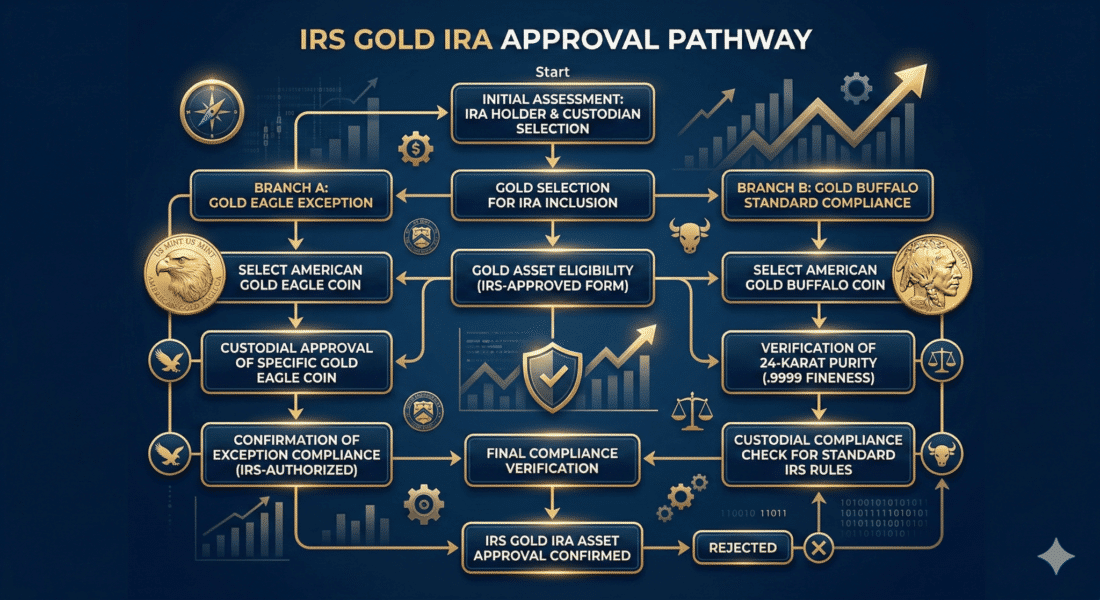
Both coins are fully approved for precious metals IRAs. No question about it.
But they qualify through slightly different paths—and understanding why can give you more confidence about what you’re buying.
The Purity Standard Under Federal Law
Under IRC Section 408(m)(3), gold has to meet a minimum fineness of .995—that’s 99.5% pure—to go into an IRA.
The Gold Buffalo clears that easily at .9999.
But what about the Gold Eagle? It’s only 91.67% pure. That’s well below the .995 threshold.
So how does it qualify?
Congress carved out a specific exception. When they passed the Gold Bullion Coin Act of 1985, they gave the American Gold Eagle its own legal standing as a U.S. government-backed bullion coin.
The IRS honors that exception. That means the Eagle is IRA-eligible even though its purity falls below the standard rule.
This is one of the most common sources of confusion for new owners. The Eagle isn’t “less gold.” It holds the same one troy ounce of pure gold as the Buffalo. It just has a congressional exemption for its alloy.
Storage and Custodian Rules
Whichever coin you choose, the IRS says your metals must be stored with an approved custodian at an authorized depository. You can’t keep IRA gold at home, in a personal safe, or in a bank safety deposit box.
You’ll typically choose between two storage options:
- Segregated storage — Your coins are kept separate from everyone else’s holdings. You know exactly which coins are yours—and they’re stored independently. This is the most popular option for owners who want that extra layer of clarity and control.
- Non-segregated storage — Your coins are pooled with other owners’ holdings of the same type. It usually costs a bit less. The gold is still yours—it’s just stored together with matching products.
Both Eagles and Buffalos are accepted at every major IRS-approved depository in the country. There’s no eligibility difference when it comes to storage.
Does Purity Actually Matter Inside an IRA?
This one’s worth thinking about.
Inside your IRA, your coins sit in a vault. They’re not being traded on a global exchange. They’re not being melted down. The gold content is identical—one troy ounce, whether it’s the Eagle or the Buffalo.
So does the purity difference matter while your gold is in the depository?
In practical terms—not really.
Where purity becomes more relevant is after you take a distribution. If you choose to take physical delivery of your metals at retirement, the Buffalo’s .9999 purity could make selling outside the U.S. a bit smoother. But for the years—or decades—your coins sit in storage, the difference is minimal.
What matters most? What gives you peace of mind. Some owners want the purest gold possible. Others want the coin with the longest track record. Neither choice is wrong—and you don’t have to decide under pressure.
Liquidity and Resale: What Happens When It’s Time to Sell?

When you buy gold for your IRA, you’re also making a decision about the future. How easy will it be to turn these coins back into cash when the time comes?
That’s what liquidity means—and it’s worth giving it some real thought.
Gold Eagle Liquidity
The American Gold Eagle is one of the most liquid gold coins on the planet.
Nearly 40 years of production. Substantially higher mintage numbers. Instant recognition from dealers, refiners, and purchasers around the world.
What does that add up to?
- Seamless resale — Walk into virtually any precious metals dealer in the U.S.—or overseas—and they’ll buy a Gold Eagle without a second thought. The coin has built that kind of trust over four decades. And that trust translates into seamless transactions when you’re ready to sell.
- Tighter spreads — Because Eagles are so widely traded, the gap between what you pay to buy and what you receive when you sell tends to be narrow and predictable. That’s a real advantage when you’re thinking about long-term value.
- Fractional flexibility — This is something the Buffalo can’t match. Gold Eagles come in 1/10 oz, 1/4 oz, 1/2 oz, and 1 oz sizes. That means you can sell part of your gold without giving up a full ounce—giving you more control over timing and cash flow.
Gold Buffalo Liquidity
The Gold Buffalo isn’t far behind. It’s built strong dealer recognition since 2006, and its market presence has been growing steadily.
How fast? Between 2006 and 2021, Buffalo mintages averaged about 30% of Eagle mintages. By 2022–2023, that ratio climbed to roughly 45%. That’s a meaningful jump.
- Growing demand — More dealers are trading Buffalos. More owners are acquiring them. And with lower overall mintage, there’s a natural scarcity that can support stronger premiums at resale. If you’re thinking long-term, that’s worth noting.
- Global purity standard — The Buffalo’s .9999 fineness aligns with what gold markets around the world expect. There’s no alloy to calculate around—which can simplify transactions overseas. Planning to sell outside the U.S. someday? That purity gives you a practical edge.
Is the Eagle more liquid than the Buffalo today? Slightly—yes.
But the gap has been closing for years. Both coins are highly liquid. Both can be sold quickly through any reputable dealer.
And resale shouldn’t be the only thing on your mind when you’re making this decision.
| Factor | Gold Eagle | Gold Buffalo |
|---|---|---|
| Years in Production | 40 (since 1986) | 20 (since 2006) |
| Average Annual Mintage (1 oz) | ~666,700 | ~217,400 |
| Fractional Sizes Available | Yes (4 sizes) | No (1 oz only) |
| Global Recognition | Very High | High and Growing |
| Typical Premium Above Spot | Lower | Slightly Higher |
| Resale Spread | Narrower | Slightly Wider |
Why 2026 Makes Both Coins More Interesting
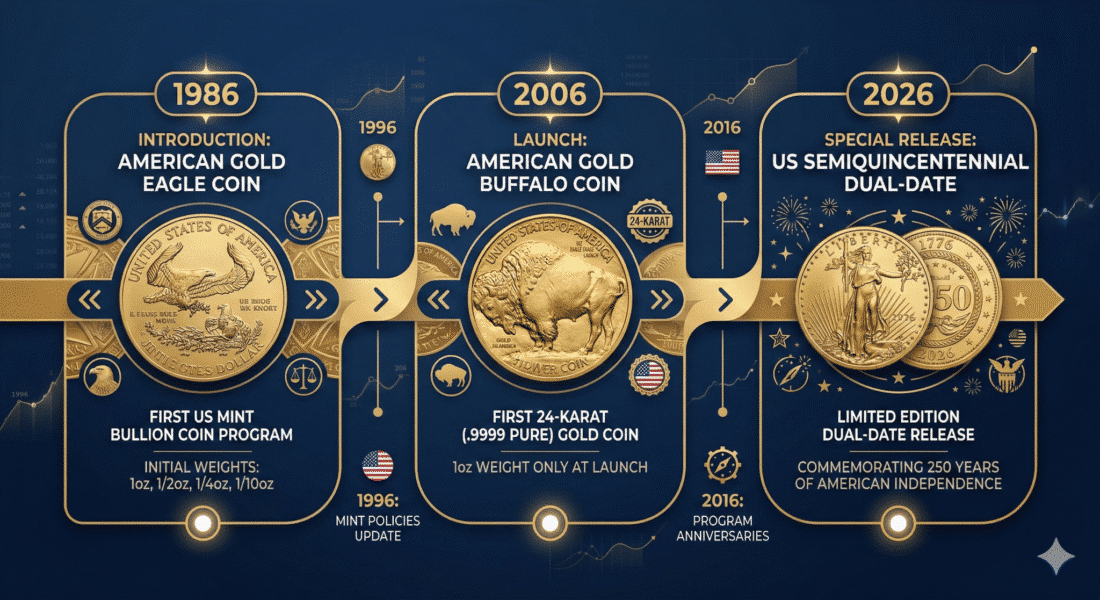
Have you heard about the Semiquincentennial?
2026 marks the 250th anniversary of America’s founding. And the U.S. Mint is honoring that milestone across its entire product line—including both the Gold Eagle and the Gold Buffalo.
What’s Different About the 2026 Coins
Both coins carry a dual date of “1776 ~ 2026” along with a special Liberty Bell privy mark inscribed with the numeral “250.”
These features appear on bullion and proof versions alike—making every 2026 Eagle and every 2026 Buffalo a one-year-only commemorative release.
The Mint is also releasing five “Best of the Mint” gold coin and silver medal sets. These sets bring back famous historic designs—like the 1907 Saint-Gaudens Double Eagle and the 1916 Walking Liberty—struck in modern .9999 fine gold.
It’s a year that stands out in U.S. coinage history. And for gold owners, it creates a window that won’t come around again.
What Does This Mean for IRA Owners?
The dual date and privy mark don’t change the gold content of your coin. You’re still getting one troy ounce of pure gold—same as any other year.
But one-year-only features can affect long-term collector demand.
Think about the 2006 Gold Buffalo—the very first year of the series. Those coins still carry meaningful premiums above standard bullion pricing, almost 20 years later.
Will the 2026 coins follow the same pattern? No one can say for certain. But commemorative-year coins from the U.S. Mint have a track record of holding stronger interest over time.
If you’re acquiring gold for your IRA this year, both coins carry the same Semiquincentennial significance. The choice between them still comes down to the fundamentals—purity, durability, liquidity, and what aligns with your goals.
- If purity and collector appeal matter most — The 2026 Buffalo combines .9999 fineness with that historic privy mark. It’s a compelling combination.
- If liquidity and sizing matter most — The 2026 Eagle offers the same commemorative features, plus the ability to buy in four different sizes.
Either way? 2026 is a more interesting year to own U.S.-minted gold than most.
How to Choose the Right Coin for Your IRA

You don’t need to overthink this. A simple framework can bring you real clarity—and help you feel positioned to move forward with confidence.
Step 1: What’s Your Purity Preference?
Ask yourself—does holding the purest possible gold coin give you more peace of mind?
If the answer is yes, the Buffalo is your coin.
If you’re comfortable with an alloyed coin that contains the exact same amount of gold, the Eagle works just as well. There’s no downside either way. It’s a matter of what feels right to you.
Step 2: How Will You Eventually Sell?
Think about what happens when it’s time to sell. Will you go through a U.S. dealer? Consider overseas markets? Take physical delivery of your metals?
- Selling domestically — Both coins are equally easy to sell through any reputable U.S. dealer. The Eagle might offer slightly tighter spreads, but the difference is modest. Either coin will move quickly.
- Selling overseas — The Buffalo’s .9999 purity gives it an edge in global markets that standardize on 24-karat gold. If you think you might sell outside the U.S. someday, that’s worth considering.
- Taking physical delivery — If you plan to take a distribution in physical form at retirement, the Eagle’s harder alloy means it’ll show less wear after years of vault storage. That said, the difference is minor—especially if your coins are in protective capsules.
Step 3: How Sensitive Are You to Premiums?
Premiums fluctuate. But Gold Buffalos typically carry slightly higher premiums above spot compared to Gold Eagles.
With gold trading above $5,000 per ounce in early 2026, even a small premium difference adds up. It’s worth comparing current pricing from a reputable dealer before you commit.
And remember—premiums you pay when you buy are premiums you’ll want to recover when you sell. That’s true for both coins.
Step 4: Do You Want Fractional Sizes?
This one’s simple. If you want to buy gold in smaller increments—1/10 oz, 1/4 oz, or 1/2 oz—the Eagle is your only U.S. Mint option. Buffalos only come in 1-ounce form.
That matters if you’re making regular IRA contributions and want to add gold steadily over time—rather than making fewer, larger purchases all at once.
| Decision Factor | Choose Gold Eagle If… | Choose Gold Buffalo If… |
|---|---|---|
| Purity Preference | You’re comfortable with 22k alloy | You want the purest gold possible |
| Resale Priority | You want maximum U.S. liquidity | You value global purity standards |
| Premium Sensitivity | You prefer lower acquisition costs | You’re willing to pay for purity and scarcity |
| Size Flexibility | You want fractional sizes (1/10, 1/4, 1/2 oz) | You’re focused on 1-ounce purchases |
| 2026 Commemorative | You want the dual-date Eagle | You want the dual-date Buffalo |
| Durability Concern | You plan to handle or transport coins | Your coins will stay in vault storage |
The Bigger Picture: Why Gold Ownership Matters in 2026

Why are so many people looking at gold right now—and what does that have to do with choosing between these two coins?
Here’s what we’re seeing today.
Central Banks Are Still Buying
Central banks around the world purchased 863 tonnes of gold in 2025, according to the World Gold Council. That’s down from the record-breaking pace of the previous three years—but still well above the 2010–2021 average of 473 tonnes per year.
Who’s buying?
- Poland — Added 102 tonnes, making it one of the largest sovereign gold purchasers in the world.
- China — Extended its buying streak for over a year straight, continuing to reduce its dollar-denominated reserves.
- Kazakhstan — Added 57 tonnes, reinforcing a long-running pattern of domestic gold accumulation.
- Brazil — Re-entered the gold market with 43 tonnes after years of minimal purchases.
Total global gold demand topped 5,000 tonnes in 2025—the first time ever.
And with gold trading above $5,000 per ounce in early 2026, the intrinsic value of precious metals continues to draw attention from central banks, sovereign wealth funds, and individual owners alike.
What Does This Mean for You?
When the world’s most powerful financial institutions are actively buying gold, it tells you something about where things are heading.
Whether you hold Eagles, Buffalos, or a mix of both—you’re holding something those institutions clearly want more of.
The choice between these two coins isn’t about finding the “right” answer. It’s about finding the right answer for you—based on your goals, your timeline, and what gives you the greatest sense of control over your own retirement.
Precious metals may appreciate, depreciate, or remain unchanged in value. Resale values depend on market conditions. But the core appeal of holding physical, U.S.-minted gold inside a tax-advantaged retirement account hasn’t changed in decades.
If you’re also weighing whether gold or silver—or both—makes sense for your IRA, comparing gold and silver acquisitions is a good next step. And before you commit, it’s always smart to understand the trade-offs. Evaluating the risks of precious metals ownership can help with that.
Frequently Asked Questions
Does the American Gold Eagle have more gold than the Buffalo?
No. Both coins contain exactly one troy ounce of pure gold—31.1035 grams.
The Eagle’s alloy adds weight to the coin, bringing its total to about 33.93 grams. But that extra weight is silver and copper—not gold.
The Buffalo weighs exactly 31.1035 grams because there’s nothing in it except gold. Different packaging—same gold content.
Which gold coin is easier to sell back in 2026?
The Gold Eagle has a slight liquidity advantage. Forty years of production and higher mintage numbers mean dealers everywhere recognize it instantly.
But the Buffalo has built strong market acceptance since 2006—and its .9999 purity is the global standard.
Both coins can be sold quickly through any reputable dealer. The difference is small.
Why is the Gold Buffalo sometimes more expensive than the Gold Eagle?
Supply and demand. The Mint produces roughly one-third as many Buffalos as Eagles each year. That smaller supply—combined with growing interest in 24-karat purity—pushes premiums higher.
The gap changes with market conditions. Sometimes it’s barely noticeable. Other times, it’s more pronounced.
Checking current dealer pricing before you decide? Always a good move.
Can I put both Eagles and Buffalos in the same Gold IRA?
You can. Both coins are fully IRS-approved under IRC Section 408(m)(3). You can hold both—along with other qualifying gold, silver, platinum, and palladium—in the same self-directed IRA.
Many owners do exactly this. They use Eagles for liquidity and fractional sizing, and Buffalos for purity and potential collector premium appreciation.
There’s no rule saying you have to pick just one. And if you want to make sure you’re navigating the process safely, identifying safe gold IRA practices is a resource worth reviewing.
Is the 2026 Gold Eagle a special edition?
Both the 2026 Eagle and the 2026 Buffalo are commemorative issues. They carry a dual date of “1776 ~ 2026” and a Liberty Bell privy mark with “250” to celebrate America’s 250th anniversary.
These features are one-year-only.
Whether that translates to stronger long-term collector demand remains to be seen—but commemorative-year coins from the U.S. Mint tend to hold interest well.
Does 24k gold scratch easier than 22k gold?
Yes. Pure gold is softer than alloyed gold. On the Mohs hardness scale, 24-karat rates about 2.5. The Eagle’s alloy pushes that to roughly 3.0.
But for coins stored in an IRA depository? This difference is mostly academic. Your coins aren’t being handled.
If you plan to take physical delivery eventually, protective capsules and proper storage take care of most scratch concerns—regardless of purity.
What does the IRS require for gold coins in an IRA?
The IRS requires a minimum gold fineness of .995 under IRC Section 408(m)(3). The Buffalo meets this easily at .9999. The Eagle qualifies through a specific congressional exception granted under the Gold Bullion Coin Act of 1985.
Both coins must be held by an IRS-approved custodian in an authorized depository. Home storage is not permitted—and doing so can result in the IRS treating your metals as a taxable distribution.
Consult your CPA or tax professional for guidance specific to your situation. Brighton does not provide financial, legal, or tax advice.
If the terminology around precious metals IRAs feels unfamiliar, Brighton’s precious metals industry terminology guide can help you get comfortable with the language.
What It Comes Down To
The Gold Buffalo and the Gold Eagle are both strong choices for a precious metals IRA. You really can’t go wrong with either one.
If purity is your priority, the Buffalo gives you .9999 fine gold—as pure as it gets.
If you value liquidity, fractional sizing, and a 40-year track record, the Eagle delivers on all three.
And in 2026, both coins carry a historic Semiquincentennial stamp that makes this year’s production uniquely worth holding.
You don’t have to choose one forever. Many owners hold both.
What matters most is that you’re taking the time to understand your options—and that you’re working with someone who can walk you through them without pressure. That’s what Brighton’s concierge service is designed to do. We’re here to provide support at every stage of ownership—from your first acquisition to your long-term strategy.
Ready to explore your options?
If you’re thinking “this all makes sense, but I don’t have time to figure it out on my own,” you’re not alone. Most customers we work with felt the same way before they realized how straightforward the process can be with the right guidance.
That’s why we offer a complimentary consultation to walk you through your options — including our No Fee Precious Metals IRA, which covers custodial fees for the lifetime of the account on qualified purchases.
We’ll show you exactly:
- How the No Fee IRA works and whether you qualify
- The difference between U.S.-minted coins and foreign alternatives
- What to expect from the purchasing and delivery process
- How to roll over or transfer existing retirement funds
- What ongoing support looks like after your purchase
Learn About the No Fee IRA — no obligation, just actionable insights you can use whether you work with us or not.
Whether you choose the Gold Eagle, the Gold Buffalo, or a combination of both—the most important step is the first one. We’re here when you’re ready.