
What’s the Process for Taking Delivery of Gold from My IRA? (2026 Steps)
If you’ve spent years building a Gold IRA—watching your metals sit safely in a depository vault—there’s a question that eventually crosses your mind.
“How do I actually get my gold?”
It’s a fair question. And the answer is simpler than most people expect.
The process is called an in-kind distribution. Three parties are involved—you, your IRA custodian, and the depository where your metals are stored.
You submit a request telling your custodian which coins or bars you want. They calculate the Fair Market Value on the processing date—and report that number to the IRS on Form 1099-R. Then the depository packages your gold in discrete, fully insured packaging and ships it straight to your door.
From request to delivery? Roughly 7 to 14 business days.
But there’s more to consider than just the paperwork. The timing of your distribution, the coins you choose, and the day your custodian processes the request—all of it affects what you’ll owe in taxes.
If you’re understanding gold IRA distribution options for the first time—or nearing the age where Required Minimum Distributions kick in—this covers every step, every fee, and every detail you’ll want to know.
Still in the early stages of establishing a precious metals IRA? Knowing how delivery works now helps you stay positioned for the day you’re ready.
Cash Distribution vs. Physical Delivery: What’s the Difference?

When it’s time to take something out of your Gold IRA, you’ve got two options.
You can sell the gold and receive cash. Or you can receive the actual coins and bars themselves.
The IRS calls the second option an in-kind distribution. And it’s the one most owners don’t realize they have.
Why Would Someone Choose Physical Delivery?
You spent years acquiring physical gold inside a tax-advantaged account. You chose specific coins—maybe American Gold Eagles or Buffalos—because you wanted something tangible. Something real.
Why sell it just to take a withdrawal?
An in-kind distribution lets you keep what you already own. The gold moves from the depository vault to your hands—without forcing you to sell at whatever today’s price happens to be.
That matters—especially with gold trading near $5,000 per ounce in early 2026. If you believe the price is heading higher, selling just to take a distribution means walking away from what comes next.
How Does the IRS Treat Each Option?
Both options trigger taxes. But the mechanics—and the long-term implications—are different.
| Feature | Cash Distribution | Physical Delivery (In-Kind) |
|---|---|---|
| What You Receive | Check or bank transfer | Your actual gold coins or bars |
| Tax Basis | Fair Market Value on liquidation date | Fair Market Value on distribution date |
| IRS Reporting | Form 1099-R | Form 1099-R |
| Future Resale | N/A—already sold | Capital gains rules apply if you sell later |
| Processing Time | 3–7 business days | 7–14 business days |
| Best For | Immediate cash needs | Long-term ownership and control |
The distinction most people miss? With a cash distribution, you’re done—the gold is gone and you’ve received dollars. With an in-kind distribution, you still own it.
You owe taxes on its value at the time of distribution. But anything that happens to the price after that? That’s yours to benefit from—or manage—on your own terms.
That sense of control is exactly why many owners choose physical delivery.
When Does Each Option Make Sense?
There’s no single right answer. It depends on your goals.
Physical delivery tends to make sense when:
- You want to hold tangible gold outside of any custodial system
- You’re fulfilling an RMD but don’t need the cash
- You’re concerned about banking instability and want metals in hand
Cash tends to make more sense when:
- You need immediate funds—maybe to cover a large expense or a tax bill
- The logistical side of receiving and securing gold feels like more than you want to manage right now
And you don’t have to choose one or the other for your entire account. Many owners take a partial in-kind distribution—some gold shipped to their door, the rest safely stored for later.
The 5-Step Delivery Process: Request to Your Front Door
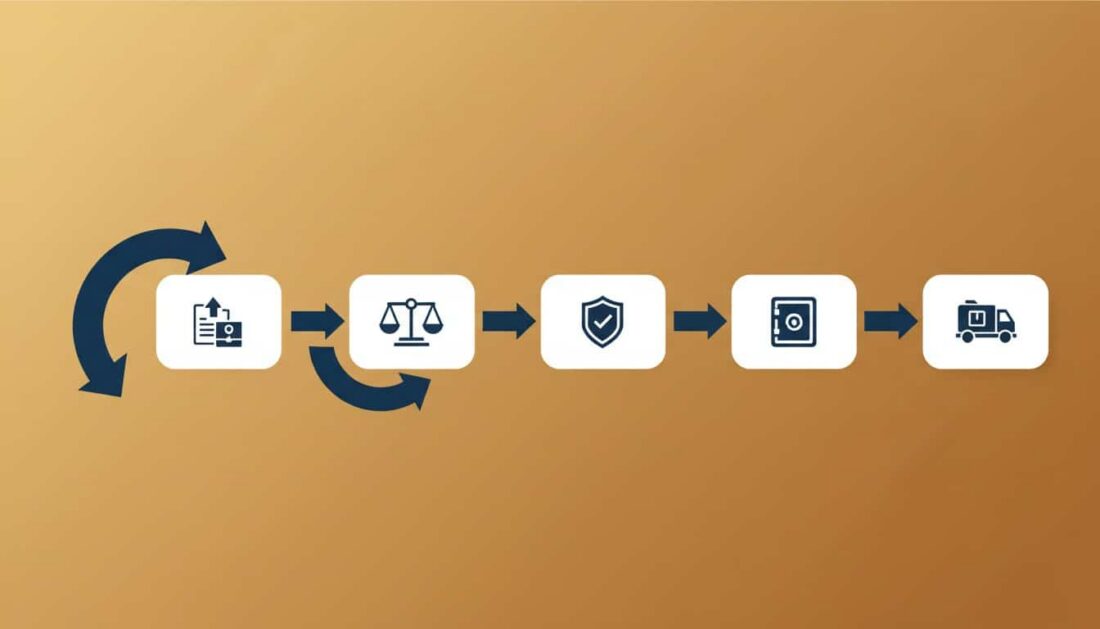
What does the process actually look like in practice?
It comes down to five steps. Each one involves coordination between you, your custodian, and the depository. None of them are complicated—but understanding the sequence helps you avoid delays and surprises.
Step 1: Submit Your Distribution Request
Everything starts with a form.
You’ll contact your IRA custodian and complete a distribution request—specifying that you want an in-kind distribution of physical metals, not cash.
Most custodians offer this form online or by mail. Some also require a phone confirmation.
You’ll typically list the specific metals you want—say, five 1-oz American Gold Eagles. You’ll also include your shipping address, your signature, and an acknowledgment of the tax implications.
One thing worth knowing early: start this process well before any deadline. If you’re fulfilling an RMD with a December 31 cutoff, submitting paperwork in late November is cutting it close. Custodians can’t rush what the IRS requires them to document.
Step 2: Fair Market Value Assessment
Once your custodian receives your request, they determine the Fair Market Value of your gold on that specific day.
This is the number that matters most—because it’s what the IRS uses to calculate your taxes.
It’s not based on the price you originally paid. It’s not based on the price the day you filled out the form. And it’s not the price the day the gold arrives at your house.
It’s the spot price on the exact day your custodian processes the distribution.
With gold near $5,000 per ounce, even a single coin creates a noticeable tax event. Five 1-oz Gold Eagles processed at $5,000 each? That’s $25,000 reported on your 1099-R.
That’s why some owners watch the market and time their request during a dip. A lower price on the processing date means a smaller number on the tax form.
Step 3: Custodian Approval and IRS Reporting
With the Fair Market Value calculated, your custodian handles everything the IRS needs to see.
That means confirming you’re age 59½ or older for a penalty-free distribution—or documenting an eligible exception if you’re younger.
It also means preparing Form 1099-R—the document that reports the value of your distribution. You’ll receive your copy by January 31 of the following year.
If this distribution counts toward your Required Minimum Distribution, the custodian updates those records too.
This step typically takes 1 to 5 business days. It can stretch longer if there are paperwork gaps or missing documentation.
Step 4: Depository Out-Shipment
Now the custodian tells the depository to release your metals.
At a facility like Delaware Depository—one of the largest precious metals depositories in the country—your specific coins or bars are pulled from the vault and verified against your account records.
From there, everything gets packaged in discrete, unmarked boxes. No logos. No labels that hint at what’s inside.
The depository arranges an insured carrier for pickup and provides you with a tracking number.
Delaware Depository carries $1 billion in all-risk insurance through Lloyd’s of London—plus up to $100,000 in per-package shipping coverage. That kind of protection gives real peace of mind during transit.
This step wraps up within 1 to 3 business days.
Step 5: Insured Delivery and Signature
Your gold ships via insured carrier—usually UPS, FedEx, or USPS registered mail—depending on the depository and the value of the shipment.
An adult must sign for the package in person. No exceptions. No leaving it on the porch.
Transit time runs 2 to 5 business days depending on your location.
When it arrives—open it immediately. Verify each coin or bar against your distribution paperwork. Confirm the type, quantity, and weight.
If anything looks off, photograph it right away and contact both your custodian and the depository.
What the IRS Needs to Know—and When

Taxes on in-kind distributions aren’t as complicated as they might sound. But they do require clarity—especially around one detail that trips people up more than anything else.
The Date That Determines Everything
Most people expect their tax bill to be based on the price they originally paid for the gold. Or the price the day it shows up at their door.
Neither is correct.
The IRS only cares about one number—the price on the day your custodian processes the distribution.
That’s the Fair Market Value. That’s what gets reported on Form 1099-R. And that’s what gets added to your taxable income for the year.
If you submit your request on March 1 but the custodian doesn’t process it until March 5—and gold jumped from $4,950 to $5,050 between those days—your tax bill is based on $5,050.
That difference adds up. Especially on larger distributions.
Traditional IRA vs. Roth IRA: Different Rules
How you’re taxed depends on the type of account you hold.
- Traditional IRA — The full Fair Market Value of the distributed gold is taxed as ordinary income in the year of distribution. No different from taking a cash withdrawal.
- Roth IRA — If you’ve held the account for at least five years and you’re 59½ or older, qualified distributions—including in-kind—are tax-free and penalty-free. That’s one of the biggest advantages of a Roth setup.
Either way, the custodian handles the reporting. You’ll receive your 1099-R by January 31 of the following year.
What Happens to Your Cost Basis After Delivery?
Once the gold leaves your IRA and enters your personal possession, the Fair Market Value on the distribution date becomes what’s called your “cost basis.” In plain terms—it’s your new starting price for tax purposes.
What does that mean down the road?
If you later sell those coins—say, a year from now when gold is trading even higher—any gain above that starting price gets taxed as a capital gain. For physical gold held longer than one year, the IRS treats it as a “collectible” and applies a rate that tops out at 28%.
And if the price drops and you sell at a loss? That loss may be deductible depending on your situation.
This is exactly the kind of detail worth discussing with a CPA or tax professional. Brighton doesn’t provide tax advice—but we’ll make sure you’re asking the right questions before you take that step.
RMDs and Physical Gold: How It Works in 2026

If you were born between 1951 and 1959, the IRS requires you to start taking Required Minimum Distributions from your traditional IRA—including a Gold IRA—the year you turn 73.
That’s the rule under the SECURE 2.0 Act. It bumped the starting age from 72 to 73 as of January 1, 2023. For those born in 1960 or later, the age jumps again to 75 starting in 2033.
But most people don’t realize—you don’t have to take your RMD in cash. You can take it in physical gold.
Taking Your RMD in Physical Metals
The IRS allows you to satisfy your RMD with an in-kind distribution. The Fair Market Value of the metals on the distribution date counts toward your required withdrawal for that year.
What does the timeline look like in practice?
- January — Calculate your RMD using your prior year-end account value and the IRS life expectancy factor from IRS Publication 590-B
- February–March — Decide whether you want to take your RMD in cash, physical metals, or a combination
- At least 60 days before your deadline — Contact your custodian to start the process. Metals distributions take longer than cash.
- After distribution — Keep every document. The valuation paperwork, the distribution form, and the 1099-R all matter at tax time.
Why the Math Doesn’t Always Line Up
Gold coins and bars come in fixed sizes. A 1-oz American Gold Eagle at $5,000 is worth $5,000—not $4,823 or $12,000.
If your RMD is $12,000, how do you take that in physical gold?
Two 1-oz Eagles would be $10,000—$2,000 short. Three would be $15,000—$3,000 over.
What most owners do is straightforward. Take physical metals for the bulk—and cash for the remainder—to hit the exact number.
| RMD Scenario | Approach | Result |
|---|---|---|
| RMD = $15,000, Gold = $5,000/oz | 3 coins ($15,000 FMV) | Exact match—fully satisfied |
| RMD = $12,000, Gold = $5,000/oz | 2 coins + $2,000 cash | Combination—fully satisfied |
| RMD = $8,000, Gold = $5,000/oz | 1 coin + $3,000 cash | Combination—fully satisfied |
| Taking more than RMD | 3 coins when RMD = $12,000 | Excess $3,000 still taxable |
One thing to keep in mind—if the Fair Market Value of the metals you take exceeds your RMD, the entire amount still counts as a distribution. And it’s all taxable as ordinary income.
The Takeaway: Don’t Wait on RMD Deadlines
Missing your RMD deadline triggers a 25% penalty—that’s a tax on the amount that wasn’t withdrawn. Under the old rules, it was 50%. The SECURE 2.0 Act brought it down. If you correct the error within two years, it drops further to 10%.
The key dates to know:
- First RMD — Due by April 1 of the year after you turn 73
- All subsequent RMDs — Due by December 31 of each year
- Important — If you delay your first RMD to that April 1 deadline, you’ll owe two RMDs in the same calendar year. That could push you into a higher tax bracket.
Since an in-kind distribution takes 7 to 14 business days to complete, don’t wait until December to get started. Give yourself—and your custodian—plenty of breathing room.
Shipping, Insurance, and What to Expect at Your Door

One of the most common concerns we hear from customers?
“Is it safe to have gold shipped to my house?”
It’s a completely reasonable question. And the answer is yes—as long as you’re working with a reputable custodian and depository that follow established protocols. Understanding how this works is part of identifying safe gold IRA practices from the very beginning.
How Major Depositories Handle Out-Shipments
Facilities like Delaware Depository and International Depository Services don’t treat precious metals shipments like ordinary packages. These are high-security operations—built for exactly this purpose.
- Discrete packaging — No logos, no markings, no indication of what’s inside. The box looks like any other delivery.
- Insured transit — Delaware Depository offers up to $100,000 in per-package shipping insurance, backed by their $1 billion all-risk policy through Lloyd’s of London.
- Adult signature required — The carrier won’t leave the package at the door. Someone 18 or older must sign in person.
- Real-time tracking — You’ll receive a tracking number so you can follow your shipment from the moment it leaves the vault.
Discrete packaging, full insurance, required signature, and tracking. That combination gives owners real peace of mind during the transit window.
What You Can Do: Your After-Delivery Checklist
The moment your package arrives, don’t set it aside. Open it right away.
- Verify the contents — Match every coin or bar against your distribution paperwork. Confirm the type, quantity, and weight.
- Inspect for damage — If anything looks off, photograph it immediately and reach out to both your custodian and the depository.
- Secure your metals — Move them to a safe, a bank safe deposit box, or a private vault right away. Understanding gold storage best practices helps you protect what you’ve worked to acquire.
- Notify your tax professional — Let your CPA know you’ve taken an in-kind distribution so they’re ready when the 1099-R arrives.
What Does Shipping Cost?
Fees depend on the depository, the carrier, and the total value of your metals.
| Fee Type | Typical Range |
|---|---|
| Custodian Distribution Fee | $25–$75 |
| Depository Shipping/Handling | $30–$150+ |
| Insurance | Included or value-based |
| Total Processing Time | 7–14 business days |
| Transit Time (Carrier) | 2–5 business days |
These fees are separate from any taxes you’ll owe on the distribution. It’s always worth asking your custodian for a complete fee breakdown before you submit your request—no surprises is the goal.
Understanding gold IRA fee structures ahead of time helps you plan with confidence.
When Taking Delivery Might Not Be the Right Move

We’ve covered how the process works—and it is straightforward. But does that mean physical delivery is always the right choice?
Not necessarily. Part of making a confident decision is weighing both sides with clear eyes. That includes evaluating the risks of precious metals ownership outside of a custodial account.
When Delivery Might Not Fit Your Situation
There are a few scenarios where taking physical delivery isn’t ideal:
- You’re under 59½ — The IRS treats any distribution before that age as an early withdrawal. You’d owe ordinary income tax on the full Fair Market Value plus a 10% penalty—unless you qualify for a narrow exception.
- You need the money quickly — In-kind distributions take 7 to 14 business days. If you need cash soon, a cash distribution is faster and more efficient.
- You don’t have a plan for storage — Once the gold is in your hands, securing it is entirely your responsibility. Without a quality home safe or a private vault, you’re taking on a risk that didn’t exist while the metals were sitting in the depository.
- You plan to sell soon anyway — If you’re going to turn around and sell the gold for cash, taking physical delivery adds shipping costs, handling time, and extra steps. A cash distribution cuts all of that out.
Why This Matters: The Case for Taking Delivery
What’s the cost of not taking delivery?
If you sell your gold at $5,000 per ounce to take a cash distribution, you’ve locked in that price. If gold keeps climbing—and many market watchers are projecting continued strength through 2026—you’ve walked away from whatever comes next.
An in-kind distribution preserves your position. You still owe taxes on the Fair Market Value at distribution—but you keep the gold. Any future change in value happens in your personal possession, outside the IRA system entirely.
For owners who see their gold as a long-term store of value—not a short-term transaction—that distinction matters.
Choosing the Right Coins and Bars for Delivery

Not every gold product in your IRA works the same way at delivery time.
The coins or bars you hold affect everything from shipping costs to how easily you can match an exact RMD amount. That’s why choosing the right IRA-approved gold coins is worth thinking about long before you’re ready to take delivery.
What Does the IRS Allow?
The IRS requires gold held in an IRA to meet a minimum purity of 99.5%. That applies to bars, rounds, and most coins.
There’s one well-known exception—the American Gold Eagle. It’s technically 22-karat (91.67% gold), but Congress specifically authorized it for IRA use. The coin contains the full stated weight of pure gold. The alloy just adds durability.
The most common IRA-approved gold products:
- American Gold Eagle — Available in 1 oz, ½ oz, ¼ oz, and 1/10 oz sizes. The most widely recognized U.S.-minted gold coin.
- American Gold Buffalo — 1 oz, 24-karat, .9999 fine. A favorite for owners who want maximum purity.
- Canadian Gold Maple Leaf — 1 oz, .9999 fine. Produced by the Royal Canadian Mint.
- Austrian Gold Philharmonic — 1 oz, .9999 fine. One of Europe’s most popular bullion coins.
- Gold bars — Must be .995+ fine, produced by an LBMA, COMEX, or NYMEX-approved refiner.
Why Fractional Coins Give You More Control
Taking delivery to fulfill an RMD? Trying to match a specific dollar amount?
Fractional coins make a real difference.
A 1/10 oz Gold Eagle at roughly $500 (at $5,000/oz gold) gives you much finer control than a full-size coin. It’s the difference between getting close to your number—and hitting it precisely.
| Coin Size | Approximate Value (at $5,000/oz) | Best For |
|---|---|---|
| 1 oz | ~$5,000 | Large distributions, long-term holding |
| ½ oz | ~$2,500 | Moderate distributions |
| ¼ oz | ~$1,250 | Precise RMD matching |
| 1/10 oz | ~$500 | Fine-tuning exact amounts |
Smaller coins do carry a higher premium per ounce than their full-size counterparts. But the flexibility they provide when it’s time to distribute often more than makes up for the added cost.
This is one of those decisions that’s easier to make early—when you’re still acquiring metals for your IRA—rather than when you’re staring down an RMD deadline.
Frequently Asked Questions
Can I take physical delivery of my gold before age 59½?
You can—but it’s expensive.
The IRS treats any distribution before 59½ as an early withdrawal. That means you’d owe ordinary income tax on the Fair Market Value of the gold, plus a 10% early withdrawal penalty on top.
There are a few narrow exceptions—permanent disability, certain medical expenses, or substantially equal periodic payments under IRS Rule 72(t). But for most people, the tax hit makes it hard to justify.
Thinking about it? Consult your CPA or tax professional first. The math might surprise you.
How much does it cost to have gold shipped from a depository to my home?
It depends on the depository, the total value of your metals, and the carrier.
Most depositories charge a flat shipping and handling fee plus insurance based on shipment value. Delaware Depository offers insured shipping with up to $100,000 per-package coverage. Your custodian may also charge a processing or distribution fee on their end.
All told, expect somewhere between $50 and $300+. Ask for a detailed breakdown before you submit your request.
Does the IRS know when I take physical possession of my gold?
Yes. Your custodian is required to report the distribution to the IRS on Form 1099-R.
That form documents the Fair Market Value on the date the distribution was processed—not the day you receive it. You’ll get your copy by January 31 of the following year.
Keep it with your tax records and share it with your CPA or tax professional during filing season.
Is an in-kind distribution taxed as capital gains or ordinary income?
Ordinary income.
The full Fair Market Value on the distribution date is added to your taxable income for that year. It works the same as a cash distribution from a traditional IRA.
But once the gold is in your personal possession, the rules shift. Any change in value from that point forward falls under capital gains rules if you sell. Your new starting price for tax purposes becomes the Fair Market Value on the distribution date—and for physical gold held longer than a year, the IRS applies a rate that tops out at 28%.
How long does the shipping process take once I submit my distribution request?
Plan for 7 to 14 business days from request to delivery.
Custodian verification takes 1 to 3 business days. IRS reporting and processing takes 2 to 5 business days. Depository out-shipment takes 1 to 3 business days. Carrier transit takes 2 to 5 business days.
Delays usually come from incomplete paperwork or address verification issues. Starting early—especially before an RMD deadline—takes the pressure off.
Can I fulfill my entire RMD by taking physical gold instead of cash?
Yes. The IRS allows you to satisfy your RMD with an in-kind distribution. The Fair Market Value of the metals on the distribution date counts toward your required withdrawal for the year.
The tricky part is matching the exact dollar amount. Gold coins come in fixed sizes, so the value may land above or below your RMD number.
Many owners handle this by taking metals for the bulk and cash for the remainder. Simple way to hit the target precisely.
What happens to my gold during shipping—is it insured?
Yes. Reputable depositories use insured carriers with up to $100,000 per-package coverage. The packaging is intentionally unmarked—nothing on the outside signals what’s inside.
An adult must sign for the delivery. And most depositories provide a tracking number so you can follow the shipment in real time.
The $1 billion all-risk insurance policy at facilities like Delaware Depository—underwritten through Lloyd’s of London—covers your metals both in storage and in transit.
Can I take delivery of gold from a Roth IRA without paying taxes?
Potentially, yes—and that’s one of the reasons Roth Gold IRAs are so appealing.
If you’re 59½ or older and your Roth IRA has been open for at least five years, qualified distributions—including in-kind—are completely tax-free and penalty-free. The 1099-R still gets filed, but the taxable amount should show zero.
If you don’t meet both requirements, taxes and penalties may apply to the earnings portion. Consult your CPA or tax professional for guidance specific to your situation.
Taking Control of What’s Yours
Taking delivery of gold from your IRA is one of those moments where everything becomes real. The metals you’ve been acquiring—the coins you’ve been watching grow in value inside a secure vault—are now in your hands.
The process to get there is clear. Submit the request. Let your custodian handle the valuation and IRS reporting. Wait for your depository to ship everything through insured transit. Seven to fourteen days, start to finish.
Getting it right means understanding the details—the processing date that determines your taxes, the RMD math that accounts for fixed coin sizes, and the plan you’ll need for secure storage once the gold arrives.
Precious metals may appreciate, depreciate, or remain unchanged. Brighton doesn’t provide financial, legal, or tax advice. Consult your CPA or tax professional for guidance specific to your situation.
Ready to Take the Next Step?
If you’re thinking “this all makes sense, but I don’t have time to figure it out on my own,” you’re not alone. Most customers we work with felt the same way before they realized how seamless the process can be with the right guidance.
That’s why we offer a complimentary consultation to walk you through your options—including our No Fee Precious Metals IRA, which covers custodial fees for the lifetime of the account on qualified purchases.
We’ll show you exactly:
- How the No Fee IRA works and whether you qualify
- The difference between U.S.-minted coins and foreign alternatives
- What to expect from the purchasing and delivery process
- How to roll over or transfer existing retirement funds
- What ongoing support looks like after your purchase
Learn About the No Fee IRA — no obligation, just actionable insights you can use whether you work with us or not.
Your gold. Your timeline. We’re here when you’re ready.