
How Do I Transfer My IRA to a Self-Directed Gold IRA? (2026 Step-by-Step)
If you’ve been watching your IRA statements and wondering whether there’s a way to hold something more tangible — you’re not alone.
Here’s the good news. Transferring an existing IRA to a self-directed Gold IRA is straightforward and IRS-sanctioned.
When it’s done as a direct trustee-to-trustee transfer, it’s non-taxable. The funds move between custodians without touching your personal bank account. No 10% early withdrawal penalty. No 20% mandatory withholding. No limit on how many transfers you can do per year.
That last part surprises most people. The IRS one-rollover-per-year rule only applies to indirect rollovers — where you personally receive a check and redeposit it within 60 days. Direct transfers? Completely different mechanism under IRS Publication 590-A. They’re unlimited.
Gold is trading near $5,040 per ounce as of mid-February 2026. That’s up more than $2,100 from a year ago. Central banks are still accumulating physical metal at historically elevated levels. Interest in understanding gold IRA funding methods has never been higher.
But interest without clarity leads to hesitation. And hesitation, in a market moving this fast, has a real cost.
This guide walks you through every step. The difference between a transfer and a rollover. What the IRS requires. A realistic timeline. Everything you need to move forward with confidence.
Why More Americans Are Moving Their IRAs to Physical Gold in 2026

Something fundamental has shifted in how Americans think about retirement.
It’s not just about returns anymore. It’s about what those returns are actually worth when you go to spend them.
A strong quarterly statement from your brokerage doesn’t always mean stronger purchasing power. When the dollar buys less every year, those numbers on the screen can be misleading. That disconnect is driving more people to look beyond paper-denominated accounts.
The Purchasing Power Question
The numbers tell a clear story.
Gold went from roughly $2,935 per ounce in February 2025 to approximately $5,040 in February 2026. That’s a gain of over 71% in twelve months. During that same stretch, the dollar’s purchasing power kept eroding under persistent inflationary pressures.
Central banks noticed.
According to the World Gold Council’s 2025 demand report, total global gold demand exceeded 5,000 tonnes for the first time ever. Central bank acquisitions alone totaled 863 tonnes. Poland, Kazakhstan, and Brazil were among the most aggressive buyers.
Think about that for a moment. Sovereign institutions — with access to every product on earth — are choosing to hold more physical gold. Not paper gold. Not ETFs. Physical metal in vaults. That’s worth paying attention to.
What Does This Mean for Your IRA?
Most traditional IRAs hold mutual funds, money market accounts, and other dollar-denominated assets. Every one of those is tied to the value of the dollar.
If you’re retired or nearing retirement, the question isn’t just “will my account go up?”
It’s this — “Will my account buy the same things in ten years that it buys today?”
That’s the core reason behind the surge in IRA-to-Gold-IRA transfers. People aren’t abandoning their retirement accounts. They’re redirecting a portion into something tangible. Something that doesn’t depend on the fiscal discipline of governments or the stability of banking systems.
The good news? The IRS has made this process straightforward. You just have to follow the rules.
The 3-Step Gold IRA Transfer Process

The entire process can be completed in as little as two weeks. Here’s how it works.
Step 1: Choose a Self-Directed IRA Custodian
A traditional IRA custodian — like your bank or brokerage — limits your options to paper-denominated assets like mutual funds and money market accounts. To hold physical gold, you need a self-directed IRA (SDIRA) custodian that handles alternative assets.
The IRS maintains a list of approved nonbank trustees and custodians under Treasury Regulation Section 1.408-2(e). Your custodian needs to be on this list or qualify as a bank entity.
So what should you look for?
- Transparent fee structure — Some custodians charge a flat rate regardless of account value. Others increase fees as holdings grow. Flat-fee structures are more predictable and more cost-effective for larger accounts.
- Established depository partnerships — Look for recognized, insured facilities like Delaware Depository, Brink’s, or International Depository Services. Ask whether segregated storage is available.
- Processing speed and support — How fast your custodian moves directly impacts your transfer timeline. Look for reviews that mention responsiveness and clear communication.
- Precious metals experience — Not all SDIRA custodians handle physical metals. Some focus on real estate or private equity. Make sure metals are a core part of their business.
For a closer look at how costs compare across custodians, this guide on understanding gold IRA fee structures breaks it down.
Step 2: Initiate the Direct Trustee-to-Trustee Transfer
Once your new SDIRA account is open, your custodian provides a Transfer Authorization Form. Some call it a Transfer Request Form or Letter of Authorization. Same thing.
This form tells your current IRA custodian to send funds directly to the new one.
Here’s the critical detail — you never touch the money. It moves from Institution A to Institution B without passing through your hands. That’s what makes it a direct transfer. And that’s why it’s not taxable.
The process works like this:
- Complete the Transfer Authorization Form — Include your current custodian’s name, account number, and the amount you want to transfer. Full or partial.
- Your new custodian submits the request — Some handle it electronically. Others use fax or mail. Most outgoing transfers take 5 to 10 business days.
- Funds arrive in your SDIRA — Your new custodian notifies you when the money has landed and is ready for purchases.
One thing to keep in mind. If your current IRA holds paper-denominated positions like mutual funds, those may need to be liquidated first. That can add a few business days. Plan accordingly.
Step 3: Select and Purchase IRS-Approved Gold
With funds in your SDIRA, you’re ready to buy physical gold. Your custodian coordinates the transaction between you, the dealer, and the depository.
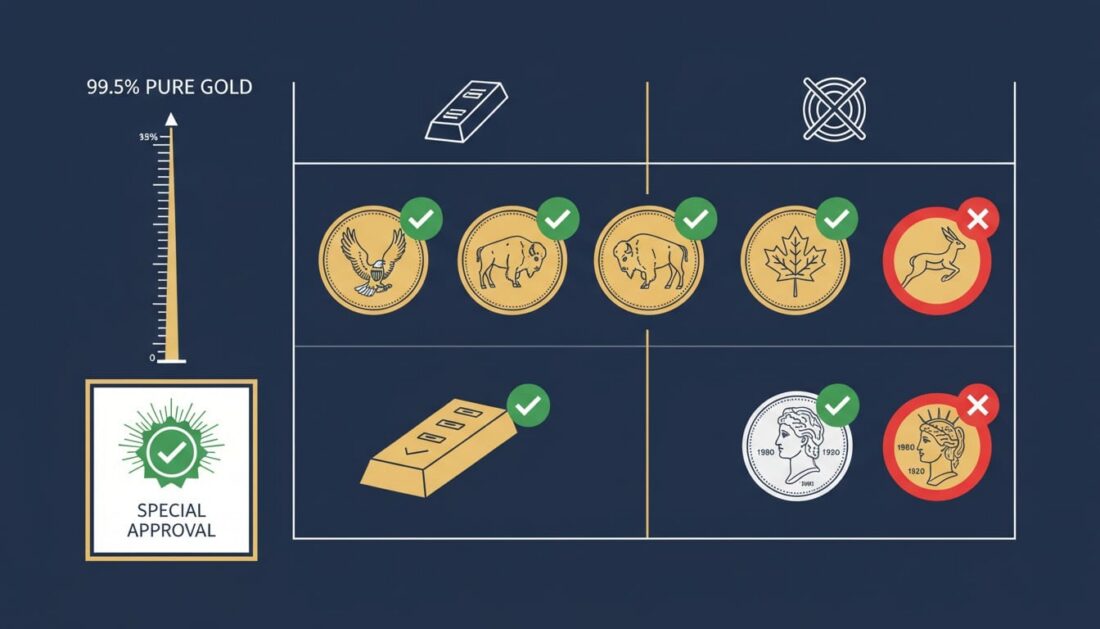
The IRS requires gold in an IRA to meet a minimum purity of 99.5% under IRC Section 408(m)(3). One notable exception? The American Gold Eagle — 91.67% pure, but specifically approved by Congress.
Popular IRS-approved products include:
- American Gold Eagle (1 oz, 1/2 oz, 1/4 oz, 1/10 oz) — The most recognized U.S.-minted gold coin. It carries a Congressional exemption and the full weight guarantee of the U.S. Mint.
- American Gold Buffalo (1 oz) — America’s first 24-karat gold coin. 99.99% purity. Produced by the U.S. Mint since 2006.
- Canadian Gold Maple Leaf (1 oz) — 99.99% purity from the Royal Canadian Mint. Includes advanced anti-counterfeiting features with a micro-engraved laser mark.
- Qualifying gold bars from COMEX-approved refiners — Must meet the 99.5% minimum with proper assay certification.
Brighton’s product comparison guide covers choosing IRS-approved gold coins — how they stack up in liquidity and premium.
After purchase, the dealer ships your gold to the IRS-approved depository designated by your custodian. You’ll get confirmation once the metals arrive and are logged into your account.
Direct Transfer vs. Indirect Rollover: Which One Should You Use?
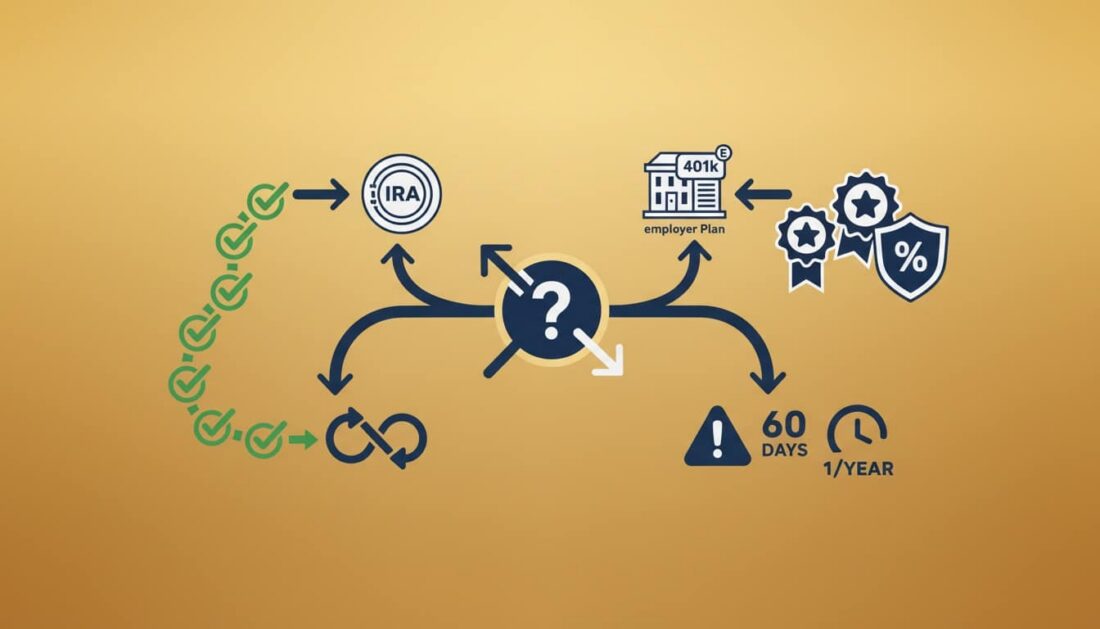
This might be the most misunderstood part of the entire process.
“Transfer” and “rollover” get tossed around like they mean the same thing. Under IRS rules, they don’t. They’re two different transactions with very different consequences.
Getting this right can save you thousands.
How a Direct Transfer Works
A direct transfer — sometimes called a trustee-to-trustee transfer — is the simplest way to move IRA funds.
Money goes straight from your old custodian to your new custodian. You never see it. Never deposit it. Never report it as a distribution.
Why does that matter?
- No tax withholding — Zero dollars withheld. The funds never pass through your hands.
- No annual limit — Do as many direct transfers as you need. The one-per-year rule doesn’t apply.
- No 60-day deadline — You never take possession, so there’s no clock ticking.
- No IRS reporting — Direct transfers between same-type IRAs aren’t reported as distributions.
How an Indirect Rollover Works
An indirect rollover is different. Your current custodian sends the funds to you — not to the new custodian. You then have exactly 60 calendar days to deposit the full amount into your new account.
This comes with real risks:
- 20% mandatory withholding on employer plans — Rolling over from a 401(k)? Your plan administrator withholds 20% for federal taxes. Even if you plan to complete the rollover. You’d need to come up with that 20% from other funds to avoid getting taxed on the shortfall.
- 10% optional withholding on IRAs — Your custodian may withhold 10% unless you opt out.
- One-per-year rule — The IRS allows only one indirect rollover in any 12-month period. Across all your IRAs combined.
- 60-day deadline is absolute — Miss it, and the entire amount becomes taxable. Under 59½? Add a 10% early withdrawal penalty.
Side-by-Side Comparison
| Feature | Direct Transfer (IRA-to-IRA) | Indirect Rollover (60-Day) |
|---|---|---|
| Funds touch your hands? | No — custodian to custodian | Yes — paid to you first |
| Tax withholding | None | 10% IRA / 20% employer plan |
| Annual limit | Unlimited | One per 12 months (all IRAs) |
| Time deadline | None | 60 calendar days |
| IRS reporting | Not reported as distribution | Reported on Form 1099-R |
| Risk of penalties | Minimal | Significant if deadline missed |
For most people moving an IRA into a Gold IRA, the direct transfer is the clear choice. Cleaner. Faster. Eliminates nearly every tax-related risk.
Got a 401(k) instead of an IRA? You’d need a rollover — but the right move is still a direct rollover where your plan administrator sends funds straight to the SDIRA custodian. This guide covers executing a penalty-free 401k rollover in detail.
What the IRS Requires: Custodians, Storage, and Eligible Metals
The IRS doesn’t take a casual approach to precious metals in retirement accounts.
There are specific rules about who can hold your gold. Where it has to be stored. What products qualify.
Understanding these upfront prevents costly mistakes.
Who Holds Your Gold?
Under IRC Section 408(a), IRA assets must be held by a qualified trustee or custodian. For precious metals, that means a bank or a nonbank entity approved under Treasury Regulation Section 1.408-2(e).
Standard brokerages like Fidelity or Schwab won’t custody physical gold. You need a self-directed custodian with depository relationships and regulatory standing to manage tangible assets.
Here’s what a custodian handles on your behalf:
- Processing transfer paperwork and coordinating with your previous custodian
- Holding legal title to the metals in the name of your IRA
- Coordinating purchases and deliveries to the depository
- Providing annual account valuations and IRS reporting (Form 5498)
- Facilitating distributions when you’re ready
Why Home Storage Isn’t an Option
This is where people run into trouble.
You can’t store IRA-owned gold at home. Not in a safe. Not in a safety deposit box. Not through an LLC structure you control.
The IRS is clear on this. Under IRC Section 408(m)(3)(B), qualifying precious metals must remain in the physical possession of the IRA trustee or an approved depository. Store them yourself? That creates a prohibited transaction under IRC Section 4975. It can disqualify your entire IRA — making every dollar immediately taxable.
That’s not theoretical. The IRS enforced this in the McNulty case (Tax Court, November 2021). They’ve continued pursuing similar violations since.
IRS-approved depositories include the Delaware Depository, Brink’s Global Services, and International Depository Services. These facilities provide:
- Fully insured storage with Lloyd’s of London or comparable coverage
- Segregated or non-segregated options — segregated keeps your metals physically separate from other owners’
- Annual audits and reporting that satisfy IRS requirements
- Physical security including biometric access, armed guards, and 24/7 surveillance
What Gold Qualifies for an IRA?
Not every gold product makes the cut. The IRS draws a hard line between “collectibles” (prohibited) and “qualifying precious metals” (allowed).
| Product | Purity | IRS Status | Notes |
|---|---|---|---|
| American Gold Eagle | 91.67% (22k) | Approved — Congressional exception | Only U.S. coin exempt from 99.5% rule |
| American Gold Buffalo | 99.99% (24k) | Approved | First 24-karat U.S. gold coin |
| Canadian Gold Maple Leaf | 99.99% | Approved | Includes micro-engraved security features |
| Austrian Gold Philharmonic | 99.99% | Approved | Europe’s most popular gold coin |
| Gold bars (COMEX-approved) | 99.5%+ | Approved | Must carry assay certificate |
| South African Krugerrand | 91.67% | Not approved | Doesn’t have a Congressional exception |
| Pre-1933 U.S. gold coins | Varies | Not approved | Classified as collectibles |
The rule of thumb? Stick to U.S.-minted products when possible. Strongest recognition. Most straightforward compliance. Widest acceptance for future liquidity.
For more on identifying safe gold IRA practices and spotting scams in the precious metals space, Brighton’s safety guide covers what every owner should know.
Your Transfer Timeline: What to Expect

One of the biggest concerns people have is time.
Gold has been moving $50 to $100 in a single session — multiple times in early 2026. Every day between “I’ve decided” and “I own gold” can feel like exposure.
Here’s a realistic breakdown.
The Standard Timeline
| Phase | Timeframe | What Happens |
|---|---|---|
| Day 1-3 | SDIRA account opening | Complete application, verify identity, designate beneficiaries |
| Day 3-5 | Transfer paperwork submitted | New custodian sends transfer authorization to your current custodian |
| Day 5-14 | Funds in transit | Your old custodian processes the outgoing transfer via wire or ACH |
| Day 14-17 | Gold purchase executed | Work with your dealer to select and purchase metals |
| Day 17-21 | Depository receipt confirmed | Dealer ships metals to depository; custodian confirms receipt |
Total: 14 to 21 business days from application to gold in a secure depository.
For more on the setup phase, this guide on executing a precious metals IRA rollover covers the timeline in depth.
What Can Slow Things Down?
Not every transfer moves at the same pace. A few common factors add days:
- Slow outgoing custodian — Some large brokerages take 7 to 10 business days. Others finish in 2 to 3. Call your current custodian first. Ask about their turnaround time.
- Positions that need liquidating — If your IRA holds paper-denominated assets like mutual funds, those have to be sold and settled as cash first. That’s usually 1 to 2 extra business days.
- Incomplete paperwork — The most avoidable delay. Double-check account numbers, custodian details, and your signature. One missing field can add a week.
- Medallion signature guarantee — Some custodians require this for large transfers. It has to come from a participating financial institution. A standard notary won’t work.
Best way to speed things up? Get your SDIRA account open and transfer paperwork submitted before you finalize metal selections. That way, the purchase happens the moment funds arrive.
How to Fund Your Gold IRA: All Your Options

A direct transfer isn’t the only way to fund a Gold IRA. You’ve got several paths depending on your situation.
Direct Transfer (IRA-to-IRA)
This is the method we’ve been walking through. It moves funds from one Traditional IRA to another Traditional IRA. Or Roth to Roth. Same account type, different custodian.
Best for: People who already have an IRA at a brokerage and want to move some or all of it into physical gold. No tax consequences.
Direct Rollover (401(k), 403(b), TSP to IRA)
Retirement funds in an employer-sponsored plan? A direct rollover sends them straight from your plan administrator to your SDIRA custodian. The money doesn’t pass through your hands — but it’s classified as a rollover, not a transfer.
The key distinction — your plan has to allow it. Most do after separation from employment. Some also permit in-service distributions at age 59½. That means you can roll funds into a Gold IRA while still working.
Best for: People with an old 401(k) from a former employer. Or those who qualify for in-service distributions from their current plan.
Annual Contributions
You can fund your Gold IRA through regular contributions too. For 2026, the IRS limits are:
- $7,500 per year if you’re under 50
- $8,600 per year if you’re 50 or older (catch-up contribution)
These apply across all your IRAs combined. Contribute $4,000 to a Traditional IRA at your brokerage? You can put up to $3,500 (or $4,600 if 50+) into your Gold IRA.
Best for: People who want to build a position gradually. Or those without a large existing IRA to transfer.
You Don’t Have to Move Everything
One of the most common misconceptions? That you have to transfer your entire balance. You don’t.
Partial transfers let you redirect a specific amount. 10%. 25%. 50%. Whatever fits. The rest stays exactly where it is.
There’s no IRS-mandated minimum. Your custodian may have their own (typically $5,000 to $25,000), but that varies by institution.
This gives you clarity and control over how your retirement is positioned — without an all-or-nothing decision.
What Happens After the Transfer

The transfer is the beginning. Not the end.
Once your gold is purchased and stored, there are a few things every owner should know.
Ongoing Account Costs
A self-directed Gold IRA carries a few annual fees:
- Custodian administration fee — Typically $50 to $300 per year. Covers account maintenance, IRS reporting, and recordkeeping.
- Storage fee — Usually $100 to $300 per year. Depends on segregated vs. non-segregated. Segregated costs more but keeps your metals separate from other owners’.
- Insurance — Most depositories include coverage in the storage fee. Worth confirming with your custodian.
These costs are real. But they’re predictable. And for many owners, the peace of mind of holding something tangible — something that isn’t a counterparty obligation — more than justifies the annual expense.
It’s worth noting that precious metals may appreciate, depreciate, or remain unchanged in value. Resale values depend on market conditions at the time of sale.
Brighton’s guide on understanding gold IRA fee structures offers a detailed side-by-side comparison.
How You Access Your Gold in Retirement
When it’s time to take distributions — at 59½ or later — you’ve got options:
- Cash distribution — Your custodian sells the gold at current market prices. You receive the cash equivalent, minus applicable taxes.
- In-kind distribution — You receive the physical gold itself. It ships directly from the depository to you. Fair market value on the distribution date counts as taxable income for Traditional IRAs.
- Required Minimum Distributions (RMDs) — At age 73, you must take annual RMDs from Traditional IRAs. You can fulfill these by liquidating a portion of your gold or by taking in-kind distributions.
For a complete overview, this guide on executing a precious metals IRA distribution covers all the options.
Tracking Your Account Value
Your Gold IRA value ties to the spot price of the metals you hold. Your custodian provides annual valuations for IRS reporting. Most update values quarterly or monthly.
FMVgold.com helps you track fair market value between statements. Brighton’s weekly Market Recap provides current pricing context and market intelligence for existing owners.
Frequently Asked Questions
How long does it take to transfer an IRA to a Gold IRA?
A direct trustee-to-trustee transfer typically takes 7 to 14 business days for funds to arrive. The full process — opening the SDIRA to gold in a depository — usually runs 14 to 21 business days.
The biggest variable? Your current custodian’s processing speed. Some finish in 2 to 3 days. Others take two full weeks. Worth calling ahead to ask.
Is a Gold IRA transfer a taxable event?
No. A direct trustee-to-trustee transfer between same-type IRAs isn’t taxable. The funds move between institutions. No distribution. No withholding. Nothing to report.
This only applies to direct transfers. Indirect rollovers — where funds are paid to you first — have different rules, including potential withholding and the 60-day deadline. Consult your CPA or tax professional for guidance specific to your situation.
Can I transfer only a portion of my existing IRA to gold?
Yes. Partial transfers are allowed and common. No IRS requirement to move your full balance.
Many owners start with 10% to 25%. Your Transfer Authorization Form includes a field for the exact dollar amount or percentage. The rest stays at your current custodian.
Do I have to pay 20% withholding on an IRA-to-IRA transfer?
No. The 20% withholding only applies to distributions from employer-sponsored plans paid directly to you. A direct IRA-to-IRA transfer has zero withholding.
Even IRA-to-IRA indirect rollovers only carry 10% withholding — and you can opt out. But with a direct transfer, withholding doesn’t apply at all. You never take possession of the funds.
How many times a year can I transfer my IRA to a self-directed gold account?
There’s no limit. Direct transfers are unlimited.
The one-per-year rule — IRC Section 408(d)(3)(B) — only applies to indirect rollovers. Direct transfers are a completely separate category. Exempt from the restriction.
Can I transfer my 401(k) to a Gold IRA while still employed?
Possibly. It depends on whether your plan allows in-service distributions.
Many 401(k)s permit these once you reach age 59½. If yours does, you can initiate a direct rollover to a self-directed IRA without leaving your job.
Not all plans offer this. Check your Summary Plan Description (SPD) or call your plan administrator. If your plan doesn’t allow it, you’d wait until you separate from that employer.
What types of gold can I hold in a self-directed IRA?
The IRS requires 99.5% minimum purity under IRC Section 408(m)(3). One exception — the American Gold Eagle (91.67% pure) is specifically approved by Congress.
Common approved products: American Gold Buffalo, Canadian Gold Maple Leaf, Austrian Gold Philharmonic, Australian Gold Kangaroo, and gold bars from COMEX-approved refiners with proper assay certification.
All IRA gold must be stored at an IRS-approved depository. Home storage is prohibited. It would disqualify the entire account.
What’s the difference between a direct transfer and an indirect rollover?
Direct transfer — funds move between custodians. You never touch the money. Non-taxable. No deadline. No withholding. No annual limit.
Indirect rollover — funds come to you first. You have 60 days to redeposit. Subject to the one-per-year rule. Potential withholding. Risk of penalties if you miss the window.
For most people moving an IRA to a Gold IRA, the direct transfer is simpler, safer, and more efficient.
The Bottom Line
Transferring your IRA to a self-directed Gold IRA in 2026 is well-defined and IRS-sanctioned. Choose an approved custodian. Initiate a direct transfer. Select qualifying gold.
Done correctly, it’s non-taxable. No annual limit. Completed in two to three weeks.
The harder part isn’t the paperwork. It’s the decision.
What portion of your retirement should be in something you can hold? Something without counterparty risk? Something central banks around the world are actively accumulating?
That’s a decision only you can make. But the process itself? More straightforward than most people expect.
Ready to move forward — but not sure where to start?
If you’re thinking “this all makes sense, but I don’t have time to figure it out on my own,” you’re not alone. Most customers felt the same way before they realized how seamless the process can be with the right guidance.
That’s why we offer a complimentary consultation to walk you through your options — including our No Fee Precious Metals IRA, which covers custodial fees for the lifetime of the account on qualified purchases.
We’ll show you exactly:
- How the No Fee IRA works and whether you qualify
- The difference between U.S.-minted coins and foreign alternatives
- What to expect from the purchasing and delivery process
- How to roll over or transfer existing retirement funds
- What ongoing support looks like after your purchase
Learn About the No Fee IRA — no obligation, just actionable insights you can use whether you work with us or not.
Your retirement savings took decades to build. Securing a portion in physical gold takes a few weeks.