
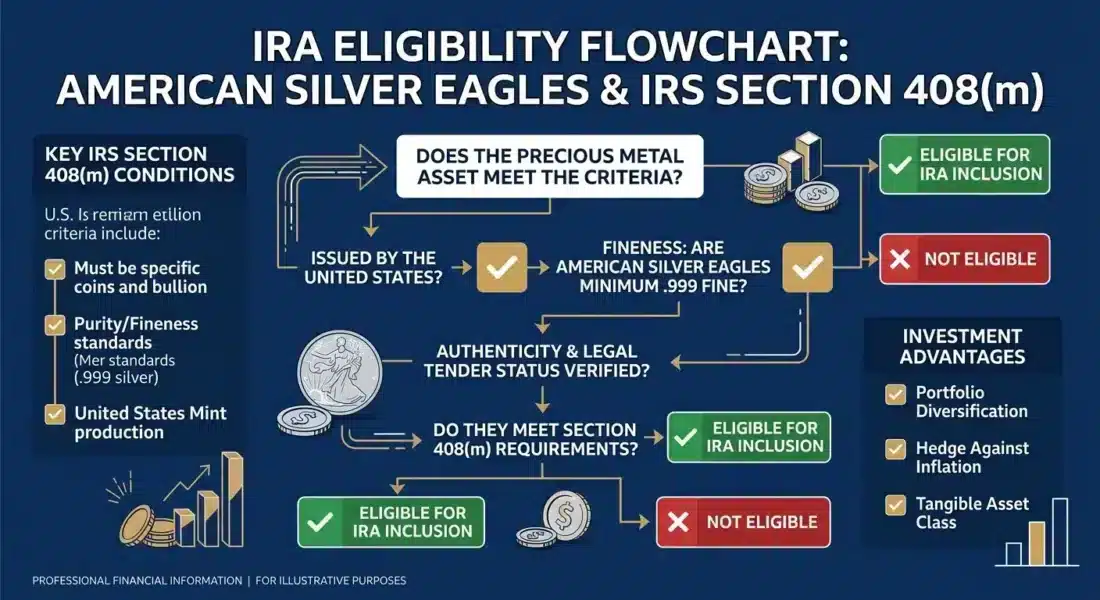
Why Are U.S. American Silver Eagles the Standard for Silver Owners?
U.S. American Silver Eagles are the standard for physical silver ownership because no other silver coin combines sovereign backing, verified purity, universal liquidity, and retirement account eligibility in a single product. Each coin contains exactly one troy ounce of 99.9% pure silver, struck by the United States Mint and carrying a legal tender face value of $1 — a direct sovereign guarantee from the U.S. government.
That guarantee has real consequences. When Congress authorized the Silver Eagle program, it created a coin the federal government certifies for weight, purity, and authenticity. Dealers recognize it without hesitation. Custodians accept it without question. And the IRS grants a specific exception under Section 408(m)(3) of the Internal Revenue Code — allowing American Silver Eagles inside self-directed IRAs, an eligibility most silver products do not share.
Physical silver pricing is anchored to global spot markets through major financial institutions and exchanges. The American Silver Eagle trades directly against that benchmark. No contract. No counterparty. No leveraged position. The CFTC has cautioned buyers about the risks of virtual and leveraged precious metals accounts, recommending physical coin delivery as the cleaner path to genuine ownership.
Silver also carries industrial demand that runs independently of financial markets — giving the metal utility across economic environments, not just favorable ones. The American Silver Eagle captures that fundamental value in a form the U.S. government stands behind, the IRS recognizes for retirement accounts, and buyers worldwide accept without hesitation.
- What Makes an American Silver Eagle Different From Other Silver?
- Why Most Silver Buyers Overlook the Liquidity Gap
- How American Silver Eagles Qualify for a Self-Directed IRA
- How to Evaluate Premiums, Pricing, and the Real Cost of Ownership
-
Frequently Asked Questions About American Silver Eagles
- Are American Silver Eagles legal tender in the United States?
- Why does the IRS allow American Silver Eagles in a self-directed IRA while banning other collectibles?
- How does the liquidity of American Silver Eagles compare to private silver rounds?
- What is the premium on American Silver Eagles and is it worth the cost?
- Can I take physical home delivery of Silver Eagles from my retirement account?
- The Silver Standard Is Already Set
What Makes an American Silver Eagle Different From Other Silver?

Not all silver is created equal.
That distinction isn't academic. It becomes very real the moment you try to do something serious with what you own.
The silver market is full of products. Rounds, bars, foreign coins, privately minted pieces — most of them contain real metal.
But containing silver and being the standard for silver ownership are two entirely different things.
What separates an American Silver Eagle from everything else isn't just what's inside the coin. It's who stood behind it when it was made.
Those distinctions don't evaporate when silver prices move. They're built into the coin's legal architecture — and they matter most exactly when you need them.
The Specifications That Set the Standard
Every American Silver Eagle contains exactly one troy ounce of 99.9% pure silver, weighing 31.103 grams.
That's not a manufacturer's claim. It's not a private assay. It's a federal specification — set by Congress and enforced by the U.S. Mint specifications.
No private mint operates at that level of institutional accountability.
The coin also carries a legal tender face value of one dollar.
That's more than symbolic. It means the U.S. government has formally certified this coin's authenticity — weight, purity, and origin.
That's the sovereign guarantee. Dealers recognize it on sight. Custodians accept it without question. Buyers worldwide don't need to verify it, because the federal government already did.
That sovereign backing is exactly why the IRS treats Silver Eagles differently from virtually every other silver product on the market.
It's not a loophole. It's not a technicality. The coin's legal standing was built in — and that's why understanding physical silver retirement protection
Why Most Generic Silver Products Fall Short
Generic silver products carry metal.
They don't carry a government's name.
Private mint rounds and foreign bullion coins clear purity thresholds. But clearing a threshold isn't the same as carrying sovereign certification.
That difference shows up at every handoff — when you sell, when you transfer, when you try to place a coin inside a retirement account. Without federal backing, every transaction triggers a new round of verification.
That friction cost doesn't announce itself upfront. It compounds quietly, every time the coin changes hands.
If you're evaluating where to buy physical silver, the purity numbers across products may look similar on paper.
But the legal standing, the global recognition, and the retirement account eligibility aren't things a private mint can replicate.
They didn't originate in a factory. They originated in an act of Congress.
| Feature | American Silver Eagle | Generic Private Round | Foreign Silver Coin |
|---|---|---|---|
| Issuing Authority | United States Mint — federal government | Private manufacturer — no sovereign backing | Foreign national mint — non-U.S. government |
| Purity Certification | Federally mandated and enforced by Congress | Self-certified by private assayer | Varies by country — no U.S. federal verification |
| Legal Tender Status | Yes — $1 USD face value backed by U.S. government | None — no legal tender designation | Varies — not recognized as U.S. legal tender |
| SDIRA Eligibility | Yes — IRS-approved under Section 408(m)(3) exception | No — excluded as a collectible under IRS rules | Generally no — most foreign coins do not qualify |
| Global Dealer Recognition | Instant — universally accepted without additional verification | Limited — requires independent verification at each transaction | Inconsistent — acceptance varies by dealer and region |
| Ownership Chain Friction | Minimal — sovereign certification travels with the coin | High — each resale or transfer may require re-authentication | Moderate to high — provenance questions arise outside home market |
| Liquidity at Point of Sale | Highest — recognized by dealers, custodians, and buyers worldwide | Lower — buyer pool limited to those familiar with the mint | Variable — strongest in country of origin, weaker globally |
Why Most Silver Buyers Overlook the Liquidity Gap
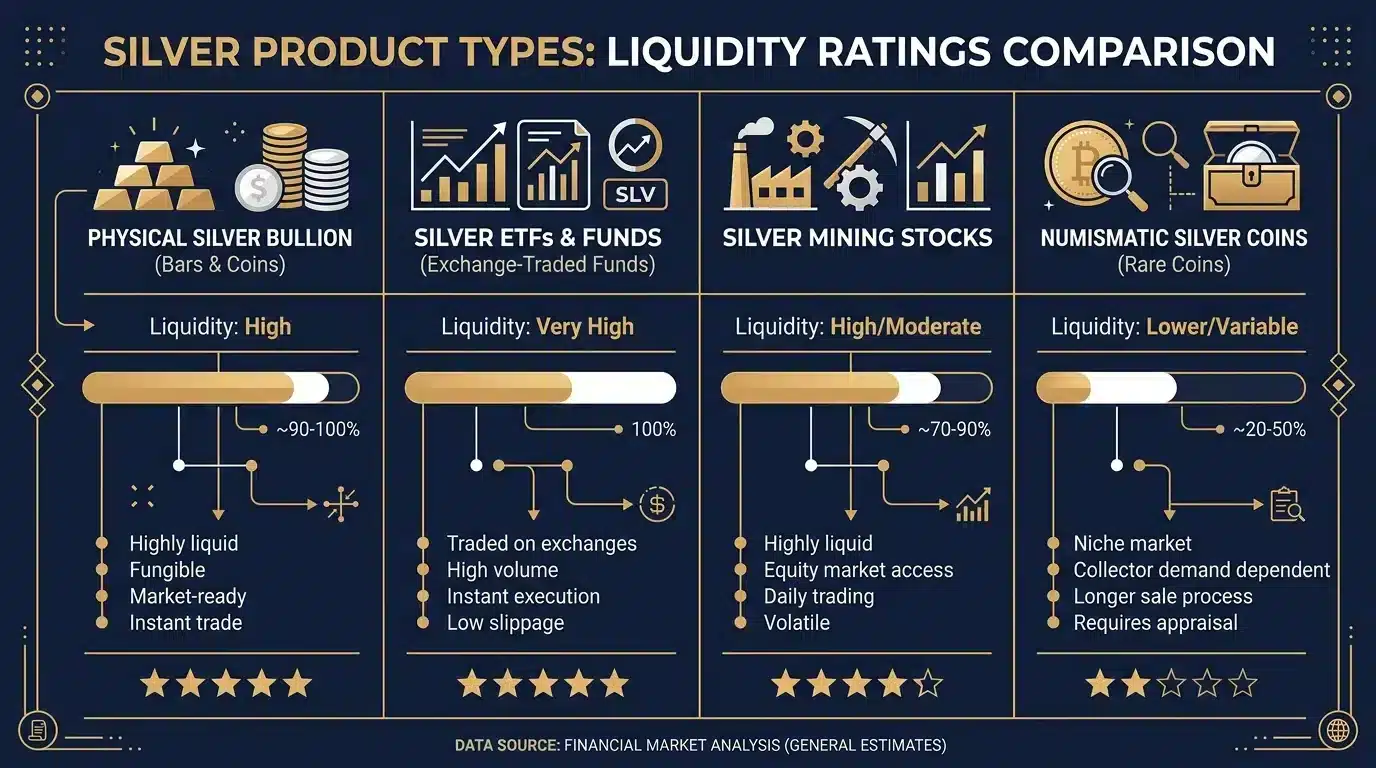
Specifications tell you what an American Silver Eagle is. Liquidity tells you what it's worth when you actually need to move it. Most buyers don't find out the difference until after the purchase — and by then, the options are already narrower.
Most buyers start with metal content and price per ounce. That's fair. But the moment you need to sell, transfer, or move silver into a retirement account, the question changes entirely. And the answer depends on what you bought in the first place.
Liquidity isn't abstract here. It's the practical reality of whether a dealer anywhere in the world will take your silver on the spot — no hesitation, no negotiation, at a price tied to the current market. The sovereign mark on an American Silver Eagle is what makes that possible.
How Silver Eagle Liquidity Works in the Real Market
Physical silver pricing is anchored to global spot markets through major exchanges — and American Silver Eagles trade directly against that benchmark. A dealer anywhere recognizes the sovereign certification on sight. No private assay. No verification step. No negotiation about authenticity. The federal government's backing already answered every question before the transaction started. That's why deals move at market speed — and why they actually close.
And that's the real point. Silver Eagles aren't just popular — the sovereign guarantee behind them functions as a universal acceptance signal across every market. When you look at how silver coins vs silver bars perform at exit, the pattern holds: sovereign-backed coins transact faster and with less friction at every stage of ownership. Privately minted rounds don't carry that signal. They carry a question mark.
The CFTC precious metals advisory warns buyers directly about leveraged and virtual precious metals accounts — and recommends physical coin delivery as the cleaner path to genuine ownership. That distinction matters. Physical delivery isn't a preference. It's the structural difference between owning silver and owning a claim on silver. Silver Eagles — held in hand or in an approved depository — eliminate that ambiguity entirely.
The Problem With Chasing the Cheapest Silver Product
Here's the question most silver buyers don't ask until it's too late: what happens when you try to sell the cheapest silver you could find? The spread that looked attractive at purchase often reverses at resale. A private mint round no dealer immediately recognizes creates friction costs that quietly erase the savings — sometimes entirely.
Rounds and foreign bullion coins can carry real silver at comparable purity. What they can't carry is the sovereign certification the U.S. government placed on every American Silver Eagle. That certification is what drives precious metals liquidity at the dealer level — and why Brighton Gold consistently recommends U.S.-minted products as the ownership standard. Not the premium option. The standard.
The total cost of ownership tells a different story than the purchase spread. Owners who hold sovereign-backed, universally recognized silver own something the market is always ready to price — on the spot, without argument, against a global benchmark. That's the gap most bargain-focused buyers discover after they've already crossed it. And there's no fixing it retroactively.
| Silver Product Type | Recognized by Dealers Nationally | Spot Price Transparency | Resale Ease | IRA Eligible |
|---|---|---|---|---|
| U.S. American Silver Eagle | Yes — sovereign certification recognized instantly at dealers nationwide | Yes — priced directly against global spot benchmark with no intermediary | High — transacts at market speed with no additional authentication required | Yes — explicitly eligible under IRS Section 408(m)(3) exception |
| U.S. Silver Rounds (Private Mint) | Partial — recognized by some dealers, but authentication varies by mint | Yes — spot-linked, but resale spread may widen without sovereign backing | Moderate — requires dealer familiarity with the private mint's reputation | No — private rounds do not qualify for SDIRA holding |
| Foreign Government Silver Coins | Partial — major issues (e.g., Canadian, Austrian) recognized, lesser-known coins often are not | Yes — spot-linked, but import premiums and authentication add friction | Moderate — acceptance varies significantly by dealer and region | No — foreign coins are generally excluded from IRS SDIRA eligibility |
| Generic Silver Bars (Private) | Limited — larger bars from recognized refiners may be accepted; smaller or unknown brands often face scrutiny | Yes — spot price applies, but dealer discount at resale is typically higher | Low to Moderate — bar authenticity often requires assay verification at point of resale | No — privately produced bars do not meet IRS coin exception criteria |
| Leveraged or Virtual Silver Accounts | Not applicable — no physical coin exists to present to a dealer | Unclear — price exposure exists on paper, but physical delivery adds cost and delay | Low — liquidation depends on platform terms, not open market acceptance | No — paper or leveraged positions are not physical holdings and do not qualify |
How American Silver Eagles Qualify for a Self-Directed IRA
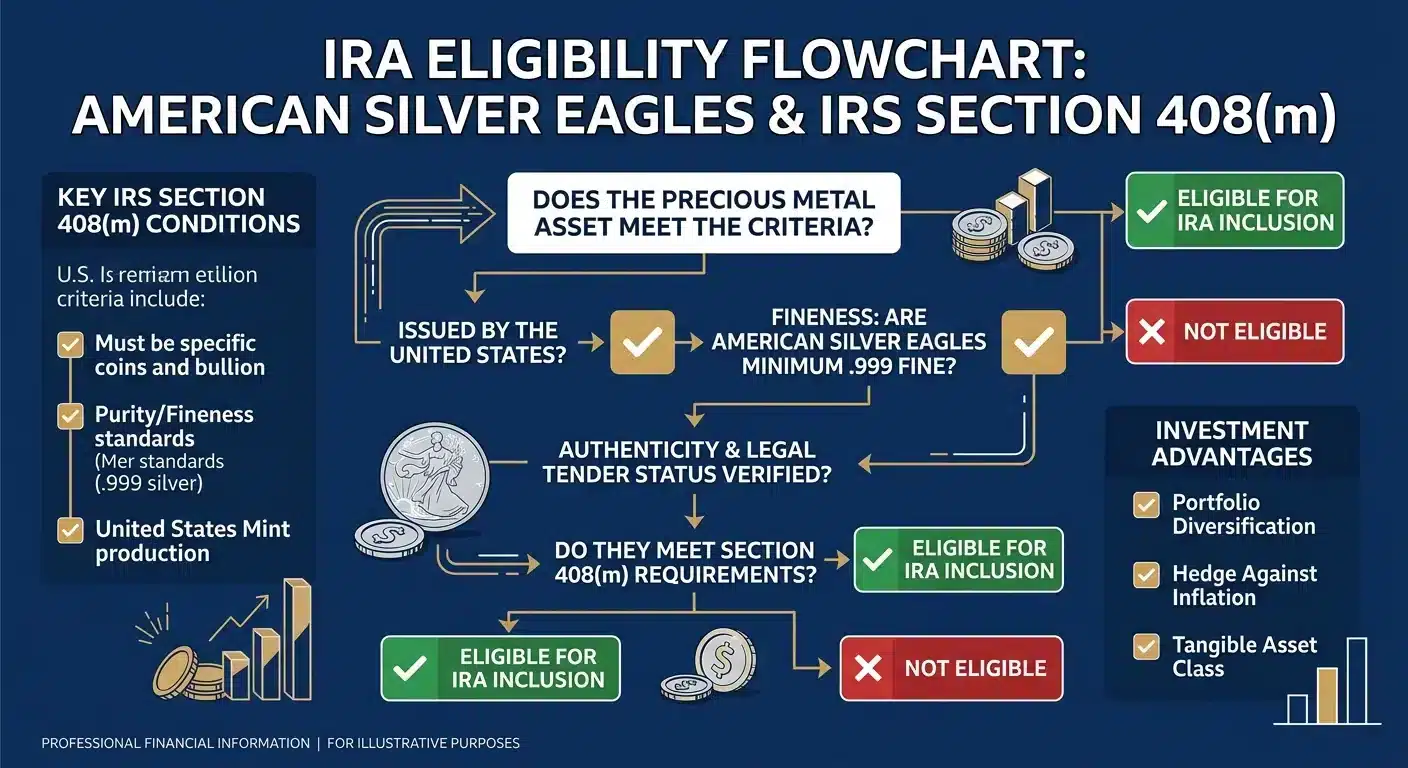
Open-market liquidity matters. But for owners building retirement wealth, the sharper question is what the IRS actually permits inside a tax-advantaged account.
Most silver products are collectibles under federal tax law. The IRS prohibits collectibles from being held inside self-directed IRAs.
Silver Eagles are different.
The IRS grants a specific exception under Section 408(m)(3) of the Internal Revenue Code, allowing Silver Eagles to be held inside self-directed IRAs.
That exception didn't happen by accident. It happened because Congress formally certified the coin's specifications — and the IRS trusts what Congress certified.
That's not a technicality. That's the sovereign guarantee doing exactly what it was designed to do.
That sovereign guarantee isn't just a mark on the coin. It's the legal infrastructure that unlocks retirement account eligibility.
Understanding physical silver retirement protection starts here — with the recognition that Silver Eagles hold a status in the U.S. tax code that most silver products simply don't share.
The IRS Exception That Changes Everything
Here's what that exception means in practice: you can hold physical American Silver Eagles inside a properly structured self-directed IRA — with the same tax treatment applied to other IRA-approved assets.
The coins sit at an IRS-approved depository, in your account's name. Not in your hands. But unambiguously yours.
That Section 408(m) carve-out is narrow — intentionally. The IRS collectibles ban is broad. The exceptions are few.
American Silver Eagles made the list because the U.S. government stood behind them. Their legal tender face value of $1 reflects a sovereign endorsement no private mint, no foreign government, and no bullion dealer can manufacture after the fact.
The IRS collectible exceptions page is explicit on this: it's the coin's congressional origin that qualifies it — not simply its silver content.
A dealer's assay doesn't get your silver into an IRA.
A private mint's purity claim doesn't either.
What gets it in is the federal certification attached to every American Silver Eagle since the program began — a certification the IRS recognizes because Congress created it. That's the sovereign guarantee in its most concrete form.
Who This Is Not For
Let's say this plainly: a Precious Metals IRA isn't the right move for everyone.
If silver looks attractive right now and you'd like to sell in a few months when the price moves — an SDIRA isn't built for that timeline. Brighton Gold isn't the right fit for that approach.
And if you want someone to guarantee silver prices will rise — or to confirm that holding physical metal in a retirement account is immune to loss — we won't say that. Because it isn't true.
Precious metals may appreciate, depreciate, or remain unchanged.
What a Precious Metals IRA offers is physical ownership inside a tax-advantaged structure. Not a performance outcome.
What this structure is built for: owners who want to hold something real, sovereign-backed, and IRS-recognized inside their retirement account — for the long haul.
If that's where you are, Brighton Gold's educational guides walk through exactly how the process works — including how our No Fee Precious Metals IRA for the lifetime of the account on qualified purchases fits into it.
No pressure. No speculation. Just the clearest picture we can give you of whether it fits.
| IRA Eligibility Criterion | American Silver Eagle | Foreign Silver Coin | Private Silver Round | Silver ETF |
|---|---|---|---|---|
| Congressional authorization | Formally authorized by Congress under the Liberty Coin Act; certification is statutory | Issued by a foreign sovereign government; not authorized under U.S. law | Produced by a private mint with no congressional or governmental authorization | No physical coin exists; represents a contractual claim on silver exposure |
| IRS SDIRA eligibility | Explicitly permitted under Section 408(m)(3) of the Internal Revenue Code | Most foreign coins are excluded; only a narrow set of government-minted foreign coins qualify under strict IRS criteria | Private rounds are classified as collectibles and prohibited from SDIRA holdings | Held as a securities position, not physical metal; ineligible for a Precious Metals IRA structure |
| Sovereign backing | Backed by the U.S. federal government; legal tender status confirmed by the U.S. Mint | Backed by the issuing foreign government only; recognition varies by country | No government backing of any kind; authenticity relies entirely on the private mint's reputation | Backed by the fund issuer's contractual obligation; no government metal guarantee |
| Legal tender status | Carries a one-dollar face value as U.S. legal tender | Legal tender in the country of origin; not legal tender in the United States | No legal tender status in any jurisdiction | No legal tender status; value is entirely market-derived |
| Custodian acceptance at IRS-approved depositories | Universally accepted by IRS-approved custodians and depositories without additional review | Acceptance varies by custodian; some qualifying foreign coins accepted, most require additional eligibility review | Rejected by IRS-approved custodians as prohibited collectibles | Held in a brokerage account, not a physical depository; no tangible storage applies |
| Physical ownership inside the retirement account | Held as physical coins in your account's name at an approved depository | Where eligible, held physically — but eligibility must be confirmed before purchase | Cannot be held physically inside a retirement account under IRS rules | No physical holding; owner holds a financial instrument, not metal |
How to Evaluate Premiums, Pricing, and the Real Cost of Ownership

Every owner eventually hits the pricing conversation.
Spot price is the number most buyers lead with. It matters. But it's only part of what you're actually paying — and the part that matters least when you try to move silver later.
Physical silver pricing anchors to global spot markets through exchanges like COMEX. What you pay above that benchmark — the premium — isn't arbitrary.
It covers manufacturing, sovereign certification, and the universal recognition built into every U.S.-minted product. That's not a dealer markup. That's the cost of what makes a Silver Eagle a Silver Eagle.
Here's something most buyers skip entirely: silver isn't priced like a collector's coin. It trades against a global industrial demand picture that includes manufacturing, technology, and silver demand statistics that have nothing to do with bullion buyers.
That demand context shapes the COMEX spot price every Silver Eagle premium is stacked on top of. Whether today's entry point is reasonable depends on understanding that.
Understanding the Silver Eagle Premium
The Silver Eagle premium covers more than metal. It covers U.S. Mint production costs, the sovereign certification stamped on every coin, and the dealer distribution infrastructure that moves it from the Mint to your hands.
Buyers who treat that premium as pure dealer profit are misreading the structure entirely. What looks like overhead is the price of verified, government-backed authenticity.
What does that premium actually buy you? Instant recognition at any dealer, anywhere in the world — no private assay, no authenticity negotiation, no hesitation.
The spot market connection is direct. A Silver Eagle trades at a known premium over a known COMEX-anchored benchmark. That means the pricing conversation at resale is almost never a surprise. That predictability has real value. It doesn't exist for private mint rounds or foreign coins in the same way.
The Silver Eagle premium is higher than alternatives. That's true. It's also the wrong place to stop the analysis.
Sovereign-backed coins retain their premium advantage at resale because the same factors that built it at purchase are still present when you sell. The COMEX benchmark doesn't disappear. The sovereign guarantee doesn't expire. The market doesn't forget between the day you buy and the day you move the coin.
What that means over a full ownership cycle is at the core of physical silver ownership.
What the Total Ownership Picture Actually Looks Like
Total ownership cost isn't a single number. It's the purchase price, the acquisition premium, storage or delivery, the resale spread, and — if you're holding inside an SDIRA — a custodian structure layered on top of all of it.
Buyers who shop on purchase price alone are solving for the wrong variable. The entry point is just where the math starts.
Silver Eagles carry a higher entry premium than generic rounds. That's worth saying directly.
What they carry in return is a sovereign certification that makes every transaction downstream cleaner, faster, and anchored to a globally recognized COMEX benchmark. That's the total picture most price conversations never actually get around to.
The sovereign guarantee isn't marketing language.
It's the invisible infrastructure beneath every pricing conversation you'll ever have as a Silver Eagle owner. It's why dealers don't question the coin. It's why the IRS made an exception for it. It's why the resale spread tends to be tighter than what buyers of private mint products quietly absorb years later.
Own the standard, and the market treats you accordingly.
| Ownership Cost Factor | What It Covers | Silver Eagle Context | Why It Matters |
|---|---|---|---|
| Spot Price | The live global benchmark price for one troy ounce of silver, set by major exchanges and financial institutions | Every Silver Eagle premium is calculated against the spot price — it's the fixed floor beneath what you pay | Understanding spot price separates the actual cost of metal from what you're paying for certification, recognition, and distribution |
| Mint Premium | The markup above spot that covers manufacturing, sovereign certification, and U.S. Mint production costs | Silver Eagles carry a higher premium than generic rounds — because they carry something generic rounds don't: a federal guarantee | The premium isn't arbitrary markup; it's the cost of what makes the coin universally recognized and instantly tradeable at resale |
| Dealer Distribution Margin | The spread a dealer charges to source, authenticate, and deliver physical coins from the Mint to the buyer | With Silver Eagles, the authentication conversation doesn't happen — the sovereign mark removes the friction that drives up margins on private mint products | Less friction at the point of sale means the distribution margin is more predictable and less subject to negotiation |
| Storage or Delivery Cost | The ongoing cost of holding physical silver — either at home, in a private vault, or at an IRS-approved depository for SDIRA holders | Silver Eagles held in an SDIRA must be stored at an approved depository; owners taking home delivery retain full physical control outside the retirement structure | Storage costs are real and ongoing — evaluating total ownership means accounting for them upfront, not discovering them after purchase |
| Resale Spread | The difference between what you paid and what a dealer will offer when you sell — the hidden cost most buyers don't calculate at purchase | Silver Eagles trade at a known premium over a known benchmark globally, which means the resale spread is tighter and the pricing conversation is rarely a surprise | A tighter resale spread is a direct financial benefit of sovereign backing — it's where the premium paid at purchase begins to recover its value |
| Custodian Structure (SDIRA only) | The administrative and custodial fees associated with holding physical metals inside a self-directed IRA | Brighton Gold's No Fee Precious Metals IRA for the lifetime of the account on qualified purchases removes the custodian fee layer that erodes returns for most SDIRA holders | Custodian fees compound over time — eliminating them structurally changes the total cost picture for long-term retirement account holders |
Frequently Asked Questions About American Silver Eagles
So the case is made. Now here's what actually matters — whether it fits your situation.
Five questions. Answered straight.
Are American Silver Eagles legal tender in the United States?
Yes — Silver Eagles are official U.S. legal tender. Congress authorized the program under the Liberty Coin Act of 1985. That's not a collector's designation. It's a federal certification.
No private mint can create legal tender. That authority belongs to Congress alone. And that's exactly what separates a Silver Eagle from every private round in the market — not the silver inside it, but the government that stood behind it when it was struck.
Why does the IRS allow American Silver Eagles in a self-directed IRA while banning other collectibles?
The IRS collectibles ban is broad by design. Almost everything gets caught by it. American Silver Eagles don't — because Congress created a narrow exception under Section 408(m)(3) of the Internal Revenue Code specifically for them.
It isn't about purity. A foreign coin at identical silver content doesn't qualify. What qualifies is congressional origin. The IRS recognizes what Congress certified. That's the sovereign guarantee doing exactly what it was built to do — opening a door that no private mint, no foreign government, and no dealer premium can replicate.
How does the liquidity of American Silver Eagles compare to private silver rounds?
Every Silver Eagle contains exactly one troy ounce of 99.9% pure silver. Every dealer worldwide already knows that. No private assay. No back-and-forth on authenticity.
Private rounds don't carry that same recognition. At resale, a Silver Eagle moves faster — at a tighter spread — because the sovereign mark settled every question before the dealer even picked it up. That difference isn't theoretical. It shows up in the transaction.
What is the premium on American Silver Eagles and is it worth the cost?
Yes, Silver Eagles carry a higher premium than generic rounds. Say it plainly and move on.
What sits above spot covers U.S. Mint production, sovereign certification, and the global distribution network behind a recognized U.S.-minted coin. That's not dealer margin — it's recoverable value baked into the coin itself. The same factors that drove the premium at purchase are still there when you sell. Sovereign-backed coins don't lose their recognition between the buy and the resale. The premium holds because the guarantee holds.
Can I take physical home delivery of Silver Eagles from my retirement account?
Physical delivery is available — but not while coins sit inside an active IRA. IRS rules require SDIRA-held metals to stay at an approved depository. Taking possession while the account is open counts as a distribution and triggers tax consequences.
Outside an IRA, direct home delivery of Silver Eagles is a clean, straightforward option. The CFTC precious metals advisory has consistently flagged the risks of leveraged and virtual precious metals arrangements — and pointed to physical delivery as the path to genuine ownership.
Brighton Gold walks customers through both paths — IRA-held storage and direct home delivery. The goal is a clear decision, not a confused one.
The Silver Standard Is Already Set
The sovereign guarantee isn't a story we're telling. It's a structural fact.
The IRS carved out a specific exception for it. Dealers recognize the coin without a private assay. The resale conversation doesn't open with an argument about authenticity. Every advantage the Silver Eagle holds traces to one decision: Congress certified it, the U.S. government stood behind it, and the market has treated it accordingly ever since.
The standard is already set. Not by Brighton Gold. Not by any dealer. By the coin itself — and the federal infrastructure built around it.
If you've decided to buy silver, the American Silver Eagle isn't one option among many. The IRS code, the global spot market connection, and the liquidity reality at every stage of ownership have already settled the question of which standard wins. What's left is this: is physical ownership inside a sovereign-backed structure where you want to be — and if so, what does that actually look like for your situation?
That's the conversation Brighton Gold is built for.
Not a pitch. Not a forecast. A straightforward walkthrough of whether a No Fee Precious Metals IRA for the lifetime of the account on qualified purchases fits your situation — before anything is signed.
You've followed the argument. You know what the sovereign guarantee actually means. What's left is making sure you have the right answers.
You've done the research. You understand the sovereign backing, the IRS eligibility, the liquidity advantage. What most people don't know is whether the structure around their Silver Eagles is actually set up correctly — or just set up.
That's the conversation Brighton Gold's complimentary consultation is built for. We walk you through how the No Fee Precious Metals IRA for the lifetime of the account on qualified purchases works, whether you qualify, and what the process looks like start to finish.
Learn About the No Fee IRA
The coins don't do the work alone. The structure matters. Let's make sure yours holds.