
Silver Coins vs. Silver Bars: Which Is Better for Wealth Preservation?
Silver coins and silver bars are both physical silver. They are not the same tool.
The better choice for wealth preservation depends on what you are trying to accomplish — liquidity, cost efficiency, retirement eligibility, or long-term storage. That question does not have a single universal answer. It has a structural one.
Sovereign coins like the American Silver Eagle contain exactly 1 troy ounce of 99.9% fine silver. They carry instant recognizability, confirmed weight and purity, and broad acceptance among dealers and custodians worldwide. That liquidity comes at a cost. Sovereign coins carry higher acquisition premiums than bars — but they trade more readily and face fewer verification questions at resale or distribution.
Silver bars deliver more raw silver per dollar spent. The premium above spot price is lower. Large-format bars suit owners accumulating significant weight. The trade-off is verification — bars from private mints require assay documentation and face more scrutiny in resale scenarios.
Both formats meet the IRS minimum purity standard of 99.9% for a self-directed Precious Metals IRA, provided they come from approved refiners and satisfy eligibility criteria under IRC Section 408(m)(3). IRA eligibility alone does not settle the coins-versus-bars question.
Global demand confirms that serious owners use both. In 2023, physical silver investment demand across bars and coins reached 248.2 million ounces — reflecting the scale of physical ownership decisions happening entirely outside paper markets.
Precious metals may appreciate, depreciate, or remain unchanged. The case for physical silver rests on ownership itself, not on price direction. The goal is to hold something real, understand what you hold, and match the format to the function. The right tool for the right job — that is the only framework that matters here.
- The Real Question Behind the Debate
- Silver Coins: Sovereign Liquidity and IRA Eligibility
- Silver Bars: Cost Efficiency and Volume Ownership
- IRA Eligibility, Purity Standards, and Compliance Criteria
- Making the Decision: Matching Format to Purpose
-
Frequently Asked Questions
- How do premium markups compare between sovereign silver coins and private silver bars?
- Are both minted silver coins and cast silver bars eligible for inclusion in a self-directed Precious Metals IRA?
- Which format is easier to liquidate when executing distributions from a retirement account?
- How do storage and insurance costs vary when holding large-format silver bars versus individual bullion coins?
- What security trade-offs should I evaluate before storing physical silver bars at home?
- The Bottom Line on Silver Coins vs. Silver Bars
The Real Question Behind the Debate

Most people open this question the wrong way.
They calculate the spread. They find the lower premium. They call it a decision. But that logic reduces a structural ownership question to a single transaction variable — and it misses almost everything that actually matters when you need your silver to perform.
The real question is never which format is cheaper to acquire.
It's what you are building, who you are building it for, and what you need your silver to actually do.
Silver doesn't exist in a vacuum. Every ounce you hold carries a specific set of characteristics — liquidity profile, verification requirements, storage weight, IRA eligibility, resale behavior.
Understanding those characteristics is what separates a deliberate physical silver strategy from a collection of individual purchases.
Precious metals may appreciate, depreciate, or remain unchanged. The format you choose shapes how you experience that reality when it counts.
Why the Coins-or-Bars Framing Misses the Point
Pitting coins against bars as a competition is the wrong frame entirely.
A hammer drives nails. A level keeps everything true. You need both — and neither makes the other redundant. The coins-or-bars question works the same way.
Silver coins and silver bars work exactly the same way.
Sovereign coins — minted by government authorities, carrying confirmed weight and purity — solve the liquidity problem. Private and accredited bars solve the cost-efficiency problem.
They are not competing for the same job. They are completing different parts of the same structure.
The coins-or-bars debate is not a debate. It's a false binary — and it benefits anyone selling you on one format over the other.
The right question is: what role does each format play in what I'm building, and do I have the right tool for each job?
That's the question physical silver ownership demands you answer before you acquire a single ounce. physical silver ownership
Who Actually Owns Physical Silver — and Why It Matters
The owners who approach physical silver with the most clarity are not watching spot prices for their next trade.
They're retirement-age Americans — former professionals, business owners, veterans — who want to hold something real, outside the paper financial system. Something no bank can freeze. Something no algorithm can digitize out of existence.
In 2023, annual physical investment demand for bars and coins reached 248.2 million ounces. That number reflects millions of individual ownership decisions made by people who understand the difference between holding and trading.
Every owner, regardless of format, works off the same underlying price signal — a globally benchmarked rate set daily through the London Silver Price benchmark in USD, GBP, and EUR per fine troy ounce.
No one gets a better price because of which format they choose.
What separates one ownership experience from another is the decision about what to buy silver and why — made with a clear understanding of what each format actually does.
| Decision Factor | What Coins Optimize | What Bars Optimize | Which Matters Most For IRA Owners |
|---|---|---|---|
| Liquidity at resale | Sovereign minting guarantees instant recognition and acceptance among dealers, custodians, and private buyers | Private mint bars require assay documentation and may face additional verification steps before resale | Coins — liquidity speed matters most when executing IRA distributions or selling during market movement |
| Acquisition cost efficiency | Higher premium above spot price reflects the sovereign guarantee and recognizability built into each coin | Lower premium above spot price delivers more raw silver weight per dollar spent at acquisition | Bars — cost efficiency compounds over large accumulations where premium difference becomes significant |
| IRA eligibility and custodian acceptance | Broadly accepted by approved custodians; sovereign origin simplifies the eligibility verification process | Eligible when sourced from approved refiners meeting IRS purity standards, but eligibility confirmation requires additional documentation | Coins — streamlined custodian acceptance reduces friction during IRA setup and annual compliance |
| Storage weight and logistics | Individual one-ounce coins require more physical storage space per total ounce held compared to consolidated bar formats | Large-format bars consolidate significant weight into fewer, easier-to-store units — reducing vault space and handling requirements | Bars — storage efficiency matters most for owners accumulating substantial weight in vaulted or home storage |
| Resale verification burden | Government-minted origin and standardized specifications reduce third-party verification requirements at point of sale | Private mint bars carry higher buyer scrutiny — assay cards, hallmarks, and chain-of-custody documentation all factor into acceptance | Coins — lower verification burden preserves speed and simplicity when ownership conditions change |
| Wealth transfer and legacy planning | Recognizable sovereign coins pass cleanly to heirs and beneficiaries without requiring specialized knowledge of the asset | Large bars may require professional appraisal or liquidation assistance during estate distribution | Coins — ease of transfer aligns with the legacy-building goals of retirement-age owners passing tangible assets to the next generation |
Silver Coins: Sovereign Liquidity and IRA Eligibility
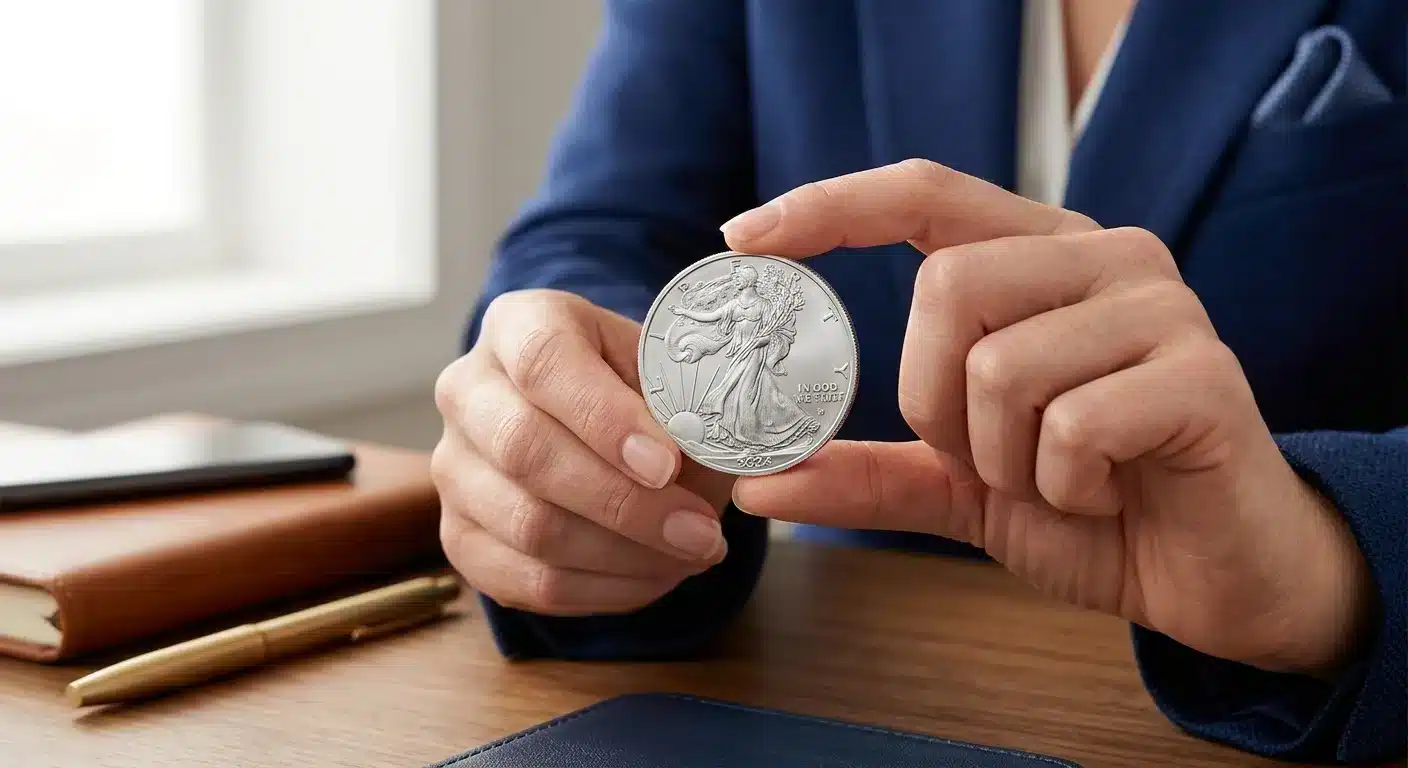
Sovereign coins are not just silver. They are silver with a government's name on it — and that distinction changes everything about how the metal behaves when it matters most.
Hold a sovereign coin and you're holding something already verified by the government that struck it. Weight confirmed. Purity confirmed. Provenance — not a question.
That matters the moment your silver needs to move. A sale, a transfer, a retirement distribution. The conversation starts from zero ambiguity — not from a stack of documentation requests.
That's the liquidity premium — not a marketing claim. A structural reality. Every dealer, every custodian, every counterparty already knows what they're looking at when a sovereign coin crosses their desk.
For owners building a position they plan to hold for years, that recognizability isn't a luxury. It's the difference between a smooth transaction and a drawn-out verification process. That's exactly why serious research into best silver coins for IRAs keeps arriving at the same short list.
What Makes a Sovereign Coin Different From a Generic Round
Not every silver round is sovereign. And that gap is wider than most buyers expect when they first start comparing price tags.
A generic round is a privately produced disc of silver. No government backing. No legal tender designation. No institutional guarantee of weight or purity beyond the reputation of whoever struck it.
Some private mints do excellent work. But excellent and sovereign are not the same thing. At the point of resale or IRA distribution, a custodian evaluating a generic round has to do work a sovereign coin eliminates entirely — verify the assay, confirm the source, assess the market for that specific product.
That friction costs time. Sometimes it costs money.
Sovereign coins arrive pre-verified. The U.S. Mint, the Royal Canadian Mint, the Perth Mint — they've already done that work. Their authority is a national government, and the market prices in that trust before any transaction starts.
The premium is real. So is the advantage it buys.
The American Silver Eagle: Why It Sets the Standard
The American Silver Eagle is the benchmark — and why U.S. American Silver Eagles are the standard comes down to specifics no private mint can replicate.
The U.S. Mint strikes each coin with exactly 1 troy ounce of 99.9% fine silver and assigns it a nominal face value of $1. That legal tender designation is federal. It is not a marketing claim.
That legal tender status isn't ceremonial. It ties the American Silver Eagle directly to federal law — the same law governing U.S. currency and coinage.
For retirement accounts, the connection is concrete. The IRS requires physical silver held in a self-directed retirement account to meet a minimum purity of 99.9% under IRC Section 408(m)(3). The American Silver Eagle satisfies that standard exactly — no additional assay, no custodian hesitation. See U.S. Mint legal tender coin specifications for the complete product details.
When owners ask which silver coin belongs in a long-term, structured position, the American Silver Eagle answers that question directly. Purity locked. Provenance federal. Market recognition as broad as the U.S. government itself.
Precious metals may appreciate, depreciate, or remain unchanged. But owning a coin that faces zero ambiguity at every stage — resale, distribution, transfer — is an advantage that compounds quietly over time.
| Coin Type | Issuing Authority | Silver Purity | IRA Eligible | Liquidity Tier |
|---|---|---|---|---|
| American Silver Eagle | U.S. Mint (Federal Government) | 99.9% fine silver | Yes — meets IRS 0.999 fineness threshold | Tier 1 — broadest dealer and custodian recognition |
| Canadian Silver Maple Leaf | Royal Canadian Mint (Federal Government) | 99.99% fine silver | Yes — exceeds IRS minimum purity standard | Tier 1 — widely accepted by U.S. dealers and IRA custodians |
| Austrian Silver Philharmonic | Austrian Mint (Federal Government) | 99.9% fine silver | Yes — meets IRS 0.999 fineness threshold | Tier 1 — strong international recognition, accepted by most U.S. custodians |
| Australian Silver Kangaroo | Perth Mint (Government-backed) | 99.99% fine silver | Yes — exceeds IRS minimum purity standard | Tier 2 — high quality, less universally recognized than U.S. and Canadian issues |
| Privately Minted Silver Round | Private Mint (No government backing) | Varies — purity dependent on mint's own assay | Conditionally — requires third-party assay verification and approved refiner status | Tier 3 — resale friction higher; custodian and dealer scrutiny required at distribution |
| Generic Silver Bar (Private) | Private Refiner (No government backing) | Typically 99.9% or higher per refiner's stamp | Conditionally — must come from LBMA-approved or IRS-recognized refiner | Tier 2–3 — recognized in bulk but requires assay documentation for IRA and private resale |
Silver Bars: Cost Efficiency and Volume Ownership

Coins earn every dollar of that premium. But not every ownership situation calls for the most expensive tool on the bench.
Silver bars exist to solve a different problem: volume ownership at the lowest possible acquisition cost per ounce.
The premium on a bar is structurally lower than on a sovereign coin. There is no government striking cost. No legal tender designation. No national mint overhead built into the price.
What you pay for is silver. That cost efficiency is real — and for owners building meaningful physical weight, it changes the math significantly.
In 2023, global physical silver investment demand across bars and coins reached 248.2 million ounces. That scale reflects one straightforward reality: serious owners use both formats.
Bars absorb a significant share of total physical demand precisely because they let buyers accumulate more silver for the same capital outlay.
Precious metals may appreciate, depreciate, or remain unchanged. But the format you choose shapes how much physical silver you actually hold when the outcome arrives.
Understanding Premium Spreads on Silver Bars
Most buyers look at the per-ounce number on a silver bar, compare it to a sovereign coin, and stop there.
The bar wins that comparison almost every time. And that win feels like a decision.
But the premium difference isn't just a transaction variable. It's a signal about what the product actually does — and ignoring that signal is where most buyers build positions they later regret.
A sovereign coin carries a higher premium because it carries a government guarantee and institutional liquidity built in.
A silver bar carries a lower premium because it offers neither of those things by default. That trade-off is not a flaw. It is the design.
Bars are built for cost-efficient accumulation — not for frictionless distribution. The buyers who understand that get exactly what they pay for. The buyers who do not are often surprised when it matters most.
COMEX silver bar specifications standardize commercial silver bars at 1,000 troy ounces with a minimum purity of 99.9% — the same threshold the IRS requires for IRA-eligible silver under IRC Section 408(m)(3).
That benchmark sets the floor for what serious market participants treat as legitimate. Retail bars echo that standard in smaller formats. The closer a product tracks to those specifications, the more straightforward resale becomes.
Nobody is questioning whether bars are legitimate. The question is whether the buyer fully understands the liquidity trade-off baked into the lower premium — before acquisition, not after.
Bar Formats and Storage Considerations
Bar formats run from fractional one-ounce pieces up to ten-ounce, one-hundred-ounce, and larger.
Each size carries a different cost-to-store and cost-to-verify profile. Smaller bars let you liquidate in partial increments — but the premium per ounce is proportionally higher than on larger formats. Larger bars cut acquisition cost but demand real planning around storage, insurance, and eventual distribution.
Size isn't a preference. It's an ownership commitment.
Storage isn't a secondary consideration. It's part of the ownership decision — and it should be made before acquisition, not after.
A one-hundred-ounce silver bar is heavy, dense, and demands a storage solution built for that weight. Home storage at that scale introduces concrete security variables: vault weight ratings, concealment, insurance riders, access logistics.
Vaulted third-party storage eliminates most of those variables — but adds ongoing fees. Neither path is automatically better. What matters is whether the storage structure matches the format. The annual physical investment demand data reflects millions of owners working through exactly this decision.
That's where the toolbox framing pays off.
Bars are the high-volume accumulation tool. Coins are the frictionless liquidity tool. Expecting quick, easy liquidation from a large-format private bar is like using a level to drive a nail — the tool is not wrong, it is just being used for the wrong job.
Owners who understand this distinction find clarity fast when they compare what each format demands in practice.
Brighton Gold's approach is to walk customers through exactly that structure — so every acquisition has a defined role before a single ounce changes hands. The right tool for the right job. That is not a slogan. It is the only framework that holds.
| Bar Format | Typical Weight | Approximate Premium Over Spot | Best Use Case | Storage Consideration |
|---|---|---|---|---|
| Fractional Bar (1 oz) | 1 troy ounce | Lower than sovereign coins, higher than larger bar formats per ounce | Entry-level accumulation; partial liquidation flexibility | Low storage footprint; suitable for home safe or vaulted storage with minimal insurance complexity |
| Small Bar (5–10 oz) | 5 to 10 troy ounces | Moderate — lower per-ounce cost than fractional bars, still accessible for incremental buyers | Steady accumulation for owners building physical weight over time | Manageable weight and size; fits most home storage solutions; straightforward for custodian vaulting |
| Mid-Size Bar (100 oz) | 100 troy ounces | Meaningfully lower per-ounce cost than coin or small-bar formats | High-volume accumulation where cost efficiency is the primary objective | Requires dedicated storage; weight demands vault-rated shelving; insurance riders and access logistics need advance planning |
| Large Bar (1,000 oz) | 1,000 troy ounces | Lowest per-ounce acquisition cost across all retail and institutional formats | Institutional-scale ownership; wholesale market participation | Significant infrastructure required; third-party vaulted storage is the practical standard; home storage is not a viable option at this scale |
| Cast Bar (any size) | Varies by format | Generally lower than minted bar equivalents due to simpler production process | Cost-first accumulation where visual finish and collectibility are not a priority | Same considerations as equivalent weight format; verify refiner credentials before acquisition to support resale clarity |
| Minted Bar (any size) | Varies by format | Slightly higher than cast equivalents due to finished appearance and assay card packaging | Owners who prioritize documentation and presentation alongside cost efficiency | Assay card packaging aids verification at resale; store flat and sealed to preserve packaging integrity |
IRA Eligibility, Purity Standards, and Compliance Criteria
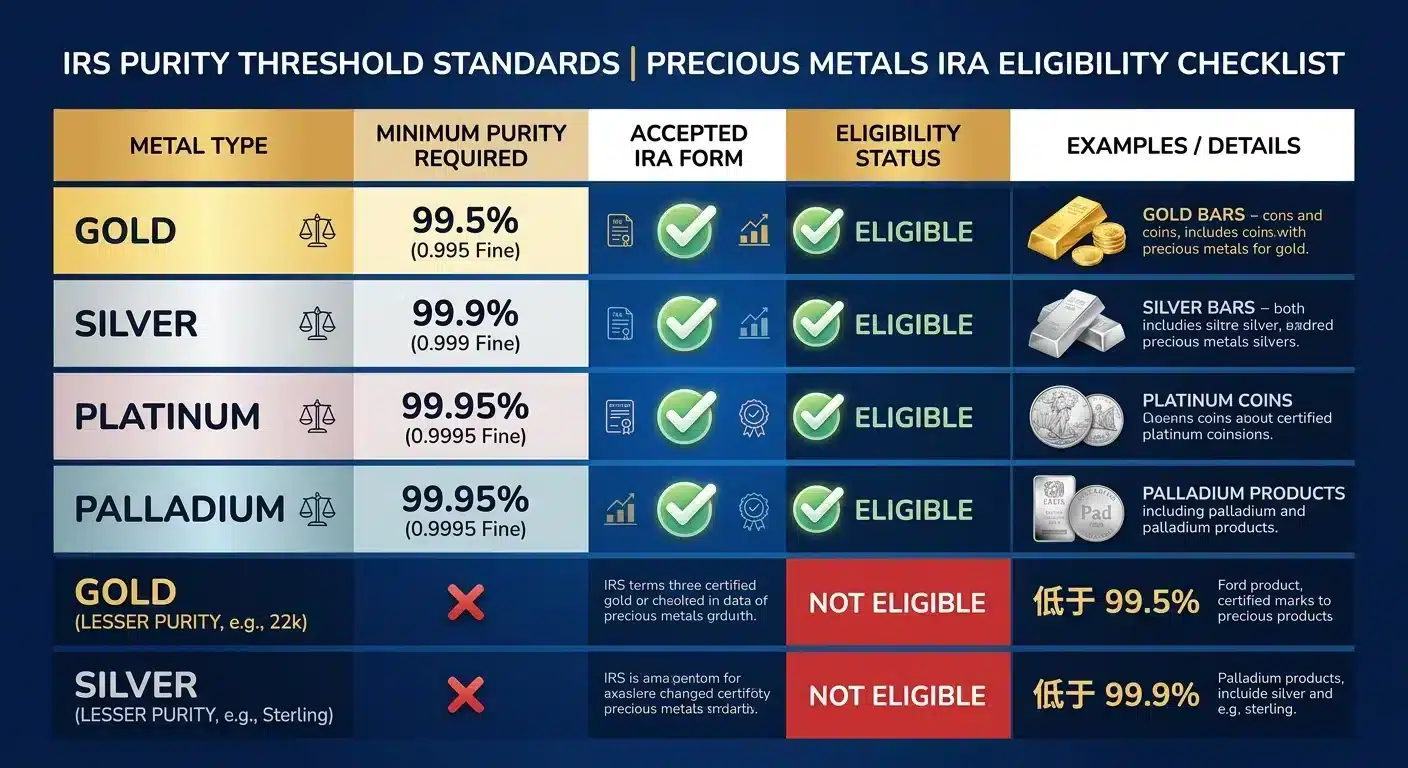
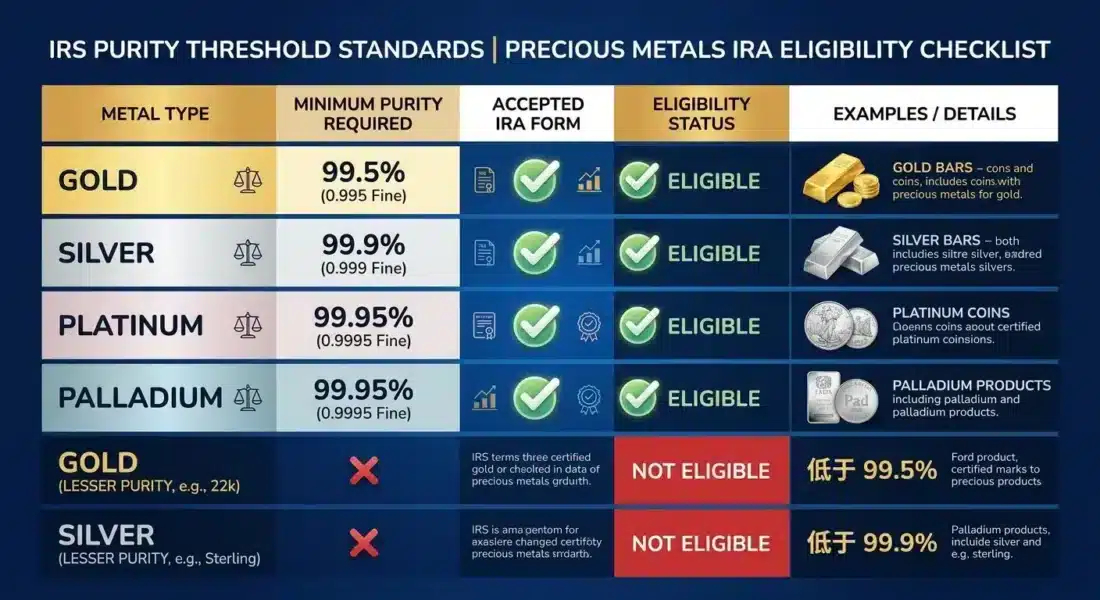
Before a single coin or bar enters the IRA conversation — there is one question that overrides every other: what will the IRS actually allow?
That question has a hard answer. The IRS sets specific eligibility criteria for physical silver held inside a self-directed retirement account — and products that fall outside those criteria are excluded, full stop. Attractive spreads don't override it. An established mint name doesn't override it. Understanding IRS purity requirements for precious metals is not a box to check later. It is the first decision gate — especially for owners operating under IRC Section 408(m)(3).
So the first question is never about price. It is: does this product qualify? Everything else follows from that answer. structured ownership in physical silver
IRS Purity Requirements: The 99.9% Threshold
Here's the number that matters: 99.9%. That's the minimum fineness — 0.999 — the IRS requires for physical silver held inside a self-directed retirement account, codified under IRC Section 408(m)(3). And it's not a custodian preference or a dealer recommendation. It's the same institutional quality benchmark commercial markets use globally, written directly into the tax code.
Miss that 99.9% threshold by any margin and the product is disqualified. Not flagged. Not reviewed. Disqualified. Including it triggers a prohibited transaction under federal law. No custodian accepts it — period.
And the standard does not care what shape the silver takes. Coins get no exemption. Bars get no exemption. What the IRS evaluates is composition — and whether the verified fineness clears 99.9%.
Which Products Qualify — and Which Don't
The American Silver Eagle is the benchmark. The U.S. Mint strikes each coin with exactly 1 troy ounce of 99.9% fine silver and assigns it a nominal face value of one dollar — a legal tender designation backed by federal law. That provenance matters practically: it removes every documentation question a custodian would otherwise have to resolve before accepting the product.
Silver bars qualify as well — but the same 99.9% fineness standard applies, and the bar must come from a manufacturer approved by a national securities or commodities exchange. Reputable refiners whose products track COMEX and LBMA delivery standards clear that bar. Generic, unbranded, or obscure private mint bars often do not. Discovering that disqualification after the purchase is an expensive lesson. The research on best silver coins to buy for retirement accounts starts exactly here — with the eligibility filter, not the price.
What does not qualify: silver rounds or bars from unverified private mints without assay documentation, anything below the 0.999 fineness threshold, and silver held personally by the IRA owner rather than at an approved depository. Precious metals may appreciate, depreciate, or remain unchanged — but a disqualified product inside a retirement account does not preserve anything. It triggers a tax event. Brighton Gold does not provide financial, tax, or legal advice — and customers with IRA compliance questions should consult a qualified tax professional before any acquisition is made.
| Product Type | Minimum Purity Required | IRA Eligible | Notes on Compliance |
|---|---|---|---|
| American Silver Eagle (U.S. Mint) | 99.9% fine silver | Yes | Struck with exactly 1 troy oz of 99.9% fine silver; legal tender designation backed by federal law; nominal face value of one dollar; no ambiguity for custodians |
| IRA-Approved Silver Bars (reputable refiners) | 99.9% minimum fineness | Yes | Must meet 0.999 fineness threshold and be produced by a manufacturer approved by a national securities or commodities exchange; assay documentation required |
| Generic or Unverified Private Mint Bars | Below 0.999 fineness threshold | No | Products that miss the fineness threshold by any margin are disqualified under IRC Section 408(m)(3); creates a prohibited transaction if held in a self-directed IRA |
| Personally-Held Physical Silver (owner possession) | N/A — custodian rule applies | No | IRS requires IRA-held silver to be stored at an approved depository, not in personal possession; personal holding triggers a prohibited transaction regardless of fineness |
Making the Decision: Matching Format to Purpose

All the research points to one question. Not which format is better in the abstract — which format fits what you're actually trying to build.
That question doesn't have a universal answer. It has a personal one. The London Silver Price benchmark sets the same daily price floor for every troy ounce of silver — in USD, GBP, and EUR — regardless of whether that ounce sits in a sovereign coin or a private bar. Both formats track the same underlying asset. What differs is what each format does for the owner holding it.
So the decision isn't about finding the "better" product. It's about matching the right tool to the right job. USGS silver production data confirms that the U.S. relies on imports for more than 70% of its domestic silver supply — which means the silver market is deep, global, and liquid at scale. Owners who understand where their format sits within that market make cleaner decisions. Owners who don't are often surprised when it counts.
This Is Not for Every Buyer
Brighton Gold is direct about this: not every buyer belongs in this conversation.
If the goal is to trade silver — buying today and selling in weeks or months when the price moves — this isn't the relationship. Brighton Gold does not provide financial, tax, or legal advice, and we don't make market timing recommendations. Precious metals may appreciate, depreciate, or remain unchanged. Owners who want a price forecast aren't the customer this framework is built for.
And if the only measure of success is the absolute lowest per-ounce spread on the market — there are dealers built for that transaction. Brighton Gold isn't one of them. The value here is clarity, structure, and long-term ownership support. Not winning a price race. Owners who want to understand what they're holding and why belong in this conversation. Bargain hunters chasing the bottom tick don't.
A Practical Framework for Choosing Between Coins and Bars
For owners still here — the framework is simple. Start with purpose. Not product.
If the primary goal is cost-efficient accumulation of physical silver weight — building meaningful ounces over time with capital efficiency — bars deserve serious consideration. The lower per-ounce premium is structural, not promotional. For owners building a long-term physical position who aren't planning near-term distributions, that cost efficiency compounds across every acquisition. The precious metals educational resources at Brighton Gold walk through exactly how that accumulation structure works in practice.
If the goal includes near-term liquidity, IRA eligibility, or the confidence of holding a government-guaranteed product that any dealer anywhere will recognize — sovereign coins are the starting point. The American Silver Eagle carries federal legal tender status and universal market recognition that no private bar can replicate. And the strongest ownership positions use both: bars for cost-efficient weight, coins for frictionless liquidity. That's the structure Brighton Gold helps customers build before a single ounce changes hands. The right tool for the right job — fully assembled.
| Ownership Goal | Recommended Format | Key Reason | IRA Compatible |
|---|---|---|---|
| Cost-efficient weight accumulation over time | Silver bars (larger formats) | Lower per-ounce premium means more physical silver acquired per dollar spent — premium savings compound across every acquisition | Yes — if bars meet 99.9% fineness and are from an approved refiner |
| Near-term or flexible liquidity | Sovereign coins (American Silver Eagle) | Government-issued legal tender with universal dealer recognition — no negotiation required at point of sale | Yes — American Silver Eagles are IRS-eligible by statute |
| Self-directed Precious Metals IRA funding | Sovereign coins or qualifying silver bars | Both formats qualify provided fineness meets the 99.9% IRS threshold — coin provenance simplifies custodian acceptance | Yes — subject to IRS fineness and approved-refiner requirements |
| Legacy transfer or long-term wealth preservation | Combination of sovereign coins and bars | Coins provide recognizable, divisible units for heirs; bars provide cost-efficient weight — both serve the long-term ownership objective | Yes — both formats are IRA-compatible when purchased to standard |
| Minimal storage footprint with maximum silver content | Large-format silver bars | Consolidated weight in fewer, larger units reduces per-unit storage requirements — practical for owners holding significant physical positions in vaulted storage | Yes — if fineness and refiner approval requirements are satisfied |
| First physical silver acquisition with limited capital | Fractional or 1 oz sovereign coins | Smaller entry point, immediate liquidity, and full IRS eligibility make sovereign coins the most flexible starting format for new owners | Yes — sovereign coins meet IRS eligibility standards at any quantity |
Frequently Asked Questions
But comparison tables don't close every open question. There are always a few that live between the research and the actual decision — the ones worth saying out loud before anything moves forward.
These are the questions Brighton Gold hears most often. They're worth asking. Here are straight answers.
How do premium markups compare between sovereign silver coins and private silver bars?
Sovereign coins carry a higher per-ounce premium. That gap is structural, not arbitrary.
The American Silver Eagle is struck with exactly 1 troy ounce of 99.9% fine silver. That government provenance — legal tender status, federal manufacturing standards, universal market recognition — costs something. It's priced into every acquisition.
Private bars carry a lower premium. Less fabrication complexity. No legal tender designation. No national mint overhead.
Both formats track the same globally benchmarked daily silver price. What differs is what you're paying for beyond the silver itself. Coins buy frictionless liquidity. Bars buy cost efficiency.
Precious metals may appreciate, depreciate, or remain unchanged. Neither format is the wrong choice. The right one depends entirely on the function it serves.
Are both minted silver coins and cast silver bars eligible for inclusion in a self-directed Precious Metals IRA?
Both qualify — but both come with conditions.
The IRS requires physical silver in a self-directed retirement account to meet a minimum fineness of 99.9%. That's the 0.999 threshold under IRC Section 408(m)(3). Format doesn't create an exemption. What the IRS evaluates is composition.
The American Silver Eagle qualifies by federal statute. No additional assay. No custodian hesitation.
IRA-eligible bars must come from a manufacturer approved by a recognized national commodities or securities exchange. Bars from unverified private mints — or anything below the 0.999 fineness threshold — don't qualify.
Brighton Gold does not provide financial, tax, or legal advice. Owners with IRA-specific compliance questions should consult a qualified tax professional before any acquisition.
Which format is easier to liquidate when executing distributions from a retirement account?
Sovereign coins are easier to liquidate. Full stop.
The American Silver Eagle carries legal tender status and universal market recognition. Any dealer will price it on sight. The conversation starts at value, not at verification.
Bars are a different story. They require assay confirmation. Large-format bars carry logistical friction — weight, transport, documentation — that sovereign coins don't.
For owners planning near-term retirement distributions, that friction isn't theoretical. It shows up in time, transaction complexity, and spread at resale.
The daily silver price is benchmarked globally per fine troy ounce — the same floor for every format. But converting physical silver to that benchmark isn't equally smooth across formats. Coins convert cleanly. Large bars require more steps.
How do storage and insurance costs vary when holding large-format silver bars versus individual bullion coins?
Storage and insurance costs follow weight, value, and format — and bars stack up differently than coins in each category.
Large-format bars — standardized at 1,000 troy ounces for commercial exchange — require professional vault infrastructure, specialized transport, and higher insurance coverage by volume. That overhead doesn't disappear once the acquisition is done. It's baked into every year of ownership.
Individual bullion coins cost more per ounce to store. Each unit needs separate handling and documentation. But a coin-based position is modular — it scales incrementally, moves in partial amounts, and audits cleanly without coordinating a logistics operation.
For IRA-held positions, both formats go to an IRS-approved depository regardless. The practical cost difference narrows at that level.
The real distinction is what happens when circumstances change. Coins give owners options. Bars demand planning before those circumstances arrive — not after.
What security trade-offs should I evaluate before storing physical silver bars at home?
Home storage for physical silver bars deserves a straight conversation — not a checklist.
Larger bars are harder to secure, harder to move quickly, and harder to liquidate without drawing attention. A meaningful silver position in bar format requires a fixed, serious storage solution — a bolted safe at minimum. That's not optional. That's the floor.
Insurance for home-stored physical silver isn't automatic. It isn't cheap. And concentrating a significant position in one location carries risk that depository-based storage distributes across a purpose-built security structure.
Coins are more portable and more modular — but home storage of any meaningful silver position carries real exposure that institutional vaulting eliminates entirely.
For IRA-held silver, home storage isn't a choice at all. IRS rules require an approved depository regardless of format. Brighton Gold does not provide financial, tax, or legal advice — owners evaluating home storage for non-IRA holdings should consult a qualified professional before making that decision.
The Bottom Line on Silver Coins vs. Silver Bars
The question was never which format wins.
It was always which tool belongs in which job.
Bars bring cost efficiency to the accumulation side. Coins bring sovereign liquidity to the distribution side. Neither replaces the other. Treating them as competitors misses the entire point.
And the toolbox only works when both tools are in it.
A position built entirely on bars is cost-efficient on the way in and friction-heavy on the way out. One built entirely on coins pays a premium at every acquisition. The strongest positions Brighton Gold helps customers build pair both — bars for weight, coins for liquidity — so every stage of ownership has the right instrument for the job. That's what the No Fee Precious Metals IRA framework is built around: matching the format to the function, not chasing the lowest spread on a single transaction.
Precious metals may appreciate, depreciate, or remain unchanged. What doesn't change is the logic of the structure. Match the format to the function, and the position holds up under any market condition.
The right tool for the right job. That's the only framework that survives contact with reality.
If you've read this far, the research is done.
Brighton Gold doesn't provide financial, tax, or legal advice — and we don't manufacture urgency to push this conversation forward. What we offer is a complimentary consultation that walks through your options, including how the No Fee Precious Metals IRA works and whether you qualify.
No pressure. No pitch. Just the clearest picture we can give you of what structured physical silver ownership actually looks like — before a single ounce changes hands.
Figuring out which format actually fits your situation — coins, bars, IRA, direct purchase — isn't something an article can settle for you. That's what a conversation is for.
Brighton Gold offers a complimentary consultation to walk through your options directly. Including how the No Fee Precious Metals IRA works and whether you qualify.