

What Are the Storage Requirements for Bulk Silver Purchases?
Bulk silver has a weight problem. Not a financial one — a physical one.
A standard 1,000-ounce silver bar weighs 68.6 pounds. Bulk silver also requires roughly 19 times more storage space than the equivalent dollar value of gold. That's not a footnote. That's the first thing any serious owner needs to understand.
Home safes weren't built for this. Fireproof cabinets weren't either. The infrastructure has to match the asset.
Bulk silver storage falls into two categories: physical logistics and legal compliance. Neither is optional once you own silver in meaningful quantity.
On the legal side, silver held inside a retirement account operates under strict federal rules. IRC Section 408(m) mandates that physical precious metals inside a self-directed IRA stay in the custody of an IRS-approved trustee. Storing IRA-held silver at home — regardless of security setup — is classified as an immediate taxable distribution. The IRS does not treat that as a gray area.
For silver held outside retirement accounts, home storage is legally permitted. But the practical barriers remain. Approved depositories offer what a residential setting cannot: UL Class 3 vaults engineered to resist tool and torch attacks for at least 120 minutes, reinforced concrete walls at least 18 inches thick, and institutional insurance coverage that residential policies do not reach. Delaware Depository carries $1 billion in all-risk transaction and custody insurance.
Owners choose between two custodial models. Segregated storage physically isolates specific serial-numbered bars belonging to one owner. Allocated storage holds equivalent weight and purity in a shared pool with guaranteed redemption rights.
Transit from dealer to depository uses armored logistics with dual-custody handoffs and real-time encrypted tracking for all high-volume silver bar transfers.
The answer is straightforward: bulk silver belongs in a professionally managed depository. The deciding factors are the storage model and whether the silver sits inside a retirement account or outside one.
- Why Bulk Silver Storage Is More Complicated Than Most Buyers Expect
- Why Home Storage Sounds Appealing — and Where It Breaks Down
- IRS-Approved Depositories: What the Law Actually Requires
- Segregated vs. Allocated Storage: Choosing the Right Custodial Method
- How Brighton Gold's No Fee IRA and Concierge Model Handle Storage
-
Frequently Asked Questions About Bulk Silver Storage
- How do I ship bulk silver safely to an IRS-approved depository?
- What is the physical weight and footprint of 1,000 ounces of bulk silver?
- Can I inspect or audit my physically stored bulk silver at the depository?
- What is the cost difference between segregated and allocated bulk silver storage?
- How does Brighton Gold's No Fee Precious Metals IRA handle storage costs for qualified bulk purchases?
- Bulk Silver Storage Is a Decision You Make Once — Make It Right
Why Bulk Silver Storage Is More Complicated Than Most Buyers Expect

Most buyers think about silver in terms of price per ounce. That's the wrong starting point. Bulk silver is a dense, heavy, physical commodity — and it has to go somewhere real.
That's where the complication starts. Not in the regulations — though those matter — but in the physical scale. Meaningful silver ownership exceeds what most residential and retail environments were ever built to handle.
Here's what we've found: once the weight, volume, and footprint are clear, every other storage decision falls into place. The noise drops. What's left is a short list of real choices — and those choices make a lot more sense when you understand how buy physical silver for long-term wealth preservation fits your retirement picture. physical silver fits into a retirement protection strategy
The Physical Reality: Weight, Volume, and Footprint
A standard 1,000-ounce silver bar weighs 68.6 pounds. Not an abstraction — a physical fact. A modest bulk position means multiple bars, and that means structural support and handling equipment a home environment doesn't have.
And then there's the volume. Bulk silver requires roughly 19 times more storage space than the equivalent dollar value of gold. That means space isn't a convenience consideration — it's a core logistical requirement. A home safe rated for a handgun and documents wasn't engineered for this reality.
Institutional depositories are built for exactly this load. UL Class 3 vault requirements specify vaults engineered to resist physical tool and torch attacks for at least 120 minutes, with reinforced concrete walls at least 18 inches thick. That's a different category of infrastructure — not a bigger safe, a fundamentally different structure. A home vault isn't in the same conversation. It was never designed to be.
Why the Industry Overcomplicates the Conversation
The storage conversation in this industry gets buried under jargon, layered fees, and fine print. That's not accidental. Confusion keeps buyers dependent on the firms manufacturing it.
Brighton Gold's approach runs the opposite direction. The core decision isn't complicated: bulk silver needs purpose-built vaulting, and the storage model — segregated or allocated — comes down to one question: do you want your specific bars physically isolated, or equivalent weight and purity guaranteed from a shared pool? Either way, you can Buy Silver with a clear picture of where it goes and how it's held before you commit to anything.
Complexity creates dependency. Brighton Gold's concierge model exists to remove that dynamic — walking customers through each step before anything is signed, so the logistics feel like a manageable checklist and not a reason to stall.
| Silver Quantity | Approximate Weight | Storage Footprint vs. Equivalent Gold Value | Key Handling Consideration |
|---|---|---|---|
| 1 standard bar (1,000 oz) | 68.6 lbs (31.1 kg) | Roughly 19x more space than equivalent gold value | Requires structural support and handling equipment beyond residential capacity |
| Multiple bars (bulk position) | Scales linearly from 68.6 lbs per bar | Compounds with each additional bar — residential environments not built for this scale | Purpose-built vaulting infrastructure required; home safes are not engineered for this load |
| Any bulk quantity (institutional vault) | Handled by purpose-built facilities rated for high-density commodity loads | Vault walls at least 18 inches of reinforced concrete | UL Class 3 vaults resist tool and torch attacks for at least 120 minutes |
Why Home Storage Sounds Appealing — and Where It Breaks Down

The instinct to keep it close makes sense. You bought it. It's yours. Holding something real — something that exists completely outside the banking system — feels like it should stay within arm's reach.
That instinct isn't misguided. It comes from the same conviction that drives most people to own physical silver at all: direct, unmediated control over something tangible. We understand that impulse. We don't dismiss it.
But concept and execution are different things. When the silver is real, the weight is real, and the legal framework is real, that instinct runs into two distinct walls. One is a logistics problem. The other is federal law. Both matter — and working through them is what it actually means to preserve wealth with physical silver.
The Self-Reliance Instinct Is Understandable — and Legally Costly for IRA Holders
For silver held inside a retirement account, home storage isn't a personal choice. IRC Section 408(m) draws a hard line: physical precious metals inside a self-directed IRA must remain in the custody of an IRS-approved trustee. That requirement doesn't bend for elaborate home vault setups. It doesn't bend at all.
The consequence is severe. Home storage of IRA-held precious metals is classified as an immediate taxable distribution. That means the IRS treats your home-stored IRA silver as if you cashed out the entire position the day you took possession. Taxes due immediately. Penalties potentially applied. The retirement account status — gone.
Most customers don't know this until after the fact. That's not complexity — that's a failure of communication the industry has never bothered to fix. Brighton Gold makes this clear before any transaction. Not buried in fine print. Before anything is signed, so customers aren't making a career-ending tax mistake while thinking they're exercising self-reliance.
Why Most Home Storage Setups Fail the Physical Test
For silver held outside a retirement account, the legal barrier doesn't apply. But the physical barrier does. And it's more significant than most people expect the first time they think it through.
The standard residential safe — even a high-quality, fireproof model — was built for documents, jewelry, and small valuables. Not bulk commodities. Bulk silver's weight-to-volume ratio demands infrastructure a residential environment wasn't built to provide. The engineering gap between a consumer-grade safe and a UL Class 3 vault — with reinforced concrete walls measuring at least 18 inches thick — isn't a matter of degree. It's a different category entirely.
UL Class 3 vaults are engineered to resist physical tool and torch attacks for at least 120 minutes. No residential product meets that standard. And as a silver position grows, the gap between what a home environment can hold and what institutional infrastructure provides grows with it. That gap is where real risk lives. The silver is heavy. The liability is heavier.
| Storage Scenario | IRS Compliance Status | Physical Security Grade | Insurance Coverage | Verdict for Bulk Silver |
|---|---|---|---|---|
| Home safe (non-IRA silver) | Compliant — no federal custody requirement for non-retirement silver | Consumer-grade — not engineered for bulk commodity weight or breach resistance | Homeowner or renter policy only — typically excludes high-value bullion or caps coverage well below bulk position value | Inadequate for meaningful bulk positions — weight, volume, and insurance gap all present |
| Home safe (IRA-held silver) | Non-compliant — violates IRC Section 408(m) trustee custody mandate | Consumer-grade — same physical limitations as non-IRA home storage | Moot — account is disqualified before insurance even becomes relevant | Prohibited — immediate taxable distribution triggered regardless of safe quality |
| Dedicated home vault (non-IRA silver) | Compliant — legal for non-retirement holdings | Improved over standard safe, but no residential product meets institutional engineering standards for bulk storage | Still limited to personal insurance — institutional-grade all-risk coverage is not available in residential policies | Better than a consumer safe, but the engineering and insurance gap remains significant at scale |
| IRS-approved depository (non-IRA silver) | Compliant — no legal requirement, but custody is fully documented and auditable | Institutional-grade — purpose-built vaulting infrastructure designed specifically for bulk precious metals | Institutional all-risk coverage included — covers physical loss, structural damage, and internal theft | Appropriate — purpose-built for exactly this asset class and ownership scale |
| IRS-approved depository (IRA-held silver) | Fully compliant — satisfies IRC Section 408(m) trustee custody requirement | Institutional-grade — same purpose-built infrastructure as non-IRA depository storage | Institutional all-risk coverage included — account structure and asset are both protected | Required for IRA silver and strongly recommended for all bulk positions — the only option that meets every standard simultaneously |
IRS-Approved Depositories: What the Law Actually Requires
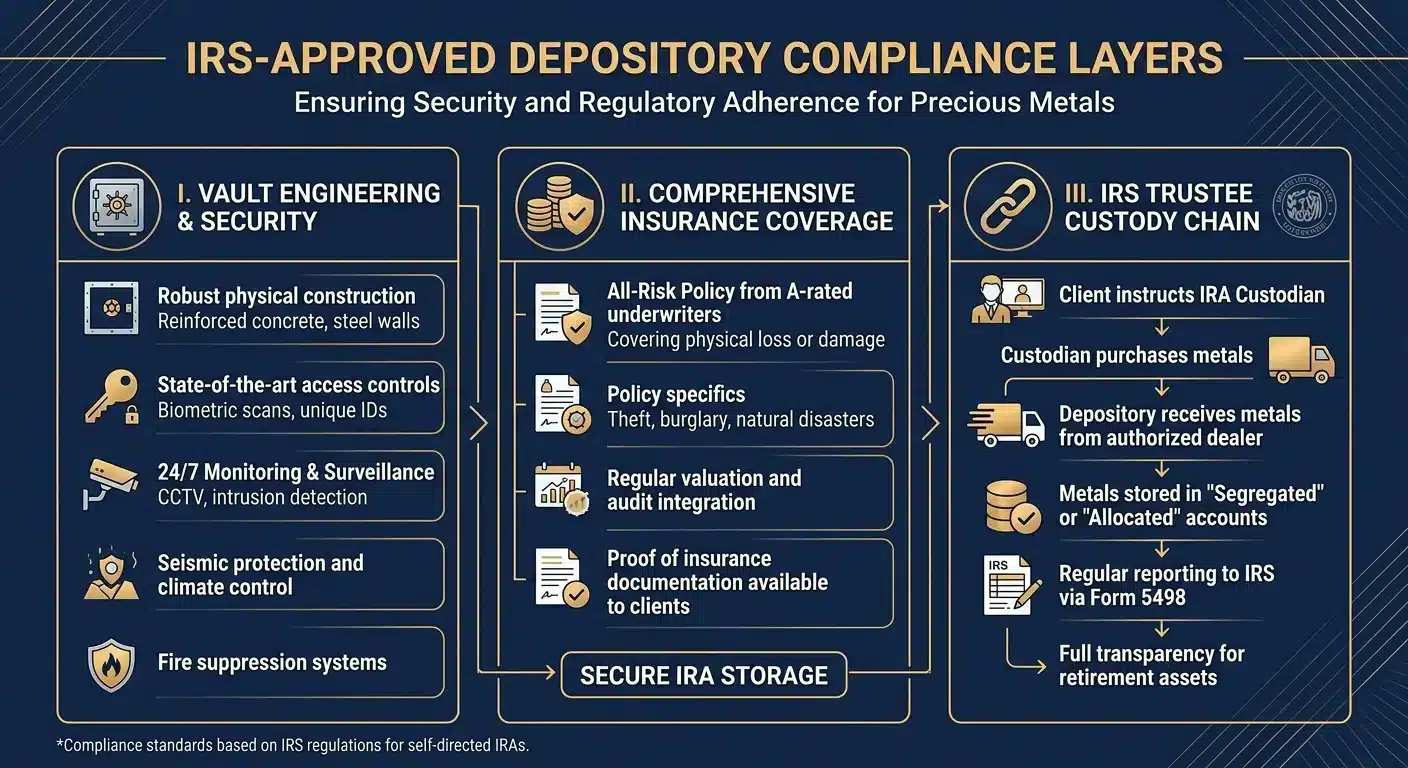
Most buyers come in asking logistics questions. Where does it go? Who holds it? What's the cost? Those are the right questions. But every single one of them has a legal floor underneath it — and that floor doesn't move.
When your silver sits inside a retirement account, storage preference doesn't enter the conversation. Federal law does. And it isn't ambiguous.
Knowing what the law actually requires — and what approved depositories are physically built to deliver — is what separates a clean position from one that quietly creates legal and financial exposure. That's what this section covers. Not theory. The actual framework.
What IRC Section 408(m) Actually Says About Precious Metals Custody
IRC Section 408(m) is the statute that controls this. It mandates that physical precious metals held inside a self-directed IRA remain in the custody of an IRS-approved trustee. That's the rule. There's no carve-out for personal safes. No exception for insured residential vaults. No provision that lets a retirement account holder take direct possession of IRA-held silver.
Get this wrong, and the consequences are immediate. Home storage of IRA-held precious metals is classified as an immediate taxable distribution. The IRS treats that as a full cash-out on the day you take possession — taxes owed right now, potential early-withdrawal penalties on top of that, and the retirement account status permanently lost on that position. Not a paperwork problem. A financial event.
That framework applies specifically to retirement-account silver. For owners holding silver outside a tax-advantaged account, there's no federal custody mandate. But the physical and logistical case for institutional storage doesn't disappear — it just changes from a legal requirement to a practical one. And for owners in either structure, the product that carries the cleanest compliance profile is American Silver Eagles the standard
Vault Engineering Standards: What 'Approved' Really Means Physically
Here's what most people miss: 'IRS-approved depository' isn't a tidiness certification. It reflects a specific tier of physical security engineering that qualifies a facility to hold assets under federal trustee custody standards. That word 'approved' is doing serious structural work.
UL Class 3 vault requirements are the infrastructure benchmark that separates institutional depositories from everything else. These vaults are engineered to resist physical tool and torch attacks for at least 120 minutes, with reinforced concrete walls measuring at least 18 inches thick. That's not an incremental upgrade from a residential safe — it's a fundamentally different category of structure. The comparison isn't close.
That standard exists for a reason. Bulk silver's density — the weight, the volume, the sheer physical mass of it — demands infrastructure that can absorb a sustained, sophisticated breach attempt without giving. A consumer-grade vault wasn't built for this problem. The gap between a home safe and a UL Class 3 facility isn't about quality. It's about purpose.
Insurance: The Layer of Protection Behind the Steel Door
Vault engineering handles the breach attempt. Insurance handles what happens if the breach succeeds. And at serious institutional depositories, that coverage isn't buried in a policy footnote. It's a structural commitment that stands behind every ounce in custody.
Delaware Depository carries $1 billion in all-risk transaction and custody insurance. That coverage extends to physical loss, structural damage, and internal theft. A $1 billion all-risk policy isn't window dressing — it's the institutional layer that stands between a customer's position and a total-loss scenario. Residential policies don't operate in the same universe.
Stack the three layers together — statutory custody compliance, UL Class 3 vault requirements, and institutional insurance coverage — and what you're looking at is a protection architecture no residential setup can replicate. That's the real meaning of 'approved.' Not a rubber stamp. An infrastructure standard that was purpose-built for exactly the kind of tangible, heavy, real asset bulk silver represents.
| Depository Requirement | Regulatory Authority | Minimum Standard | What It Protects Against |
|---|---|---|---|
| IRS-Approved Trustee Custody | IRC Section 408(m) | Physical precious metals held within a self-directed IRA must remain in the custody of an IRS-approved trustee | Immediate taxable distribution triggered by home storage or direct personal possession |
| Home Storage Prohibition | IRC Section 408(m) | Home storage of IRA-held precious metals is classified as an immediate taxable distribution | Loss of retirement account status, immediate tax liability, and potential early-withdrawal penalties |
| Physical Vault Engineering | Underwriters Laboratories (UL) Class 3 Standard | Reinforced concrete walls measuring at least 18 inches thick; resistance to physical tool and torch attacks for at least 120 minutes | Sustained physical breach attempts against bulk commodity holdings |
| All-Risk Custody Insurance | Institutional depository policy (e.g., Delaware Depository) | $1 billion in all-risk transaction and custody insurance covering physical loss, structural damage, and internal theft | Total-loss scenarios including theft, structural failure, and internal custodial risk |
Segregated vs. Allocated Storage: Choosing the Right Custodial Method
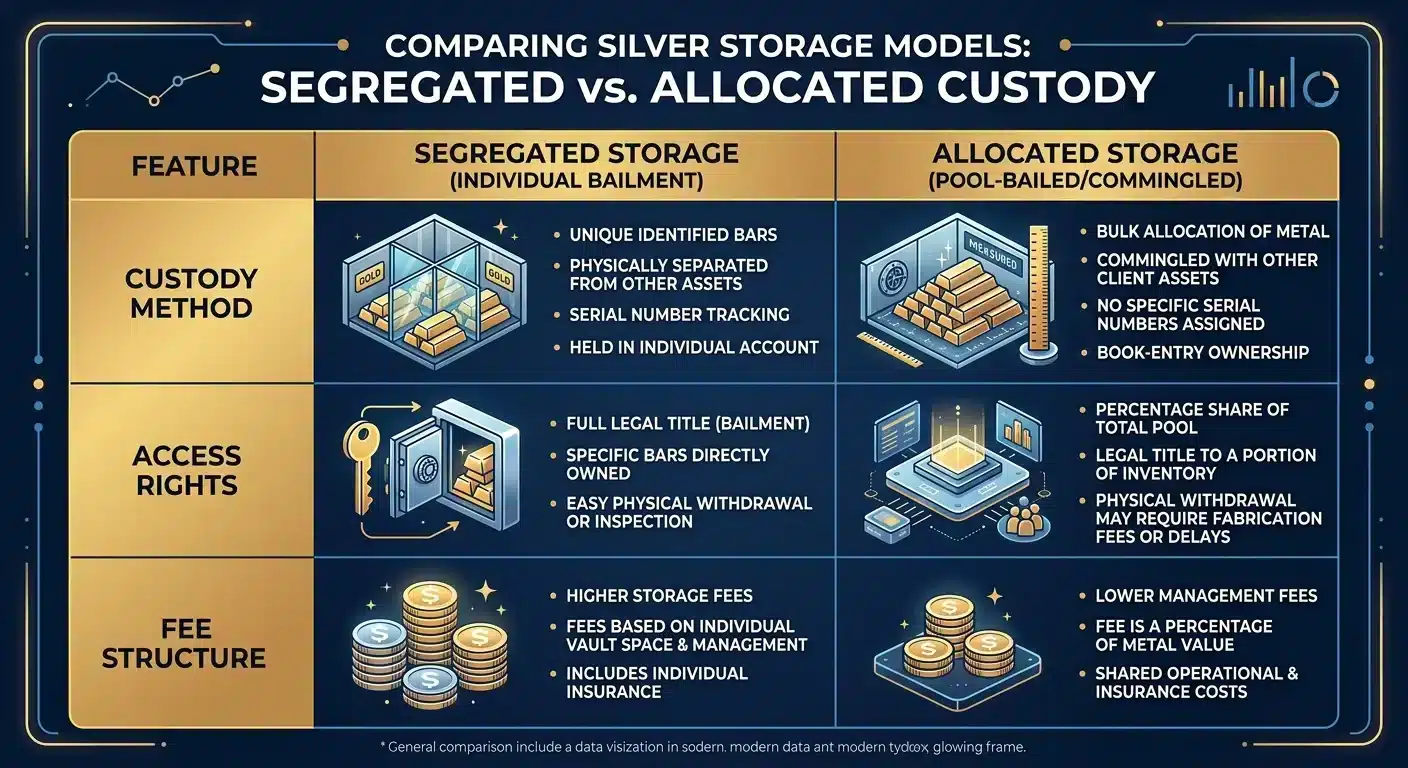
So institutional vaulting is settled. Now the actual question: which custody arrangement fits the way you want to own silver?
IRS-approved depositories offer two primary models: segregated storage and allocated storage. These aren't two flavors of the same thing. They represent fundamentally different custodial holding methods — and the difference matters before you commit to either one.
Here's the core question: do you want your specific bars physically isolated under your name, or do you want a guaranteed ounce count held in a professionally managed shared pool? Both options sit completely outside the commercial banking system. Both are compliant. But they serve different ownership profiles — and picking the wrong one introduces friction you didn't need. For owners building the full ownership case, buy physical silver for long-term wealth preservation lays out why the structure you choose matters as much as the metal itself. silver's industrial demand case
Segregated Storage: Your Bars, Your Serial Numbers, Your Shelf
Segregated storage means your specific, serial-numbered bulk bars are physically isolated in their own designated space at the depository. No other customer's metal shares that space. Your bars are identified, logged by serial number, and held exclusively under your account — nothing pooled, nothing shared.
That specificity means something concrete. With segregated positions, you can request an audit of those exact bars — not a pool position, not an account balance. Your property. For owners who've built their philosophy around direct accountability and maximum tangibility, segregated custody is the most literal expression of that conviction.
Be clear about what you're actually isolating, though. A standard 1,000-ounce silver bar weighs 68.6 pounds. Bulk silver requires roughly 19 times more storage space than the equivalent dollar value of gold. Segregated storage means a dedicated physical footprint for that weight and volume — and that specificity typically carries a premium in custody fees. Know the trade-off before you choose it.
Allocated Storage: Guaranteed Ounces in a Shared Pool
Allocated storage works on different logic entirely. The depository holds equivalent weight and purity in a shared pool — guaranteeing exact ounces upon redemption. You don't own Bar #A4721. You own a guaranteed claim on a defined number of ounces of qualifying silver. The distinction is structural, not cosmetic.
For many customers, that structure works exactly as needed. What matters is that the ounces exist, that they're held in a compliant and fully insured institutional facility, and that the redemption claim is ironclad. Allocated custody delivers all of that — often at a lower per-ounce storage cost than segregated arrangements, because the depository manages the pool efficiently across multiple account holders.
The segregated versus allocated storage options aren't ranked by quality — they're ranked by fit. Owners who prioritize maximum traceability and physical specificity tend toward segregated. Owners who prioritize cost efficiency and guaranteed-ounce redemption without the premium footprint tend toward allocated. Brighton Gold's concierge model walks you through exactly that trade-off — before you decide, not after.
Who This Is Not For: Choosing Storage Based on the Wrong Criteria
One custody decision pattern is worth naming directly. Some buyers choose their storage model on the lowest stated fee — full stop. No question about what that choice means at redemption. No question about what it costs operationally over five years.
Brighton Gold isn't the right partner for customers whose entire custody decision comes down to the cheapest number on the page. The value of a well-structured arrangement — segregated or allocated — comes from the institutional infrastructure behind it, the compliance architecture it sits inside, and the long-term support that comes with it. Choosing storage the way you'd choose a commodity strips out everything that makes the arrangement worth having.
We work with customers who want to understand what they're holding, how it's held, and why the structure matters — and then make a clear-eyed decision from that foundation. That's the relationship we're built for. If the goal is finding the cheapest line on a fee schedule, that's a different conversation. We'd rather say that plainly than pretend it isn't.
| Custodial Method | How Your Silver Is Held | Audit / Inspection Access | Typical Annual Fee Range | Best Suited For |
|---|---|---|---|---|
| Segregated Storage | Your specific, serial-numbered bars are physically isolated in a dedicated space under your account — no other customer's metal shares that space | You can request an audit of your exact bars by serial number — you're verifying your property, not a pool position | Higher than allocated — reflects the dedicated physical footprint and individualized tracking required for your specific bars | Owners who prioritize maximum traceability, physical specificity, and direct accountability over their exact bars |
| Allocated Storage | The depository holds equivalent weight and purity in a professionally managed shared pool — you own a guaranteed claim on a defined number of ounces, not specific bar numbers | Audit access verifies your guaranteed ounce count and the pool's total holdings — not individual bar serial numbers | Typically lower than segregated — the depository operates the pool efficiently across multiple account holders, reducing per-ounce overhead | Owners who prioritize cost efficiency, guaranteed-ounce redemption, and institutional compliance without the premium footprint cost |
How Brighton Gold's No Fee IRA and Concierge Model Handle Storage

Here's where most customers land after all of that: is there a way to own bulk silver without the storage decision becoming a part-time job?
There is. But it takes the right partner — not a regulatory PDF and a list of approved facilities.
That's what Brighton Gold's concierge model is built for. We don't hand customers a depository directory and walk away. We walk the entire chain alongside them — from the first custody conversation to the armored transit leg to the ongoing storage arrangement.
Every step that looked complicated from the outside becomes manageable when someone who knows it is standing next to you.
And for qualified purchases structured inside a Precious Metals IRA, we've removed the cost barrier that makes most customers hesitate before they even start. The No Fee Precious Metals IRA covers fees for the lifetime of the account on qualified purchases.
That's not a promotional offer. It's a structural commitment — because the kind of long-term ownership bulk silver deserves shouldn't be eroded by recurring fees that compound quietly in the background.
What the No Fee IRA Actually Covers — and What That Means for Storage Costs
The question we hear most at this point is the right one: what does "no fee" actually cover?
It deserves a plain answer.
Brighton Gold's No Fee Precious Metals IRA eliminates the ongoing IRA custody and storage fees for the lifetime of the account on qualified purchases. The institutional infrastructure — the IRS-approved depository, the custody arrangement, the compliance architecture — doesn't accrue annual fees that quietly erode your position over time.
What you put in stays working for you.
That structure matters more than it sounds. Bulk silver's physical density — the weight, the footprint, the volume — means institutional storage costs aren't trivial. Customers who've run the math on segregated versus allocated arrangements know fee pressure can push you toward a choice that isn't actually the right fit.
The No Fee IRA resets that calculus. The custody decision becomes about what fits your ownership goals — not about which option is least expensive. That's how it should be made. For customers who want to go deeper on how all of this connects, Brighton Gold's learning center walks through the full ownership picture.
How the Armored Transit and Custody Chain Works End-to-End
Most customers never ask how their silver actually moves from a transaction to a depository vault. The focus is on the ownership decision — not the shipping lane.
But transit is where physical assets are most exposed. That part of the chain is worth understanding.
Brink's Global Services handles armored transit for high-volume silver bar transfers. Every handoff runs dual-custody — no single point of failure in the chain of possession. Real-time encrypted tracking covers all physical transit coordinates between origin and vault.
The metal is never in an unaccounted-for state. That's not a marketing line. That's what dual-custody architecture means when you're moving 68.6 pounds of silver.
That logistics chain is what Brighton Gold connects customers to. We don't hand you a carrier contact and wish you luck.
The infrastructure is already in place. Our job is making sure you understand each handoff, confirming the chain of custody at every stage, and ensuring your position arrives properly logged and fully compliant. You're acquiring silver — not a logistics certification.
Concierge Support Before, During, and After the Storage Decision
Here's what most people don't see coming: the questions don't stop when the metal is vaulted.
That's when a different set starts. Auditing your position. Switching between segregated and allocated arrangements. What redemption actually looks like when the time comes.
Brighton Gold's concierge support is built for exactly that timeline. We're present before the storage decision — walking through the segregated versus allocated trade-off with no pressure toward either. We're present during the transaction and transit process — confirming every step in the custody chain.
And we're available after the metal is vaulted. Not just at the point of sale. Throughout the life of the ownership relationship — because that's when the real questions tend to arrive.
That's the reframe this entire article has been building toward. Institutional vaulting isn't the surrender of control. It's the only practical way to hold something this tangible, this heavy, and this real without compromising its integrity or its legal standing.
This heavy. This real. Brighton Gold's concierge model and No Fee Precious Metals IRA exist to make that structure work — from the first conversation to the last.
| Ownership Stage | Brighton Gold Concierge Action | Storage Benefit Delivered | Relevant Compliance Layer |
|---|---|---|---|
| Initial Custody Decision | Walks customer through segregated versus allocated trade-offs based on ownership goals, not fee minimization | Custody structure matched to fit — not defaulted to cheapest option | IRS-approved depository selection; IRC Section 408(m) compliance confirmed before any transaction |
| IRA Setup and Qualification | Structures qualified purchases inside the No Fee Precious Metals IRA framework, eliminating ongoing custody and storage fees for the lifetime of the account | Institutional infrastructure costs don't erode the position over time | Self-directed IRA custodian coordination; IRS trustee custody requirements satisfied |
| Armored Transit Coordination | Connects customer to the established armored logistics chain — no self-sourcing of carriers or custody contracts required | Dual-custody handoffs and real-time encrypted tracking at every transit point | Chain-of-custody documentation; unbroken possession record from origin to vault |
| Vault Arrival and Logging | Confirms position is properly logged, compliant, and held under the correct account structure at the receiving depository | Metal arrives in the correct custodial arrangement — segregated serial-number isolation or allocated pool position — as chosen | Depository intake verification; custody classification confirmed against IRA account records |
| Ongoing Ownership Support | Available after vaulting for questions about auditing, switching between custody types, and redemption mechanics | Long-term ownership clarity — not just point-of-sale support | Continuous IRS-approved custody maintained; redemption and distribution rules observed throughout ownership |
Frequently Asked Questions About Bulk Silver Storage
The structure makes sense. Now the sharper questions start.
Regulations and vault engineering are the foundation. But once that clicks, customers move fast to the next layer — cost, logistics, and whether they can actually verify what they own.
These are the questions we hear most from customers who've done the research and are ready to act. Straight answers only.
How do I ship bulk silver safely to an IRS-approved depository?
The transit leg runs through an armored logistics network — not a standard carrier. Brink's Global Services employs dual-custody handoffs for all high-volume silver bar transfers. Physical possession is verified and documented at every point in the chain. Real-time encrypted tracking platforms oversee all transit coordinates between origin and vault — so the metal is never in an unaccounted-for state.
Brighton Gold's concierge model coordinates the entire process. Customers don't source their own carriers. They don't negotiate armored transport contracts. That infrastructure is already in place — and we walk every step of it alongside you.
What is the physical weight and footprint of 1,000 ounces of bulk silver?
A standard 1,000-ounce silver bar weighs 68.6 pounds (31.1 kg). That's not an abstraction — it's a physical fact that changes the conversation the moment you're planning a real custody arrangement.
And silver's lower value density compared to gold makes the footprint problem just as significant. Bulk silver requires roughly 19 times more storage space than the equivalent dollar value of gold. That's not a rounding error — it's the reason institutional vaulting isn't a preference for serious bulk positions. The infrastructure required simply doesn't exist at home. This heavy. This real.
Can I inspect or audit my physically stored bulk silver at the depository?
Yes — and that right doesn't disappear once the metal is vaulted. IRS-approved depositories are built to accommodate account holder audits.
With segregated storage, your specific serial-numbered bars are physically isolated. You're not confirming a pool — you're confirming your property. With allocated storage, an audit confirms your guaranteed ounces against the pool's records.
Brighton Gold's concierge team walks you through how to initiate that request — what documentation comes back, what the timeline looks like, what to expect at each step. You don't have to figure that out by yourself.
What is the cost difference between segregated and allocated bulk silver storage?
The difference comes down to what you're paying for. Segregated storage physically isolates your specific, serial-numbered bars in dedicated space — and you pay for that footprint directly. Given that bulk silver requires roughly 19 times more storage space than the equivalent dollar value of gold, the premium for segregated custody reflects a real physical cost. It's not arbitrary.
Allocated storage holds equivalent weight and purity in a shared pool, guaranteeing exact ounces upon redemption. The depository manages that pool efficiently across multiple account holders — which typically translates to a lower ongoing cost than segregated arrangements.
Neither model is ranked by quality. They're ranked by fit. Maximum traceability or cost efficiency — that's the actual trade-off. Brighton Gold's concierge model is built to walk you through exactly that distinction before you decide.
How does Brighton Gold's No Fee Precious Metals IRA handle storage costs for qualified bulk purchases?
Brighton Gold's No Fee Precious Metals IRA eliminates the ongoing IRA custody and storage fees for the lifetime of the account on qualified purchases. The institutional infrastructure holding your bulk silver — the IRS-approved depository, the custody arrangement, the compliance architecture — doesn't accrue annual fees that quietly erode your position over time.
For customers who've run the math on segregated versus allocated arrangements and felt fee pressure nudging them toward a choice that isn't the right fit, the No Fee Precious Metals IRA resets that calculus. The custody decision becomes about what fits your ownership goals — not about which option is cheapest.
Delaware Depository carries $1 billion in all-risk transaction and custody insurance. That's the level of institutional infrastructure your position sits inside — at no ongoing fee on qualified purchases. This heavy. This real. The structure should match the asset. Ours does.
Bulk Silver Storage Is a Decision You Make Once — Make It Right
Bulk silver doesn't care about your ownership philosophy. It weighs what it weighs. It takes up the space it takes up. And the infrastructure holding it has to be built for exactly that reality — not the idea of it.
This isn't a decision you revisit every quarter. You make it once. The storage structure you choose will hold something real, something heavy, and something legally structured — potentially for decades. That consequence deserves more than a quick comparison of fee schedules.
This heavy. This real. The weight of that phrase isn't rhetorical. It's the entire argument.
Every layer this article covered exists for a reason. The IRS custody mandates. The vault engineering standards. The insurance architecture. The segregated versus allocated trade-off. The armored transit chain.
None of that is complexity for its own sake. It's the direct consequence of owning something that sits completely outside the paper financial system. The infrastructure isn't a burden on your ownership — it's what makes your ownership legitimate, protected, and recoverable on your terms.
Owning something real means holding it through a structure built for what it actually is. That's not a compromise. That's the point.
Here's the verdict: institutional vaulting backed by the right partner is not a concession on ownership. It's the fullest expression of it.
Brighton Gold's concierge model and No Fee Precious Metals IRA exist to close the gap between the ownership decision and the ownership reality. Compliance handled. Logistics handled. What you're left with is something tangible, protected, and yours.
This heavy. This real. If that's the kind of ownership you're building, make the infrastructure decision worthy of it.
You've seen what bulk silver actually demands — the vault grade, the compliance layer, the custody structure. That's not small. And it shouldn't sit in an arrangement that doesn't match it. If the No Fee Precious Metals IRA sounds like it fits your situation, one conversation with Brighton Gold will tell you whether it does. No pressure. Just a clear picture of what's possible.