

Segregated vs. Non-Segregated Storage: Which Is Safer for Gold?
Both storage types live inside the same vault.
Segregated and non-segregated storage are held at the same fortress-grade, IRS-approved depositories — the difference is not about physical security. It is about ownership identity.
Both arrangements require gold to be held by an independent, third-party depository, separate from the IRA custodian. The IRS mandates this under Internal Revenue Code Section 408(m). Home storage is prohibited. Non-compliant arrangements trigger immediate tax distribution penalties. The vault itself — whether segregated or non-segregated — operates under the same institutional standards and federal requirements.
Here is where they diverge.
With non-segregated storage — also called commingled storage — gold is held alongside other customers' metal of the same type and purity. The owner holds a specific quantity and weight. On withdrawal or liquidation, equivalent metal is returned, not the exact pieces originally deposited. For standard bullion, this is structurally sound and cost-effective.
With segregated storage, specific coins or bars are physically separated, individually identified, and returned exactly as deposited. No commingling. No equivalency. The same pieces — with the same provenance.
The question serious owners ask is not which option is safer from theft or institutional failure. Both are. The real question is whether the specific identity of what is held matters.
For sovereign-minted coins — like the Gold American Eagle — it does. The condition, the specific strike, the unbroken chain of custody directly affect long-term resale value and liquidity. Receiving equivalent weight is not the same as reclaiming the exact coins acquired.
For standard bullion bars, non-segregated storage is a rational, compliant choice. For sovereign-minted coins where provenance is part of the value, segregated storage is not a luxury — it is an ownership strategy.
- How Institutional Gold Vaulting Actually Works
- Why Most Gold Storage Comparisons Get It Wrong
- What Non-Segregated Storage Actually Means for Your Gold
- What Segregated Storage Actually Means for Your Gold
- Who Should Choose Which Option — and Why the Answer Depends on What You Own
-
Frequently Asked Questions About Gold Storage Options
- What is the main difference between segregated and non-segregated vaulted gold storage?
- Are there extra costs associated with selecting segregated storage for physical gold?
- Does non-segregated (commingled) storage put my gold at risk of loss if the depository defaults?
- Can I switch from non-segregated to segregated storage after setting up my Gold IRA?
- Which storage option is recommended for U.S.-minted physical coins like the Gold American Eagle?
- The Bottom Line on Gold Storage
How Institutional Gold Vaulting Actually Works

Most people picture a gold vault the way movies show a bank vault — one reinforced room, everything stacked together. That image isn't wrong. It's just incomplete.
Here's what doesn't change between segregated and non-segregated storage: the vault itself. Every IRS-approved depository runs under federal mandate, independent custodian oversight, and institutional audit protocols. The walls are the same. The alarms are the same. The compliance threshold is identical.
What differs is the record — not the room.
Secure vaulted storage at any compliant depository answers one question automatically: is your gold safe? Yes. That's settled.
The question that actually matters is different: when you ask for your gold back, what exactly do you get?
The IRS and SEC Rules That Govern Every Approved Depository
The federal framework is not a suggestion. IRS rules under Internal Revenue Code Section 408(m) prohibit home storage of IRA-held metals entirely. Non-compliant arrangements are treated as immediate taxable distributions — penalties included.
No exceptions for small quantities. No grace windows. The vault isn't a best practice. It's a legal requirement.
SEC guidance on precious metals custody makes one thing explicit: your IRA custodian cannot hold the physical metal on-site. The depository must be a fully independent third party — structurally separate, not just administratively distinct.
And because physical precious metals are excluded from FDIC insurance protection, the institutional credentialing of that depository isn't a formality. It's the only protection model that exists.
By the time your gold reaches an approved depository, it has already cleared a regulatory threshold no single dealer controls. That standard was built and enforced by federal regulators — not by whoever sold you the metal. What that means for you: your gold is protected by a physical wealth protection framework that exists entirely outside the sales relationship.
What Chain of Custody Means in Practice
Chain of custody isn't a marketing phrase. It's the documented record of every movement, transfer, and verification event tied to a specific piece of metal — from acquisition through depository acceptance through any eventual withdrawal.
In a segregated arrangement, that chain is tied to your specific coins — your serial numbers, your strike condition, your exact physical pieces. In a non-segregated arrangement, the chain tracks quantity and purity on your behalf, not identity.
Both are auditable. Both are compliant. But only one guarantees that the physical objects you originally acquired are the ones that come back to you.
For sovereign U.S.-minted coins — like the Gold American Eagle — that distinction isn't a technicality. It's the entire point of ownership.
| Storage Feature | IRS Requirement | Applies to Segregated | Applies to Non-Segregated |
|---|---|---|---|
| Third-party depository custody | Mandatory — metals must be held by an independent, IRS-approved trustee or depository separate from the custodian | Yes | Yes |
| Home storage prohibition | Strictly prohibited — non-compliant storage is treated as an immediate taxable distribution | Yes | Yes |
| FDIC insurance coverage | Not applicable — physical precious metals are excluded from FDIC protection; institutional credentialing is the protection model | Yes | Yes |
| Physical separation from custodian assets | Required — the depository must operate as an entirely separate legal and physical entity from the IRA custodian | Yes | Yes |
| Ownership record type | Compliant under either arrangement — the distinction is how ownership identity is tracked, not whether it is tracked | Tied to specific, individually identified pieces — serial numbers and strike condition recorded | Tied to quantity and purity on the owner's behalf — equivalent metal returned, not the exact pieces deposited |
| Chain of custody audit trail | Both arrangements are auditable and compliant under federal depository standards | Tracks the identity of your specific coins or bars through every movement and verification event | Tracks quantity, weight, and purity on a pooled basis — ownership is recorded, physical identity is not |
| Return on withdrawal or liquidation | Either arrangement meets IRS structural requirements for distribution | Your exact coins or bars — the specific pieces you originally acquired | Equivalent metal of the same type, purity, and weight — not necessarily the original pieces |
Why Most Gold Storage Comparisons Get It Wrong
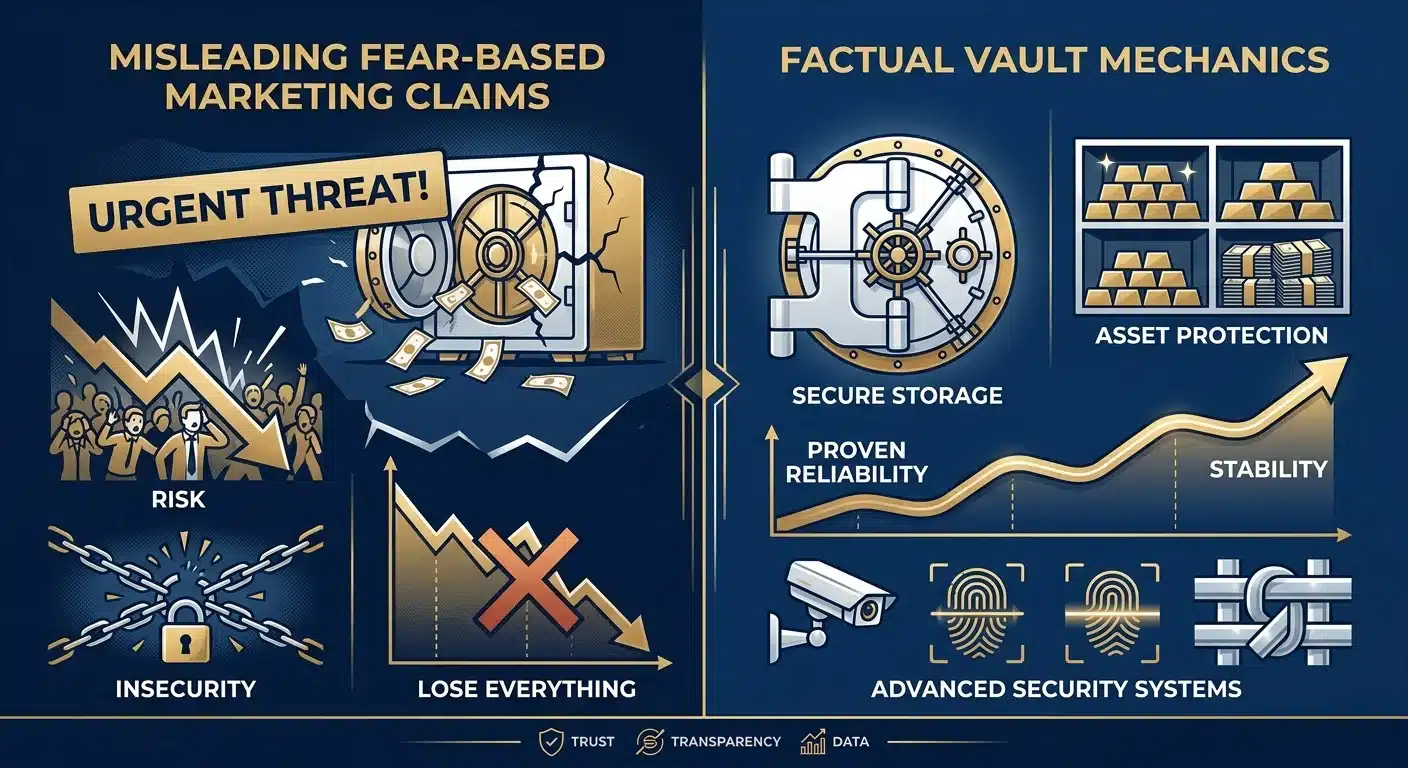
Most storage comparisons get the question wrong on purpose.
The industry frames this as a security contest. Segregated storage gets the "safe" label. Non-segregated storage gets quietly coded as the risky alternative — implicitly cheaper, implicitly lesser.
That framing isn't consumer education. It's a sales mechanism wearing consumer education as a disguise.
Here's what that framing erases: both options sit inside the same IRS-approved, federally regulated, institutionally audited depository.
The CFTC has flagged this pattern specifically — warning that unregulated dealers frequently fabricate secure custody fees and manufacture complexity to justify them. The fear of "unsafe" commingled storage is the product being sold. The vault itself was never the variable.
The Fear-Based Marketing Playbook Competitors Use
The playbook is remarkably consistent. Step one: photograph the vault. Step two: imply that commingled metal means your gold is somehow diluted, at risk, or mixed beyond recovery.
Step three: offer segregated storage — at a premium — as the only protection against this manufactured threat.
The threat was never real. The premium is.
Federal enforcement has caught up with the most aggressive versions of this. The FTC has shut down major firms for misrepresenting storage realities — and now requires dealers to disclose physical storage addresses and exact annual costs. The physical separation of client metal from corporate assets must be verifiable on demand.
What the enforcement record reveals isn't isolated misconduct. It is a structural pattern: complexity and fear are more profitable than clarity.
The CFTC recommends independent physical auditing of vaults as a primary consumer protection. That recommendation exists because the gap between what dealers claim and what actually sits inside those vaults has proven — repeatedly — to be wide.
Guaranteed buybacks often mask inflated initial prices. That's another layer of the same playbook: lead with fear, close with a premium, and make the customer feel grateful for paying it.
Before you accept any dealer's version of what physical storage entails, start with the structure — not the sales pitch.
Brighton Gold's approach starts from the opposite direction.
We don't use vault imagery to manufacture urgency. We explain the structural difference — ownership identity versus equivalent weight — and let serious owners decide what matters to them.
That is the only honest version of this comparison.
Who This Article Is Not For
Brighton Gold's approach to vaulted storage isn't built for every type of buyer. Worth saying directly.
If you're here to find out which storage option delivers the best price performance or the highest short-term return — that's not a question the storage structure answers. It's not a question we answer, either.
The precious metals resource center at Brighton Gold is built for owners who want to understand what they're holding and how it's protected.
Not buyers chasing urgency. Not people looking for confirmation that the market is about to move.
If the goal is long-term, intentional ownership of physical metal, this is the right conversation. If the goal is speculation, there are better resources for that — and we'll be the first to say so.
| What Competitors Claim | The Actual Reality | Why the Distortion Exists |
|---|---|---|
| Commingled storage is unsafe — your gold could be lost, diluted, or mixed beyond recovery | Both segregated and non-segregated storage operate inside the same IRS-approved, federally regulated, institutionally audited depository — the physical security standard is identical | Fear of "unsafe" commingling is a sales mechanism; it justifies a premium fee for segregated storage by manufacturing a threat that the vault itself never posed |
| Segregated storage is always the superior choice for serious precious metals owners | Segregated storage is a strategic necessity only when the specific identity of your metal — its provenance, condition, and chain of custody — materially affects its resale value and liquidity, as with sovereign U.S.-minted coins | Positioning segregated storage as universally superior converts a nuanced ownership decision into a default upsell, regardless of whether the customer's holdings justify the recurring cost |
| Complex storage structures and elevated fees signal higher security and better protection | Complexity in storage arrangements frequently reflects dealer profit margins, not enhanced protection — federal enforcement has required firms to disclose exact annual costs and physical storage addresses precisely because this gap has been exploited | Fabricated custody complexity allows unregulated dealers to charge fees that bear no relationship to the actual institutional cost of compliant depository storage |
| Guaranteed buybacks are evidence of a dealer's confidence in the metal's value | Guaranteed buyback offers often mask inflated initial acquisition prices — the buyback guarantee is structured to benefit the dealer, not the owner | Bundling a buyback guarantee with a storage offering creates the appearance of a complete, protective package while obscuring the real cost embedded in the original transaction |
| Non-segregated storage means you do not truly "own" your gold | Non-segregated storage is a legally and structurally sound ownership model — you own a specific quantity and weight of metal that meets institutional purity standards; what you do not own is the identity of specific pieces | Blurring the line between ownership and physical identity conflates two distinct concepts — and makes non-segregated storage sound like a legal gray area when it is a federally compliant arrangement |
| All gold dealers offer equivalent storage quality — the choice is simply a matter of price | Custodian credentialing, independent audit protocols, and the verifiable physical separation of client metal from corporate assets vary significantly across dealers — and are not visible from a fee schedule alone | Race-to-the-bottom pricing comparisons divert attention from the structural factors that actually determine the integrity of a storage arrangement over time |
What Non-Segregated Storage Actually Means for Your Gold
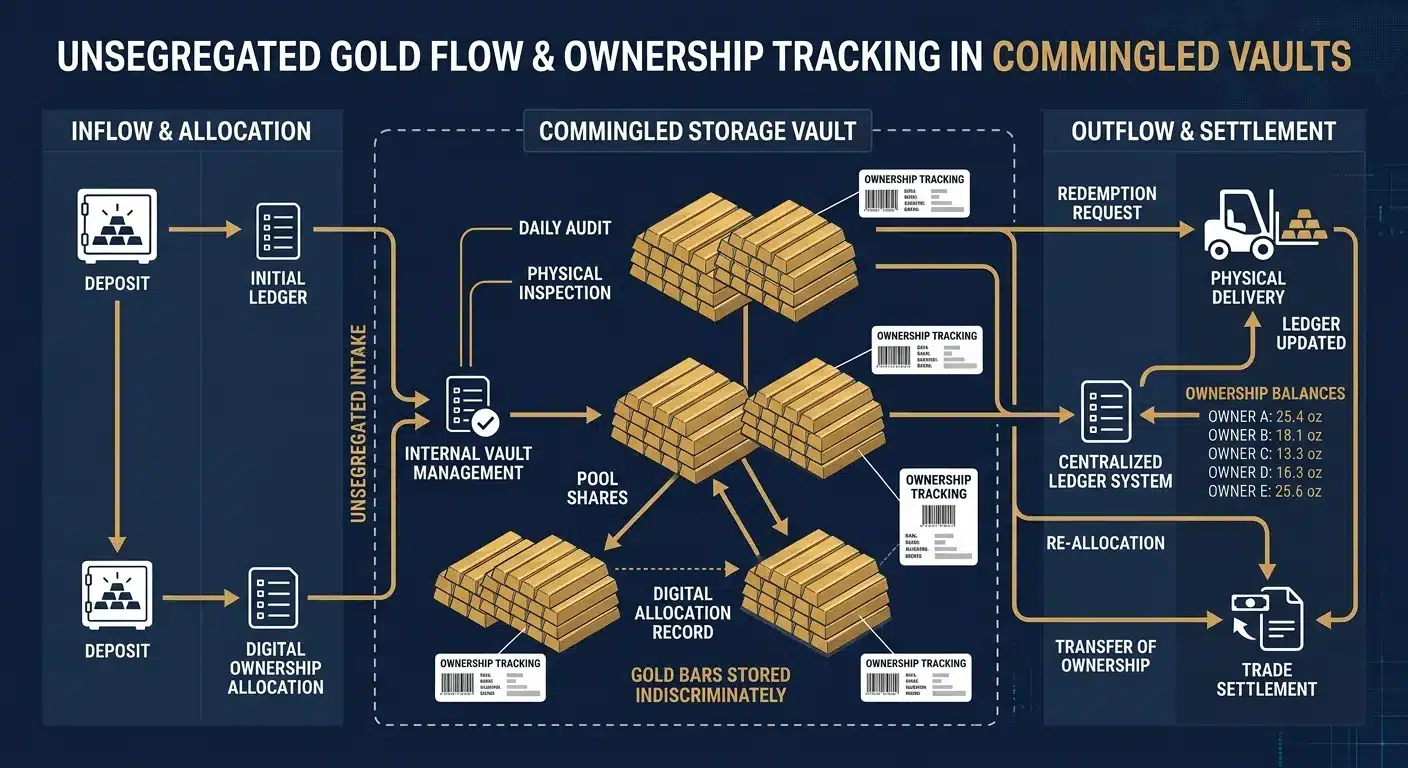
Non-segregated storage has a reputation problem — and almost every bit of it was built by the people selling you the alternative.
Strip the fear away. What you find is a federally compliant, institutionally rigorous custody arrangement that works exactly as designed for the vast majority of physical gold owners.
Here's what it actually means: your gold sits in an IRS-approved depository alongside other customers' metal of the same type and purity. You own a specific quantity and weight — documented, audited, and legally yours.
The depository tracks that ownership precisely. What it doesn't track is the identity of your specific bars or coins.
That's the whole distinction.
Quantity versus identity — that's the entire non-segregated storage story.
Not safety. Not security. Not institutional integrity. Those are identical in both arrangements. The only variable is whether what comes back to you is your exact pieces or their verified equivalent.
For standard bullion, that difference rarely matters. For sovereign-minted coins, it matters entirely.
How Commingled Vaulting Works Operationally
When metal enters a commingled vault, it's accepted, weighed, assayed, and recorded against your account by quantity and purity. Then it's stored alongside other holdings of identical specification — same type, same grade, same institutional standard.
The LBMA's chain of custody framework enforces exactly this kind of tracked, purity-verified vaulting — locking custody movements to a certified, unbroken loop of trusted depositories.
This isn't a loose system. It's a rigorous one.
Digital tracking networks audit vault contents continuously — verifying quantity, confirming custodial integrity, flagging discrepancies before they compound.
The physical criteria enforced across approved depositories aren't suggestions. They're structural requirements, independently verified.
The commingled vault isn't a loose pile. It's a precisely documented institutional holding — and fear-based marketing depends on you never knowing that.
Here's what makes this model different from the alternatives people casually assume are just as safe. An IRS-approved depository operates under a legal architecture that a bank safe deposit box never touches — no custodian accountability, no independent audit requirement, no structural separation from the institution's own assets.
Your IRA custodian is prohibited from holding the physical metal on-site. The depository is an independent third party, accountable on its own terms.
That's a fundamentally different protection model than the risks of a bank safe deposit box.
Legal Protections That Apply to Non-Segregated Holdings
Non-segregated holdings carry the full weight of the federal custody framework. Your IRA custodian can't commingle your metal with its own assets, can't hold it on-site, and can't represent ownership claims that conflict with the depository's independent records.
Physical precious metals are excluded from FDIC insurance protection — which means the depository's institutional credentialing isn't a formality.
It's the protection model itself.
Chain of custody tracking applies to non-segregated holdings just as it applies to segregated ones — the difference is what the chain is attached to. In a commingled arrangement, the chain tracks your quantity and purity entitlement.
That record is auditable, legally binding, and structurally protected against counterparty risk.
For owners whose goal is long-term physical ownership of standard bullion — not the recovery of specific coins — non-segregated storage isn't a compromise. It's the right choice.
| Characteristic | Non-Segregated (Commingled) Storage | Key Implication for the Owner |
|---|---|---|
| What you legally own | A documented quantity and purity entitlement — not specific bars or coins | Your ownership is real, auditable, and legally binding — it is defined by weight and grade, not by individual piece identity |
| Physical security level | Same fortress-grade, IRS-approved, independently audited depository used for segregated holdings | The vault does not become less secure because your metal is held alongside equivalent metal — the institution is identical |
| Regulatory framework | Full federal custody structure applies — custodian is prohibited from holding metal on-site; independent third-party depository required | Non-segregated is not a lighter or informal custody arrangement — it operates under the same legal architecture as segregated storage |
| What comes back to you on withdrawal | Equivalent quantity and purity — verified, compliant metal matching your entitlement, not your original specific pieces | For standard bullion, this distinction is operationally irrelevant — the metal you receive is fungible and indistinguishable in grade |
| Audit and tracking method | Digital tracking networks monitor quantity and purity entitlements continuously across the commingled pool | Your holding is not invisible inside the pool — it is a precisely documented ledger entry, independently verifiable at any time |
| Where it falls short | Sovereign-minted coins — like the Gold American Eagle — carry value tied to their specific condition, provenance, and physical identity | If the exact coins you acquired are what matter for resale value and long-term liquidity, non-segregated storage cannot preserve that — segregated custody is the appropriate structure |
| FDIC insurance status | Physical precious metals held in an IRS-approved depository are excluded from FDIC insurance protection | The protection model is the depository's independent credentialing and regulatory accountability — not a government deposit guarantee |
What Segregated Storage Actually Means for Your Gold

Segregated storage means one thing — your exact pieces come back to you.
Not equivalent weight. Not the same purity grade pulled from a shared pool. The specific coins you acquired, held in an individually identified space inside an IRS-approved depository, available for return exactly as deposited.
That distinction is invisible until you try to get your metal back.
With non-segregated custody, you own a quantity entitlement — a documented claim on a specific weight and purity. With segregated custody, you own a specific physical identity. The same institutional depository. The same federal compliance framework. Entirely different answers to the question: "What exactly is mine?"
For owners of standard 999.9-fine bullion bars, that identity question almost never matters. One bar of identical specification is legally and economically interchangeable with any other. The quantity entitlement model works — cleanly and completely.
But sovereign U.S.-minted coins are a different calculation entirely. Strike condition. The date. An unbroken chain of custody. The Gold American Eagle carries independent liquidity value that equivalent weight cannot replicate. For those owners, segregated custody isn't a premium upgrade. It's the only arrangement that preserves what they actually acquired. That's what secure vaulted storage is built to protect. what that looks like in practice
How Individual Custody Tracking Works
Here's what segregated custody actually looks like at the depository level — your holdings go into a dedicated, individually marked space. The chain of custody runs directly to your specific pieces.
Every movement. Every audit. Every verification event. All of it tied to those exact coins — not to an equivalent quantity sitting somewhere in the same vault. The record doesn't describe a pool you belong to. It describes your metal.
The legal requirements under IRC Section 408 set the floor: IRA-held metals must sit with an approved, independent depository — a qualified bank or non-bank trustee that is structurally separate from the custodian. Segregated storage operates inside that same mandatory framework. It doesn't replace it.
What it adds is ownership specificity. Digital tracking networks audit vault contents continuously. In a segregated account, those audit records point to your coins individually — not to a pooled quantity that happens to include your entitlement.
The LBMA's chain of custody standard applies at the institutional level — full stop, regardless of storage type. Custody movements are locked to a certified, unbroken loop of trusted vaults. That's the foundation. Every compliant depository operates on it.
What segregated custody builds above that foundation is individual traceability. The vault's integrity is the floor. Your specific coins being identifiable within it — that's the ownership guarantee segregated storage adds on top.
The Real Cost Structure of Segregated Storage
Segregated storage costs more. Say that plainly — don't hide it and don't exaggerate it.
The higher fee reflects real operational work: maintaining individually identified spaces, running separate audit trails, and guaranteeing that specific pieces — not equivalent weight — are available on withdrawal. That overhead is legitimate. The cost differential reflects it accurately.
The question isn't whether segregated storage is more expensive — it is. The only question worth asking is whether the coins you hold justify that ongoing premium.
For sovereign U.S.-minted coins like the Gold American Eagle — where long-term resale liquidity depends on physical condition and provenance — the answer is yes. For standard bullion where any bar of identical purity is legally interchangeable, paying a continuous premium to isolate specific bars is a cost with no corresponding ownership benefit.
And home storage isn't the workaround. IRS rules under Section 408(m) are unambiguous — non-compliant arrangements trigger immediate tax distribution penalties. The real decision sits between two compliant, institutionally sound options. Which one is right depends entirely on what you're holding.
| Storage Type | Ownership Record | Annual Fee Range | Best Suited For | Resale Liquidity Impact |
|---|---|---|---|---|
| Non-Segregated (Commingled) | Quantity and purity entitlement — documented, audited, and legally binding, but not tied to specific physical pieces | Lower recurring cost — reflects shared operational infrastructure across pooled holdings | Standard bullion bars and rounds where identical purity and specification make individual pieces interchangeable | No material impact for standard bullion — equivalent weight at identical purity carries the same market value on resale |
| Segregated | Specific physical identity — exact coins held in an individually accounted, separately marked space; audit trail runs to those precise pieces | Higher recurring cost — reflects dedicated storage space, individual audit records, and guaranteed return of specific pieces on withdrawal | Sovereign U.S.-minted coins where strike condition, date, and provenance carry independent liquidity value beyond melt weight | Direct impact — preserved physical condition and documented chain of custody supports stronger resale positioning for condition-sensitive coins |
Who Should Choose Which Option — and Why the Answer Depends on What You Own

The vaults are equivalent. The security is equivalent. The federal compliance floor is identical.
But what each arrangement actually does for you — that's where they split. And that split runs entirely through what you own.
The right storage arrangement isn't determined by which option sounds more secure. It's not determined by which one your dealer pushes — especially when that dealer earns more when you pick the expensive one.
There's one question that settles it: does the physical identity of your specific pieces carry independent ownership value?
If yes, segregated storage is a structural requirement. If no, non-segregated isn't a compromise — it's the correct call.
The CFTC has said this directly: unregulated dealers frequently fabricate custody fees, and guaranteed buyback offers often mask inflated initial prices.
That warning exists because the storage decision is one of the most reliable pressure points in this industry. Complexity and fear are more profitable than clarity. This is exactly where that playbook runs hardest.
Know what you own and what each arrangement actually delivers for that ownership — and the grip those tactics depend on disappears.
When Non-Segregated Storage Is the Right Call
Non-segregated storage is right when what you hold is standard bullion — bars or rounds where one piece of identical purity and weight is legally and economically interchangeable with any other.
Own 10 ounces of 999.9-fine gold? Your goal is long-term physical ownership of that quantity. Non-segregated storage delivers exactly that: documented, audited, federally compliant custody of your entitlement — at a cost that doesn't compound silently against your holdings over time.
Ask one question before accepting anyone's storage recommendation: when the time comes to exit, what do you actually need back?
If the answer is ten ounces of 999.9-fine gold in any form that meets that specification, the identity of the specific bars is irrelevant. Non-segregated storage protects everything that matters — your quantity, your purity, your documented ownership claim against a federally supervised depository.
Understanding how secure storage for physical wealth protection works at the institutional level puts this decision in the right frame.
Owners building long-term physical holdings in standard bullion — prioritizing quantity over specific provenance — will find non-segregated storage to be the operationally sound, cost-efficient match.
The FTC now requires firms to disclose physical storage addresses and exact annual costs. A reputable depository operating under that standard delivers exactly the custody framework this ownership model requires.
No inflated premium. No manufactured complexity. Just the arrangement that fits what you're holding.
When Segregated Storage Is Worth the Premium
Segregated storage earns its premium when what you hold is sovereign U.S.-minted coins — Gold American Eagles, Silver American Eagles, or other sovereign-strike products where long-term resale liquidity is tied directly to physical condition and specific provenance.
These aren't interchangeable units. Two Gold American Eagles from different strike years or condition grades aren't economically equivalent — and the market treats them accordingly.
Only segregated custody guarantees you get the exact pieces back. Not their weight equivalent. Not the nearest match from a shared pool. Your coins.
Both storage types operate fully within the same federal compliance structure. IRS rules on qualified trustees and custodians require that IRA assets be held by a qualified trustee or custodian — not the account owner — and neither arrangement touches that requirement.
So segregated storage isn't adding regulatory compliance. That's already satisfied by either option.
What it adds is a custody guarantee that runs to your specific pieces — not to an equivalent entitlement in a shared pool.
The IRS regulations governing IRA trustees and asset separation require that client metal remain structurally separate from corporate assets — a standard both storage types satisfy.
But for sovereign-minted coins, the ownership question doesn't stop there.
It comes down to whether the specific pieces you acquired — in their specific condition — are available when you need them. Segregated storage is the only arrangement that answers that question with a definitive yes.
The Qualification Gate: Matching Storage to Ownership Goals
Here's the qualification gate — stated plainly.
Own standard bullion, long-term quantity ownership, lowest sustainable cost: non-segregated storage is the right choice.
Own sovereign U.S.-minted coins, preservation of specific provenance and condition that drives long-term resale liquidity: segregated storage isn't an upgrade. It's a structural requirement of the ownership model you've already chosen.
What neither option should ever be is a decision made under pressure from a dealer whose margins benefit from the more expensive arrangement.
The CFTC recommends independent physical auditing of vaults as a primary consumer protection — not a courtesy. The FTC has shut down major firms for misrepresenting storage realities. That enforcement record exists for a reason.
The protection against that category of risk isn't complicated: match your storage choice to what you actually own. That clarity is the only thing that removes the grip fear-based selling depends on.
| What You Own | Recommended Storage Type | Primary Reason | Fee Justification |
|---|---|---|---|
| Standard bullion — bars or rounds of a uniform purity and weight specification (e.g., 999.9-fine gold bars) | Non-Segregated (Commingled) | Identical-purity bullion is legally and economically interchangeable — your ownership claim is a quantity entitlement, not a claim to specific pieces. Non-segregated storage protects what matters: documented, audited custody of your exact entitlement. | Lower recurring cost is structurally justified because no operational premium is required to identify, isolate, or track specific pieces. Paying for segregation provides no additional ownership benefit when the pieces are interchangeable. |
| Sovereign U.S.-minted coins — Gold American Eagles, Silver American Eagles, or other sovereign-strike products with condition-dependent resale value | Segregated | Sovereign-minted coins are not interchangeable units. Physical condition, strike year, and specific provenance directly determine long-term resale liquidity. Segregated custody guarantees the return of your exact pieces — not an equivalent quantity. | Higher recurring cost is justified because the operational work is real: individually marked storage, separate audit trails, and a custody guarantee that runs to your specific coins. The premium preserves the ownership quality that makes these coins worth holding. |
| Mixed holdings — a combination of standard bullion and sovereign-minted coins within the same account or overall ownership position | Segregated for sovereign coins; Non-Segregated for standard bullion | The two ownership models have different structural requirements. Applying a single storage type to both categories either overpays for the bullion or under-protects the sovereign coins whose value depends on physical identity. | Fee efficiency is achieved by matching the storage arrangement to the ownership model of each holding category — not by applying the higher-cost option uniformly across all holdings. |
| Large-quantity standard bullion accumulation — owners prioritizing total ounce count and long-term quantity preservation above all other factors | Non-Segregated (Commingled) | When the ownership goal is quantity — not provenance — the physical identity of individual bars carries no independent value. Non-segregated storage delivers federally compliant, institutionally supervised custody of the full entitlement at a cost structure that does not compound against the position over time. | Cost efficiency compounds meaningfully over a long holding period. The recurring fee differential between segregated and non-segregated storage, applied across a large-quantity position over many years, represents a real ownership cost with no corresponding ownership benefit for interchangeable bullion. |
| Legacy or estate-focused holdings — sovereign coins acquired with the intent to transfer specific pieces to heirs or beneficiaries | Segregated | Legacy transfer depends on the ability to identify and pass on specific physical pieces — not an equivalent weight claim against a commingled pool. Segregated custody maintains the chain of ownership from acquisition through transfer, preserving the specific coins' condition and provenance for the next owner. | The cost premium directly protects the ownership integrity that makes legacy transfer meaningful. Non-segregated storage cannot guarantee the return of the specific coins originally acquired — only an equivalent entitlement — which may not satisfy the intent behind legacy-focused ownership. |
Frequently Asked Questions About Gold Storage Options
Now for the questions that actually move the decision.
These are the questions Brighton Gold hears most — costs, depository risk, IRA mechanics, and which arrangement fits sovereign U.S.-minted coins. Direct answers only.
What is the main difference between segregated and non-segregated vaulted gold storage?
Both arrangements live inside the same IRS-approved, fortress-grade depositories. The physical security infrastructure is identical. This is not a safety question.
The difference is ownership identity.
With non-segregated storage, your metals are held alongside other customers' holdings of the same type and purity. You own a documented entitlement — a specific quantity and purity grade. On withdrawal, you receive metal meeting that specification. Not the exact pieces you deposited. Their verified equivalent.
With segregated storage, your specific coins or bars are assigned a dedicated, individually identified space. They are held separately, audited separately, and returned to you exactly as deposited. The chain of custody runs to the individual piece — not to the pool.
That distinction only matters when the identity of your specific pieces carries independent ownership value. For sovereign U.S.-minted coins, it does. For standard bullion, it rarely does.
Are there extra costs associated with selecting segregated storage for physical gold?
Yes — and the cost difference is real and recurring. Segregated storage requires individually identified vault space, separate audit trails, and the operational infrastructure to guarantee that your specific pieces are available on withdrawal. That is not a manufactured premium. It reflects actual custody work.
The FTC requires firms to disclose physical storage addresses and exact annual costs — so any reputable depository will give you a clear number before you commit. Ask for it. Put it next to what you hold.
For standard bullion — where any piece of identical purity is legally and economically interchangeable — that recurring cost delivers no ownership benefit beyond what non-segregated storage already provides. The quantity entitlement model works. Paying more to isolate specific bars adds nothing to what you own.
For sovereign U.S.-minted coins whose resale liquidity is tied to physical condition and specific provenance, the cost is justified. Because only segregated custody guarantees you get those exact pieces back — and that guarantee is the point.
Does non-segregated (commingled) storage put my gold at risk of loss if the depository defaults?
This is the fear the industry exploits most. It deserves a direct answer.
Both storage types operate under the same federal custodial framework. The physical separation of client metal from corporate assets must be verifiable at any approved depository. Your holdings are not a corporate asset. They cannot be used to satisfy depository liabilities. That structural protection applies to non-segregated holdings exactly as it applies to segregated ones.
Physical precious metals held in either arrangement are also excluded from FDIC insurance — but that is not the protection mechanism here. The protection is structural: independent third-party vaulting, separate from the custodian, with documented ownership claims against the depository's physical holdings.
Non-segregated storage does not mean unprotected. It means your entitlement is to equivalent metal — not to specific bars. A depository default does not erase that entitlement. Digital tracking networks audit vault contents continuously to maintain that integrity.
The risk profile is not meaningfully different between the two arrangements for standard bullion. What differs is what you get back — not whether you get it back.
Can I switch from non-segregated to segregated storage after setting up my Gold IRA?
Yes — but confirm the mechanics with your custodian before you initiate anything.
Switching storage types is an operational change, not an IRS event. As long as the metal stays inside an IRS-approved depository and your qualified trustee relationship remains intact under Section 408(m), the custody reclassification doesn't trigger a distribution or a tax consequence. The physical metal doesn't leave the vault. What changes is how your holdings are identified and recorded within it.
The process typically involves a formal request to your custodian, a review of available segregated arrangements at your current depository, and an adjustment to your ongoing storage fee going forward.
Before you initiate the switch, ask whether your holdings actually justify it. If you acquired sovereign U.S.-minted coins and you're sitting in non-segregated storage right now, the answer is probably yes — switching preserves the provenance integrity those coins depend on for resale liquidity. If you hold standard bullion, you're adding a recurring cost with no corresponding ownership benefit.
Match the arrangement to what you own. That's the only basis for the decision.
Which storage option is recommended for U.S.-minted physical coins like the Gold American Eagle?
Segregated storage — and the reasoning is structural, not promotional.
Sovereign U.S.-minted coins like the Gold American Eagle are not interchangeable units. Their long-term resale liquidity depends on physical condition and specific provenance. Non-segregated storage guarantees your quantity and purity. It does not guarantee the return of your specific coins.
Both arrangements satisfy IRS requirements under Section 408(m), which mandates that IRA-approved metals be held in an approved trustee or depository — not at home, not with the account owner. Compliance is not the differentiator.
The differentiator is whether the physical identity of your specific pieces carries ownership value that justifies individual custody. For Gold American Eagles, it does.
That is the only basis Brighton Gold uses to make this recommendation. Not margin. Not fee structure. The ownership model you have already chosen — when you acquired coins whose value is tied to what they specifically are — answers the storage question for you.
The Bottom Line on Gold Storage
This was never a security question.
Both arrangements sit inside the same fortress-grade institutions. Same federal custodial requirements. Same independent audit oversight. Same regulatory floor.
The vault is the vault. What differs is the ownership strategy — and that's the only question worth answering.
Standard bullion owners holding quantity — not a specific physical identity — belong in non-segregated storage. It's federally compliant, institutionally rigorous, and operationally built for exactly that model. The math works. The protection holds. The recurring fee doesn't eat the upside for no reason.
Owners of sovereign U.S.-minted coins are in a different position. Their resale liquidity is tied to physical condition and specific provenance. Equivalent weight is not the same thing as the exact coins they acquired. For those owners, segregated custody isn't an upgrade — it's a structural requirement of the ownership model they already chose.
Not because one vault is safer. Because one ownership model demands individual traceability and the other doesn't. That distinction — not fear, not dealer pressure, not a fee inflated to signal quality — is the only legitimate basis for this decision.
Brighton Gold works with customers to match the right storage structure to what they actually own — not to what generates the highest margin on the other side of the transaction. That's a different starting point than most of this industry offers.
If you're still working through which arrangement fits your holdings — or whether a Precious Metals IRA with the No Fee IRA structure makes sense for your situation — that conversation starts with clarity, not pressure.
The storage choice should reflect the ownership model you've chosen. The vault as vault — that clarity is the only thing that removes the power fear-based selling depends on. If you can't yet articulate what that model is, that's exactly where the work begins.
That question doesn't have to stay open. If you're still working out whether your holdings belong in segregated or non-segregated custody — or whether the No Fee IRA structure fits what you actually own — Brighton Gold offers a complimentary consultation to answer exactly that. No pressure. No pitch. Just a straight conversation about what you hold and what it needs.