
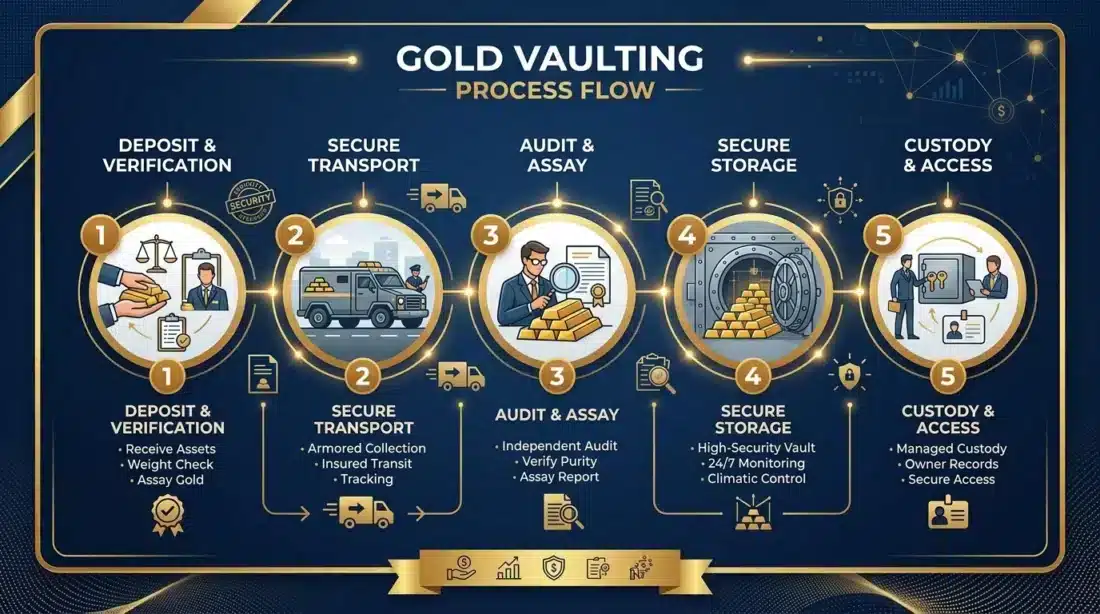
How Does the Brighton Gold Concierge Vaulting Service Work?
Brighton Gold's Concierge Vaulting Service is a fully managed, end-to-end secure storage solution for physical precious metals. It combines institutional-grade depository access with a dedicated concierge team that handles every step — so the owner never has to figure it out alone.
From the moment a customer decides to vault, Brighton Gold manages custody establishment, transit logistics, and ongoing account support. The entire process typically completes in under two weeks.
The service moves through five structured stages: Initial Consultation, Custody Establishment, Metals Transfer and Transit, Vault Confirmation, and Ongoing Concierge Support. Every stage is built around one principle — a safe anyone can verify. At any point, an owner can confirm exactly where their metals are, who holds them, and how to retrieve them.
That's not a marketing promise. It's the structural standard.
Professional depositories operate under strict institutional requirements. The LBMA's Good Delivery standards mandate a minimum gold purity of 99.5% and enforce rigorous chain-of-custody tracking from refinery to vault. The Federal Trade Commission advises consumers to verify storage facilities and understand all associated fees before committing to any vaulted arrangement. Brighton Gold's service is built to satisfy both — verified, accredited custodians at every stage and full transparency on costs from the start.
Metals are held in segregated, allocated storage. That means they're identified, tracked, and confirmed as belonging to a specific owner — not pooled with anyone else's holdings.
True ownership of physical gold means more than holding a receipt. It means holding something verifiable, transferable, and entirely outside the paper financial system. The concierge vaulting service exists to make that level of ownership accessible — without complexity, without confusion, and without working with providers who treat storage as an afterthought.
- What Concierge Vaulting Actually Means
- Who Concierge Vaulting Is — and Isn't — For
- The Step-by-Step Vaulting Process
- What Institutional Security Actually Looks Like
- Accessing, Auditing, and Exiting Your Vaulted Holdings
-
Frequently Asked Questions
- How are my physical precious metals secured within Brighton Gold's concierge vaulting service?
- What is the difference between segregated and allocated vaulted storage?
- Can I inspect or audit my physical gold holdings once they are in the depository?
- How does the chain of custody protect my assets during transit to the vault?
- What is the process for withdrawing my gold from the secure vaulting service?
- Does Brighton Gold's vaulted storage work for a Precious Metals IRA?
- Verified Control Is the Point
What Concierge Vaulting Actually Means

"Vaulted storage" means something entirely different depending on who's running it.
Most dealers hand you a confirmation number and consider the transaction closed. The metals may technically be inside a vault somewhere. But you — the owner — are left to track down the custodian, decode the fee structure, and figure out retrieval on your own.
That's not ownership. That's a receipt.
Concierge vaulting is the alternative. A dedicated team handles every logistical step — from Vaulted Storage setup through custody confirmation — while keeping the owner informed and in control throughout.
The process is handled for you. Not handed off to you.
Storage as an Extension of Ownership
Here's a question worth sitting with: when did you last think of a storage arrangement as part of owning something — rather than a fee attached to it?
Real ownership of physical gold means you can confirm — right now, today — exactly where your metals are, who holds them, and precisely how to get them back. Not eventually. Not after three phone calls.
Understanding what secure protection requires starts with that standard. If you can't answer those three questions on demand, what you have is closer to a claim than ownership.
Brighton Gold treats vaulted storage as part of the ownership experience — not a loose end to sort out after the transaction closes.
Our concierge team maintains continuity across every stage. You don't wake up three months later wondering who holds your metals or what a fee line item means.
Why Most Gold Storage Falls Short
The precious metals industry has a storage problem. And it isn't a shortage of vaults.
Most dealers close the sale and treat storage as a separate matter — something the customer navigates independently, after the fact. No handoff. No follow-through.
Owners frequently don't know which custodian holds their metals, what fees look like over time, or what steps are required to retrieve their holdings. The Federal Trade Commission specifically advises consumers to verify storage facilities and understand all associated fees before committing — because the industry has a long history of making that information harder to find than it should be.
That opacity isn't accidental. A storage arrangement the owner doesn't fully understand is one they won't question. And one they won't leave.
The Federal Trade Commission's consumer protections exist because customers deserve to know who holds their assets, under what terms, and with what recourse. The vaulting relationship touches all of it. The FTC Safeguards Rule sets the standard for how institutions must protect customer financial information — and it applies directly to the data shared during the custody establishment process.
We believe the standard should be the opposite of opaque. The entire process — from custody establishment to vault deposition — should complete in under two weeks, with the owner informed at every step.
That's not a premium tier. That's what ownership looks like when someone takes it seriously.
| Storage Model | Who Manages Logistics | Chain of Custody Visibility | Concierge Support | Typical Timeline |
|---|---|---|---|---|
| Brighton Gold Concierge Vaulting | Fully managed by Brighton Gold's dedicated concierge team at every stage | Complete visibility from custody establishment through vault confirmation | Dedicated team maintains continuity across all five stages — Initial Consultation through Ongoing Concierge Support | Typically completed in under two weeks, with owner informed throughout |
| Standard Dealer Storage Referral | Handed off to a third-party storage provider after the sale closes | Limited — owner receives a confirmation number but must independently verify custodian and holdings | None after the point of sale — owner navigates logistics independently | Variable and undefined — timeline depends on the third party, not the dealer |
| At-Home or Private Safe Storage | Managed entirely by the owner — no institutional support | No external verification — owner relies solely on personal record-keeping | None — owner assumes full logistical and security responsibility | Immediate, but ongoing security, insurance, and access risks fall entirely on the owner |
| Self-Directed IRA Storage (No Guidance) | Owner coordinates directly with custodian and depository without dealer involvement | Partial — custodian statements provided, but no dedicated liaison to interpret or verify | None from the dealer — custodian may offer account statements only | Dependent on custodian processing schedules; owner has no direct channel to accelerate |
Who Concierge Vaulting Is — and Isn't — For

So — is this the right fit for you?
Concierge vaulting isn't for everyone. Brighton Gold doesn't pretend otherwise.
This service is built for a specific kind of owner — someone who has spent years building something real and wants that same level of care applied to protecting it. Not the cheapest option. Not the fastest transaction. The right arrangement, managed properly, from start to finish.
The United States Geological Survey tracks national gold supply chains and the accredited depositories that safeguard domestic physical holdings. That's the same institutional-grade infrastructure Brighton Gold's concierge service connects directly into — not a workaround, not an approximation.
Our learning center exists to make those standards explicit before any customer makes a single decision.
The Owner Who Wants Verified Control
The customer this service was built for already knows what they're protecting.
They've spent decades building something real. Independence, verified control, and a documented chain of custody aren't preferences — they're requirements.
They're not looking for someone to tell them what to do with their money. They want a team that handles the logistics — custody establishment, transit, vault confirmation — while keeping them informed at every stage.
The Federal Trade Commission advises consumers to verify storage facilities and understand all associated fees before committing to any arrangement. These customers already know to ask those questions. We make sure they get real answers.
What they want back is simple. Metals held in their name. A documented chain of custody. A clear path to retrieval — a safe you can verify.
That's who this was built for.
Who Should Look Elsewhere
Brighton Gold isn't the right fit for everyone. That's not a disclaimer — it's the point.
If the primary goal is trading — buying metals today and selling when the price moves — this isn't the right relationship. Brighton Gold doesn't forecast prices, time the market, or provide recommendations on when to buy or sell.
Speculation and long-term physical ownership are different goals. We're built for one of them.
If the deciding factor is purely price — if the conversation starts and ends with the spread — Brighton Gold is likely not the right match.
The value here is in the guidance, the verified custody chain, and the ongoing support that continues long after the transaction closes. Customers who need the lowest number will find it somewhere else.
Customers who need the process done right will find it here.
| Customer Profile | Primary Goal | Right Fit for Concierge Vaulting | Why or Why Not |
|---|---|---|---|
| Long-term owner focused on wealth preservation | Hold verified, allocated physical gold in their name — outside the paper financial system | Yes | The concierge model is built precisely for this: segregated custody, documented chain of custody, and ongoing support through every stage of ownership |
| Retirement-aged customer transferring or rolling over a qualified account | Move existing retirement savings into physical metals through a structured, guided process | Yes | Brighton Gold's team manages every logistical step — from Custody Establishment through Vault Confirmation — so the owner is informed and in control throughout |
| Customer prioritizing legacy and tangible wealth transfer | Hold something real, verifiable, and transferable that exists outside any financial institution | Yes | Segregated, allocated storage means the metals are identified in the owner's name and can be retrieved or transferred with a clear, documented path |
| Short-term speculator seeking to trade on price movements | Buy and sell metals based on market timing and price forecasts | No | Brighton Gold does not forecast prices, time the market, or provide investment recommendations — the concierge service is built for ownership, not trading |
| Customer whose primary decision factor is price | Find the lowest spread available in the market regardless of service quality | No | The value is in verified custody, ongoing support, and a documented ownership experience — customers focused solely on the lowest number will find better-matched options elsewhere |
| Customer seeking financial, tax, or legal direction | Have a team tell them what to do with their money and provide fiduciary guidance | No | Brighton Gold educates and guides through the logistics of physical ownership — it does not provide financial, tax, or legal advice, and refers customers to licensed professionals for those decisions |
The Step-by-Step Vaulting Process
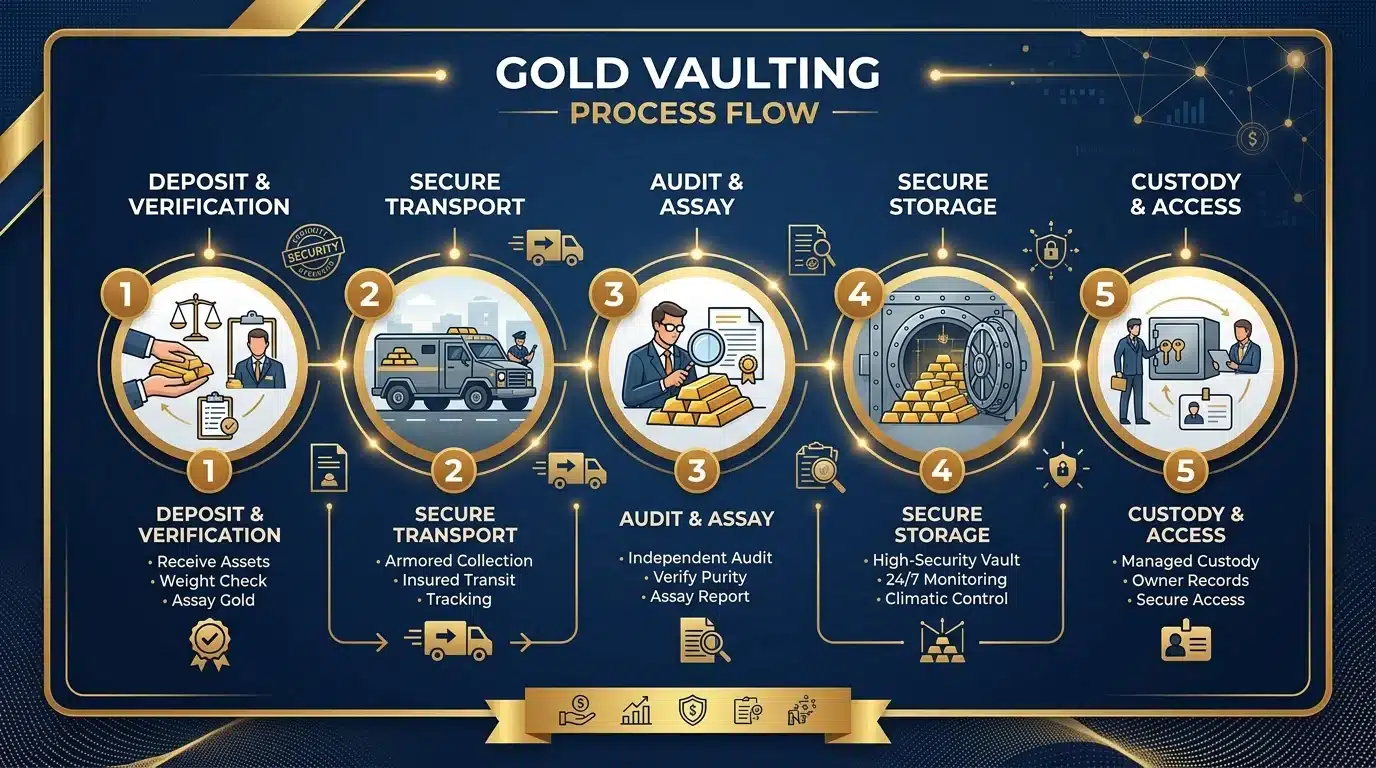
Here's what the process actually looks like — and it's simpler than the industry makes it seem.
Brighton Gold built this process to be straightforward — not because simplicity is a selling point, but because complexity has always been the industry's way of keeping customers dependent.
From custody establishment to vault deposition — the whole process completes in under two weeks.
Not a goal. Not a best-case estimate. That's the operational commitment. You shouldn't spend weeks wondering if your paperwork is stalled or your metals are sitting in transit limbo.
Step 1: Initial Consultation
The Initial Consultation is where things start — and it's not a sales call dressed up as guidance.
Our concierge team walks through your ownership goals, the type and quantity of metals you're considering, and the storage configuration that fits your situation. No assumptions. No pressure.
The goal is to confirm that vaulted storage is genuinely the right arrangement before any paperwork is initiated. Every question about how your personal and financial information is handled gets answered — including the data protection practices that govern what responsible institutions are required to follow.
Step 2: Custody Establishment
So the consultation is done. Now the ownership structure gets made official.
Brighton Gold's team handles the custodian paperwork, coordinates with the accredited depository, and ensures your metals are held in segregated, allocated storage — identified as yours, not pooled with anyone else's holdings.
That documentation is not administrative detail. It's what makes your ownership verifiable at any future point — auditable, retrievable, and on the record. See what chain of custody means in practice.
Step 3: Metals Transfer and Transit
Transit is the stage where most owners brace for something to go wrong. That anxiety is understandable. It's also where getting the concierge model right matters most.
Physical gold in transit moves through the same accredited depository infrastructure the United States Geological Survey tracks as part of national supply chain security for domestic physical holdings.
That infrastructure exists because chain-of-custody breaks — even small ones — have consequences. The standards are strict. The documentation requirements are strict. Your metals move inside that system.
Brighton Gold's team manages the transit logistics end to end — coordinating secure transport, maintaining custody documentation throughout, and confirming safe arrival at the depository.
You're not handed a tracking number and left to interpret updates on your own. Every step is handled. Every step is documented.
Step 4: Vault Confirmation
Vault Confirmation is where the process closes — and where ownership stops being a pending transaction and becomes something you can verify on demand.
Once the metals arrive and are accepted at the accredited depository, the owner receives confirmation of custody — the specific holdings, the storage designation, and the documentation that confirms the metals are held in their name.
That's a safe you can verify. Not a receipt. Not a promise. A documented record of exactly where your metals are, who holds them, and how to retrieve them — on demand, at any point.
Step 5: Ongoing Concierge Support
Most dealers treat vault confirmation as the finish line. For Brighton Gold, it's the beginning of the ownership relationship.
After confirmation, our concierge team stays available — for questions about your holdings, for help with exchanges, for guidance when your circumstances shift.
That's the model Brighton Gold was built around. Support at every stage of ownership, not just at the moment of sale. The relationship doesn't close when the vault door does.
| Process Step | What Happens | Who Handles It | Estimated Timeline | Customer Action Required |
|---|---|---|---|---|
| Initial Consultation | Concierge team reviews ownership goals, metals type and quantity, and storage configuration to confirm vaulted custody is the right arrangement | Brighton Gold concierge team | Completed before any paperwork is initiated | Share ownership goals and ask questions — no commitment required |
| Custody Establishment | Custodian paperwork completed, accredited depository coordinated, and segregated allocated storage confirmed in the owner's name | Brighton Gold concierge team and accredited custodian | Initiated immediately following consultation approval | Review and sign custody documentation |
| Metals Transfer and Transit | Secure transport arranged, chain-of-custody documentation maintained throughout transit, and safe depository arrival confirmed | Brighton Gold concierge team manages logistics end to end | Coordinated promptly after custody establishment is complete | No logistics management required — concierge team handles all coordination |
| Vault Confirmation | Owner receives official confirmation of custody: specific holdings, storage designation, and documentation confirming metals are held in their name | Accredited depository and Brighton Gold concierge team | Issued upon verified depository acceptance | Review custody confirmation and verify holdings documentation |
| Ongoing Concierge Support | Concierge team remains available for questions, exchanges, and guidance — the ownership relationship continues beyond the point of vault confirmation | Brighton Gold concierge team | Continuous — no end date | Contact the concierge team whenever questions arise or circumstances change |
What Institutional Security Actually Looks Like
Confirmed custody is only the beginning. What makes ownership feel real is knowing you can verify it, access it, or walk away from it — whenever you choose.
Most owners know their metals are "stored securely." That's the line they were given — and most never push back on it.
But security isn't a feeling. Professional depositories don't run on good intentions. They operate against documented, auditable standards — standards that govern everything from bar purity to chain-of-custody records. The question isn't whether you trust your dealer. It's whether you can verify the infrastructure behind the promise.
There's a real difference between "I was told it's secure" and "I can verify it is."
That difference is the entire point of institutional-grade custody. The infrastructure behind serious vaulted storage is built on protocols that predate any individual transaction — protocols with names, governing bodies, and public records. Understanding those protocols turns a receipt into a verified claim of ownership.
LBMA Good Delivery Standards and What They Require
The benchmark for institutional gold vaulting is the LBMA Good Delivery standard. It governs the entire lifecycle of a gold bar — from the refinery floor to the vault shelf.
Under Good Delivery rules, gold bars must meet a minimum purity of 99.5%, with precise weight tolerances and full traceability at every point of custody transfer.
These aren't aspirational targets. They're mandatory requirements for any refiner or vault operating within the accredited network. Non-compliance means removal.
London-monitored vaults currently hold over 8,000 tonnes of physical gold under this framework. That's not a benchmark for central banks alone — the same standards protecting those reserve holdings apply to every accredited depository in the network. That includes the ones Brighton Gold's concierge service connects customers to directly.
Good Delivery standards also require strict chain-of-custody documentation — a continuous, auditable record linking each bar to its origin, its transit, and its current custodian.
The FTC puts it plainly: verify the storage facility and understand what the documentation trail actually covers. Not because dealers are dishonest — but because "trust me" is not a custody record. Every transfer documented. Every holding traceable. No gap in the record acceptable.
That's what makes What Is a Chain of Custody and Why Does It Matter for Gold? worth reading before custody paperwork is ever signed. FTC guidance on secure data handling reinforces the same principle: documentation gaps are where accountability breaks down, and the chain of custody is only as strong as the records behind it.
Segregated vs. Allocated Storage: Understanding the Distinction
Now, within that framework, there's one decision most owners get wrong — or skip entirely: segregated versus allocated storage. It matters more than the paperwork makes it sound.
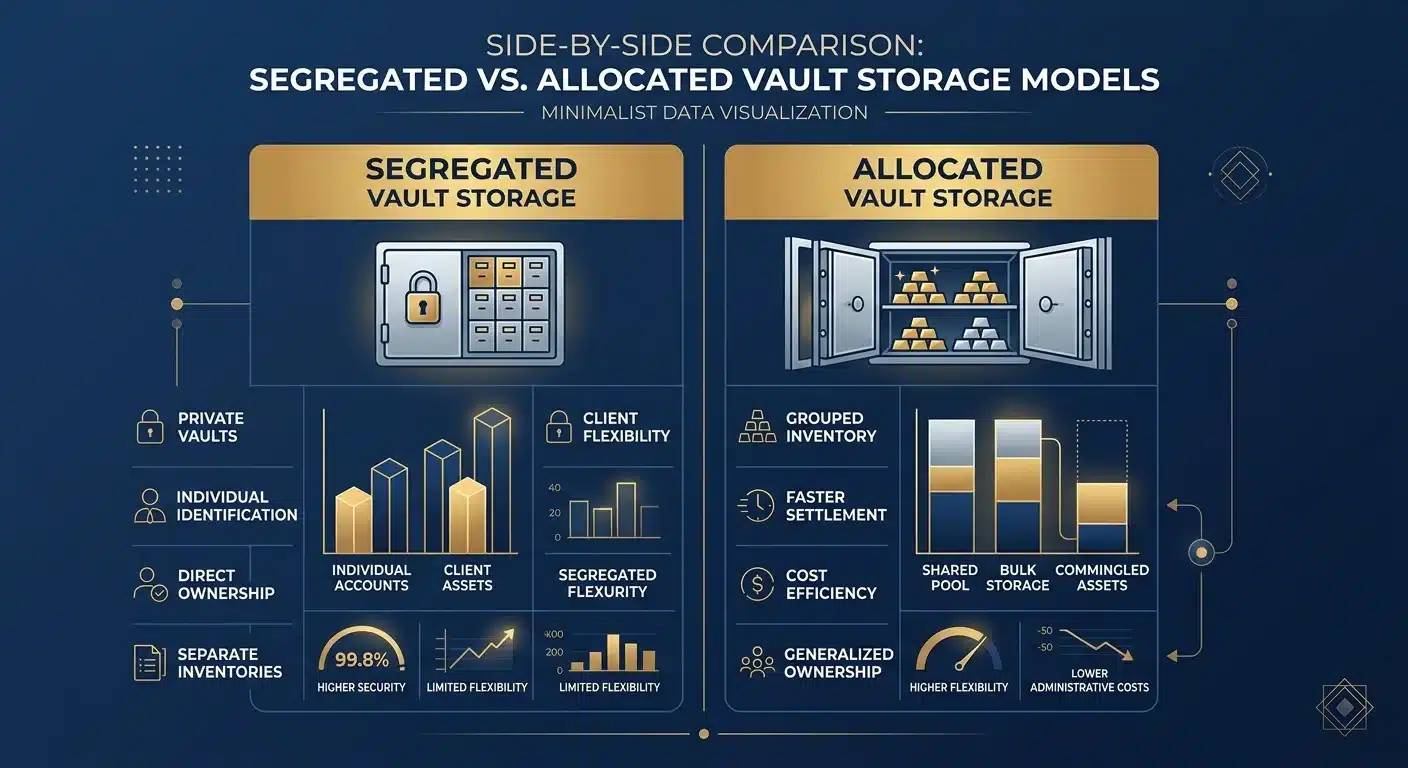
Allocated storage means your specific metals — the actual bars or coins you purchased — are held in your name and identified as yours individually. Not pooled. Not fungible. Yours.
Segregated storage goes one step further. Your holdings are physically separated from other customers' metals, held in a dedicated space within the depository.
Both models confirm individual ownership. But segregated custody confirms individual physical separation — the ability to point to a specific holding and say, without ambiguity, "that is mine." How you weigh that distinction shapes decisions about geographic storage diversification down the line. geographic storage diversification
Physical gold's liquidity doesn't exist in a vacuum. Average daily trading volumes exceeding $100 billion depend on depository networks where custody is verifiable and settlement is reliable. That infrastructure is what makes gold tradeable — not just holdable.
So the storage designation chosen at Custody Establishment isn't a bureaucratic checkbox. It's the foundation of every verification that follows. Get that decision right at the start, and everything the concierge process builds afterward is on solid ground.
| Security Standard | Requirement | Why It Matters for Owners | Source Authority |
|---|---|---|---|
| LBMA Good Delivery — Bar Purity | Minimum 99.5% gold purity required for all accredited bars | Every bar entering an accredited vault meets a documented, verifiable standard — not a dealer's claim | LBMA Good Delivery |
| LBMA Good Delivery — Chain of Custody | Strict chain-of-custody tracking required from refinery to vault | Ownership is traceable at every transfer point — gaps in documentation are not acceptable under the standard | LBMA Good Delivery |
| Institutional Vaulting Scale | London-monitored vaults hold over 8,000 tonnes of physical gold under LBMA oversight | The same protocols protecting national reserve holdings apply to every accredited depository in the network | LBMA London Vault Holdings |
| Global Liquidity Support | Average daily gold trading volumes exceed $100 billion, underpinned by institutional depository networks | High-integrity custody infrastructure is what makes physical gold rapidly accessible and transferable when needed | World Gold Council |
Accessing, Auditing, and Exiting Your Vaulted Holdings

Confirmed custody is step one. What makes it mean something is knowing you can verify it, access it, or walk away — on your terms, on your timeline.
Here's what most people skip: they get the custody paperwork signed and stop asking questions. What happens when I want to check on them? What does getting them back actually look like? Those answers should exist before anything moves into a vault.
Security without access isn't ownership. It's faith in a system you can't see. Brighton Gold's concierge vaulting service is built on the opposite premise — verify your holdings, request an audit, or start a withdrawal without figuring it out alone.
How to Verify Your Holdings Are There
Verification starts with documentation — not a phone call, not a handshake. When Vault Confirmation is complete, you receive custody records that name your specific holdings: the type, the quantity, the storage designation, held in your name at the accredited depository.
That record isn't a courtesy summary. It's the baseline everything else is measured against.
Those records carry real weight. The chain-of-custody framework governing institutional-grade vaulting networks means your custody documents aren't informal notes — they're auditable entries in a continuous, unbroken record. That's exactly what the FTC advises consumers to scrutinize before committing to any storage arrangement.
Every entry traceable. Every holding confirmed.
And when questions come up — they will — the concierge team is the first call. They confirm current holdings, clarify storage designation, and coordinate directly with the depository for formal audit requests.
No informal hand-waves. No unanswered questions left open. The FTC’s Start with Security guide calls for exactly this kind of layered, documented approach to protecting sensitive information — and that's the standard the process is built to meet.
Requesting a Withdrawal or Physical Delivery
Withdrawing your metals — for physical delivery, an exchange, or a full exit from vaulted storage — follows a defined path. Brighton Gold's concierge team initiates the withdrawal on your behalf, coordinates with the depository, and manages every step from vault to your hands.
You don't get handed a set of instructions and left to sort it out. Every step is handled. Every step is documented.
Physical gold's liquidity isn't abstract. Average daily trading volumes exceed $100 billion — that number exists because institutional depository networks make custody verifiable and settlement reliable.
Your withdrawal request runs on that same infrastructure. It's not a complicated exception. It's a routine, documented transaction inside a system built to handle it.
The entire concierge vaulting service — from Initial Consultation through Ongoing Concierge Support — is built toward one outcome: you hold something real, you know exactly where it is, and you can retrieve it without confusion.
That's what Brighton Gold means by support at every stage of ownership. Not a transaction that closes. A relationship that continues — with a safe you can verify at every point along the way.
| Owner Action | Process Overview | Typical Timeframe | Concierge Role |
|---|---|---|---|
| Verify current holdings | Owner contacts the concierge team; team confirms holdings against custody documentation on file and, if needed, coordinates a formal audit request with the depository | Confirmation typically provided promptly; formal depository audit coordinated within a defined window | Primary point of contact — reviews custody records, liaises with depository, and delivers a clear written confirmation to the owner |
| Request a physical audit | Concierge team submits a formal audit request to the accredited depository; the depository verifies the specific holdings against the chain-of-custody record and returns documented confirmation | Timeframe determined by the depository's audit scheduling; concierge team manages the coordination and communicates outcomes | Initiates and tracks the audit request end-to-end — owner is never required to navigate the depository directly |
| Arrange physical delivery | Owner requests delivery through the concierge team; team coordinates secure, insured transit from the depository to the owner's designated address, maintaining chain-of-custody documentation throughout | Logistics initiated promptly after request; total delivery window depends on transit distance and carrier scheduling | Manages all logistics — carrier coordination, transit insurance, custody documentation, and delivery confirmation |
| Execute an exchange | Owner works with the concierge team to exchange existing holdings for different products; team facilitates the transaction, updates custody records, and confirms the new holdings at the depository | Exchange process coordinated in alignment with current market availability and depository processing | Handles the full exchange workflow — from product selection guidance through updated custody confirmation |
| Exit vaulted storage entirely | Owner initiates an exit through the concierge team; team coordinates either full physical delivery or liquidation in accordance with current market conditions, managing all depository release documentation | Timeline aligned with the chosen exit method — physical delivery or liquidation each follow defined workflows | Guides the owner through every exit step — depository release, transit or settlement coordination, and final custody close-out documentation |
Frequently Asked Questions
Here's where it gets personal. The process is documented. The security standards hold. But owners close to a decision always have one more layer — specific, practical questions that don't fit neatly into a service overview.
These are the questions that sit between understanding the service and actually feeling ready to move. Getting them answered without having to dig — that's what the concierge model is built for.
How are my physical precious metals secured within Brighton Gold's concierge vaulting service?
Your metals are held at an accredited, institutional-grade depository. Not a third-party facility chosen informally — a documented, auditable custody environment that governs bar purity, chain-of-custody tracking, and verification procedures. That's the same institutional framework behind the LBMA Good Delivery standard.
The concierge team manages every step — from Metals Transfer and Transit through Vault Confirmation. You receive custody documentation that identifies your specific holdings by type, quantity, and storage designation.
And it doesn't stop at deposit. Through Ongoing Concierge Support, the team stays available to confirm current holdings or coordinate formal verification whenever you need it.
What is the difference between segregated and allocated vaulted storage?
Allocated storage means your metals are held in your name as individually identified assets — tracked as yours, not pooled with anyone else's holdings.
Segregated storage takes it further. Your metals are physically separated from other customers' holdings within the depository itself.
Both models confirm individual ownership. The difference is physical separation. Segregated custody means you can point to a specific bar or set of coins and say, without ambiguity: that is mine. How precisely that level of confirmation matters to you is one of the first things the concierge team helps you work through.
Can I inspect or audit my physical gold holdings once they are in the depository?
Yes. The FTC advises consumers to verify storage facilities and understand all associated fees before committing to any arrangement. Brighton Gold's service is built around that standard — not as a compliance checkbox, but as a baseline expectation every owner is entitled to hold.
Vault Confirmation delivers custody records identifying your holdings by type, quantity, and storage designation. That documentation is the verification — not a summary, not an assurance, the actual record.
Formal audit requests are coordinated through the concierge team at any point. You don't figure that out alone. A safe you can verify isn't a tagline. It's the operational commitment.
How does the chain of custody protect my assets during transit to the vault?
Chain-of-custody documentation creates a continuous, auditable record — linking each bar to its origin, its transit, and its current custodian. Nothing moves informally. Nothing goes undocumented.
During Metals Transfer and Transit, every movement is tracked against that framework. The institutional protocols behind the LBMA Good Delivery standard — precise purity requirements, strict traceability at every custody transfer — apply throughout.
When the metals reach the depository and Vault Confirmation is complete, that record confirms they arrived intact, accounted for, and held specifically in your name. There are no gaps. That's the point.
What is the process for withdrawing my gold from the secure vaulting service?
Withdrawal is a defined process — not something you figure out as you go. The concierge team initiates the request on your behalf and coordinates directly with the depository.
Physical delivery, an exchange, or a full exit from vaulted storage — all handled the same way: documented, coordinated, and tracked from vault to completion. Average daily trading volumes in physical gold exceed $100 billion precisely because institutional depository networks make custody verifiable and settlement routine. A withdrawal request isn't a complicated exception. It's a standard transaction inside a system built for it.
The full process from custody establishment through vault deposition is designed to complete in under two weeks. Withdrawal logistics follow a similarly structured, clearly communicated timeline.
Does Brighton Gold's vaulted storage work for a Precious Metals IRA?
Yes. Vaulted storage through Brighton Gold is fully compatible with a Precious Metals IRA.
IRA-held metals must be stored at an IRS-approved depository — not at home, not in a personal safe. Brighton Gold's concierge service connects owners directly to accredited depositories that satisfy those requirements. The same five-stage process applies, from Initial Consultation through Ongoing Concierge Support.
The metals are held in the IRA's name, at an approved facility, with the same custody documentation and concierge access that applies to every vaulted arrangement. The IRA structure doesn't complicate the process — the concierge model is built to handle it.
Verified Control Is the Point
Every stage of this process was built to answer one question.
Do you know exactly where your metals are, who holds them, and how to get them back?
That's not a logistics question. That's the definition of ownership.
Custody establishment through vault deposition typically completes in under two weeks. But the timeline isn't what matters.
What matters is what you're holding when it's done. Not a handshake. Not a verbal assurance. Documentation — auditable, institutional, continuous — that confirms your metals exist, where they exist, and that they belong to you.
That's the gap between faith and ownership. And it's exactly what a safe you can verify closes.
Brighton Gold built this service around a single conviction: holding something real should feel real.
Not opaque. Not a process you have to take on faith.
If you can't verify it — at any moment, without asking permission — you don't own it. You're trusting that someone else does the right thing. That's not ownership. That's exposure.
That's the process. What's left is figuring out whether it fits your situation — and whether the No Fee IRA is the right structure for what you're holding. Brighton Gold offers a complimentary consultation to walk through exactly that, no pressure, no obligation.