
How Do I Clean and Maintain My Physical Silver Coins?
Physical silver coins do not need to be cleaned. That is the answer — and everything that follows explains why getting it wrong costs.
The surface of a silver coin is not just metal. It carries the original mint luster applied at the moment of striking. That luster is what cleaning destroys first. It does not matter whether the method is a commercial silver dip, a baking soda paste, or a dry microfiber cloth. The result is the same: permanent damage to a surface that cannot be restored. Wiping a coin moves microscopic dust particles across the metal face, leaving fine friction marks classified as hairlines. Those marks disqualify the coin from mint-state designations. The damage is invisible at first. It is not reversible later.
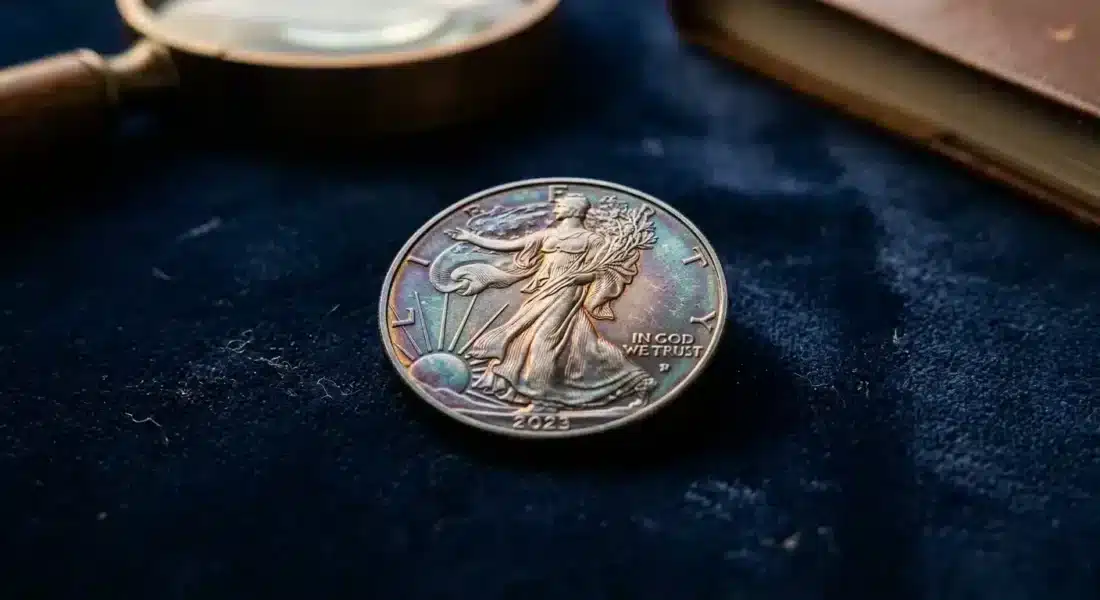
Silver reacts with its environment. Exposure to sulfur compounds in the air produces silver sulfide — the multi-colored toning that owners sometimes mistake for contamination. That toning is not damage. It is chemistry. Natural, original toning enhances visual appeal and increases market value. Removing it destroys both.
Proper maintenance is not a cleaning regimen. It is a handling and storage discipline. The U.S. Mint instructs owners to hold coins by their edges only, never touching the obverse or reverse faces. Cotton or latex gloves are required whenever handling unprotected silver coins. Storage must use chemically inert, PVC-free holders — polyvinyl chloride breaks down over time and releases hydrochloric acid directly onto the metal. Temperature-controlled environments with low relative humidity are required to inhibit oxidation.
The PCGS grading standard is unambiguous. Chemically or physically cleaned coins are classified as damaged and will not receive numeric grades. Abrasive cleaning strips original mint luster permanently. Once that surface is gone, no professional intervention brings it back.
Maintaining physical silver means doing less, not more. The owners who preserve long-term value are the ones who never touch the metal without purpose — and who understand that a clean-looking coin and a well-preserved coin are not the same thing.
- The Cleaning Instinct That Destroys Silver Coin Value
- Why Cleaning Silver Coins Is Almost Always the Wrong Move
- What Silver Toning Actually Is — and Why It Belongs There
- How to Handle Physical Silver Coins Without Causing Damage
- The Right Way to Store Physical Silver Coins Long-Term
- Frequently Asked Questions About Silver Coin Care
- Physical Silver Ownership Starts With What You Don't Do
The Cleaning Instinct That Destroys Silver Coin Value
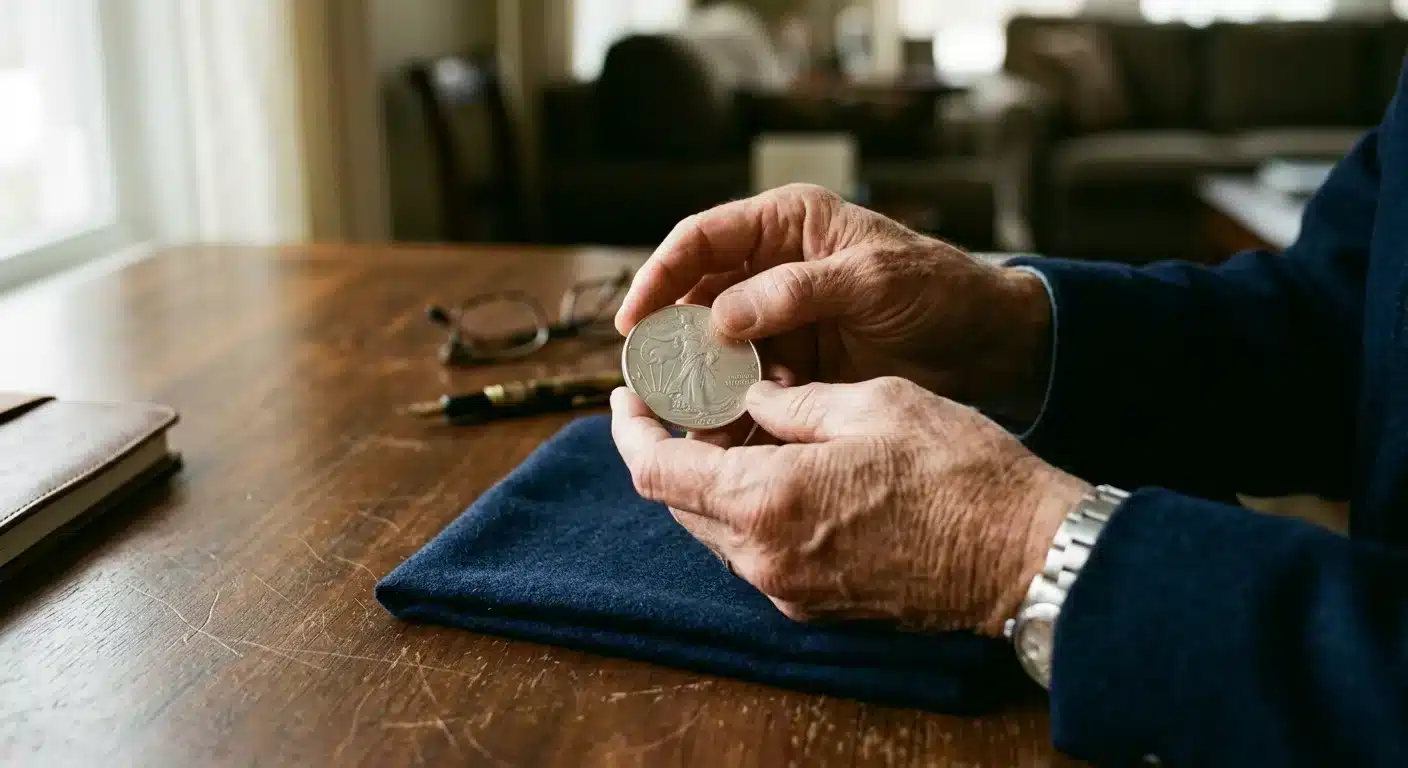
A coin looks dull. Or spotted. Or not as bright as the day it arrived. The instinct is immediate and completely understandable: clean it.
That instinct is the single most destructive action a silver owner can take.
Silver does not forgive contact. The surface formed at the moment of striking is the surface you have — permanently.
A cloth. A fingertip. A chemical solution. Each one leaves a mark that cannot be undone.
Here's the closest analogy: a fingerprint. Leave one on a raw silver coin and you won't see it with the naked eye. But the oils are already working — etching into the metal's surface chemistry before the coin is back in its holder.
Every cleaning attempt after that is the same fingerprint, applied more deliberately, across the entire face of the coin.
Why Most Silver Owners Get This Wrong From Day One
Most owners who damage their silver never know they did it. They see toning and read it as a problem. They reach for a cloth or a chemical dip because no one told them the alternative.
The alternative is doing nothing. That is the correct answer. The appearance of a coin has no bearing on its preservation status — and confusing the two is where value destruction starts.
Professional Coin Grading Service reports are unambiguous: chemically or physically cleaned coins are classified as damaged and will not receive numeric grades.
That classification is permanent. No appeal. No remediation. No resubmission path restores a cleaned coin to gradeable status.
The damage compounds because it's invisible when it happens. Wiping a silver coin's surface — even with a clean microfiber cloth — grinds microscopic dust particles across the metal face. The resulting friction marks are classified as hairlines.
Those hairlines won't show without magnification. They are fully visible to a grading service. The damage that looks like nothing today is what eliminates premium value tomorrow — and that distinction matters for long-term silver protection.
The Financial Cost of a 'Clean' Coin
The financial consequence is direct and permanent. Hairlines from surface contact instantly disqualify a coin from mint-state designations.
A coin that would have graded MS-65 or higher becomes ungradeable. An ungradeable coin trades at melt value — not numismatic premium.
Abrasive cleaning strips original mint luster. That luster is what separates a bullion coin from a worn one in the secondary market.
Once it's gone, the coin signals handling. Every buyer discounts accordingly. No polish, no professional service, and no corrective treatment restores what was removed.
Here's what that means in practice. A coin a grading service would have certified as undamaged — one a secondary buyer would have purchased at a meaningful premium — becomes a coin sold strictly on silver content.
The cleaning that felt like maintenance was, in economic terms, destruction. At Brighton Gold, the guidance to every silver owner is consistent: clean and maintain physical silver coins means understanding that maintenance begins and ends with what you do not do to the metal.
| Cleaning Method | What It Removes | Damage Caused | Impact on Numismatic Grade |
|---|---|---|---|
| Commercial silver dip (chemical bath) | Toning, oxidation, and original mint patina | Etches raw metal surfaces; removes the native silver sulfide layer that formed naturally over time | Coin classified as chemically cleaned — permanently ungradeable |
| Baking soda paste or household abrasive | Surface oxidation and visible spotting | Microscopic scratching across the entire obverse and reverse; strips original strike detail | Abrasion pattern visible under grading magnification — mint-state designation eliminated |
| Dry cloth or microfiber wipe | Dust, fingerprint oils, and surface residue | Grinds microscopic particles across the metal face, leaving hairlines — fine friction marks invisible to the naked eye | Hairlines disqualify the coin from mint-state designations; coin grades below its undamaged potential or becomes ungradeable |
| Fingertip contact on coin face | Nothing visible — damage is immediate and invisible | Skin oils etch into the metal's surface chemistry; the contact point becomes a permanent chemical alteration | Fingerprint etching registers as damage on grading inspection; reduces surface integrity score |
| Commercial metal polish | Tarnish, toning, and surface oxidation | Removes original mint luster entirely; polished surface signals heavy aftermarket handling to any buyer or grading service | Polished coins trade at melt value — numismatic premium is erased regardless of the coin's underlying rarity or strike quality |
Why Cleaning Silver Coins Is Almost Always the Wrong Move
Most silver owners who damage their coins never meant to. They saw a dull surface or a dark spot. They reached for something to fix it.
That instinct is where the damage begins.
Here's what makes it worse: the damage is invisible when it happens.
By the time an owner sees the problem — usually when they try to sell — it's already permanent. Owners who preserve value understand that gap. Owners who quietly destroy it usually don't find out until it costs them.
So here's what this section actually covers: the physical and chemical science behind why cleaning fails, what DIY methods do at the surface level, and when professional conservation is — and is not — appropriate.
The answer to most cleaning questions is the same: don't do it. Understanding the science makes that discipline easier to hold.
The Chemistry Behind the Damage
Silver is a reactive metal. The moment a coin leaves the mint, its surface starts responding — to humidity, airborne sulfur compounds, skin oils, and physical contact.
That reactivity isn't a flaw. It's the metal doing exactly what metal does. Treating it like a problem to solve is where owners go wrong.
When an owner reaches for a cloth or a chemical solution, they're not removing contamination. They're working against the coin's original surface.
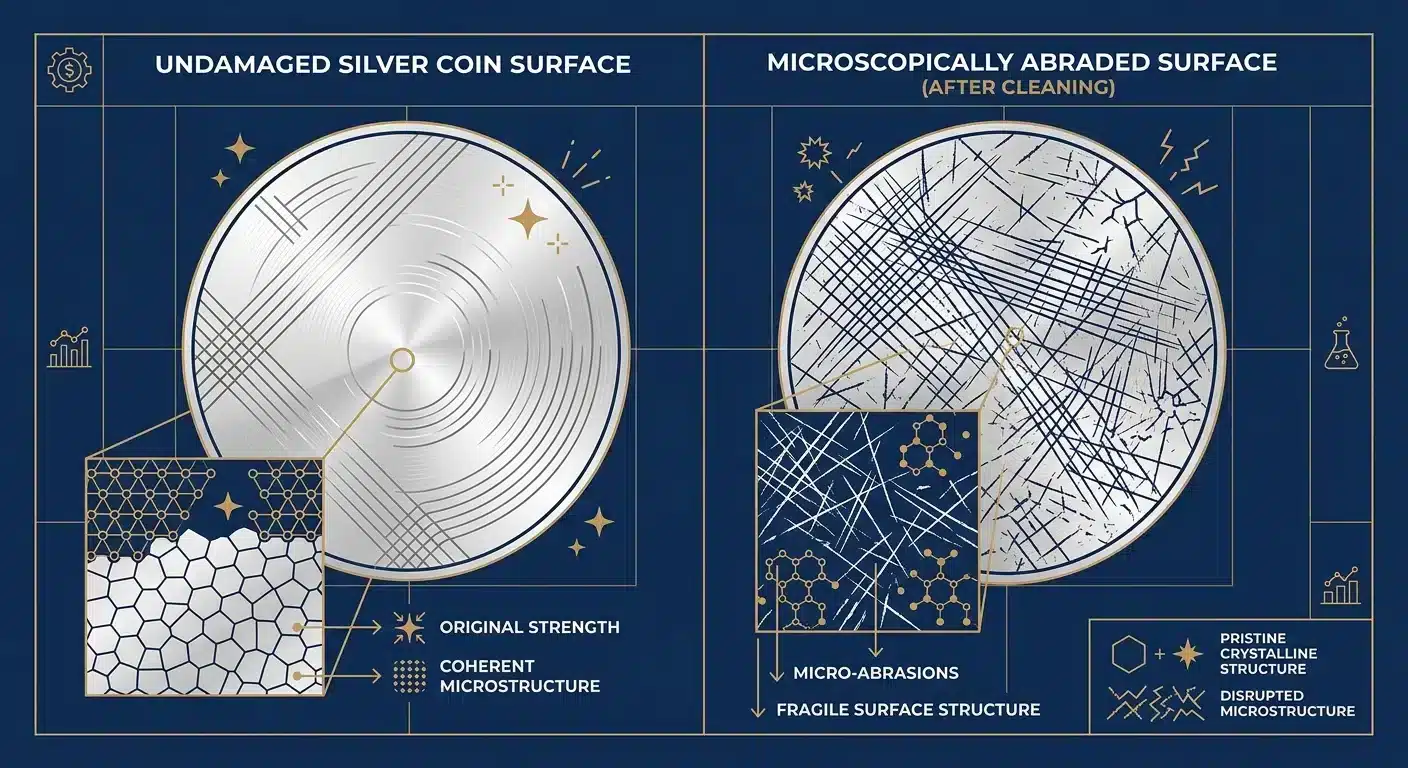
Wiping a silver coin — even with a clean microfiber cloth — grinds microscopic dust particles across the metal face. Those friction marks are classified as hairlines. They're not visible to the naked eye. They are fully visible to a grading service. And they don't go away.
Hairlines instantly disqualify a coin from mint-state designations. A coin that would have graded as undamaged — and traded at a meaningful numismatic premium — becomes a coin sold strictly on its silver content.
The cleaning that felt like maintenance was, in physical terms, destruction. U.S. Mint coin care guidance confirms the boundary: the moment any abrasive contact occurs — however minor — preservation ends and damage begins.
Why DIY Cleaning Methods Make It Worse
Baking soda paste. Commercial silver dip. Dish soap and warm water. These methods circulate widely online.
They all share the same outcome: they permanently etch raw metal surfaces. Amateur cleaning agents do not lift contamination — they chemically react with the silver itself.
Abrasives and home chemicals strip the original mint luster from the coin's surface. That luster is not a coating. It is the natural result of the striking process — formed at the moment the die met the metal.
Abrasive cleaning strips it permanently. There is no process that restores it. The U.S. Mint coin care instructions exist precisely because this damage pattern is so common and so final.
That same logic extends to storage. A coin that survives every cleaning attempt can still be destroyed by the wrong holder. PVC-based flips break down over time and release hydrochloric acid directly onto the metal surface — a slow-motion version of the same destructive chemistry as a commercial dip.
Non-intervention doesn't stop at what you don't put on the coin. It includes where the coin lives. That means proper storage conditions are not optional — they're the other half of the discipline.
What Professional Conservation Actually Means — and Who It's For
Professional numismatic conservation exists for one specific, narrow purpose: stabilizing a coin's surface organically, without altering the original strike or mint finish. It's not a cleaning service. It's not a restoration service.
It doesn't reverse damage already done — it prevents further deterioration where a surface is already compromised. Professional Coin Grading Service reports are unambiguous: chemically or physically cleaned coins are classified as damaged and will not receive numeric grades. Professional conservation is designed to avoid that classification — not undo it.
For most silver bullion owners, professional conservation is never relevant. It applies to rare numismatic specimens with significant pre-existing surface issues — not to standard bullion coins held for long-term preservation.
So if you're asking whether your silver coins need professional conservation, they almost certainly need storage discipline instead. The best owners leave no trace of their ownership on the metal itself. That discipline starts with never reaching for a cloth in the first place.
| DIY Cleaning Agent | Chemical Action | Surface Effect | Grading Outcome |
|---|---|---|---|
| Dry cloth or microfiber wipe | Mechanical abrasion from embedded dust particles | Microscopic hairlines scored across the coin face | Disqualified from mint-state designation; trades at melt value only |
| Commercial silver dip | Chemical reaction strips the metal surface directly | Original mint luster permanently removed; surface appears artificially bright | Classified as chemically cleaned — no numeric grade assigned |
| Baking soda paste | Mild abrasive etches the metal at the molecular level | Surface altered beyond recovery; original strike character erased | Classified as damaged; ungradeable by major grading services |
| Dish soap and warm water | Residual minerals and physical wiping create surface contact damage | Subtle hairlines and water-spot etching degrade the field | Reduces numismatic premium; mint-state designation at risk |
| Professional numismatic conservation | Organic stabilization without chemical or abrasive contact | Original strike and mint finish preserved; no surface alteration | Coin remains gradeable; preserves full numismatic and bullion premium |
What Silver Toning Actually Is — and Why It Belongs There
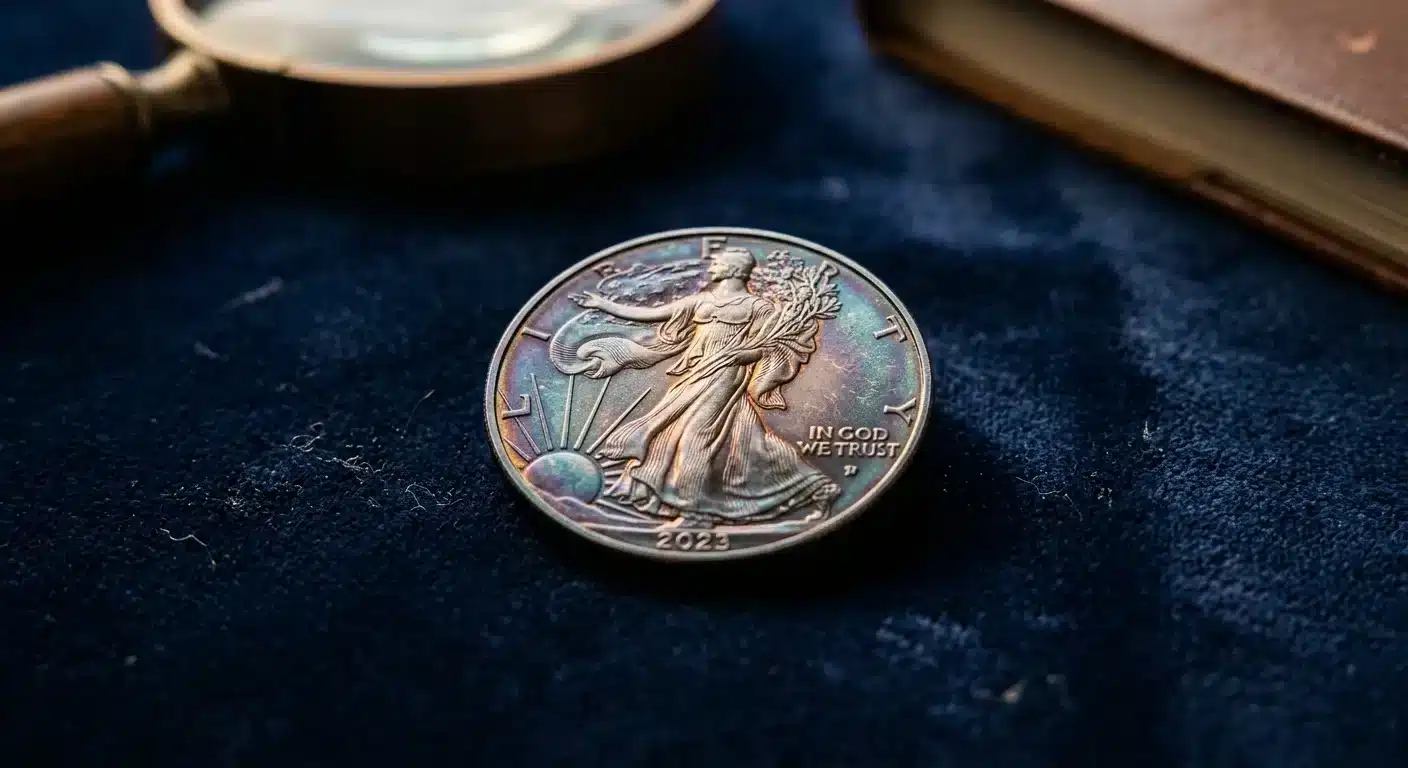
Toning makes owners nervous. A dark ring at the edge. A subtle color shift across the face. The instinct is immediate: fix it.
That instinct is wrong.
Toning is not contamination. It is not damage. It is silver's surface chemistry doing exactly what it should. Reaching for a cloth to remove it is like sanding the patina off an antique — because you prefer the look of bare wood.
That distinction — between authentic toning and actual surface damage — is one most owners never learn until it costs them. The surface that looks like a flaw is often the surface working correctly. What creates the real flaw is the attempt to undo it. Owners who protect long-term value understand this before they ever open the capsule.
The Science of Natural Silver Toning
Silver is reactive. Environmental sulfur compounds bond with the surface and form silver sulfide — that's the toning you're looking at. That reaction begins the moment a coin leaves its mint packaging.
Not neglect. Atmospheric chemistry.
Toning starts at the edges, where gas exchange is greatest, and works inward over time. Colors shift from light gold to amber, then blue, then purple, then black at the deepest stages. Each stage reflects the thickness of the silver sulfide layer on the surface.
None of it alters the metal underneath. The silver content is unchanged. The strike is unchanged. The original mint finish sits fully intact beneath the toning layer.
Numismatic Guaranty Company coin conservation research is direct: natural, original toning often enhances visual appeal and increases market value. Cleaned surfaces degrade market premium. Toning is evidence of an undisturbed surface. A cleaned coin is evidence of intervention.
The secondary market reads both signals. It prices them accordingly — with no ambiguity about which one wins.
When Toning Adds Value Versus When It Signals a Problem
But not all toning reads the same way. Attractive, naturally developed toning — even and colorful, consistent with the coin's age and storage history — is a net positive in the secondary market.
It signals authenticity. It signals an undisturbed surface. Those are the two things serious buyers are looking for.
Problematic toning looks different. Spotty, blotchy, or streaked discoloration — caused by moisture, reactive storage materials, or direct surface contact — means something external accelerated the reaction unevenly.
The toning isn't the damage. The storage conditions that caused it are. And the correct response is better environmental discipline — not a chemical dip that destroys what's left of the original surface.
Here's what that means in practice: amateur cleaning agents like baking soda or commercial silver dips do not evaluate whether toning is attractive or problematic. They react with the silver regardless. They permanently etch raw metal surfaces. The coin that entered the process with valuable, original toning exits it with a chemically altered surface that no secondary buyer, grader, or conservator can restore.
The best owners leave no trace on the metal. That is not a passive choice — it is a disciplined one.
| Toning Appearance | Likely Cause | Market Impact | Recommended Action |
|---|---|---|---|
| Even gold-to-amber progression across the entire coin face | Natural atmospheric sulfur exposure over time | Positive — signals an undisturbed, original surface; commands numismatic premium | Leave completely undisturbed; maintain current storage conditions |
| Rich blue-to-purple toning consistent with the coin's age | Long-term stable storage in an archival-safe environment | Positive to neutral — visually attractive, widely recognized as authentic | No action required; document with photographs for ownership records |
| Spotty or blotchy discoloration concentrated in irregular patches | Moisture exposure or contact with reactive storage materials | Negative — suggests environmental disruption; reduces secondary market appeal | Improve storage environment immediately; move to PVC-free, climate-controlled housing |
| Streaked or wiped-looking marks across the coin face | Physical contact with cloth, tissue, or bare skin | Severely negative — marks indicate handling damage; grading services classify as impaired | No chemical or physical intervention; consult professional numismatic conservator before any further handling |
| Uniform deep black across the full coin surface | Extended exposure to high-sulfur environments without protective housing | Neutral to negative depending on coin type — acceptable on some older pieces, problematic on modern bullion | Evaluate storage conditions; no DIY cleaning; seek professional assessment if secondary market sale is planned |
| Bright, unnaturally uniform surface with no toning whatsoever | Prior chemical cleaning with silver dip or abrasive agent | Severely negative — cleaned coins are classified as damaged by grading services and trade at bullion-only prices | No further intervention possible; value is limited to silver melt content |
How to Handle Physical Silver Coins Without Causing Damage
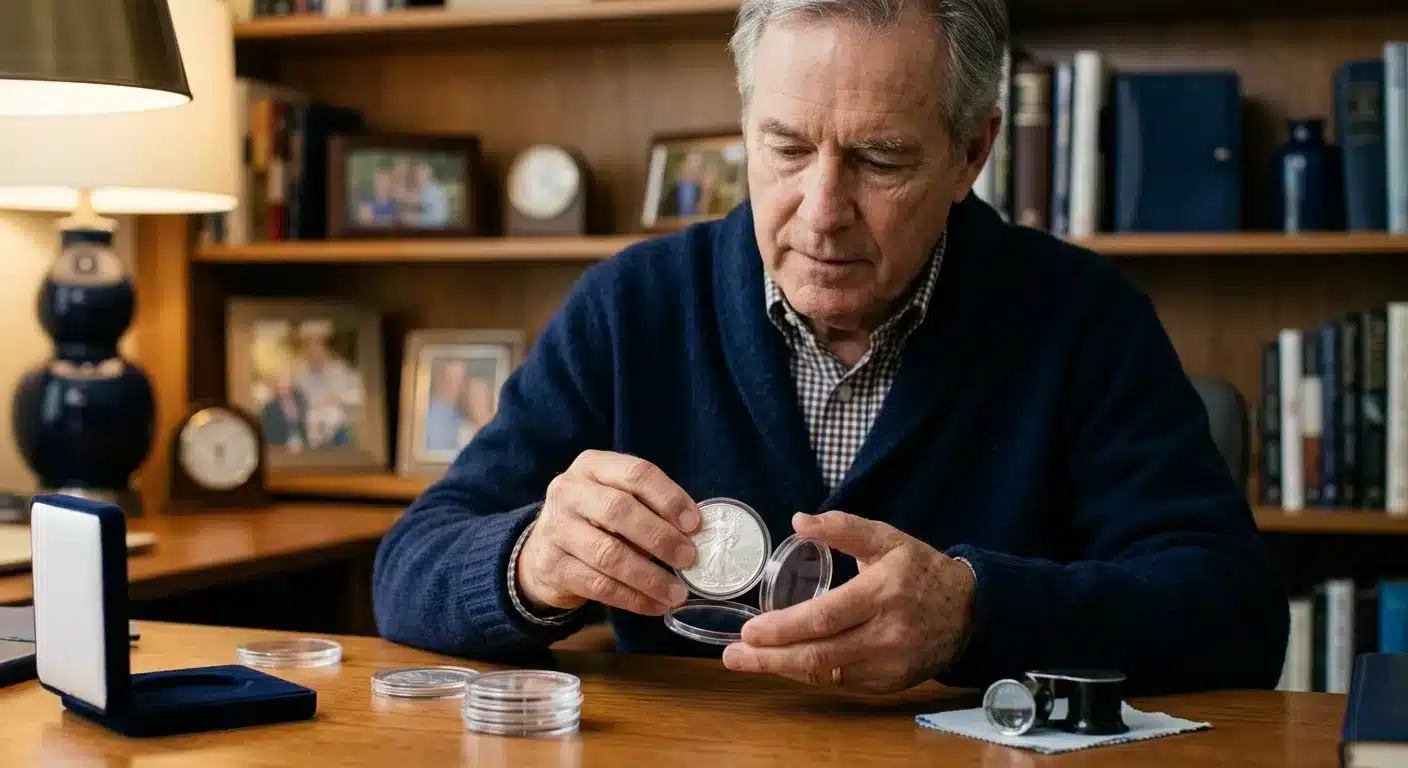
Understanding why cleaning destroys silver is step one. Step two is turning that understanding into a physical habit you don't break.
Non-intervention isn't passive. It demands a specific protocol — the right hold, the right materials, the right environment — executed every single time a coin moves.
Every fingerprint is a transfer event. The oils, salts, and acids in human skin make contact with the coin's surface and begin reacting with the metal immediately.
The mark is invisible to the naked eye. To a grading service, it is a permanent record of mishandling.
So what does the correct protocol actually look like? The official U.S. Mint coin care instructions are explicit on this. Brighton Gold's approach mirrors them exactly. What follows is the complete standard.
The Edge-Hold Standard
The official U.S. Mint coin care instructions are clear: hold coins strictly by their edges. Never touch the obverse or reverse faces.
This isn't a preference. It's the single most important physical habit a silver owner can build.
The edge-hold keeps skin away from the two surfaces that carry the coin's strike, luster, and numismatic detail. That's the entire point.
Held correctly by the edges, a coin can't be fingerprinted. It can't be scratched by a ring or a nail. Palm moisture stays off the face. The obverse and reverse remain untouched — which is exactly where they need to stay.
Practice it before you touch a single coin. Thumb and forefinger on opposite edges. Keep the coin parallel to the surface below — so if it slips, it falls flat instead of rolling.
Thirty seconds to learn. A lifetime of protection.
Gloves, Work Surfaces, and the Right Environment
The edge-hold handles the obvious risk. But it doesn't handle everything.
Clean, lint-free cotton or latex gloves must be worn when handling unprotected, raw silver coins. Gloves eliminate skin oil transfer entirely — which matters most during longer handling sessions when the edge-hold becomes harder to sustain without a lapse.
The surface underneath the coin matters just as much. Handle coins over a clean, soft pad — a microfiber mat or a dedicated numismatic surface — so any accidental drop lands on something that won't scratch.
Never handle coins over a hard desk or tile floor. A single drop onto concrete or ceramic is enough to nick an edge and eliminate a mint-state grade. The pad isn't optional. silver's role in retirement
Who This Discipline Is — and Isn't — For
This protocol is built for owners who intend to hold physical silver for years. People who paid a premium at acquisition and understand that resale value is partly a function of what the surface looks like when the coin changes hands.
But it isn't built for everyone — and that's fine to say directly.
Owners who buy bullion coins and store them sealed in original mint packaging without ever opening them don't need to master the edge-hold or the glove protocol. Sealed original packaging is the most protective environment a bullion coin can occupy. If you're not grading, gifting, photographing, or physically inspecting your coins, the correct handling protocol is to not handle them at all.
For owners building a longer-term strategy, How Do I Buy Physical Silver for Long-Term Wealth Preservation? covers the ownership fundamentals that make this discipline worth having.
The best owners leave no trace of their ownership on the metal itself.
Cleaning leaves a trace. Wiping leaves a trace — hairlines the grading services classify as permanent surface damage. Even a well-intentioned touch without gloves leaves a trace.
This isn't about being precious with an object. It's about understanding that the coin's surface is the record of its history. The cleanest history is the one no owner interrupted.
The Right Way to Store Physical Silver Coins Long-Term
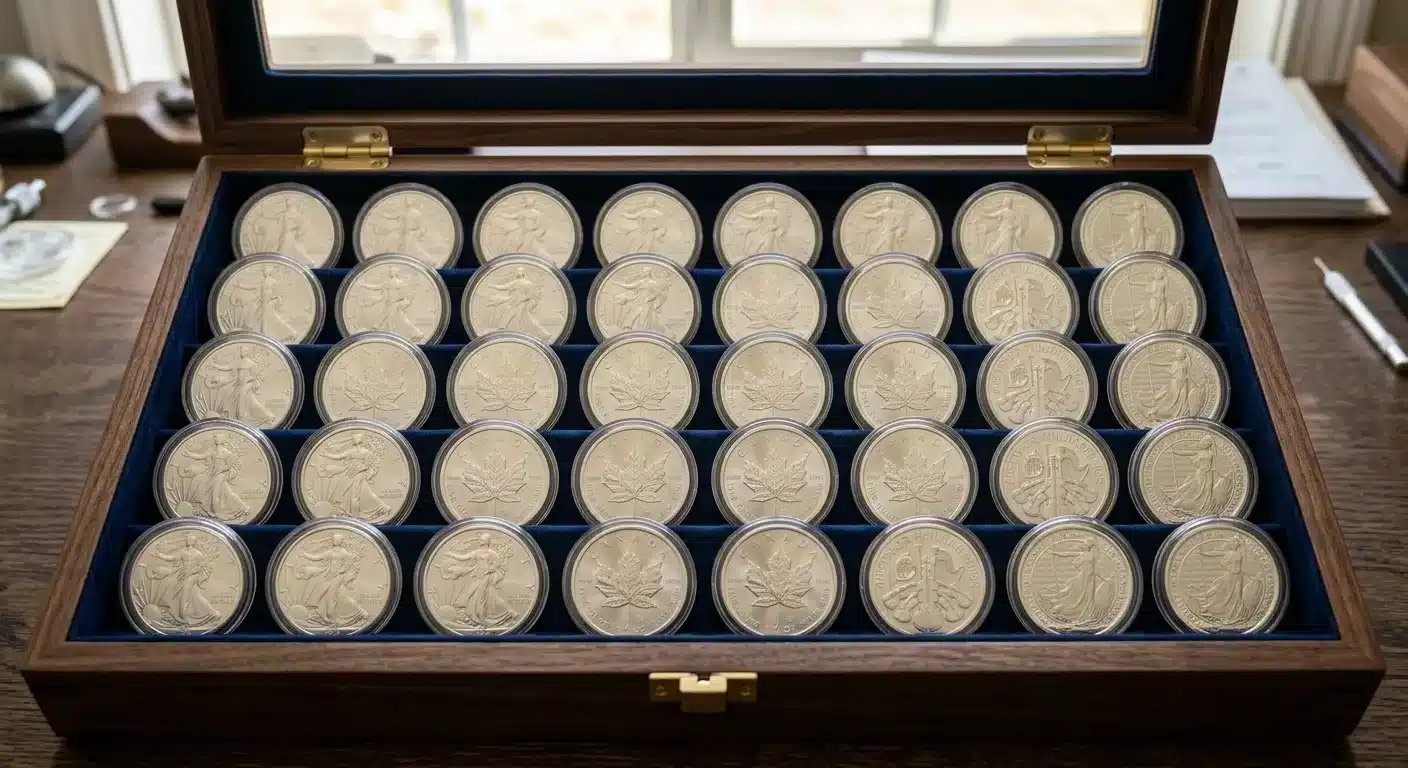
Handling is the active risk. The moment skin meets silver, the damage is already done.
Storage is the passive risk. And passive damage is worse — because it accumulates for years before anyone notices.
A coin can survive decades of correct handling and still suffer irreversible surface erosion from a single bad storage choice.
The environment your silver sits in is either working for the metal or against it. There is no neutral position.
So what does correct storage look like? Not complicated — but every decision inside it is deliberate. Materials. Temperature. Humidity. Containment. Each one either protects the surface or accelerates its deterioration.
The United States Mint coin care guidance makes those requirements explicit — and they're consistent with every serious long-term ownership framework in the industry.
PVC-Free Storage — Why the Container Matters as Much as the Coin
Most owners treat the container as an afterthought. That's the mistake.
The container isn't a passive holder. It's an active chemical environment — and it's the most common source of long-term damage that owners never see coming.
PVC flips are the single most destructive storage material in widespread use. Polyvinyl chloride breaks down over time and releases hydrochloric acid — which actively etches the surface of any silver coin stored inside it.
The damage accumulates slowly. That is exactly why so many owners never connect the cause to the effect. By the time the surface is visibly compromised, years of acid contact have already done their work. The container that looked like protection was the source of the problem.
The correct materials are chemically inert: Mylar flips, hard acrylic capsules, or inert polyethylene holders. They don't off-gas. They don't react with silver. They don't break down under normal storage conditions.
Get the container wrong and nothing else you do for the coin's long-term condition matters. Every other storage decision — temperature, humidity, containment — rests on this one. It's not a preference. It's the foundation.
Climate, Humidity, and Environmental Controls
Silver reacts with its environment continuously — even sealed inside the right container.
Sulfur compounds in ordinary air produce silver sulfide on exposed metal surfaces. That reaction creates the multi-colored toning that many owners read as damage. It is not damage. It is atmospheric chemistry, doing exactly what physics requires.
Two variables control the environment: temperature and relative humidity. Elevated humidity accelerates oxidation. And the goal isn't to slow that process — it's to prevent it from taking hold at all.
Stability matters as much as the correct baseline. Repeated swings between warm and cool, dry and humid, stress the coin's surface through cycles of expansion and contraction. A controlled, consistent environment isn't optional. It's what the discipline of non-intervention looks like in practice.
Natural, original toning is not your enemy. It often enhances visual appeal and increases market value. Cleaned, stripped surfaces do the opposite — they reliably degrade market premium.
A stable, low-humidity environment lets toning develop slowly and organically. That's what serious long-term owners want. The coin reads as undisturbed. In the secondary market, that signal has real value.
For more on how environmental decisions affect your holdings over time, see What Are the Storage Requirements for Bulk Silver Purchases?
Storage Options Compared: Capsules, Slabs, and Vaulted Storage
No single storage format is right for every owner. Each one trades off accessibility against protection level against cost.
Airtight capsules protect individual coins from environmental exposure and keep them accessible for inspection. Certified slabs from professional grading services provide the highest level of tamper-evident protection — but they're permanently sealed. Opening a slab destroys the encapsulation. That's worth understanding before you choose it.
Vaulted storage removes the entire environmental burden. A professional depository maintains the temperature, humidity, and inert containment standards your silver requires — without any ongoing effort on your part.
For owners holding significant quantities, it's the most reliable way to ensure the passive risk of storage never compounds into active loss. Non-intervention extends to the environment itself. The best storage solution is the one you never have to manage.
If you're building a position in physical silver, Buy Silver and speak with our team about which storage path fits your situation.
| Storage Format | PVC Risk | Environmental Protection | Best For | Brighton Gold Availability |
|---|---|---|---|---|
| Individual Hard Acrylic Capsule | None — chemically inert acrylic emits no reactive compounds | Protects against physical contact and airborne particulates; does not control humidity independently | Raw bullion coins handled, transported, or displayed regularly | Yes — Brighton Gold recommends inert capsules for all individual bullion coin storage |
| Mylar or Polypropylene Flip | None — PVC-free flips are chemically stable and safe for direct contact | Lightweight protection against contact contamination; minimal environmental barrier without additional enclosure | Temporary individual coin organization within a sealed, climate-controlled safe | Yes — acceptable for interim organization inside a compliant primary storage environment |
| PVC Flip | High — PVC degrades over time and releases hydrochloric acid directly onto coin surfaces | Provides no useful environmental protection; actively accelerates surface damage | Not recommended for any silver coin storage under any circumstance | No — Brighton Gold does not endorse PVC storage materials in any form |
| Professional Grading Slab (PCGS / NGC) | None — hermetically sealed holders are chemically inert and airtight | Highest available surface protection; hermetic seal eliminates ambient humidity and airborne sulfur contact | Numismatically significant coins where documented grade and condition record are priorities | Applicable for graded coins — Brighton Gold can discuss graded coin options during a complimentary consultation |
| Home Safe with Silica Gel Desiccant | None — the safe itself is inert; silica gel actively absorbs ambient moisture | Controls relative humidity within the enclosed space; effectiveness depends on consistent maintenance of desiccant packets | Owners storing moderate quantities at home in a climate-controlled interior room | Yes — recommended for home storage; Brighton Gold advises pairing with inert capsules for each coin |
| Approved Third-Party Depository (Vaulted) | None — professional facilities use purpose-built inert housing and shelving | Highest available environmental standard — climate-controlled, insured, and purpose-built for precious metals | Owners holding larger quantities or silver held inside a Precious Metals IRA (IRS-required for IRA-held metals) | Yes — Brighton Gold's Precious Metals IRA service includes guidance on approved depository selection |
Frequently Asked Questions About Silver Coin Care
These are the questions owners still have after reading everything above. Good. That means they're taking this seriously.
Every answer here is direct. If the answer is "don't do it," that's what we say.
Should you ever clean dirty silver coins?
No. And there's almost no circumstance where that changes.
A coin that looks dirty has one of two things on it: natural toning, or genuine debris. Natural toning is silver sulfide — a chemical reaction with environmental sulfur. That's not dirt. Removing it strips the original surface and kills the market value.
Genuine debris belongs in the hands of a professional numismatic conservator. Not a cloth. Not a dip. Not whatever home remedy came up in a search.
The risk of permanent damage from any DIY attempt is not comparable to the cosmetic problem you're trying to fix. Leave it alone.
How do you remove tarnish from silver coins without ruining their value?
You don't. That's the whole answer.
What looks like tarnish is silver sulfide — formed through direct environmental exposure. Getting rid of it means either a chemical agent that etches raw metal or a physical abrasive that grinds particles across the coin's face. Both outcomes are permanent.
Here's what the market actually says: natural, original toning does not reduce value. On an uncleaned coin with original surfaces, the market premium is consistently higher than the same coin after cleaning. Serious buyers know this.
The toning isn't the problem. Trying to remove it is.
What is the safest way to store physical silver coins?
Sealed original mint packaging, if you have it. That's the simplest and most protective option.
If the coin is raw, use a hard acrylic capsule or a Mylar flip. Never a PVC flip — polyvinyl chloride off-gasses hydrochloric acid directly against the coin's surface over time. That's not a risk worth taking.
Store the container somewhere climate-controlled with low relative humidity. A quality home safe with silica gel desiccant packets handles most home storage situations.
Vaulted professional storage exceeds that standard — and it's required for silver held inside a Precious Metals IRA.
Does toning reduce the market value of physical silver coins?
Natural toning does not reduce market value. It often increases it.
The distinction that matters is between original toning — developed organically on an untouched surface — and the uneven, blotchy discoloration caused by improper storage or reactive materials. Original toning is evidence of an undisturbed surface. Serious buyers read that signal clearly.
Cleaned surfaces degrade market premium. A coin with honest toning and original surfaces will outperform a polished coin of the same type in any informed transaction.
The coin that looks less shiny is often worth more. That is not a paradox once you understand what the surface is actually telling you.
How should I handle silver bullion coins to prevent scratches?
Hold every coin by its edges. Never touch the obverse or reverse faces. That's the starting point — not a suggestion.
Wear clean, lint-free cotton or latex gloves whenever you're handling a raw, unprotected coin. Work over a soft padded surface so a dropped coin doesn't take edge damage.
Do not wipe the surface. Not with a microfiber cloth. Not with anything. Even a clean cloth grinds microscopic dust particles across the metal and produces hairlines — fine friction marks that permanently disqualify a coin from mint-state designations. The U.S. Mint says it. Every serious grading authority confirms it.
The edge-hold and the glove aren't extra precautions. They're the entire protocol. Leave no trace.
Physical Silver Ownership Starts With What You Don't Do
Every section here arrives at the same conclusion: don't touch it.
Not because silver ownership is passive. Because the coin's surface is a permanent record — and every uninvited contact writes into it.
A fingerprint. A hairline. A chemical etch from a household cleaner applied with good intentions and zero understanding of what it was touching.
The best owners leave no trace of themselves on the metal.
They hold by the edges. They store in chemically inert containers. They keep humidity low and temperature stable. They see natural toning as the coin's own history — not a flaw to correct.
And they never reach for a cloth, a dip, a polish, or a rinse. That restraint isn't passivity. It's the entire discipline, in full.
Resale value, numismatic integrity, and long-term physical condition are all downstream of one decision made repeatedly over years: whether to intervene or not.
Casual buyers erode their own assets not through neglect — but through action. The wipe. The clean. The polish that felt responsible in the moment and proved permanent in the outcome.
Brighton Gold works with owners who understand that difference. And that understanding starts with a single, non-negotiable habit: decide now what you will never do to your silver. The coin you hold five years from now will carry the exact record of every decision you make today. Leave No Trace.
You've already learned what it takes to hold silver the right way. The question now is whether your broader ownership strategy holds to the same standard.
Brighton Gold offers a complimentary consultation to walk you through what that looks like in practice — including whether the No Fee Precious Metals IRA for the lifetime of the account fits where you are.
The best owners leave no trace on the metal. The best strategies leave no question unanswered. Learn About the No Fee IRA