
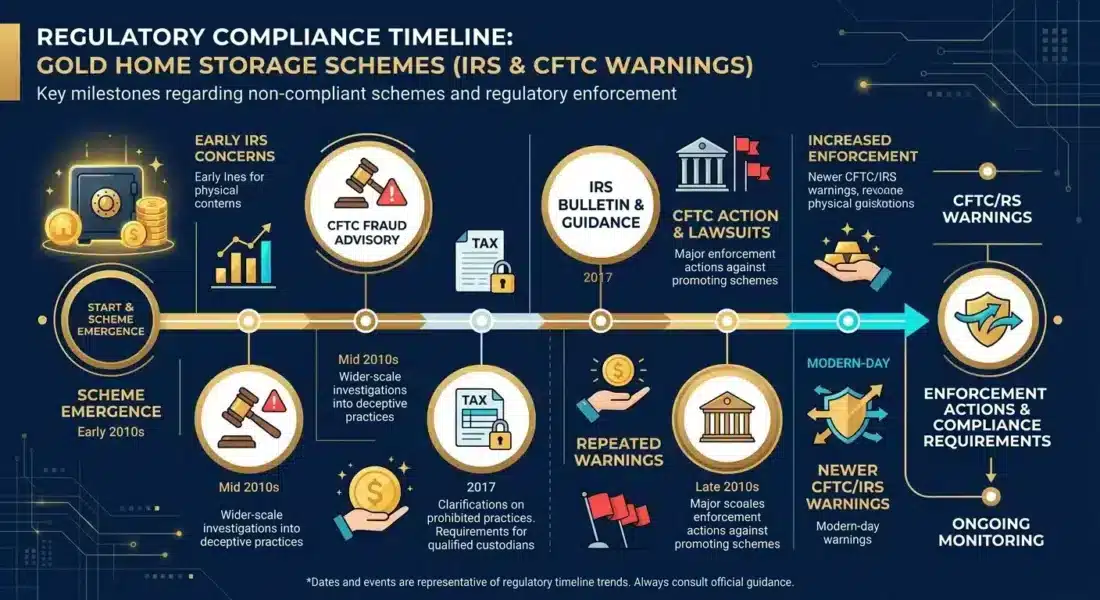
Why Is Secure Storage Critical for Physical Wealth Protection?
Ownership without proper custody is not ownership. That is the answer — and everything else follows from it.
When physical gold or silver sits outside an approved, institutional-grade depository, it loses its legal protections, its tax-advantaged status, and its structural separation from the financial system. The distinction matters more than most people realize before they need it.
Federal tax law is explicit. Under Internal Revenue Code Section 408(m), self-directed precious metals held in personal possession — rather than with an approved trustee — are immediately stripped of tax-advantaged status. The retirement protection a Gold IRA is designed to provide disappears the moment metals leave an approved facility.
A vault is not just a box. It is a legal and structural boundary between what an owner holds and what a bank, regulator, or third party can reach.
Beyond tax compliance, storage quality determines whether physical metals are genuinely isolated from counterparty risk. Metals stored inside commercial banks or fractional-reserve institutions expose owners to the same systemic vulnerabilities the physical metals were acquired to avoid. Institutional-grade vaulted storage — held in approved, non-bank facilities — removes that exposure.
The risks of inadequate storage are documented at the federal level. Regulators have warned that home storage arrangements marketed as tax-free loopholes lead to severe tax penalties, back taxes, and forced asset liquidation. Separately, unregulated firms have been identified charging inflated fees disguised as standard vaulting services — quietly eroding physical holdings over time.
The highest-confidence storage model is the one sovereign institutions use to protect national reserves. London vault systems maintain precise inventories of thousands of tonnes of fine gold specifically to preserve institutional trust and settlement liquidity.
For individual owners, the principle is identical: storage must be institutional-grade, legally compliant, fee-transparent, and fully separated from the banking system. Precious metals may appreciate, depreciate, or remain unchanged — but none of that matters if improper storage has already compromised legal ownership before the market moves at all.
- What Secure Storage Actually Means for Physical Precious Metals
- Why the Common Approach to Gold Storage Fails
- The Home Storage Trap: What the IRS and CFTC Actually Say
- How Institutional-Grade Vaulting Works — and Why It Matters
- Segregated vs. Non-Segregated Storage: Making the Right Call
-
Frequently Asked Questions About Secure Storage for Physical Precious Metals
- Can I store IRA-approved gold at home legally?
- What is the difference between segregated and non-segregated storage?
- How are physical precious metals secured inside an IRS-approved depository?
- What are the risks of using a non-accredited vault or storage scheme?
- How does Brighton Gold's concierge vaulting process work for new customers?
- The Bottom Line on Physical Wealth Protection
What Secure Storage Actually Means for Physical Precious Metals

Secure storage isn't a feature. It's a prerequisite.
You can't evaluate whether your gold or silver is doing its job until you know whether you legally own it in a way that holds up.
Here's the question most customers never think to ask: does your storage structure actually separate your metals from the financial system — or does it just feel like it does?
That distinction is everything. Vaulted storage done correctly creates a legal and structural boundary between what you own and what a bank, regulator, or creditor can reach. Done incorrectly, it creates the appearance of protection while leaving every real vulnerability intact.
We believe clarity here is non-negotiable. Knowing what qualifies as secure storage — and what doesn't — is the first step toward ownership that's real.
Precious metals may appreciate, depreciate, or remain unchanged. But none of that matters if the custody structure fails before the market ever moves.
Ownership Is Only as Real as the Structure That Protects It
Here's what most customers assume: buying it means owning it.
That assumption is mostly right — until the structure underneath it fails. The storage arrangement you choose determines whether your claim to those metals is enforceable. Legally. Financially. Practically.
Storage inside a commercial bank or fractional-reserve institution puts you back inside the system you were trying to leave.
Physical doesn't mean safe when the institution holding your metals has its own solvency problems. If that institution fails, your metals don't automatically walk out with you. The counterparty risk doesn't disappear — it travels through whatever custody structure you chose.
Non-bank vaulted facilities cut that exposure off at the root. Your metals are held in your name, isolated from any commercial banking balance sheet, and governed by custody agreements that exist entirely outside the fractional-reserve system.
What makes ownership real isn't the weight of the coin. It's the structure protecting it. And how that protection is structured at the account level starts with how accounts are titled.
The Legal Definition of Approved Storage Under Federal Tax Law
Federal tax law doesn't suggest compliant storage — it requires it. Cross the line, and the consequences are immediate.
Under IRS rules governing retirement accounts, the custody structure alone determines whether your metals keep their tax-advantaged status — or forfeit it entirely.
Internal Revenue Code Section 408(m) is unambiguous: self-directed precious metals lose their tax-advantaged retirement status the moment they leave an approved trustee's custody.
Personal possession — regardless of how secure your home setup feels — is not a compliant arrangement under federal law. The tax protections collapse. The IRS treats the metals as a distribution.
Brighton Gold builds around this legal reality — not around what's easiest to sell.
Approved depositories, qualified custodians, and transparent custody agreements aren't add-ons. They're the foundation that makes a Precious Metals IRA function the way it's supposed to. Our framework is built so customers know exactly where their metals are, exactly how they're held, and exactly what that means for their tax status — before anything is signed.
| Storage Type | Legal Compliance | IRS Tax Status | Counterparty Risk Exposure | Ownership Control |
|---|---|---|---|---|
| IRS-Approved Depository (Non-Bank) | Fully compliant — meets all federal custody requirements for retirement-held metals | Tax-advantaged status preserved under IRC Section 408(m) | Minimal — held outside the balance sheet of any fractional-reserve institution | Complete legal ownership in your name, governed by custody agreements independent of the banking system |
| IRS-Approved Depository (Bank-Affiliated) | Compliant — meets federal custody requirements if trustee is properly approved | Tax-advantaged status preserved provided the custodian is IRS-qualified | Moderate — physical metals may sit adjacent to the bank's balance sheet; custody agreement governs separation | Legal ownership intact, but counterparty exposure depends on the institution's financial health |
| Home Storage (Personal Possession) | Non-compliant — personal possession disqualifies retirement-held metals under federal tax law | Tax-advantaged status immediately revoked; IRS treats metals as a taxable distribution | High — no institutional safeguards, no custody framework, no legal separation from personal liabilities | Physical possession exists, but enforceable legal ownership as a retirement asset is lost |
| Home Storage Marketed as 'Checkbook IRA' Loophole | Non-compliant — regulators have explicitly identified these arrangements as fraudulent workarounds | Tax-advantaged status lost; owners face back taxes, penalties, and potential forced liquidation | Very high — no regulatory oversight, no approved trustee, no protection from legal or financial claims | Ownership is legally precarious — the structure fails under IRS or creditor scrutiny |
| Unaccredited Private Vault (Non-Custodial) | Non-compliant for retirement accounts; may be permissible for non-IRA cash purchases depending on arrangement | Tax status unaffected for non-IRA holdings, but no retirement protections apply | High — no regulatory framework, no approved trustee relationship, counterparty risk determined entirely by the provider's solvency | Physical possession possible, but legal enforceability of ownership depends entirely on private contractual terms |
Why the Common Approach to Gold Storage Fails

Most customers asking about gold storage are asking the right question. They're just getting answers from an industry that profits from their confusion.
The dominant storage model is built around opaque fee structures and marketing language. Not legal clarity. Not structural protection. Not genuine ownership.
When a storage arrangement collapses — fraudulent scheme, non-compliant setup, fees quietly gutting the holdings — the industry moves on.
The tax penalties don't. The forced liquidations don't. The eroded metals don't. Those stay with the owner.
Two failure modes define how most storage arrangements break down. First: the home storage scheme — marketed as a loophole, flagged by federal regulators as fraud. Second: the opaque fee structure — vaulting services charging premium rates while quietly reducing what you actually hold.
Both are industry-wide. Both are preventable.
Why Most Precious Metals Owners Get Storage Wrong
The most common mistake isn't recklessness. It's trusting a pitch that sounds almost right.
Home storage arrangements marketed as 'tax-free loophole IRAs' promise simplicity. They promise control. What they actually deliver is a non-compliant custody structure that federal regulators have explicitly flagged as fraudulent.
The CFTC is direct: severe tax penalties, back taxes, forced liquidation.
The loophole was never real. The IRS treats personal possession as a taxable distribution. The metals don't disappear — but the tax-advantaged status does, permanently.
But legal exposure isn't even the deepest problem. There's a structural gap no home safe closes.
Gold held at home — however locked down the setup — isn't isolated from personal liability, creditor claims, or domestic systemic risk the way institutional-grade, non-bank vaulted custody is. Physical possession feels like control. Control and enforceable ownership are not the same thing. The rules governing what happens when custody breaks down are spelled out in IRS distribution guidelines for retirement accounts — and they are not forgiving.
That confusion isn't accidental. The marketing behind home storage schemes is engineered to sound authoritative — legal-sounding terminology, IRS code references, the appearance of expertise.
Brighton Gold's approach is the opposite. We help customers understand exactly what the rules require before anything is signed. Our precious metals educational resources translate compliance language into plain terms — because an informed customer makes a better decision, every time.
Opaque Fee Structures That Quietly Erode Physical Holdings
The second failure mode is less dramatic. That's exactly what makes it dangerous.
Unregulated firms charge inflated fees disguised as standard storage services — premium vaulting rates that quietly eat into physical holdings. The fee structure looks legitimate on paper. The erosion shows up later, when owners realize their holdings are smaller than the statements ever made clear. The FTC has documented this pattern explicitly — hidden markups that compound silently across years of ownership.
Here's what opacity actually costs.
When fee structures aren't disclosed upfront — when storage rates are buried in fine print or adjusted without clear notice — the customer can't make an informed decision. Predatory firms exploit that gap, charging what the market will bear rather than what the service costs.
Precious metals may appreciate, depreciate, or remain unchanged. Hidden fees guarantee a loss that has nothing to do with the market.
Brighton Gold's framework is built to close that gap — transparent custody agreements, approved depositories, and fee structures disclosed before commitment, not discovered after.
That's not a marketing position. It's what separates a long-term ownership relationship from a transaction that benefits one side. It's what you get with a concierge vaulting approach.
Who This Warning Is Not For
Worth saying directly: many customers caught in these schemes made sincere, well-intentioned decisions.
Sincerity doesn't make a non-compliant arrangement compliant. Good intentions don't offset IRS penalties.
If you're looking for a short-term trade — metals in, metals out, price movement as the goal — Brighton Gold is probably not the right fit.
If you want someone to guarantee that gold will protect you from every possible outcome, we can't offer that. No one honestly can. Precious metals may appreciate, depreciate, or remain unchanged. That's the truth, and we say it plainly.
Brighton Gold is built for customers who want to hold something real for the long haul — and who want the custody structure around it to be legally sound, fee-transparent, and clearly theirs.
The industry's common failures don't have to be yours. The right structure exists. It takes a provider willing to build it correctly from the start.
| Storage Failure Type | How It Occurs | Financial Consequence | Regulatory Status |
|---|---|---|---|
| Home Storage Scheme | Dealers market personal possession of IRA-held metals as a legal loophole, using IRS code language to create an appearance of compliance | Tax-advantaged status collapses immediately; the IRS treats personal possession as a taxable distribution, triggering back taxes and forced asset liquidation | Explicitly flagged as fraudulent by the CFTC and FTC; no IRS-compliant basis exists for home storage of retirement-held precious metals |
| Opaque Fee Structure | Unregulated firms charge premium vaulting rates buried in fine print or adjusted post-commitment, disguised as standard storage services | Physical holdings erode over time as inflated fees quietly reduce the quantity of metals the owner actually retains | Not illegal in isolation, but the FTC identifies hidden fee inflation as a core vector of consumer harm in the precious metals space |
| Non-Bank Custodial Exposure | Metals are held inside commercial banking institutions or custodians whose balance sheets are exposed to fractional-reserve systemic risk | If the holding institution fails, the owner's metals are not automatically isolated — counterparty risk travels through the custody structure chosen | Not prohibited, but falls outside the structural protection of non-bank, institutional-grade vaulted custody that genuine ownership requires |
| Non-Compliant Custody Arrangement | Owners select storage structures that fall outside IRS-approved trustee requirements, often without realizing the arrangement is non-compliant | Retirement account loses tax-advantaged status under Internal Revenue Code Section 408(m); metals are treated as a distribution at the point of violation | Directly prohibited under federal tax law; non-compliance is not a gray area — disqualification is immediate upon departure from approved custody |
| Advisor-Framed Sales Pressure | Firms position sales representatives as financial advisors or fiduciaries, directing customers toward high-margin storage arrangements without disclosure | Customers make custody decisions based on perceived expert guidance rather than transparent, disclosed terms — creating misaligned expectations and post-purchase disputes | Creates implied fiduciary obligations the firm does not legally hold; the FTC identifies misleading advisor framing as a consumer protection concern |
The Home Storage Trap: What the IRS and CFTC Actually Say
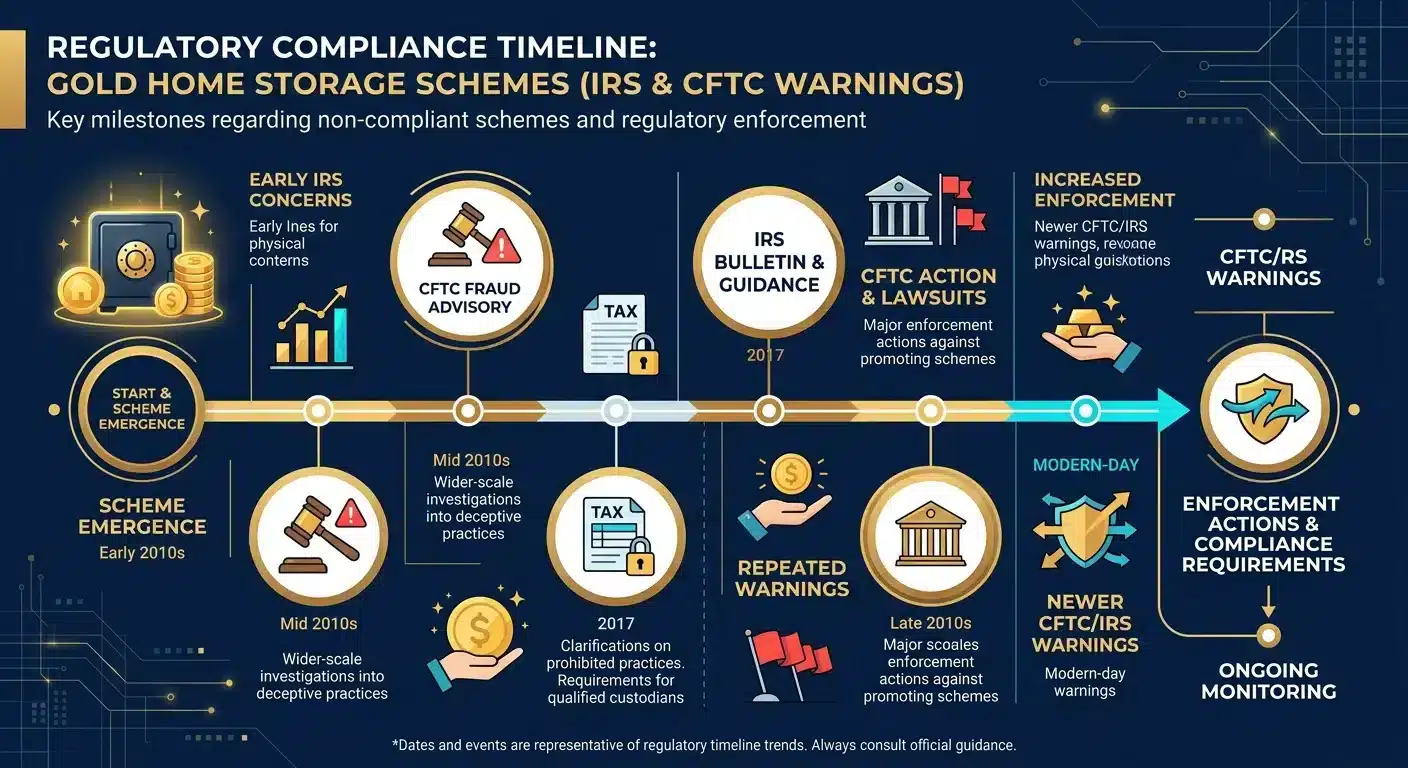
Home storage schemes are the most dangerous shortcut in the precious metals industry. Not because they sound obviously wrong. Because they sound almost right.
The pitch is familiar: hold your gold at home, keep control, structure it so your tax-advantaged status survives. What the pitch never mentions is that federal regulators have examined this exact arrangement — and issued explicit warnings about what it actually delivers.
The law isn't ambiguous here. Section 408 of the Internal Revenue Code requires an approved trustee to hold qualifying IRA assets. That's the structure. Remove the trustee and the tax-advantaged status goes with it — not as a penalty, but as a direct consequence of how these accounts are legally built. IRS guidance on Individual Retirement Arrangements makes the trustee requirement explicit — this isn't an interpretation, it's the governing framework.
And that's exactly what the pitch leaves out. What gets sold as control is a compliance violation with persuasive packaging. The consequences aren't hypothetical — they're documented by federal regulators who have reviewed these arrangements in detail.
IRC Section 408(m) and the Personal Possession Prohibition
Internal Revenue Code Section 408(m) is the governing statute. It doesn't leave room for interpretation.
Self-directed precious metals held in personal possession — rather than with an IRS-approved trustee — lose their tax-advantaged retirement status immediately. The IRS doesn't treat this as a procedural misstep. It treats it as a taxable distribution.
That hits hardest for anyone who rolled over a 401(k) or transferred an existing IRA into a Precious Metals IRA. The whole point of that move was the tax protection. The moment the custody structure falls outside what the IRS recognizes — that protection disappears. The metals are still physical. The ownership is still real in a practical sense. But the tax status that made the entire arrangement worth doing? Gone. Retroactively.
This isn't bureaucratic red tape. It's the actual dividing line between what the IRS treats as a retirement account and what it treats as a taxable distribution. Brighton Gold's framework is built to stay clearly on the right side of that line — approved depositories, qualified custodians, and full custody agreements in place before any metals change hands. What disqualifies home storage is worth understanding before the structure is set up, not after an audit surfaces the problem.
How Home Storage Schemes Lead to Tax Penalties and Asset Liquidation
The CFTC's warning on home storage gold IRAs is unambiguous.
These arrangements — marketed with legal-sounding language and references to IRS codes — lead to severe tax penalties, back taxes, and immediate forced liquidation of assets. The loophole framing is intentional misdirection. There is no compliant version of a home storage IRA under current federal law — IRC Section 408 is unambiguous on the trustee requirement, and no arrangement structured around personal possession satisfies it.
What makes this failure mode particularly brutal is its timing. The penalties don't arrive when the scheme is sold. They arrive years later — when an audit or regulatory review surfaces what was set up. By then, the firm that structured the arrangement has moved on. The tax liability hasn't. The forced liquidation hasn't. Those stay with the owner. That's not a risk most customers understand when they sign.
The customers targeted by these schemes aren't reckless. They want control and privacy over what they own — and that's a completely reasonable thing to want. But a non-compliant workaround doesn't deliver control. It delivers exposure. The right answer to that desire is a custody structure that provides genuine legal ownership, tax compliance, and institutional-grade security at the same time. Precious metals may appreciate, depreciate, or remain unchanged. What shouldn't be in question is whether the structure holding them is legally sound.
| Regulatory Body | Warning Issued | Consequence Described | Source Authority |
|---|---|---|---|
| Internal Revenue Service (IRS) | Internal Revenue Code Section 408(m) | Self-directed precious metals held in personal possession lose tax-advantaged retirement status and are treated as a taxable distribution | law.cornell.edu/uscode/text/26/408 |
| Commodity Futures Trading Commission (CFTC) | Consumer Advisory on Home Storage Gold IRAs | Severe tax penalties, back taxes, and immediate forced liquidation of assets | cftc.gov/ConsumerProtection |
| Federal Tax Authority (IRS) | Taxable Distribution Classification | Personal possession of IRA-held metals triggers immediate disqualification of the retirement account's tax-protected structure | law.cornell.edu/uscode/text/26/408 |
| Federal Regulatory Agencies (IRS + CFTC) | Fraud Classification of Home Storage IRA Schemes | Arrangements marketed as tax-free loophole IRAs are flagged as fraudulent — penalties may arrive years after the non-compliant structure is established | cftc.gov/ConsumerProtection |
How Institutional-Grade Vaulting Works — and Why It Matters

Most people asking about vaulted storage aren't really asking about vault specifications.
They're asking: if I do this correctly, is what I own actually mine?
That's the right question. And the answer lives entirely in the structure surrounding the metals — not the metals themselves.
A vault is not just a box. It is a legal and structural boundary between what you own and what a bank, regulator, or bad actor can touch.
The quality of that boundary — the custodial framework, the regulatory approval, the isolation from fractional-reserve institutions — determines whether ownership is real or illusory. Research on counterparty risk confirms that mitigating systemic exposure requires storage structures isolated from the balance sheets of depository banks and fractional-reserve institutions.
Institutional-grade vaulting exists precisely to create that isolation — legally, structurally, and permanently.
Every risk we've covered traces back to the same failure.
Home storage schemes, opaque fee structures, custody arrangements that dissolve under regulatory pressure — they all trade the legal substance of ownership for the appearance of it.
Institutional-grade vaulting closes that gap. What that structure actually involves is worth understanding before you commit to any arrangement. what that structure actually involves
What Happens Inside an IRS-Approved Depository
An IRS-approved depository operates under requirements that most storage marketing glosses over entirely.
The facility must meet federal standards for physical security, insurance, and custodial accountability. The custodian holding your metals must be an IRS-approved trustee — not a marketing company, not a dealer acting as a de facto custodian, not a third-party arrangement invented to sidestep the approval requirement.
Those distinctions aren't technicalities. They're the difference between a compliant account and a taxable distribution.
Inside an approved depository, your metals aren't just sitting in a room. They're inventoried — logged, audited, held under documented custody protocols that create a clear, enforceable chain of title.
The facility is purpose-built: hardened physical infrastructure, 24-hour monitoring, insurance coverage calibrated to the actual value stored.
That structure is what makes the tax-advantaged status of a Precious Metals IRA legally defensible. Not the marketing language. The custody record.
What approved depository custody delivers — beyond the physical security — is proof.
At any point, ownership can be confirmed against a documented, auditable record. That record is what separates metals held in a compliant structure from metals regulators classify as personal possession.
And that distinction is not a technicality. It's the line between a recognized retirement account and a taxable distribution.
How Global Institutions Use Vaulted Storage to Protect Reserve Wealth
Here's the thing: institutional vaulted storage isn't a retail concept someone invented for gold IRA customers.
Global central banks use it to protect their most critical reserve assets — specifically as a defense against digital currency debasement and domestic systemic failures.
When monetary systems come under pressure, the assets that hold their authority are the ones held outside those systems. Non-bank. Non-digital. Independently custodied.
London vault systems — the custody infrastructure underlying international settlement markets — maintain precise physical inventories totaling thousands of tonnes of fine gold.
That precision isn't incidental to the system. It is the system.
International market participants rely on vaulted custody records because institutional trust in gold's reserve role depends on physical accountability. Not a digital ledger entry someone can revise. Physical metal, documented, held.
This is the model that institutional-grade depository custody for private owners mirrors. The scale differs. The structural principle does not.
When you hold physical metals in an approved, non-bank depository — isolated from the balance sheets of commercial banks and fractional-reserve institutions — you are applying the same custody logic that sovereign reserve managers rely on.
Precious metals may appreciate, depreciate, or remain unchanged. What that custody structure protects is not price performance. It is the enforceability of ownership itself.
Brighton Gold's Concierge Vaulting Framework
Brighton Gold's approach to vaulted custody is built around a single premise: the process should be transparent before anything is signed, not disclosed after.
Our wealth protection secure storage plans are structured so customers understand the custody arrangement, the approved depository, and the full fee structure before commitment.
Not as an afterthought buried in documentation. Before.
And that's not a sales position. It's a practical requirement.
Customers who don't fully understand their custody arrangement before signing can't make informed decisions about it afterward. Customers who discover fee structures or compliance gaps after the fact aren't in a neutral position — they're in a worse one, often with fewer options than they had at the start.
Transparent custody agreements, qualified custodians, approved depositories. That's the foundation. Everything else is downstream of those three things.
We believe the standard for precious metals custody should be the same standard that global institutions apply to reserve wealth: unencumbered, independently held, and legally documented at every stage.
Brighton Gold's concierge vaulting service is built to deliver exactly that — not as a premium add-on, but as the baseline for what responsible physical ownership looks like.
Precious metals may appreciate, depreciate, or remain unchanged. What shouldn't change — ever — is the legal integrity of the structure holding them.
| Vaulting Feature | What It Provides | Who Relies On It | Why It Matters to Individual Owners |
|---|---|---|---|
| IRS-Approved Depository Designation | Legally recognized custodial status that preserves the tax-advantaged classification of retirement-held metals | Precious Metals IRA holders, self-directed IRA custodians, federal regulators | Without an approved depository, metals held in an IRA lose their tax-advantaged status — the IRS treats possession as a taxable distribution |
| Isolation from Bank Balance Sheets | Physical separation of your metals from the liabilities and liquidity risks of commercial banking institutions | Sovereign reserve managers, central banks, institutional custodians | Metals stored outside fractional-reserve structures are not subject to bank insolvency, bail-in risk, or institutional liquidity constraints |
| Documented Chain of Title | A precise, auditable ownership record that confirms exactly what you hold and under what custodial arrangement | Individual owners, qualified IRA trustees, compliance auditors | Without a documented chain of title, ownership is asserted — not provable. Regulatory or legal disputes require enforceable records, not verbal assurances |
| Purpose-Built Physical Security | Hardened facility infrastructure, continuous monitoring, and insurance coverage calibrated to the actual value of stored assets | International settlement markets, high-net-worth private owners, institutional depositors | General commercial storage is not designed for precious metals custody — purpose-built depositories provide the physical accountability that retail facilities cannot |
| Transparent Fee Structure | Full disclosure of all custody, administration, and storage costs before any metals change hands | Long-term owners evaluating total cost of ownership over time | Opaque fee arrangements erode the real value of holdings over time — often quietly, and without the owner's clear awareness until the damage is done |
| Segregated vs. Commingled Custody Options | The ability to hold metals individually assigned to your account, or pooled within a larger institutional inventory, with clear documentation of which arrangement applies | Owners who prioritize direct accountability versus those who weigh cost efficiency against individual traceability | Understanding which custody model applies to your holdings determines how verifiable your ownership is at any given point — and what retrieval looks like in practice |
Segregated vs. Non-Segregated Storage: Making the Right Call

Institutional custody is the baseline. But there's a second decision buried inside it — one that determines what ownership actually means at the asset level.
Most customers don't think to ask it until it's already been made for them: are your metals held exclusively in your name, or pooled with everyone else's?
That's not a technicality. It determines what you actually own, how fast you can verify it, and what happens to your claim if the custodial arrangement breaks down.
A metals holding is only as real as the documented, auditable record that proves it is yours — not a proportional share of someone else's pool. Understanding the full chain of custody
Here's what the international settlement markets have already figured out: physical accountability is not optional. You can't settle gold at the institutional level on ledger entries someone can revise after the fact.
The same logic runs down to individual ownership. The question is whether your specific metals — your specific coins or bars — are traceable to you by serial number and weight. Or whether your position is a share of a pooled allocation that lives primarily on paper.
How Segregated Storage Works in Practice
Segregated storage means your metals are physically separated from every other owner's holdings inside the depository.
Your specific coins or bars are identified by serial number, weight, and purity — logged under your name, held in a dedicated space, and auditable as a discrete, named holding. Not a share. Not an allocation. Yours.
That structure eliminates an exposure that commingled arrangements can't touch: the risk that a custodial failure, accounting error, or contested claim reaches your specific holding.
Storage structures isolated from the balance sheets of fractional-reserve institutions reduce counterparty risk at the account level. Segregated storage extends that isolation inward — down to the individual asset inside the vault. The vault is the boundary. Segregation is what makes that boundary real.
The practical result: you can verify ownership at the asset level, not just the account level.
When your metals are segregated, the inventory record names your specific holdings. Not a proportional claim against a larger pool. Legal title to a specific asset — not a beneficial interest in a shared one.
That distinction is the difference between ownership that holds up and ownership that depends on someone else's accounting.
When Non-Segregated Storage Is — and Is Not — Acceptable
Non-segregated — or commingled — storage is not automatically a compliance failure.
For cash purchases held outside an IRA, it can be a cost-effective structure — particularly for standard bullion products where the specific serial number of a given bar or coin carries less legal weight to the owner. The structure is legitimate. The question is whether it fits the owner's custody goals.
But there are contexts where non-segregated storage introduces exposure that deserves attention before you accept it.
London vault systems — the foundation of international gold settlement — maintain precise physical inventories of thousands of tonnes of fine gold specifically because institutional trust depends on physical accountability, not shared allocations. That logic doesn't stop applying when you move from sovereign reserves to personal retirement holdings.
When the integrity of your ownership record matters, commingled structures ask you to trust the custodian's internal accounting rather than a direct, verifiable chain of title. That's a different kind of risk. Know what you're taking on.
Brighton Gold makes this distinction explicit before any decision is made — not discovered after.
Our concierge guidance walks customers through which structure aligns with their custody goals, their IRA requirements, and their long-term ownership priorities. The choice between segregated vs. non-segregated storage isn't a detail buried in fine print. It's a structural decision that deserves a direct conversation.
Precious metals may appreciate, depreciate, or remain unchanged. What should always be unambiguous is whether the specific metals in storage are legally, documentably yours.
| Storage Option | How Metals Are Held | Verification Access | Cost Consideration | Best Suited For |
|---|---|---|---|---|
| Segregated Storage | Your specific coins or bars are physically separated from all other owners' holdings — identified by serial number, weight, and purity, and held in a dedicated space under your name | Verifiable at the asset level — your specific holdings are documented by serial number and can be audited as a discrete, named position | Higher than commingled arrangements, reflecting the dedicated space and individualized inventory management required | IRA-held metals, owners who prioritize direct legal title to specific assets, and anyone for whom chain-of-title verifiability is a non-negotiable ownership standard |
| Non-Segregated (Commingled) Storage | Your metals are pooled with other owners' holdings of the same type and purity — you hold a proportional claim against a shared vault allocation rather than title to specific, identified pieces | Verifiable at the account level — your position is confirmed as a share of the pool, not as a traceable claim against individually identified assets | Lower than segregated arrangements, as operational costs are distributed across all owners sharing the allocation | Cash purchases of standard bullion products outside an IRA, where cost efficiency is the priority and the specific serial number of a given bar or coin carries less legal significance to the owner |
Frequently Asked Questions About Secure Storage for Physical Precious Metals
Storage questions surface late. That's the pattern — customers get through the bigger decision, then the details no one mentioned upfront start coming in. Compliance questions. Custody distinctions. Process specifics that should have been covered first.
These answers are direct. Storage is where ownership either holds — or quietly disappears.
Can I store IRA-approved gold at home legally?
No. And the IRS leaves no room for creative interpretation.
Internal Revenue Code Section 408(m) is explicit: self-directed precious metals held in personal possession — rather than with an approved trustee — lose their tax-advantaged retirement status immediately. It doesn't matter how the arrangement is packaged or marketed. The moment metals leave approved depository custody, the IRA protection collapses.
The CFTC has documented what follows: severe tax penalties, back taxes, and immediate forced asset liquidation. What gets sold as a loophole is a compliance violation waiting to surface — often years after the arrangement was set up, long after the firm that sold it has moved on.
Approved depository custody isn't a technicality. It's the structural requirement that determines whether a Precious Metals IRA functions as intended — or becomes a taxable distribution.
What is the difference between segregated and non-segregated storage?
Segregated storage means your specific metals — identified by serial number, weight, and purity — are physically separated from every other owner's holdings inside the depository. Your coins or bars are held in a dedicated space, logged under your name, and auditable as a discrete, documented position. Not a share. Not an allocation. Yours.
Non-segregated storage pools your metals with other owners into a shared vault allocation. You hold a proportional interest — not a claim to specific assets. For standard cash purchases involving common bullion products, commingled storage can be cost-effective and entirely legitimate.
But when the enforceability of your specific ownership claim matters, the distinction changes. Mitigating counterparty risk requires storage structures isolated from the balance sheets of depository banks and fractional-reserve institutions — and segregated storage extends that isolation inward, down to the level of individual ownership inside the vault itself.
The question is whether your metals are traceable to you by serial number — or whether your position lives primarily on someone else's accounting ledger.
How are physical precious metals secured inside an IRS-approved depository?
IRS-approved depositories operate under standards that a commercial safe or a bank safety deposit box cannot replicate.
Access is controlled and restricted to authorized custodial personnel. Holdings are inventoried at the asset level — serial numbers, weights, purity certifications — maintained under documented chain-of-custody protocols that create a clear, enforceable ownership record. Not a ledger entry. An auditable physical position.
Federal tax law requires a three-party structure: the owner retains legal title, an approved trustee administers the account, and the depository holds the physical metals. Those roles cannot collapse into one another. The moment they do, the arrangement is disqualified.
Sovereign institutions apply this same model to protect reserve wealth — unencumbered, physically accountable, independently held. That structural principle is what qualifies a private depository for IRA custody. The facility is purpose-built for this function. The structure is what makes the tax-advantaged status legally defensible.
What are the risks of using a non-accredited vault or storage scheme?
The risks aren't theoretical. They're documented — and they arrive on a delay.
Home storage schemes draw direct regulatory scrutiny. The CFTC is explicit: these arrangements lead to severe tax penalties, back taxes, and immediate forced asset liquidation. The penalties don't surface when the arrangement is sold. They surface during an audit — sometimes years later — when the non-compliant structure is finally examined. By then, the firm that structured it has moved on.
Non-accredited vaults introduce a different category of exposure. Without independent audit requirements, insurance standards, or segregation protocols, there's no enforceable framework protecting the owner's specific claim. Physical ownership in a non-bank facility reduces exposure to commercial banking failures — but only when the facility itself is structurally isolated from those systems. A non-accredited vault provides storage. It doesn't provide the legal framework that makes ownership stick.
That's the real risk — not just financial loss. It's the quiet erosion of a legal claim the owner believed was secure, until the moment it needed to hold.
How does Brighton Gold's concierge vaulting process work for new customers?
Brighton Gold's process starts with a complimentary consultation — not a transaction.
Before any metals are selected or any account is opened, customers walk through the full custody structure: the approved depository, the qualified custodian, the segregation options, and the complete fee picture. Everything disclosed upfront — not discovered after the paperwork is signed.
For customers rolling an existing retirement account into a Precious Metals IRA — including the No Fee IRA for the lifetime of the account on qualified purchases — we coordinate the custodian transfer and depository setup as part of the process. For cash purchases, we work through the delivery versus vaulted storage decision based on what the customer actually needs — not a default recommendation that works for us.
A customer who fully understands their custody arrangement makes a better decision. That's not a service philosophy. It's the structural reason clarity has to come before anything else.
Precious metals may appreciate, depreciate, or remain unchanged. What Brighton Gold's process protects — from the first conversation through every stage of ownership — is the legal integrity of the structure holding them.
The Bottom Line on Physical Wealth Protection
Here's what every section of this article has been saying in different ways.
A vault isn't just a box. It's a legal and structural boundary between what you own and what a bank, regulator, or bad actor can reach.
Where you store determines whether that ownership is real or a paper fiction. And once that boundary is gone, you don't get to rebuild it retroactively.
Home storage schemes collapse that boundary the moment you sign. Opaque fee structures eat through it slowly — quietly — until the owner discovers a holding smaller than what they thought they had. Non-compliant custody arrangements erase it entirely, often before anyone realizes something has gone wrong.
The only structure that holds under pressure is institutional-grade vaulted custody: approved depository, independently held title, fully documented, and structurally isolated from the fractional-reserve systems that physical metals are specifically meant to stand outside of.
Precious metals may appreciate, depreciate, or remain unchanged. What the right custody structure protects isn't price performance. It's the enforceability of ownership itself — the thing that makes the metals mean something when it counts.
Brighton Gold's vaulting framework is built around that boundary — not as a premium add-on, but as the baseline for what physical ownership actually means.
Before anything is signed, our concierge guidance walks customers through every layer: the approved depository, the qualified custodian, the full fee picture, and the segregation decision. No buried disclosures. No details that surface later.
A vault is not just a box. It's the legal and structural line between ownership that holds and ownership that only looks like it does. The only question worth asking right now is whether the structure currently holding your metals enforces that boundary — or quietly dissolves it.
You've seen what institutional-grade custody looks like. Now find out what it looks like for your situation. Brighton Gold offers a complimentary consultation — not a sales pitch — to walk you through the actual custody structure, how the No Fee IRA works, and whether you qualify.