
How Can I Physically Audit My Vaulted Gold?
Physically auditing vaulted gold means one thing: a bar number, a verified weight, and an independent set of eyes confirming your metal is exactly where the paperwork says it is.
A monthly statement is not proof. A certificate is not proof. The only proof is a bar number, a confirmed weight, and a match against an official vault ledger — verified by someone standing in the room.
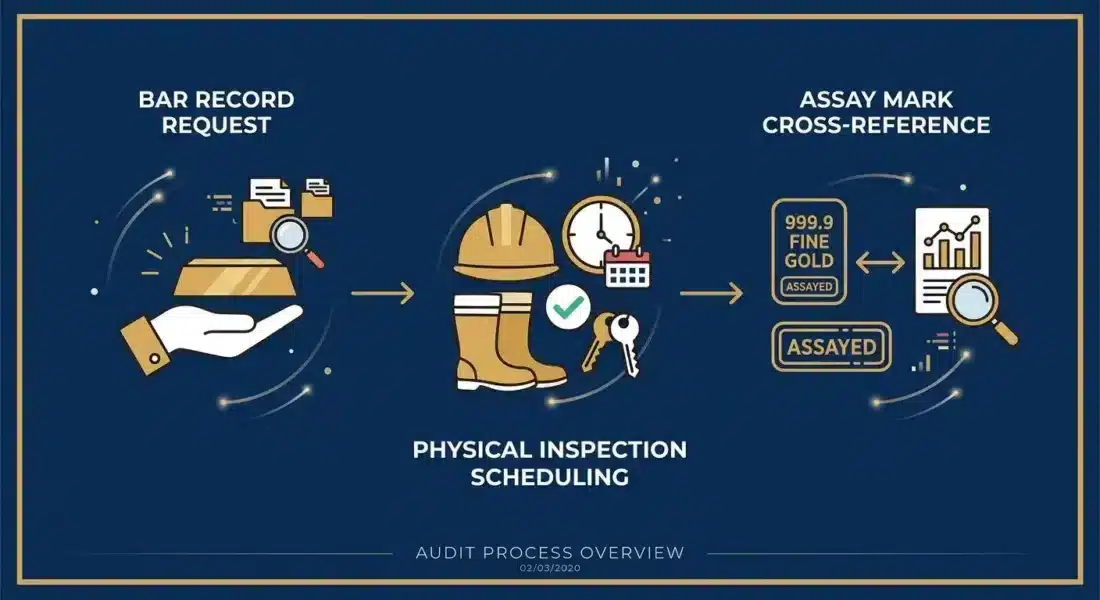
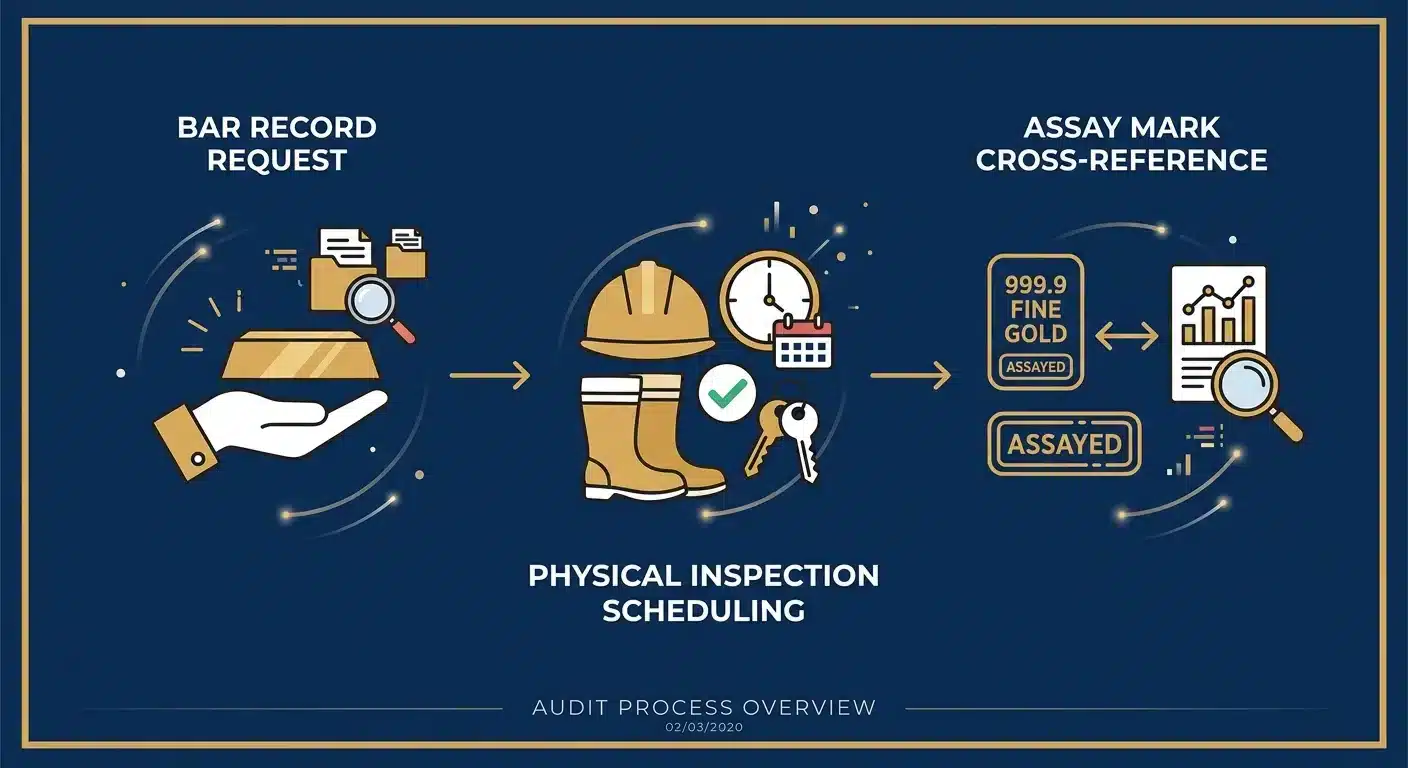
The process works in three stages. First, request bar identification records from the depository or dealer — the serial numbers, weights, and assay marks tied to your holdings. Second, arrange either a direct inspection visit to the facility or engage an independent, certified third-party auditor to conduct physical verification on your behalf. Third, cross-reference the bar numbers and assay marks on the physical metal against the official vault ledger to confirm they match what your records show.
The regulatory environment makes this verification the owner's responsibility — not the custodian's. Internal Revenue Code Section 408(m) requires that metals held inside a Self-Directed IRA be kept in the physical possession of an IRS-approved trustee or depository. Home storage is prohibited. The Securities and Exchange Commission has stated that self-directed IRA custodians are generally not responsible for evaluating or auditing the safety of physical assets held inside third-party depositories. That gap — between what the rules require and what custodians actually check — is exactly where a physical audit lives.
For Good Delivery gold bars, the London Bullion Market Association sets the physical standard: bars must weigh between 350 and 430 fine troy ounces with a minimum purity of 99.5%. Those are the figures an independent auditor will verify against your bar records.
A physical audit is not an emergency procedure. It is a routine ownership right — one any metals owner can and should request at any time.
- Why Paper Statements Are Not Proof of Physical Custody
- How a Physical Gold Audit Actually Works
- What Documentation Proves Your Gold Is Actually There
- How Brighton Gold Supports Ongoing Verification After Your Purchase
-
Frequently Asked Questions About Auditing Vaulted Gold
- Can I physically visit a depository to view and audit my vaulted gold?
- What documents must a vault provider supply to verify my gold is actually there?
- How does an independent third-party audit of a gold depository work?
- What is the difference between segregated and allocated vaulted storage audits?
- How does Brighton Gold verify the physical custody of my metals after purchase?
- Your Metal. Your Right to Verify It.
Why Paper Statements Are Not Proof of Physical Custody

A monthly statement tells you what a system says you own.
It does not tell you what is physically sitting in a vault. Those are two different things — and the distance between them is exactly where ownership risk lives.
The CFTC warns that fraudulent operations have taken payment, issued statements that looked completely legitimate, and never acquired the physical metal at all. Customers held paper. The vault held nothing. That is not a fringe scenario — it is the reason physical verification exists as a discipline. Paper and metal are two different things. That distinction is the foundation of physical wealth protection.
The IRS rules add a layer most owners don't fully absorb. Under Internal Revenue Code Section 408(m), physical metals inside a Self-Directed IRA must be held in the physical possession of an IRS-approved trustee or depository — home storage is prohibited. So the regulation guarantees your metal is somewhere specific. But it does not guarantee anyone has confirmed it is actually there. That confirmation is yours to request.
Why Most Custodians Won't Help You Verify
Most owners find this out the hard way: the custodian holding your Self-Directed IRA is not responsible for verifying what is physically inside the depository. The SEC has said this plainly — custodians are not required to evaluate or audit the safety of physical assets held in third-party depositories.
That is not negligence. It is the design of the system. Custodians handle the administrative and regulatory side of the account — not the physical chain of custody. Physical verification runs through a separate chain: the depository's internal controls, independent third-party auditors, and the owner. Relying on audited and insured depositories is the right foundation. But the audit itself is an active step. Nobody initiates it for you.
That's exactly why the dealer relationship matters long after the purchase is done. A custodian won't initiate a physical audit on your behalf. A monthly statement won't trigger one. The owner who knows how to request bar identification records — and has a concierge partner willing to coordinate it — holds real ownership.
Everyone else holds a number on a page.
| What Paper Statements Show | What They Cannot Confirm | Why the Gap Matters |
|---|---|---|
| Your account balance in dollar value | Whether physical bars are present in the vault | Dollar values reflect market pricing — not physical inventory confirmation |
| The total quantity of metal credited to your account | Whether that quantity corresponds to specific, identifiable bars | Quantity on paper can exist without a bar number tied to your name |
| The name of the depository holding your metals | Whether your specific metals are segregated and physically located there | Naming a facility is not the same as confirming your bars are inside it |
| Transaction history and purchase confirmations | Whether the metal purchased was ever physically acquired by the depository | A purchase record confirms a transaction occurred — not that metal changed hands |
| A custodian's administrative record of your IRA holdings | Whether the custodian has verified the physical safety of those assets | Custodians manage the account structure — physical verification is outside their mandate |
| Storage fee receipts and account statements | Whether the bars tied to those fees carry verified assay marks and weights | Paying storage fees confirms a service relationship — not physical possession of specific bars |
How a Physical Gold Audit Actually Works
Most owners never learn this process. Not because it's complicated — because the industry doesn't explain it.
That gap is intentional. Close it by knowing exactly what to ask for.
Here's what a physical audit actually is: a bar number tied to a specific weight, that weight confirmed by an independent set of eyes, matched against the official vault ledger. Institutional vaults run dual-control systems and track individual bar numbers — the infrastructure is already there. The question is whether you know how to access it. how to audit physical gold holdings starts with that exact question.
Step 1: Request Your Bar Identification Records
Step 1 is the foundation — and most owners skip it without realizing it.
Your depository or dealer must produce bar identification records: serial numbers, individual weights, assay marks, and the specific vault location where those bars sit. Not a ounce total. Not an account summary. The actual inventory data tied to actual metal.
A dollar value is not a bar record. An ounce total is not a bar record. Those are two different documents — and only one of them proves you own something physical.
If your provider can't produce the underlying inventory data — the specific record tying your name to a physical object — that response is itself the answer.
Step 2: Schedule a Direct or Third-Party Physical Inspection
Step 2 moves from paper to metal. Two paths get you there.
The first is a direct visit. You go to the depository. You observe the bars. You read the serial numbers yourself. Most reputable facilities allow this — it's a standard ownership right, not a favor, not an unusual request. Treating it like one is a red flag worth noting.
The second path is engaging an independent, certified auditing firm. This isn't a workaround — it's how institutional verification is built to work. Certified auditors cross-reference bar assay marks against official vault ledger data. The process is formal, documented, and repeatable.
But knowing which firm to contact, how to initiate the engagement, and what to expect from the final report — that's not common knowledge. That's exactly the kind of support the Brighton Gold concierge model is built around.
Step 3: Cross-Reference Assay Marks and Vault Ledger Data
Step 3 is the confirmation — and it's where the numbers either hold or they don't.
Every Good Delivery gold bar carries assay marks: the refiner's stamp, the serial number, and the purity level. The London Bullion Market Association sets the physical standard — bars must weigh between 350 and 430 fine troy ounces, with a minimum purity of 99.5%. Those are the exact figures an independent auditor measures your bars against. Not approximations. Not ranges. Those specific thresholds.
Cross-referencing means putting the physical bar next to the ledger entry and confirming they match — bar number to ledger, weight to specification, assay mark to record.
When those align, the audit is done. A bar number. A verified weight. An independent set of eyes. That's the proof. Not a certificate. Not a statement. A confirmed physical record — the only kind that actually holds.
| Audit Step | Who Initiates | Documents Required | What Gets Verified |
|---|---|---|---|
| Request Your Bar Identification Records | Account holder or concierge dealer partner | Account statement, allocated holdings report, depository contact details | That specific bar serial numbers, individual weights, and assay marks are on record and tied to your account |
| Schedule a Direct or Third-Party Physical Inspection | Account holder (direct visit) or independent certified auditing firm (third-party inspection) | Bar identification records, depository access authorization, auditor engagement letter | That physical bars exist at the stated location and correspond to the serial numbers on file |
| Cross-Reference Assay Marks and Vault Ledger Data | Independent certified third-party auditor or account holder during direct inspection | Physical bar assay marks, vault ledger printout, bar identification records | That refiner stamps, serial numbers, weight, and purity on each physical bar match the official vault ledger entry assigned to your account |
What Documentation Proves Your Gold Is Actually There
The process doesn't matter if the paperwork is wrong.
Three steps get you there. But arriving means holding specific documents — not a summary, not a statement — that constitute verified proof of physical custody. Know what to ask for before you ask.
Real proof has three parts.
A bar identification record — individual serial numbers, specific weights, assay marks, vault location. A physical inspection report signed by a facility representative or a certified independent auditing firm. A vault ledger extract showing your named bars are formally assigned to your account.
Each document alone is partial. Together, they form the chain.
When the bar number on the physical metal matches the bar number on the ledger — which matches the bar number on your identification record — that's proof. A monthly statement showing an ounce total and a dollar value is none of those things.
Institutional vaults are built to produce exactly this documentation. Dual-control systems and bar tracking mechanisms maintain the chain of custody that makes independent verification possible.
The infrastructure is there. What's missing — for most customers — is a dealer who stays in the relationship long enough to help request it.
That's what secure vaulted storage logistics looks like when the dealer relationship extends past the date of purchase. The bar number, the verified weight, the independent set of eyes — the vault can produce all of it. Someone has to know to ask.
Segregated vs. Allocated Storage: What the Audit Difference Means
But not all vaulted storage is structured the same way. And that difference matters the moment you try to audit.
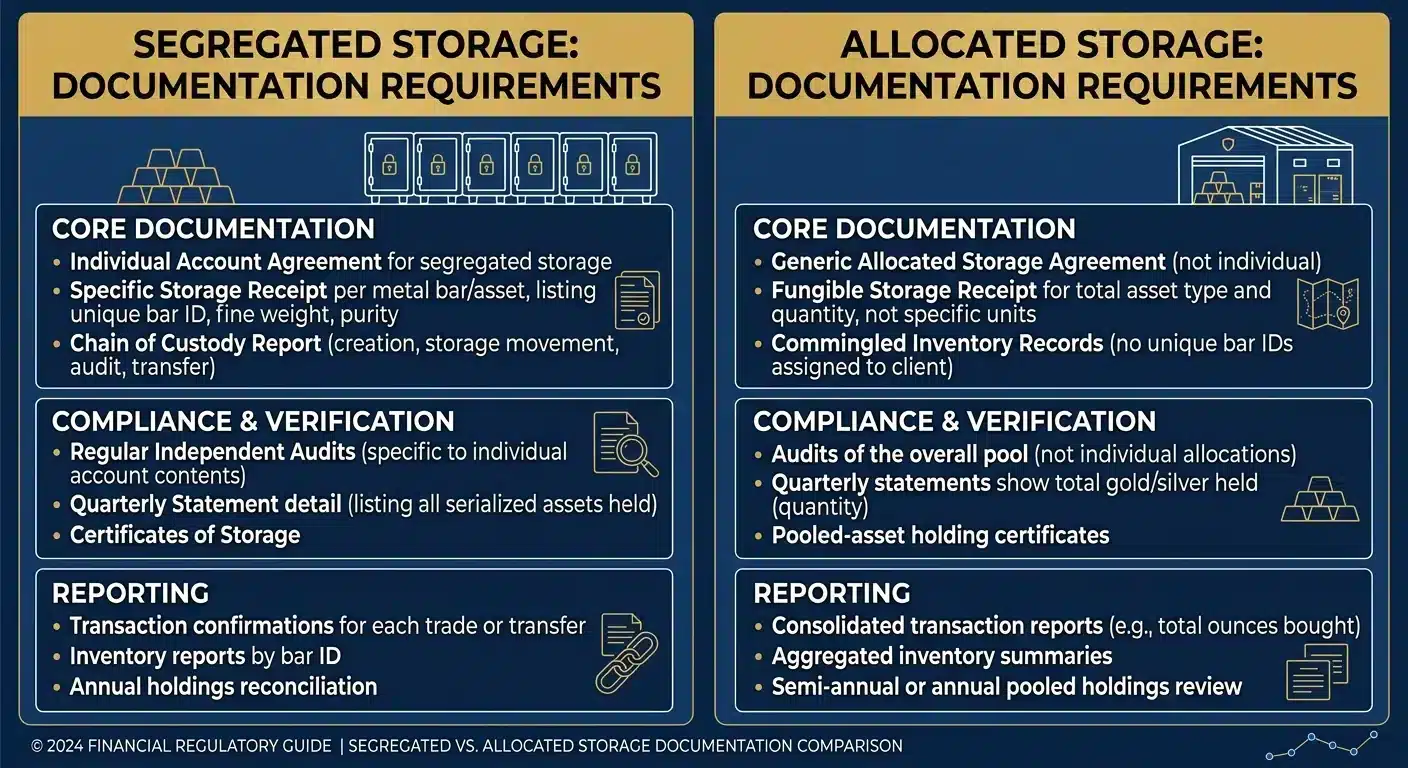
Segregated storage means your specific bars are physically separated from other customers' holdings — a dedicated space assigned to your account. Allocated storage means your holdings are identified by specific bar numbers within a shared vault, but your bars aren't physically isolated from others.
With segregated storage, a physical inspection is direct. Your bars occupy a defined space. Confirming presence means accessing that space and cross-referencing bar numbers against your records. Straightforward.
With allocated storage, the inspection requires tighter cross-referencing. The auditor has to confirm that the specific bar numbers assigned to your account are physically present within the shared inventory — and that they match the vault ledger entries.
Both are fully auditable. Segregated is simpler. Allocated requires disciplined documentation — which is exactly why the bar identification record from Step 1 matters so much. Without it, allocated storage verification has nothing to check against.
For Good Delivery bars, the physical standard doesn't change based on storage arrangement. The LBMA mandates a weight range of 350 to 430 fine troy ounces and a minimum purity of 99.5%. Those are the figures an independent auditor confirms against your physical bars — regardless of whether your account is segregated or allocated.
Knowing which structure your account uses, and what documentation your depository must produce under each arrangement, is where you start. That's when proof of ownership stops being a concept and becomes a document you can actually read.
| Storage Type | Ownership Structure | Audit Access | Documentation Standard |
|---|---|---|---|
| Segregated Storage | Your specific bars physically separated from all other account holders — held in a dedicated, named space | Direct physical inspection is straightforward — your bars occupy a defined, accessible location | Bar identification record, physical inspection report, vault ledger extract tied to your dedicated space |
| Allocated Storage | Your holdings identified by specific bar numbers within a shared vault — bars are assigned to you but not physically isolated | Inspection requires precise cross-referencing of bar numbers against shared vault inventory and ledger entries | Bar identification record with individual serial numbers, third-party audit report, vault ledger extract confirming your bars within shared inventory |
| Paper / Certificate-Only | Ownership represented by a certificate or account balance — no specific bar assignment | No physical inspection pathway — verification is limited to the issuing institution's internal records | Account statement only — does not constitute proof of physical custody |
How Brighton Gold Supports Ongoing Verification After Your Purchase

Most dealers are gone before the confirmation email is cold.
The metals move to the depository. The relationship ends. And the customer is left to figure out bar identification records, inspection logistics, and vault ledger cross-referencing entirely on their own.
That's the industry default. Brighton Gold is built around the opposite.
The Brighton Gold concierge vaulting service treats the purchase date as the beginning — not the finish line.
When the time comes to request bar identification records, schedule a physical inspection, or cross-reference assay marks against vault ledger data, customers work through that process with support — not alone. That isn't a bonus. It's the entire model.
The SEC notes clearly that self-directed IRA custodians are generally not responsible for evaluating or auditing the safety of physical assets inside third-party depositories. That gap doesn't close itself. It closes when the dealer stays in the relationship — and knows exactly how to move through the process with you.
Ongoing verification doesn't stop at one vault.
Some customers hold significant physical positions across multiple IRS-approved depositories — spreading single-point exposure without loosening audit discipline. The concierge model supports that structure the same way it supports a single facility: bar identification records, inspection coordination, ledger cross-referencing.
The process doesn't change when the metals are in more than one place. Neither does the support. diversify across storage locations
Who This Service Is Not Designed For
This isn't the right fit for every buyer. We say that directly.
If the goal is a short-term position, a quick trade, or a dealer relationship that wraps up the moment the metals move — Brighton Gold isn't that partner. The concierge model is built for owners who intend to hold. And who want the verification infrastructure to match that intention.
The CFTC warns that fraudulent operations have issued legitimate-looking statements for physical metals that were never actually acquired. The vault held nothing. The customer held paper.
That isn't a hypothetical. It's the documented outcome for owners who never requested bar identification records, never scheduled a physical inspection, and never cross-referenced a vault ledger.
Brighton Gold works with customers who want to close that gap — not ignore it. A bar number, a verified weight, and an independent set of eyes aren't optional. They're the baseline.
Customers looking for price forecasts, guaranteed returns, or someone to function as a financial advisor won't find that here. Brighton Gold doesn't forecast markets. It doesn't hold itself out as a fiduciary.
What we offer is more durable than any of that: a secure vaulted storage relationship and ongoing concierge access for the life of the account.
So when the time comes to verify what you own — and it will come — you already know who to call and exactly what to ask for.
| Support Stage | What Brighton Gold Provides | Customer Action Required |
|---|---|---|
| Bar Identification Record Request | Connects customer with depository contact to initiate the formal records request; provides guidance on what documentation to ask for and how to interpret what is returned | Submit the request to the IRS-approved depository; confirm that records include individual bar serial numbers, specific weights, assay marks, and vault location |
| Physical Inspection Coordination | Facilitates scheduling of either a direct customer visit or an independent, certified third-party audit; advises on what to bring, what to observe, and what constitutes a complete inspection | Choose inspection method — direct visit or third-party auditor; confirm inspection date with the depository and retain all signed inspection documentation |
| Vault Ledger Cross-Reference Support | Guides the customer through comparing physical bar assay marks and serial numbers against formal vault ledger entries assigned to their account; clarifies what a confirmed match means as proof of custody | Gather bar identification records, physical inspection report, and vault ledger extract; confirm that bar numbers align across all three documents |
| Multi-Location Storage Verification | Supports owners holding positions across multiple IRS-approved depositories; applies the same bar identification, inspection, and ledger cross-reference process to each facility | Maintain separate documentation sets per facility; confirm that bar records, inspection reports, and ledger entries are reconciled for each storage location independently |
| Ongoing Account Access and Guidance | Remains the customer's point of contact for the life of the account — not just at purchase; available when questions arise about custody, documentation, or initiating a new verification cycle | Reach out when circumstances change — new storage decisions, questions about segregated versus allocated structures, or readiness to initiate another physical audit |
Frequently Asked Questions About Auditing Vaulted Gold
So far, this has been about understanding the audit. Now it's about executing one. Here are the questions that actually come up when you try.
These aren't hypotheticals. They're the questions we hear from owners who've done the research and are ready to request an audit.
Can I physically visit a depository to view and audit my vaulted gold?
Yes — and confirm that right before you commit to a depository, not after.
Most IRS-approved facilities allow scheduled owner visits. You request an appointment directly or through your dealer. You bring your bar identification records. You match serial numbers and weights against the physical metals yourself.
Visit procedures vary. Some facilities require advance notice. Some route access through a facility representative. What doesn't vary: the option must exist, and your dealer should handle the scheduling with you.
If a vault provider pushes back on direct visits — that's your answer.
What documents must a vault provider supply to verify my gold is actually there?
Three documents. Not one. Not two.
First: a bar identification record listing individual serial numbers, specific weights, and assay marks for every bar assigned to your account. Second: a signed physical inspection report from a facility representative or a certified, independent third-party auditing firm. Third: a vault ledger extract confirming your named bars are formally assigned to your account — not pooled, not estimated, assigned.
Each document alone is partial. Together, they close the chain.
A monthly statement showing a total ounce figure doesn't make this list.
How does an independent third-party audit of a gold depository work?
The auditor walks in with your bar identification records. They physically locate each bar assigned to your account. They cross-reference assay marks against the vault ledger — line by line.
Institutional vaults support this through dual-control systems and bar tracking mechanisms built specifically to maintain the chain of custody. The LBMA's Good Delivery standards set the baseline for how that tracking works at the bar level — serial numbers, weights, assay marks.
The auditor signs a report documenting every confirmed bar. That report is yours to keep.
Paper claim versus verified fact. That's the difference.
What is the difference between segregated and allocated vaulted storage audits?
The difference comes down to physical isolation.
With segregated storage, your specific bars occupy a dedicated space assigned solely to your account. The inspection is direct — your bars are in a defined location, and confirming them means accessing that space and matching serial numbers to your records.
With allocated storage, your holdings are identified by specific bar numbers within a shared vault. Your bars aren't physically isolated from other customers' metals. The audit still works. But it requires tighter cross-referencing — the auditor must confirm your specific bar numbers are physically present within the shared inventory and reconcile them against the vault ledger.
Both structures are fully auditable. Segregated is simpler. Allocated demands more precise documentation discipline — which is exactly why the bar identification record from Step 1 isn't optional.
How does Brighton Gold verify the physical custody of my metals after purchase?
Brighton Gold's concierge model doesn't stop at the confirmation email.
When you need bar identification records, we help you request them. When you're ready to schedule a physical inspection, we coordinate it with you. When it's time to cross-reference assay marks against vault ledger data, you're not doing that alone.
The SEC notes clearly that self-directed IRA custodians are generally not responsible for auditing the safety of physical assets inside third-party depositories. That gap doesn't close itself. It closes when your dealer stays in the relationship — not one who disappears after the transaction.
Internal Revenue Code Section 408(m) requires your metals to be held at an IRS-approved depository. We help you confirm — on an ongoing basis — that the physical reality actually matches that requirement.
A bar number. A verified weight. An independent set of eyes. That's what we're here to help you get.
Your Metal. Your Right to Verify It.
Physical gold is the one asset you can actually confirm exists.
Not because someone told you. Because a bar number matched a ledger entry, a weight met specification, and an independent set of eyes was in the room when it happened.
A bar identification record, a signed inspection report, and a vault ledger extract aren't paperwork. They're the difference between a statement that says you own gold and a confirmed physical record that proves it.
The infrastructure to do this already exists.
Institutional depositories produce bar identification records. Independent auditors cross-reference assay marks against vault ledger data. This isn't a custom process you're inventing — it's a standard one that nobody explained to you.
The only variable is whether you know to ask. And whether the dealer you're working with makes that ask simple — or quietly impossible.
Brighton Gold's position is plain: ownership isn't a statement. It's a verified fact.
A bar number, a confirmed weight, an independent set of eyes — that's what proof looks like. Not a monthly account total. Not a certificate that says trust us. A chain of custody that holds under scrutiny.
The concierge model is built to support that standard for the life of the account. The infrastructure exists. The process is clear. What separates one dealer from another is whether they stay in the relationship long enough to help you use it — or whether they hand you a number on a page and call it ownership.
That bar number, that verified weight, those independent eyes — Brighton Gold's No Fee IRA is built to help you get all three, for the life of the account. Start with a complimentary consultation about what verification looks like for your specific holdings.