
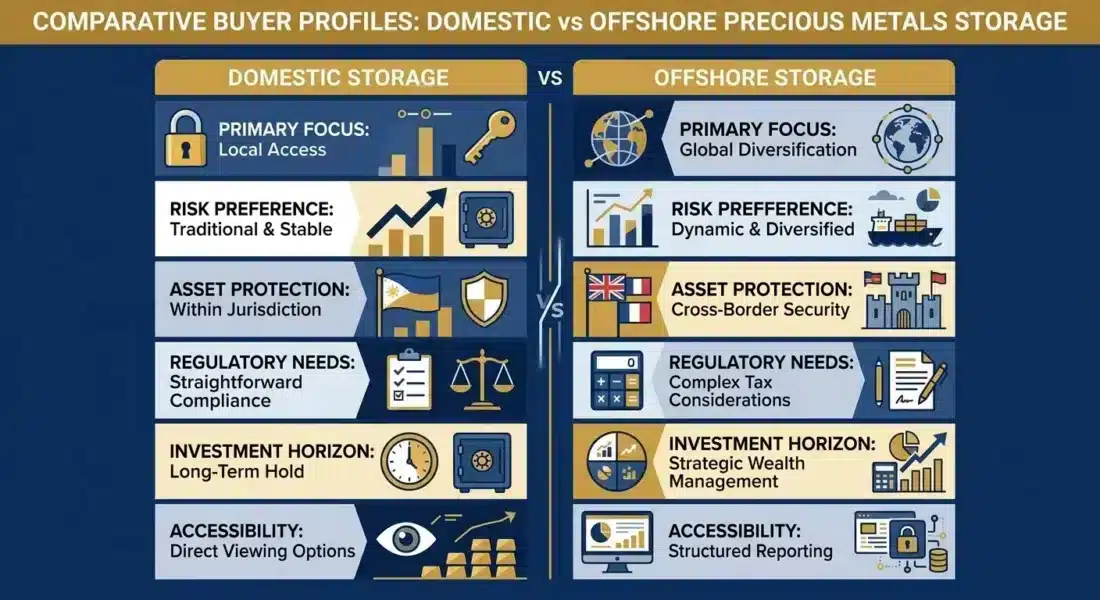
Are Offshore Storage Vaults Safer Than Domestic U.S. Depositories?
Offshore storage vaults and domestic U.S. depositories both secure physical gold and silver at an institutional level. The vault itself isn't the question. The legal structure surrounding it is.
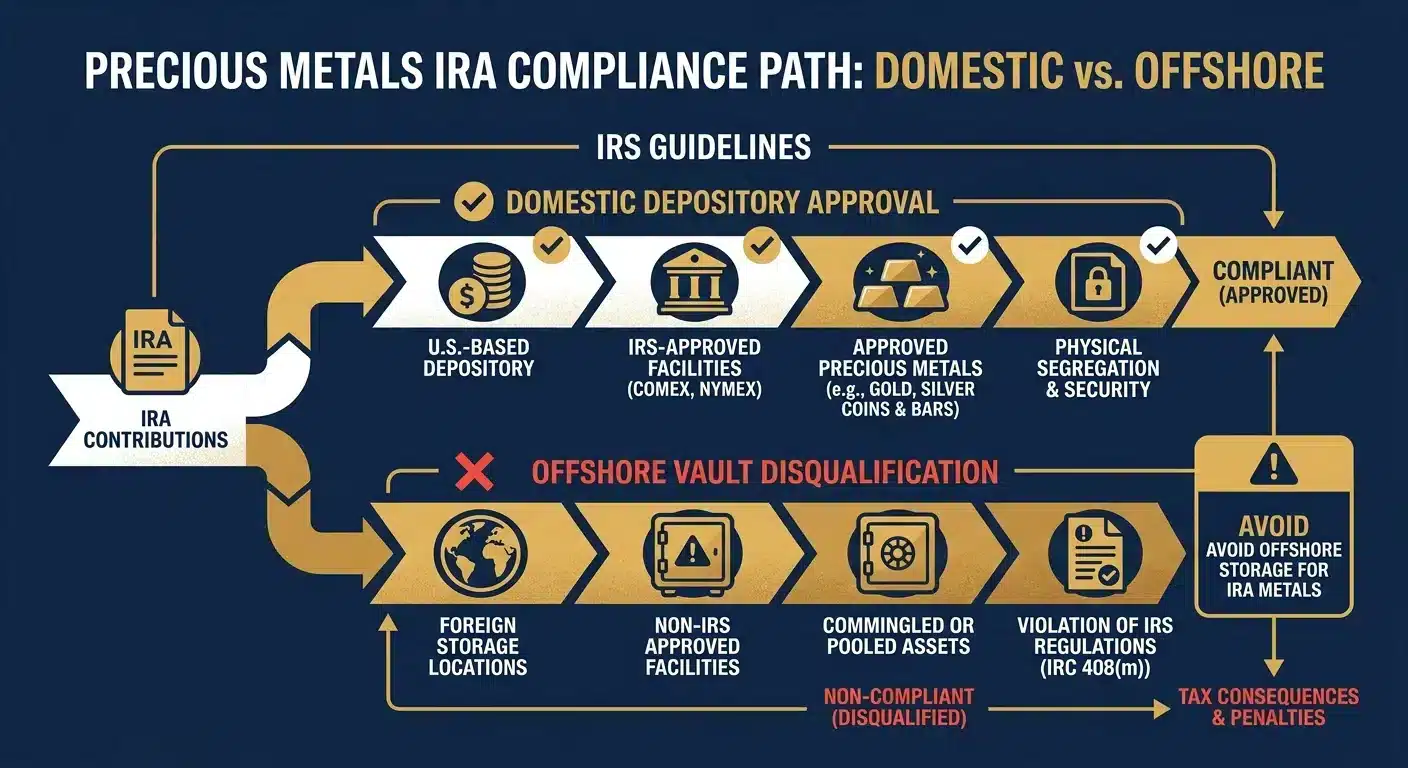
For metals held inside a self-directed IRA, there is no comparison to make. Under Internal Revenue Code Section 408(m)(3), physical precious metals in a self-directed IRA must be held by an approved trustee or a domestic U.S. depository. Offshore storage isn't a permitted option. Using one triggers distribution treatment — meaning taxes and potential penalties on the full account value.
For metals held outside an IRA — purchased directly for personal ownership — offshore vaults are legally available. But availability isn't the same as advantage. Offshore storage introduces foreign jurisdiction risk, repatriation complexity, and logistical barriers that don't exist with domestic depositories. Access delays, currency conversion requirements, and a foreign government's legal framework all stand between an owner and their metals when speed matters.
Domestic U.S. depositories hold metals in the owner's name, with clear legal title, inside a regulatory environment that is fully navigable. Audits run on domestic timelines. Disputes resolve under U.S. law. Liquidity — the ability to sell, transfer, or take physical possession — is direct.
Above-ground gold stocks reached approximately 212,582 tonnes globally, held across sovereign central banks, institutional vaults, and private depositories worldwide. The vaulting infrastructure is mature on both sides of this question. Institutional-grade security isn't what separates them.
What separates them is the legal, tax, and access structure surrounding the vault. For retirement-focused owners, domestic depositories deliver the compliance certainty and title clarity that offshore alternatives cannot match.
- The Industry Pitch for Offshore Vaults — and Why It Doesn't Hold Up
- IRS Rules, IRA Compliance, and Why Offshore Storage Is a Hard No for Retirement Accounts
- How Domestic U.S. Depositories Actually Work — and What They Guarantee
- When Offshore Storage Might Be Relevant — and Who It Is Actually For
-
Frequently Asked Questions About Offshore vs. Domestic Vault Storage
- Is storing gold in Switzerland safer than using a U.S. depository?
- Can I use an offshore vault for a self-directed Precious Metals IRA?
- What are the tax implications of moving gold to an offshore depository?
- What happens if a foreign country freezes assets held in an offshore vault?
- How does the physical audit process differ between domestic and international vaults?
- Domestic Depositories Are the Right Answer for Retirement-Focused Owners
The Industry Pitch for Offshore Vaults — and Why It Doesn't Hold Up

There's a pitch making the rounds in the precious metals space. It goes like this: domestic depositories are exposed to U.S. government overreach, dollar risk, and political instability. The smart move — the sophisticated move — is to hold your gold offshore, beyond the reach of any single jurisdiction.
It sounds like serious thinking. It's framed as the strategy that informed, forward-looking owners use to protect generational wealth. But the pitch is selling a version of safety that doesn't match what retirement-focused owners actually face — legally or practically.
Here's the right question: not whether an offshore vault is strong, but whether you're actually holding the key. When you look at what the offshore pitch leaves out — the IRS rules, the access barriers, the jurisdictional exposure — the key is often in someone else's hands.
Why the Offshore Pitch Sounds Compelling
The offshore pitch works because it speaks to real concerns. Owners who've spent decades building retirement savings are right to think carefully about systemic risk, dollar purchasing power, and the long-term stability of U.S. financial institutions. Those aren't paranoid questions. They're reasonable ones — and the offshore pitch knows exactly how to meet them.
Offshore vaults in Switzerland, Singapore, or the Cayman Islands carry a specific kind of credibility. The jurisdictions themselves do the selling — they signal political neutrality, banking secrecy, and distance from domestic volatility. For someone genuinely worried about what's next, that framing lands. It's designed to.
And some offshore vaulting operations are genuinely credible. Institutional-grade security is a real feature of the best facilities. But the vault itself isn't the problem. The problem is everything surrounding it — the legal structure, the access rights, the tax treatment once your metals cross a border — and whether any of that holds up against LBMA-compliant custody standards that serious owners should be demanding.
What the Offshore Marketing Leaves Out
Here's what the offshore pitch consistently leaves out — and it's not a footnote. For metals held inside a self-directed IRA, offshore storage isn't a strategic option. Under Internal Revenue Code Section 408(m)(3), the IRS requires IRA-held metals to remain in the physical possession of an approved domestic U.S. depository. Put them in a vault in Geneva, and the IRS doesn't call it international diversification. It calls it a distribution — full taxation on the account's value, plus potential penalties. The vault's reputation doesn't change the tax code.
For metals held outside an IRA, offshore storage is legally permissible. But the pitch rarely walks through what access actually looks like in practice. Foreign governments freeze assets. They restrict repatriation. They change the legal framework governing private gold ownership when political or economic pressure demands it. That's not speculation — that's the documented history of cross-border asset control under stress.
CFTC enforcement actions have targeted precious metals operators who misrepresented custody structures — including offshore arrangements — to deceive retirement purchasers out of hundreds of millions of dollars. FTC charges have been filed against operators who fabricated systemic domestic risks specifically to justify excessive storage markups, with older Americans as the primary targets. Fear-based urgency isn't just a marketing style. In the worst cases, it's the mechanism of fraud.
That gap — between the marketing story and the legal reality — is exactly what owners need to see clearly before they decide. The full structural comparison is in the breakdown of offshore vs domestic storage vaults. What gets sold as geographic sophistication often turns out to be a stack of barriers — legal, logistical, and tax-related — standing between you and the metals you thought you owned outright.
| Storage Type | Jurisdiction | IRA Eligible | Primary Risk Factor | Regulatory Oversight |
|---|---|---|---|---|
| Domestic U.S. Depository | United States | Yes — IRS-approved and required for IRA-held metals | Minimal — operates under established federal oversight with clear legal title | IRS, CFTC, and SEC regulatory frameworks |
| Offshore Vault (IRA account) | Foreign jurisdiction (e.g., Switzerland, Singapore) | No — triggers distribution treatment, taxes, and potential penalties | Critical — IRS disqualification of the account on full value | Foreign law governs; U.S. regulatory protections do not extend |
| Offshore Vault (personal / non-IRA ownership) | Foreign jurisdiction | Not applicable — metals held outside retirement account structure | High — foreign asset freeze risk, repatriation barriers, and jurisdictional law changes | Subject to foreign government policy; no U.S. regulatory recourse |
| Home or Bank Safe Deposit Box (personal) | United States | No — IRS prohibits personal possession of IRA-held metals | Moderate — no institutional oversight, limited insurance, FDIC does not cover contents | Minimal formal oversight; no chain-of-custody audit trail |
IRS Rules, IRA Compliance, and Why Offshore Storage Is a Hard No for Retirement Accounts
The offshore pitch lives at the marketing layer. The jurisdictions are real. The fears it plays to are real. But there's a layer underneath that the pitch almost never mentions — and for retirement-focused owners, that's the only layer that matters.
For metals held inside a self-directed IRA, offshore storage isn't a strategic option. It's a disqualifying one. The IRS rule doesn't bend for geography. It doesn't bend for vault reputation. It doesn't bend for how sophisticated the marketing argument sounds.
Start with what the IRS requires — and what happens when those requirements aren't met.
The IRS Domestic Depository Requirement Explained
Under Internal Revenue Code Section 408(m)(3), physical precious metals held inside a self-directed IRA must be in the physical possession of an approved trustee or a domestic U.S. depository. That's the rule — stated plainly. There's no carve-out for foreign vaults. There's no exception for politically neutral jurisdictions. No provision exists for offshore arrangements, regardless of how well-regarded the facility is.
That's where the vault metaphor breaks down. Metals sitting inside an impenetrable Swiss facility are still metals sitting inside an impenetrable Swiss facility. But if the custody structure doesn't comply with IRC Section 408(m)(3), the IRS doesn't recognize it as a valid IRA holding. The vault isn't the question. The key is. And that key isn't in your hands — it's in the hands of a tax liability.
The SEC's framework arrives at the same conclusion through a different door. SEC custody rules — specifically SEC Rule 206(4)-2 — require that registered investment advisers use qualified custodians. In practice, that structure channels institutional precious metals toward domestic chartered banking entities, not foreign facilities. That's not a conservative preference held by cautious regulators. That's the institutional consensus, built on the same foundational logic as IRC Section 408(m)(3). Domestic custody is the standard. Offshore arrangements sit outside it. Owners thinking through geographic diversification of storage need to separate the question of where metals are physically located from the question of whether that custody structure is legally compliant — because those are not the same question.
What Happens If You Store IRA Metals Offshore
If IRA-held metals end up in an offshore depository — whether through a misunderstanding of the rules or advice that glossed over them — the IRS treats the account as having taken a distribution. The full value of the metals becomes taxable income in the year the violation occurs. Not a portion. The full value.
Penalties stack on top of that tax bill — and how hard they hit depends on the account holder's age and account type. For someone who spent decades building a retirement account, this isn't a paperwork correction. It's a financial event that can reshape their entire retirement picture.
This is what the offshore pitch never walks through. It frames the vault's location as the safety variable. But for retirement-focused owners, the actual risk isn't geopolitical — it's a tax code violation hiding inside a storage strategy that sounds sophisticated. Storing metals offshore doesn't mean you're protecting your savings. It may mean you've triggered the loss of their tax-advantaged status entirely. That's the part of the story that doesn't make it into the brochure.
| IRA Compliance Factor | Domestic U.S. Depository | Offshore Vault | IRS Authority |
|---|---|---|---|
| Custody location requirement | Must be held in physical possession of an approved trustee or domestic U.S. depository | Foreign depository — does not satisfy IRC Section 408(m)(3) custody requirement | Internal Revenue Code Section 408(m)(3) |
| IRA-eligible status | Compliant — metals retain tax-advantaged IRA status | Non-compliant — IRS treats offshore holding as a disqualifying distribution | Internal Revenue Code Section 408(m)(3) |
| Qualified custodian framework | Domestic chartered banking structures satisfy qualified custodian mandates | Offshore vaults generally fall outside qualified custodian requirements | SEC Rule 206(4)-2 |
| Institutional custody standard | Aligns with SEC framework for registered investment advisers | Sits outside the regulatory consensus for institutional custody | SEC Rule 206(4)-2 |
How Domestic U.S. Depositories Actually Work — and What They Guarantee

Domestic U.S. depositories aren't the default because the industry settled on convenience. They're purpose-built — designed specifically to meet the legal, regulatory, and custody requirements that govern physical precious metals inside retirement accounts and private ownership.
That's where the vault metaphor lands. A domestic depository doesn't just hold your metals securely. It keeps the key in your hands. Title is clear. Jurisdiction is known. And the rules governing your access don't shift based on a foreign government's priorities or an international legal framework you can't easily work through.
One thing to clear up before going further: domestic depositories are not bank safe deposit boxes. Some owners treat those as equivalent options. They're not. The protections, insurance structures, and custody standards are in a different category entirely — and so are the gaps. If you're seriously evaluating any storage option, start by understanding the risks of storing gold in a bank safe deposit box.
Segregated vs. Commingled Storage
Now, the decision that actually matters in day-to-day ownership: segregated or commingled storage. That choice has direct implications for how clearly those metals are yours — and how unambiguous that title is when it counts.
Segregated storage means your specific metals — your coins, your bars, your rounds — are physically separated from every other owner's holdings. They sit in a designated space under your name. When an audit happens, your metals are identifiable as yours. There's no pooled position. No shared lot. No ambiguity about which physical units belong to which account.
Commingled storage pools metals of the same type and purity across multiple owners. You hold a documented claim to an equivalent quantity — not to specific physical units. That's a legitimate structure. It's widely used. But for owners whose primary concern is direct, unambiguous ownership of identifiable metals, commingled doesn't deliver that. Segregated does. The difference isn't technical — it's the difference between owning a specific thing and owning a claim to something equivalent.
Institutional Audit and Insurance Standards
Institutional domestic depositories operate under audit and insurance standards that most private vaults — and almost no overseas facilities — actually match. Major vaulting operators comply with London Bullion Market Association standards for physical bar purity verification and chain-of-custody documentation. That's not a marketing claim. It's a verifiable, auditable standard with defined protocols — and the documentation exists to back it up.
Insurance at institutional depositories is structured around precious metals custody specifically. Coverage terms, limits, and the claims process are all governed by domestic law. Disputes don't cross jurisdictions. You're not trying to enforce an insurance claim through a foreign legal system in a language you don't speak, under rules that don't prioritize your interests. That's not a small detail — that's the entire difference between a recoverable loss and an unresolvable one.
This is what domestic depositories actually deliver — not just physical security, but structural clarity at every layer that matters to a retirement-focused owner. The audit trail is verifiable. The insurance is enforceable. The title is yours. The vault isn't the question. The key is. And here, the key stays in your hands.
| Storage Feature | Segregated Account | Commingled Account | Relevance to IRA Owners |
|---|---|---|---|
| Physical title to specific metals | Yes — your exact coins, bars, or rounds are held under your name and identifiable by serial number or lot | No — you hold a documented claim to an equivalent quantity, not to specific physical units | Critical for owners who want unambiguous, direct ownership of identifiable metals inside their IRA |
| Audit traceability | High — your holdings are physically separated and independently verifiable during any inspection | Moderate — your claim is documented, but your metals are pooled with other owners of the same type and purity | Segregated storage provides a cleaner audit trail, which matters when IRS compliance documentation is required |
| Cost structure | Higher — dedicated physical space and individualized custody protocols carry a premium | Lower — pooled storage distributes overhead across multiple account holders | IRA owners should weigh the cost difference against the title clarity they need for long-term retirement planning |
| IRS compliance eligibility | Yes — fully compatible with IRC Section 408(m)(3) domestic depository requirements | Yes — fully compatible with IRC Section 408(m)(3) domestic depository requirements | Both structures satisfy IRS custody rules when held at an approved domestic depository; neither is disqualifying |
| Liquidity and access | Direct — specific metals are released under your name with minimal coordination required | Equivalent — your documented claim can be fulfilled from the pooled inventory without delay | Both structures support prompt access for distributions or exchanges; neither creates meaningful access friction |
| Insurance applicability | Coverage applies to your identifiable, separated holdings | Coverage applies to the pooled inventory against which your claim is held | Both structures carry institutional insurance governed by domestic law — disputes stay within a known, enforceable legal framework |
When Offshore Storage Might Be Relevant — and Who It Is Actually For
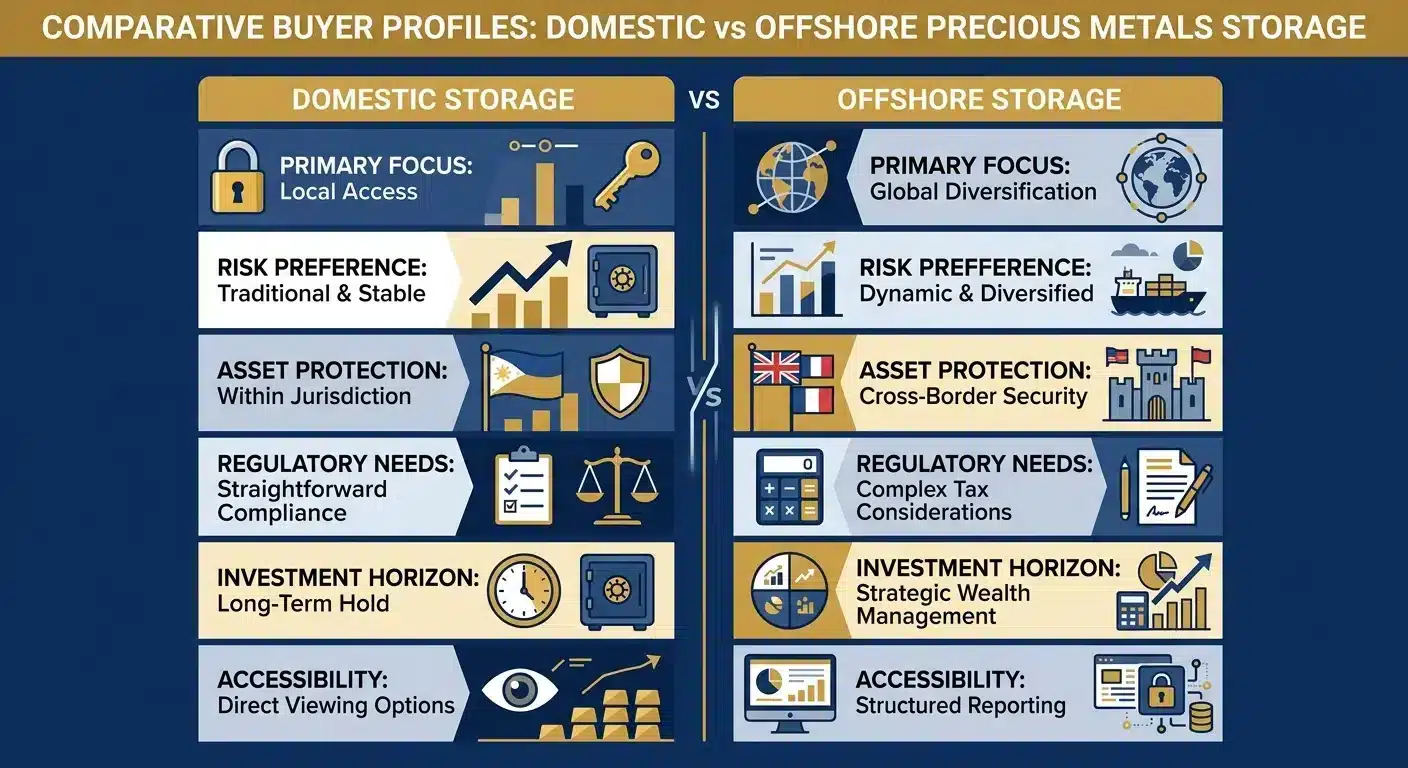
Here's the honest answer: offshore storage isn't inherently illegitimate.
For a very specific owner — someone with substantial international business interests, assets across multiple jurisdictions, and legal structures already built to operate across borders — an offshore vault can serve a real purpose. That purpose, however, has almost nothing to do with retirement savings or IRA compliance.
That legitimate use case is institutional. Think the high-net-worth individual or the family office with holdings spread across multiple countries — one that already has international tax counsel on retainer and custodial arrangements built from the ground up for cross-border complexity. For that profile, geographic diversification of physical holdings is a deliberate, professionally managed strategy. Not a response to an advertisement. And because verifying holdings across jurisdictions is materially harder than a domestic audit, knowing how to audit vaulted gold before you commit to any structure matters more than where the vault is located.
That profile is real. But it's a small one — and it looks nothing like the customer the offshore pitch typically chases. The marketing targets retirement-aged Americans worried about domestic risk, not international businesspeople with established cross-border legal frameworks. If you're evaluating offshore storage because an advertisement made domestic institutions sound dangerous, that's the marketing doing its job. It isn't a legitimate custody strategy doing yours. Brighton Gold's precious metals learning center exists precisely to close that gap — between what the pitch says and what the rules actually require.
The Anti-Persona: Who Offshore Storage Is Not For
So let's name the profile this conversation isn't for.
If you're considering offshore storage because you want to trade metals short-term, because an urgency-driven pitch convinced you that U.S. institutions are about to collapse, or because you're looking for a way around U.S. tax reporting requirements — offshore storage won't solve those problems. And Brighton Gold isn't the right fit for that conversation.
The CFTC has prosecuted precious metals custody fraud schemes involving hundreds of millions of dollars. The FTC has charged operators who fabricated domestic risk narratives specifically to push older Americans into excessive storage arrangements — offshore and otherwise. Fear-based urgency isn't a bold strategy. In the worst-documented cases, it's the mechanism that makes fraud possible.
Buyers who move from that place tend to discover the vault was never really theirs to begin with.
Brighton Gold works with customers who want to hold something real for the long haul — owners who care about title clarity, legal compliance, and what happens to their metals in their family's hands, not just in a bull market.
If the goal is a sophisticated geographic arbitrage play, or a strategy that sidesteps domestic legal frameworks, we're not the right fit. That's not a failure. It's a match problem. The customers we're built for are asking a different question entirely — not 'where can I hide this?' but 'how do I make sure I actually hold the key?'
| Owner Profile | Cash Purchase Outside IRA | Precious Metals IRA | Offshore Storage Compatible |
|---|---|---|---|
| Retirement-aged American with IRA assets | Compatible — domestic depository required by IRS | IRS-prohibited offshore; domestic depository only | Not compatible — triggers taxable distribution |
| Private cash purchaser, domestic focus | Compatible — domestic depository or home delivery | Not applicable | Legally permissible but adds complexity, cost, and jurisdictional risk with no structural benefit for most owners |
| High-net-worth individual with international assets and cross-border legal counsel | Compatible — offshore vaulting can serve a deliberate, professionally structured purpose | Not applicable — IRA assets must remain domestic | Compatible within a professionally managed multi-jurisdiction strategy |
| Family office with assets held across multiple countries | Compatible — offshore vaulting integrated into estate and tax planning structures | Not applicable — IRA assets must remain domestic | Compatible when legal and custodial frameworks are already built for cross-border complexity |
| Buyer responding to fear-based urgency marketing | Legally permissible but decision is driven by pitch, not strategy — title clarity and access rights are the variables that matter | IRS-prohibited offshore — marketing claims do not change the tax code | Not compatible with a sound ownership strategy — the marketing rationale isn't a legitimate custody rationale |
Frequently Asked Questions About Offshore vs. Domestic Vault Storage
Some questions don't fit inside a table. They're the ones you're still sitting with after the reading is done. Here are the straight answers.
The goal here isn't to close anything. It's to make sure you have a clear picture before you make a decision that touches your retirement savings for years.
Is storing gold in Switzerland safer than using a U.S. depository?
Switzerland's reputation for financial privacy and institutional stability is real. It's earned. But reputation doesn't transfer into legal title clarity for a U.S. retirement owner — and that's the gap the marketing skips.
For a self-directed Precious Metals IRA, Internal Revenue Code Section 408(m)(3) requires that metals stay in the custody of an approved trustee or a domestic U.S. depository. A Swiss vault doesn't satisfy that requirement. Full stop. The vault's security rating doesn't change what the IRS calls the custody structure.
For metals held outside an IRA — cash purchases, personal holdings — Swiss storage is legal. But it introduces foreign jurisdiction exposure, complex tax reporting obligations under FBAR and FATCA, and access friction that domestic depositories don't carry.
The question was never whether Switzerland's vaults are secure. The question is whether your key works from where you're standing. For most retirement-focused owners, it doesn't.
Can I use an offshore vault for a self-directed Precious Metals IRA?
No. The IRS isn't ambiguous on this.
Internal Revenue Code Section 408(m)(3) requires that physical precious metals held inside a self-directed IRA stay in the physical possession of an approved trustee or a domestic U.S. depository. An offshore vault — regardless of reputation, security rating, or audit credentials — doesn't meet that requirement.
Storing IRA-held metals offshore triggers a deemed distribution. The full account value becomes taxable income in the year the violation occurs. Under 59½? Early withdrawal penalties stack on top.
This isn't a gray area. It can't be structured around with the right paperwork or a carefully worded agreement. If a dealer tells you offshore storage works inside your Precious Metals IRA, that's a compliance risk — not a sophisticated strategy.
What are the tax implications of moving gold to an offshore depository?
The tax implications are serious — and offshore marketing rarely puts them front and center.
If metals inside an IRA move to an offshore depository, the IRS treats that as a taxable distribution. The entire fair market value becomes ordinary income the year it happens. Penalties may apply on top.
For metals held outside an IRA, it's different — but not simple. U.S. persons must report foreign financial accounts under FBAR rules when aggregate balances exceed applicable thresholds. FATCA reporting obligations may also apply. Neither requirement is a reason to avoid international estate planning altogether. Both are reasons to have a CPA and a tax attorney involved before anything crosses a border.
Brighton Gold doesn't provide tax or legal advice. What we do is make sure customers know these questions exist before making a decision that's hard to reverse.
What happens if a foreign country freezes assets held in an offshore vault?
That depends entirely on the jurisdiction. And that uncertainty is the risk — not some hypothetical attached to worst-case scenarios.
A foreign government's authority over assets held within its borders is real and enforceable. In jurisdictions with strong rule of law, a freeze or confiscation may be remote. But remote isn't impossible. And your ability to contest that action as a U.S. citizen is limited in ways that simply don't apply domestically.
You'd be working through a foreign legal system. Foreign language. Foreign timelines. No guarantee that U.S. diplomatic pressure moves things in your favor — or fast enough to matter.
The FTC has charged precious metals operators who fabricated domestic risk scenarios specifically to make this kind of foreign exposure sound preferable — targeting older Americans with exactly those arguments. The honest comparison runs the other direction: domestic depositories operate under U.S. law, in U.S. courts, with enforcement mechanisms you can actually reach.
How does the physical audit process differ between domestic and international vaults?
Domestic depositories maintain auditable, verifiable chain-of-custody documentation. Reviewing it doesn't require crossing a border — or navigating a foreign bureaucracy.
Major vaulting operators comply with London Bullion Market Association (LBMA) standards for physical bar purity verification. Reputable domestic facilities build those same protocols into their custody structures as a baseline. Not a premium feature. Not an upgrade tier. The floor.
For a U.S.-based owner, requesting an audit on a domestically held position is governed by domestic law. That same request directed at an international facility introduces language barriers, foreign regulatory timelines, and jurisdictional complexity that simply don't exist with a domestic provider.
With segregated storage — where your specific metals are physically separated and identified — the verification process is especially clean. Your metals are yours. The documentation confirms it. The audit reinforces it. That level of clarity gets harder to achieve across an international boundary. And harder to enforce if something goes wrong.
Domestic Depositories Are the Right Answer for Retirement-Focused Owners
The vault was never the question. The key is.
Most offshore facilities are physically sound. That's not the argument. The argument is whether you actually hold the key — legally, structurally, and in practice. For retirement-focused owners, one answer holds up: a domestic U.S. depository. Title is clear. Jurisdiction is known. Internal Revenue Code Section 408(m)(3) isn't a technicality to engineer around. It's the foundation the entire structure stands on — and no amount of geographic sophistication changes that.
Offshore storage as a retirement strategy isn't sophisticated. It's a compliance risk dressed in the language of independence.
The pitch sells geography as safety. But geography is the least important variable in this decision. What matters is whether your legal title is intact. Whether your tax-advantaged status survives the structure. Whether your access to your own metals depends on a foreign government's current priorities — or on nothing at all.
Domestic depositories deliver all three. For IRA holders, offshore arrangements deliver none of them. That's not a close call.
Brighton Gold works with owners who want to hold something real. Something with a clear chain of title. A verifiable audit trail. A structure their family can actually access when it matters — not when a foreign jurisdiction decides to permit it.
If that's where you are, the path is straightforward. A complimentary consultation walks you through how a domestic depository works, what the No Fee Precious Metals IRA looks like in practice, and whether the structure fits your situation. No urgency. No pressure.
The vault isn't the question. The key is. The only thing left is making sure yours is in the right hands — in vaulted storage you can actually stand behind.
You've done the research. You know the difference between domestic clarity and offshore complexity. The next question is whether your current custody setup actually holds up — or whether it's built on assumptions you've never tested.
Brighton Gold offers a complimentary consultation to walk you through what domestic custody looks like in practice — including how the No Fee Precious Metals IRA works and whether it fits your situation.
No pressure. No pitch. Just a straight answer about whether your metals are where they should be.