

What Is a Chain of Custody and Why Does It Matter for Gold?
A chain of custody for physical gold is the documented, unbroken record of every hand a piece of metal passes through — from the mine where it was extracted, through the refinery, through the dealer, and into the vault or home where it is held.
It is the verification trail that proves a specific bar or coin is exactly what it claims to be: genuine, untampered, and legitimately owned.
For gold owners, chain of custody is not a bureaucratic formality. It is the foundation of what physical ownership actually means.
Gold without a verifiable custody record is gold whose history cannot be confirmed. That uncertainty affects resale value, storage acceptance, and the long-term confidence of anyone holding it.
The institutional framework behind this is substantial. The London Bullion Market Association and the World Gold Council launched the Gold Bar Integrity program to digitize gold bar supply chains and track provenance from mine to final vaulted storage. The LBMA's Responsible Sourcing Program requires 100% compliance from all accredited refiners and systematically verifies mining origin coordinates. The World Gold Council's responsible sourcing framework establishes 10 specific principles of responsible gold mining and mandates third-party assurance for mining companies tracking physical inventory. Global bullion markets use a synchronized ledger system — including a pilot blockchain that tracks individual physical bar serial numbers — to verify purity and block counterfeit bullion from entering institutional exchanges.
For U.S.-minted coins specifically, the United States Mint operates under strict federal regulations to guarantee the weight, gold content, and purity of every coin it produces. That government backing gives U.S.-minted products a distinct provenance advantage in custody tracking that foreign alternatives do not carry.
The Federal Trade Commission advises gold buyers to independently verify the storage and physical delivery arrangements of any retail metal purchase. That guidance reflects a practical reality: a gold purchase is only as secure as the custody arrangement protecting it.
Physical gold is only as trustworthy as the hands it passed through. A sealed, documented custody record is the difference between verified wealth and a claim that can never be fully proved.
- What Chain of Custody Actually Means for Physical Gold
- How the Global Gold Supply Chain Actually Works
- U.S.-Minted Coins and the Custody Advantage
- What Verified Custody Looks Like in Practice
-
Frequently Asked Questions About Chain of Custody for Gold
- What does chain of custody mean for physical gold?
- How do I verify that vaulted gold has a certified chain of custody?
- Why are U.S.-minted coins easier to track through the supply chain than foreign bullion?
- What is the risk of buying physical gold without a verified chain of custody?
- How does Brighton Gold secure custody of physical metals during transit and after delivery?
- Custody Is the Ownership
What Chain of Custody Actually Means for Physical Gold

When you acquire physical gold, you're not just acquiring metal. You're acquiring a history — and if that history can't be verified, the metal's legitimacy can't be either.
Chain of custody answers one question: can you prove, at any point, exactly where this gold came from, who handled it, and how it arrived in your possession? If yes — you own something verifiable. If no — you're holding something on faith.
That's not a technicality. A broken custody record means your ownership is defensible only until someone challenges it — and at that point, you're arguing from memory, not from documentation. That's what secure storage physical integrity actually protects against — not just theft, but the inability to prove what you hold.
The Definition That Changes How You Think About Ownership
Most ownership conversations start in the wrong place. Buyers ask about spot price. About delivery timelines. About whether silver or gold makes more sense right now. They rarely ask the one question that matters most over time: who held this metal before me — and how do I know?
Here's the definition that changes how you think about this. A chain of custody is the complete, unbroken, documented sequence of transfers from the point of production to the point of storage. Every transaction. Every transfer of physical possession. Every custodian in between.
When that sequence is intact and verifiable, the metal's legitimacy isn't a matter of trust — it's a matter of record. When it isn't, you're left with a claim you can't fully prove.
That's why U.S.-minted coins carry a real advantage here. The United States Mint operates under strict federal regulations — weight, gold content, purity, all of it backed by the full authority of the federal government. That's not marketing language. That's statutory. The U.S. Mint’s coin and medal programs document the full scope of these federal standards — provenance starts clean, at the source, under government oversight that no private refiner can replicate.
Why Most Buyers Never Think to Ask About Custody
Most buyers don't ask about custody because nobody told them to. They ask about price. Delivery time. Whether the coin ships in a protective case. The documented trail of every hand that touched the metal before theirs? That's not something most dealers volunteer.
That silence has a cost. The Federal Trade Commission warns gold buyers to independently verify the storage and physical delivery arrangements of any retail metal purchase — not because most transactions go wrong, but because when they do, buyers who didn't ask are left with no recourse. The gap between what you assume you've confirmed and what you've actually confirmed is exactly where custody problems live. The FTC didn't publish that guidance to fill a page. They published it because buyers got burned.
The Federal Trade Commission's rules require dealers to disclose delivery timelines clearly. Specific filing guidelines exist for reporting unauthorized custodian transfers. Those aren't hypothetical edge cases — they're responses to real failures, situations where buyers didn't ask the right questions before the transaction closed and had nothing to stand on afterward. The questions exist. Ask them before you buy.
Physical gold is a long-term decision. The documentation behind it needs to be just as durable as the metal itself. Custody records aren't paperwork for paperwork's sake — they're the evidence that your ownership holds up when it's tested. And at some point, it will be tested. IRS required minimum distribution worksheets illustrate exactly this principle: the documentation behind an asset determines what you can legally claim and defend over time.
| Custody Stage | Who Is Responsible | What Gets Verified | Risk If Skipped |
|---|---|---|---|
| Mining and Refining | Mine operator and accredited refiner | Origin coordinates, conflict-free sourcing, purity level, and refinery accreditation status | Metal enters the supply chain with no verifiable source — legitimacy is assumed, not confirmed |
| Minting and Fabrication | Government mint or private fabricator | Weight, metal composition, and purity against statutory or industry standards | Bar or coin specifications can't be independently verified — buyer relies entirely on seller's word |
| Wholesale and Dealer Transfer | Wholesale distributor and retail precious metals dealer | Transfer documentation, serial numbers, and continuity of physical possession between parties | Gaps in the transfer record create questions about whether the metal is the same piece that left the mint |
| Shipping and Transit | Insured carrier and receiving custodian | Secure packaging, insurance coverage, tracking records, and confirmation of receipt | Unverified transit creates exposure to loss, substitution, or damage with no documented accountability |
| Storage and Vaulting | Approved depository or custodian | Segregated or allocated storage confirmation, ongoing audit trails, and owner-of-record documentation | Without verified storage records, the owner can't confirm the metal held in their name is physically present and intact |
How the Global Gold Supply Chain Actually Works
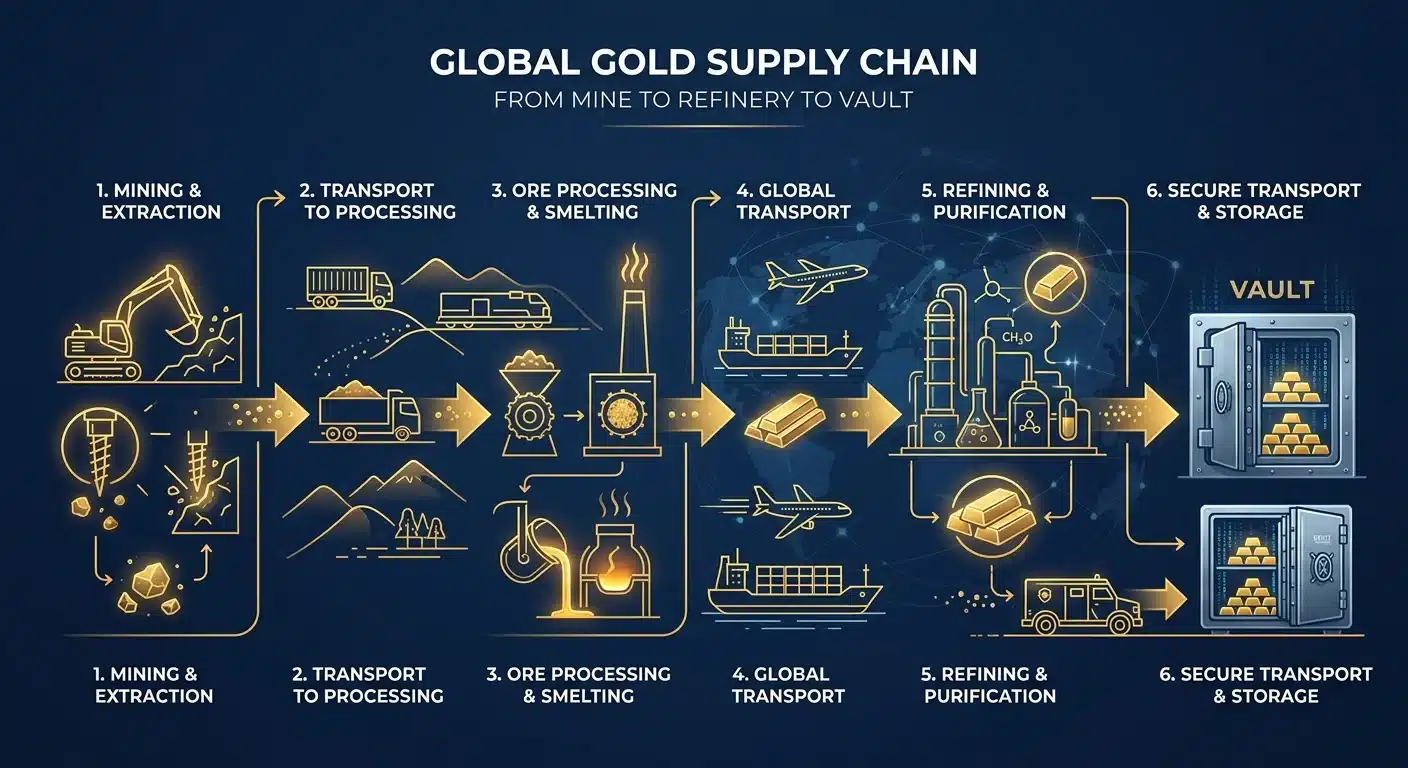
Physical gold doesn't arrive in a vault fully formed. It travels — sometimes across continents, through multiple hands, under varying degrees of oversight — before it reaches the owner who holds it long-term.
That journey is what makes chain of custody more than a compliance term. It's the operational reality of what physical ownership actually requires.
The global gold supply chain has a defined structure — and verification checkpoints built into it at every major transition point.
When those checkpoints hold, the metal arriving in your vault is exactly what it claims to be. When they don't, the gap doesn't announce itself. It just sits quietly in the documentation, unverifiable.
Understanding that structure isn't academic. It's what separates owners who can prove what they hold from buyers who are running on assumption.
And assumption is where custody problems begin.
From Mine to Refinery: The First Critical Handoff
The first handoff happens the moment raw ore leaves the mine and enters a refinery. That's where gold transforms from a natural material into a standardized product — and where the first documented custody record is supposed to be established.
Whether it actually is depends entirely on the refinery's compliance standing. Not the dealer's assurance. Not the seller's word. The refinery's.
The World Gold Council's responsible sourcing framework establishes 10 specific principles of responsible gold mining and mandates third-party assurance for companies tracking physical inventory.
That requirement exists because self-reporting at the mine level isn't sufficient. Provenance has to be independently verified before a bar can enter the institutional supply chain with a clean record. No third-party sign-off means no clean starting point — regardless of what the paperwork says.
For U.S.-minted coins, the first handoff looks different — and more defensible. Federal statutory requirements govern where the metal comes from and how it's processed before it ever becomes a coin.
That government backstop doesn't eliminate custody considerations further down the chain. But it does mean the provenance starts clean, at the source, under a level of oversight that privately minted products can't replicate. That's a real distinction — not a marketing claim.
LBMA Good Delivery and the Institutional Verification Standard
Once gold leaves the refinery, it enters the institutional market — and that's where the LBMA's Good Delivery standard functions as the primary verification threshold. The LBMA and the World Gold Council launched the Gold Bar Integrity program in March 2022 specifically to digitize gold bar supply chains and track provenance from mine to final vaulted storage.
Good Delivery bars carry documented weight, purity, and origin. The LBMA's Responsible Sourcing Program requires 100% compliance from all accredited refiners — with systematic verification of mining origin coordinates. That's not a best-practice recommendation. It's a condition of market access.
The LBMA and the World Gold Council didn't stop at documentation standards. They built enforcement infrastructure behind them. A pilot blockchain now tracks individual physical bar serial numbers — designed specifically to block counterfeit or illicit bullion from entering institutional exchanges.
Every bar moving through a major financial center should have a verifiable identity. Not a paper receipt that follows the transaction. A documented record that follows the metal.
This is the institutional standard. Rigorous, multilayered, and built on the recognition that physical gold's value is inseparable from its provenance.
The question every owner should ask isn't whether these systems exist — it's whether the dealer they're working with operates inside them. That's where concierge vaulting becomes a meaningful distinction, not a service upgrade.
Where Custody Breaks Down — and What It Costs the Buyer
Custody doesn't break down at the refinery.
It breaks down at the retail level — in the gap between institutional standards and the experience of the individual buyer who never knew those standards existed.
Most retail gold purchases don't come with a custody briefing. The buyer gets a product, a certificate, and an assumption that everything before it was handled correctly.
That assumption is often reasonable. But "often reasonable" isn't the same as verifiable — and for long-term physical ownership, verifiability is what matters. The Federal Trade Commission is direct about this: buyers should independently verify the storage and delivery arrangements of their purchase before the transaction closes, not after.
The cost of a custody gap isn't always immediate. It shows up later — when a dealer can't verify the metal's origin at resale, when a storage facility won't accept bars with incomplete documentation, or when a transfer to a new custodian requires history that was never captured.
Just as IRS Publication 590-B governs what retirement account owners are obligated to document over time, custody documentation governs what physical gold owners can actually prove they hold. Ownership without documentation is ownership you can't fully defend.
This is the practical case for treating chain of custody for gold as a priority from day one — not something to sort out after the metal is already somewhere.
Physical gold is only as trustworthy as the hands it passed through. When the record of those hands is intact, what's sitting in the vault is verified wealth. When it isn't, you're holding something you can't fully prove.
| Supply Chain Stage | Verification Body | What Is Checked | LBMA Compliance Required |
|---|---|---|---|
| Mining & Extraction | World Gold Council (WGC) | Environmental, social, and governance compliance; third-party assurance of physical inventory tracking | Yes — 10 principles of responsible gold mining mandated |
| Refining | LBMA Responsible Sourcing Program | Anti-money laundering compliance; conflict-free sourcing verification; mining origin coordinates | Yes — 100% compliance required for all accredited refiners |
| Institutional Market Entry | LBMA / World Gold Council — Gold Bar Integrity Program | Provenance digitization; bar-level supply chain tracking from mine to final vaulted storage | Yes — GBI program initiated March 2022 to track gold bars across the supply chain |
| Bullion Market Transfer | Global Bullion Exchanges / Synchronized Ledger System | Individual bar serial number verification; screening to block counterfeit or illicit bullion from institutional exchanges | Yes — blockchain ledger tracks individual physical bar serial numbers |
| Vaulted Storage | LBMA / Custodian Facility | Final custody record confirming provenance from mine to vault; bar identity matched to documented chain | Yes — GBI program designed to complete the chain from mine to final vaulted storage |
U.S.-Minted Coins and the Custody Advantage

Here's what most buyers skip right past: Federal standards governing U.S. Mint production lock down every dimension of what goes into a coin — where the metal originates, how it's manufactured, and how the final product's weight, gold content, and purity get verified. That's not a dealer's assurance. That's a statutory requirement backed by the full authority of the federal government. No private seller can make that claim.
And for anyone who cares about provenance — every serious long-term owner should — that distinction cuts deep. The custody record for a Gold American Eagle doesn't start with a dealer's invoice. It starts at the Mint, under federal oversight, before the coin ever touches the commercial supply chain.
A shorter chain is a cleaner chain. Every additional hand a piece of metal passes through is another point where documentation lapses, provenance blurs, and verification becomes a matter of trust rather than record. U.S.-minted coins reduce that exposure at the structural level — not because any particular dealer is more careful, but because the government backstop at origin removes the most uncertain part of the custody equation before the transaction even begins.
Why Federal Standards Create a Shorter, Cleaner Chain
Federal oversight at the production level does something no privately minted product can replicate. It establishes provenance that doesn't depend on any single custodian's record-keeping. The metal's origin, composition, and purity are documented by the issuing government — not the seller. That distinction doesn't fade with each transfer. It's embedded in the coin from the moment it leaves the Mint.
So when you're thinking about secure storage for physical wealth, what goes into the vault matters as much as the vault itself. A coin whose origin is federally verified arrives with a custody record that's already clean. That's the starting condition every subsequent custodian inherits. It's why U.S.-minted products are the standard at Brighton Gold — not a preference, a baseline.
The LBMA's Responsible Sourcing Program demands 100% compliance from all accredited refiners and mandates systematic verification of mining origin. That standard exists so institutionally traded bars can be traced back to their source. U.S.-minted coins don't require a private refiner to clear that bar — the federal manufacturing process already exceeds it. Fewer verification layers are needed because the government doesn't leave provenance to self-reporting.
Foreign Bullion and the Verification Gap
Foreign bullion isn't inherently suspect. Some internationally minted products carry strong provenance records and meet rigorous institutional standards. But those standards are external and applied after the fact — layered onto the product once it leaves the refinery, rather than built into the production process by statutory requirement. That's the distinction. And it's the one that matters when you're trying to verify what you own rather than trust what you were told.
The LBMA's Good Delivery framework is genuinely rigorous — 100% compliance required for all accredited refiners, with systematic origin verification built in. But those controls operate at the institutional level. The moment a bar moves from an institutional exchange into the retail market, the chain of custody it carries is only as reliable as that retail dealer's own documentation practices. That's where the gap opens. And most buyers never think to ask what's on the other side of it.
For U.S.-minted coins, that gap is narrower from the start. The federal statutory requirements governing metal sourcing don't disappear when the coin changes hands — they're embedded in the object itself, verifiable by any dealer, depository, or future buyer who examines the coin's markings. Foreign bullion asks you to trust the documentation that traveled with it. A Gold American Eagle asks you to trust the United States government's production standards. Those are not the same proposition.
Who This Approach Is Not For
This approach isn't the right fit for every buyer. If you're shopping for the lowest price on generic gold bars and provenance history isn't part of the equation, we're not describing what you want. We won't pretend we are.
Buyers focused purely on price-per-ounce — who want to move fast on a transaction without working through custody documentation — aren't the customers this model is built for. Brighton Gold's concierge approach means slower, more deliberate transactions where provenance is part of every conversation. That's the tradeoff. It's real, and we're transparent about it.
What we work with are owners who understand that physical gold is only as trustworthy as the hands it passed through — and who want confirmation, not assumption, that every link in that chain is intact before the metal reaches their vault. For those owners, the federal backing of U.S.-minted coins isn't a premium feature. It's the baseline expectation. And it's where a verifiable custody record either begins cleanly — or doesn't begin at all.
| Attribute | U.S.-Minted Coins (Gold American Eagle) | Foreign Bullion | Why It Matters for Custody |
|---|---|---|---|
| Provenance Origin | Established at the U.S. Mint under federal statutory requirements — before the coin enters commercial supply | Established by a private refinery, then verified through external institutional frameworks applied after production | Government-origin provenance doesn't depend on any single custodian's record-keeping — it's embedded in the object itself |
| Purity & Weight Guarantee | Backed by the full authority of the federal government — statutory, not contractual | Backed by the refinery's own assay and, where applicable, third-party certification from institutional programs | Statutory guarantees are verifiable by any dealer or depository; refinery guarantees require trusting the documentation that traveled with the bar |
| Chain Length (Number of Verification Points) | Shorter — federal oversight at production removes the most uncertain custody link before any commercial transaction begins | Longer — typically requires additional verification layers once the bar moves from institutional exchange into retail distribution | Every additional hand a piece of metal passes through is another point where documentation can lapse and provenance can blur |
| Retail Verification Ease | Coin markings are recognizable and verifiable by any dealer, depository, or future buyer without specialized documentation review | Verification relies on accompanying documentation — certificates, assay cards, refinery records — that must be intact and credible | A custody record embedded in the object itself is more durable than one that exists only in paperwork |
| Transfer Readiness | Federal backing persists through every subsequent transfer — the provenance claim doesn't weaken as the coin changes hands | Provenance reliability depends on the quality of documentation passed along at each transfer point | Long-term owners who anticipate future resale or custodian transfers benefit from provenance that doesn't require reconstruction |
| IRA Eligibility & Custodian Acceptance | Broadly accepted by IRA custodians and approved depositories — provenance and purity meet regulatory thresholds by design | Eligibility varies by product; some foreign bullion qualifies, but acceptance depends on meeting specific purity and sourcing criteria | Custody documentation that satisfies regulatory requirements from the point of production simplifies every downstream institutional interaction |
What Verified Custody Looks Like in Practice

Verified custody isn't a concept. It's a sequence.
Every handoff documented. Every transfer traceable. The record starts the moment a purchase is confirmed — and it doesn't stop until the metal is vaulted in the owner's name.
The LBMA and the World Gold Council didn't build the Gold Bar Integrity program as a paperwork exercise. They built it because provenance claims without documentation trails aren't provenance — they're assertions. Their registry, initiated in March 2022, tracks gold bars from mine to final vaulted storage, creating a ledger that follows the metal, not just the transaction.
That's the institutional model. What verified custody looks like at the retail level should reflect the same logic.
The Federal Trade Commission doesn't hedge on this. Buyers are responsible for independently verifying the storage and physical delivery arrangements of their purchases.
That's not fine print buried in a disclosure. It's a recognition that custody integrity can't be assumed — it has to be confirmed, at every stage, with documentation that holds up.
The Closed-Loop Protocol: From Purchase to Vaulted Storage
A closed-loop custody protocol means nothing moves without a record.
From purchase confirmation through insured transit carrier to approved depository — every handoff is documented in sequence. The owner doesn't inherit a gap-filled paper trail. They inherit a clean one.
Brighton Gold's concierge model is built around that sequence. Each handoff in the custody chain is handled, verified, and communicated — not assumed.
Owners receive confirmation as the metal moves. Not a single notification when it arrives — confirmation at each stage. The difference between those two experiences is the difference between a custody record and a custody hope.
How metals are held at the depository matters as much as how they arrive. Storage structure determines whether an owner can point to a specific bar or coin as theirs — or whether they hold an interest in a commingled pool no one can individually identify.
For owners who care about verifiable custody, that's not a preference. It's a foundational question that needs an answer before anything goes into a vault. That's the conversation that starts with segregated and non-segregated storage.
What to Expect During Transit and Delivery
Transit is where custody chains break most often.
It's also where the least documentation typically exists. A responsible dealer treats transit as an active custody stage — not a gap between purchase and delivery.
Insured, fully tracked shipping is the baseline. But the documentation that travels with the shipment — serial numbers, weight verification, the chain-of-custody form recording who released the package and who received it — is what makes transit a custody record rather than a custody gap.
Global bullion markets recognized this when they piloted a blockchain system to track individual physical bar serial numbers, specifically to prevent documentation gaps at the point of transfer. That's not an industry curiosity. It's an acknowledgment that the transit handoff is where provenance is most at risk.
Buyers acquiring metals through a Vaulted Storage arrangement bypass transit risk entirely. The metals move directly from dealer to depository — without passing through the owner's hands.
That's not a convenience feature. It's a custody design decision. When metals never leave an institutional custody environment, the documentation chain stays unbroken from purchase to vault. No gap. No assumption. No moment where the record depends on a shipment that hasn't arrived yet.
Vaulted Storage and the Long-Term Custody Record
Long-term custody is where the record either earns its value or quietly loses it.
Every year with clean, complete documentation makes the metal easier to transfer, resell, or pass to the next generation. Every year with gaps makes those same actions harder to execute cleanly.
A depository that issues regular, independently verified account statements — confirming the specific metals held, their serial numbers where applicable, and the owner's title — isn't just providing storage. It's maintaining the custody record in real time.
The parallel is direct. Just as IRS Publication 590-A sets the documentation standards that protect the status of retirement account contributions, a reliable depository sets the standard that protects the verifiable status of an owner's physical holdings. What you can prove is what you can defend.
Physical gold is only as trustworthy as the hands it passed through.
When every link in that chain is documented — from federal mint to insured transit to verified depository — the metal in the vault is genuinely, demonstrably yours. That's not a promise. It's what verified wealth looks like when custody is treated as a continuous obligation rather than a one-time transaction.
| Custody Checkpoint | Responsible Party | Documentation Required | What Brighton Gold Provides |
|---|---|---|---|
| Purchase Confirmation | Dealer (Brighton Gold) | Signed purchase agreement, product description, serial numbers where applicable, agreed delivery or vaulting arrangement | Written confirmation of every transaction detail before metals move — no assumption, no ambiguity |
| Insured Transit | Licensed carrier under dealer oversight | Chain-of-custody form recording release party, receiving party, weight verification, and insured value at each handoff | Active monitoring of the transit stage as a custody period — not a logistics gap between purchase and arrival |
| Depository Intake | Approved third-party depository | Intake receipt confirming specific metals received, serial numbers logged, and owner title established at the account level | Verification that metals entered the depository under the owner's name — not commingled or held in a general account without attribution |
| Ongoing Vaulted Storage | Approved depository with independent auditing | Periodic account statements confirming metals held, owner title, and specific holdings — independently verified where applicable | Communication at each stage of custody so owners hold a living record, not a single arrival notification |
| Segregated vs. Non-Segregated Allocation | Depository, in coordination with dealer guidance | Documentation specifying whether the owner holds title to specific, individually identifiable metals or an interest in a commingled pool | Guidance on the custody implications of each storage type before the decision is made — not after the metals are already vaulted |
| Transfer, Resale, or Inheritance | Owner, dealer, and depository acting in coordination | Complete, unbroken custody record from original purchase through every subsequent handoff — traceable and presentable to any future buyer, estate, or institution | A custody record built to hold up over time — clean documentation that makes transfer, resale, or legacy transfer straightforward rather than contingent on memory or incomplete records |
Frequently Asked Questions About Chain of Custody for Gold
The mechanics make sense on paper. But here's what buyers actually want to know: what does a custody failure cost them — and can the dealer they're working with prove anything at all?
Here are the questions worth answering directly — especially the ones that come after the purchase, when the metal is already vaulted and the owner wants to know if the record they were handed actually holds up.
What does chain of custody mean for physical gold?
It's the documented sequence of verified handoffs that tracks metal from its point of origin — a federally regulated mint or accredited refinery — through every transfer until it reaches the owner's vaulted storage.
Each link in that chain is a recorded event. Who held the metal. Who released it. Who received it. Under what verified conditions.
When that sequence is intact and complete, the metal's provenance, purity, and ownership history can be confirmed at any point — by the owner, a future buyer, or an estate executor. When it isn't, one or more of those handoffs exists only as an assumption.
And assumption, in physical gold ownership, is where custody problems begin.
How do I verify that vaulted gold has a certified chain of custody?
Start with the depository. A credible, approved depository issues account statements that name your specific holdings — serial numbers included where applicable — and confirms title in your name. That document is the foundation of your custody record.
Then work backward. Ask your dealer for the transit documentation: the chain-of-custody form that records who released the package, who received it, and the weight and serial verification that traveled with the shipment.
The Federal Trade Commission is direct about this: buyers are responsible for independently verifying the storage and physical delivery arrangements of their own purchases. That guidance exists because custody verification isn't passive — it's something you confirm, not something you assume.
If the dealer can't produce sequential documentation for every stage, that gap is worth resolving before it compounds into something harder to fix.
Why are U.S.-minted coins easier to track through the supply chain than foreign bullion?
U.S.-minted coins like the Gold American Eagle are manufactured under strict federal statutory requirements governing how metal is sourced and processed — with composition backed by the full authority of the United States government.
That federal backing isn't just a quality mark. It's built-in provenance verification that travels with the coin regardless of how many times it changes hands. Any dealer, depository, or future buyer can confirm a U.S.-minted coin's authenticity against known federal production standards — without relying on third-party documentation that may not have survived the intervening transfers.
Foreign bullion doesn't carry that baseline. Its provenance depends entirely on the documentation that accompanied it — documentation that varies in completeness and verifiability depending on the refinery, country of origin, and chain of dealers it passed through before reaching you.
Shorter chain. Cleaner record. That's the structural custody advantage U.S.-minted products carry from the start.
What is the risk of buying physical gold without a verified chain of custody?
Without a verified chain of custody, what you're holding is a physical object whose history you can't confirm. That gap doesn't stay theoretical.
Resale gets harder. Dealers and depositories apply greater scrutiny to metals with incomplete provenance records. Some institutional buyers won't accept them at standard terms. And estate planning gets complicated when an executor or heir can't fill documentation gaps that existed before they arrived.
The London Bullion Market Association and the World Gold Council launched the Gold Bar Integrity program in March 2022 specifically because the industry recognized that provenance claims without documentation create systemic risk — for institutional markets and individual owners alike.
The same risk applies at the retail level. An unverified custody record doesn't get easier to reconstruct over time. It gets harder. And the problems it creates don't surface until the moment you need that record to hold.
How does Brighton Gold secure custody of physical metals during transit and after delivery?
Transit is an active custody stage — not a gap between purchase confirmation and vault arrival.
Metals move through insured, fully tracked shipping. The documentation that travels with each shipment — weight verification, serial numbers, and the chain-of-custody form recording who released and who received the package — becomes part of the owner's permanent custody record. Not a summary. Not a single arrival notification. Confirmation at each stage of the handoff.
For customers who choose a Brighton Gold Concierge Vaulting Service arrangement, metals move directly from dealer to an approved depository — without passing through the owner's hands. The documentation chain stays unbroken from purchase to vault. No transit custody gap to account for afterward.
The goal is a custody record the owner can verify, transfer, and rely on at any point, for any purpose. That's what ownership actually looks like when custody is treated as a continuous obligation — not a one-time transaction.
Custody Is the Ownership
Here's what this entire conversation has been building toward: chain of custody isn't paperwork.
It isn't a compliance formality that dealers manage while owners look the other way. It's the substance of ownership itself — the documented, unbroken sequence of verified handoffs that transforms a physical object into something you can genuinely call yours.
When that chain is intact, the metal in the vault is verifiable. When it isn't, what you hold is closer to a belief than a title.
And every serious decision flows from that one reality.
Which products to acquire. Which dealer to work with. Segregated or commingled storage. These aren't independent logistics questions — they're custody questions in disguise.
The choices that protect custody integrity compound over time. The ones that ignore it create gaps. And gaps get harder to close the longer you wait.
Brighton Gold builds the custody-preserving decision in as the default — not the upgrade, not the premium tier.
When every link holds — mint to transit to independently verified depository — that metal is provably yours.
Not a claim. A documented fact.
That's verified wealth, not just a claim. And if you can't trace every hand that touched your gold, you don't fully own it yet.
That custody record doesn't build itself. It starts with the first conversation — before any purchase, before any coin moves. Brighton Gold's concierge model is designed around keeping every link in that chain intact, and it includes a No Fee Precious Metals IRA for the lifetime of the account on qualified purchases. If verified ownership matters to you, that's where this begins.