
Here’s a surprise most people don’t realize until it’s too late: the danger in a Gold IRA usually isn’t the gold.
Gold has held its value for thousands of years. It doesn’t depend on any company’s promise, any government’s guarantee, or any bank’s solvency. That’s exactly why so many Americans consider it for retirement.
The real risk? The people and companies standing between you and that gold.
Federal regulators have documented over $500 million in fraudulent precious metals sales over the past decade—and many of those schemes specifically targeted retirement account holders. The dealers overcharging by 100%. The “home storage” arrangements that trigger massive tax penalties. The custodians who disappear with customer funds.
Gold as an asset is historically stable. But the dealer selling it, the company storing it, and the arrangement they propose—those introduce risks that have nothing to do with gold’s value.
So are Gold IRAs safe? Yes—when they’re structured correctly through legitimate custodians and IRS-approved depositories. The challenge is knowing what “correctly” looks like, and spotting the red flags before you commit your retirement savings.
That’s what this guide is for.
We’ll walk through the specific scams targeting Gold IRA customers in 2026, the warning signs that signal trouble, and the structural safeguards that separate trustworthy operations from costly mistakes. You’ll know exactly what questions to ask—and what answers should concern you.
The Real Question: Asset Safety vs. Provider Safety

When someone asks “Are Gold IRAs safe?” they’re usually asking two different questions at once.
Separating them helps you understand where the real risks actually lie.
Why Physical Gold Itself Is Historically Stable
Gold has served as a store of wealth for over 5,000 years.
It doesn’t rust, corrode, or degrade. It can’t be printed, hacked, or inflated away by central bank policy. Every ounce of gold that exists today will still exist a century from now.
This durability is what draws retirement-focused customers to precious metals in the first place.
Unlike paper assets that depend on corporate earnings, government backing, or financial system stability—physical gold has intrinsic value recognized across cultures and throughout history.
Now, precious metals may appreciate, depreciate, or remain unchanged in value. They’re not immune to price fluctuations. But the metal itself remains tangible and real regardless of what happens in broader markets.
Where the Actual Risks Hide
The risk in a Gold IRA isn’t typically the gold—it’s the people and companies involved in getting that gold into secure storage on your behalf.
Think about how a Gold IRA actually works.
You transfer retirement funds to a self-directed IRA custodian. That custodian works with a precious metals dealer to acquire gold for you. The gold then moves to a depository for storage. Multiple parties are involved—and each one introduces potential points of failure.
If the dealer overcharges by 100%, you’ve lost half your purchasing power before the gold even reaches the vault.
If the custodian fails to maintain proper records, your ownership could be disputed.
If the storage arrangement isn’t IRS-compliant, your entire IRA could be disqualified.
The safety of a Gold IRA depends almost entirely on the structure and the people involved—not on gold’s inherent value.
What “Counterparty Risk” Actually Means for Your Retirement
You’ll hear this term a lot when comparing Gold IRAs to other options. It’s worth understanding.
Counterparty risk is the possibility that another party in a transaction will fail to meet their obligations.
With a gold ETF, for example, you don’t own physical gold. You own shares in a fund that claims to hold gold on your behalf. If the fund manager fails, if the custodian bank faces insolvency, or if any link in that chain breaks—your ownership claim could be compromised.
Physical gold in an IRA eliminates most counterparty risk because you own the actual metal. It sits in a vault with your name on it. Even if the dealer who sold it to you goes bankrupt tomorrow, your gold remains yours—held separately by an independent custodian.
This is precisely why proper structure matters so much.
A well-structured Gold IRA separates the dealer, custodian, and depository into independent roles. Each serves as a check on the others. That separation is your protection.
The Five Most Damaging Gold IRA Scams in 2026

Federal regulators including the Commodity Futures Trading Commission (CFTC), the SEC, and FINRA have joined forces to warn retirement-aged Americans about precious metals fraud.
Here’s what we’re seeing cause the most damage.
Scam #1: The “Home Storage” Gold IRA Trap
This might be the most dangerous Gold IRA scam—because it sounds so appealing.
Keep your IRA gold at home. In your own safe. Under your direct control. Some promoters even claim you can set up an LLC and serve as your own trustee.
The IRS has been clear: this arrangement is not compliant with tax law.
According to IRS regulations, precious metals held in an IRA must be in the physical possession of a bank or an IRS-approved nonbank trustee. The IRS states explicitly that gold and other bullion are “collectibles” under IRA statutes—with an exception only for certain highly refined bullion held by approved custodians.
Home storage violates this requirement. The consequences are severe:
- The entire value of your metals is treated as a taxable distribution
- Income tax applies at your marginal rate—potentially up to 37%
- A 10% early withdrawal penalty applies if you’re under 59½
- Your IRA could be completely disqualified
One widely-reported case involved Andrew and Donna McNulty, who stored Gold and Silver American Eagle coins in their home safe as part of a self-directed IRA through an LLC structure. A tax court judge ordered them to pay $270,000 in taxes on approximately $730,000 in IRA assets—plus penalties exceeding $50,000.
If any company tells you home storage is legal for IRA metals, that’s a clear sign to walk away.
Scam #2: The Numismatic Coin Premium Trap
Here’s how this one works.
A dealer recommends “exclusive” or “semi-numismatic” coins. They claim these coins are rare, will appreciate faster than bullion, or are somehow “non-confiscatable.” The premiums on these coins can reach 40% to 200% above the gold’s actual melt value.
When you eventually sell? Dealers typically offer only the spot price—the melt value of the gold content. The massive premium you paid vanishes.
The CFTC has warned specifically about this practice. Standard bullion coins like American Gold Eagles typically carry premiums of 5-10% over spot price under normal market conditions.
Anything dramatically higher deserves scrutiny.
| Legitimate Practice | Red Flag |
|---|---|
| 5-10% premium on standard bullion | 40-200% premium on “exclusive” coins |
| Clear breakdown of spot price vs. total cost | Quotes only final price, won’t itemize |
| Focus on IRA-approved bullion coins | Pushes numismatics or collectibles for IRA |
| Easy to verify pricing with other dealers | “Exclusive” coins impossible to price-check |
| Written fee disclosure before purchase | Verbal promises, vague about actual charges |
Scam #3: Hidden Fees and Cost Manipulation
Some dealers advertise attractive pricing to get you on the phone—then layer in fees that only become clear after you’ve committed.
Common hidden charges include account setup fees, annual maintenance fees, storage fees, insurance fees, transaction fees for buying, separate transaction fees for selling, wire transfer fees, and account closure fees.
Individually, some of these are legitimate. The problem is when they’re not disclosed upfront—or when they’re dramatically higher than industry norms.
The CFTC documented one case where a gold dealer and IRA custodian charged nearly $150,000 in commissions and fees to a customer who rolled over a $300,000 retirement account.
That’s half the account gone before any market movement.
Always request a complete written fee schedule before committing to any transaction. A legitimate company will provide this readily. If a dealer hesitates, pressures you to decide before you can review costs, or says fees are “customized” and can’t be disclosed—that’s a warning sign.
Scam #4: The Bait-and-Switch
The pattern starts with an advertisement for competitively priced bullion.
You call to inquire. The salesperson agrees that bullion is a great choice—then gradually steers you toward higher-margin products.
Maybe the bullion you wanted is “temporarily out of stock.” Maybe there’s a “better option” the salesperson just remembered. Maybe the advertised coins are available, but these other coins offer “special advantages.”
The Red Rock Secured case illustrates this perfectly.
The SEC and CFTC charged the company with fraud after discovering salespeople would discuss low markups on common bullion (1-5%), then sell customers “premium” Canadian Red-Tailed Hawk coins with actual markups ranging from 100% to 130%.
The company was ordered to pay over $56 million in restitution and penalties.
If a dealer advertises one product but consistently pushes you toward another—that’s a classic bait-and-switch.
Scam #5: Fake Experts and Unlicensed Advice
Many precious metals salespeople call themselves “account executives,” “IRA specialists,” or even “advisors.”
But as the CFTC notes, these individuals are typically commissioned salespeople—not licensed financial professionals.
They may not be registered with any regulatory body. They don’t have a fiduciary duty to act in your best interest. Their income depends on what they sell you, not on whether the purchase serves your goals.
Questions worth asking:
- “Are you registered with FINRA, the SEC, or any state regulator?”
- “Do you have a fiduciary obligation to me?”
- “How are you compensated for this transaction?”
An honest salesperson will acknowledge they’re not a financial professional and encourage you to consult one. A scammer will dodge these questions or make vague claims about expertise.
How to Verify a Gold IRA Company Before You Commit

The time to verify a company is before you transfer any funds—not after something goes wrong.
Here’s a clear process.
Check the Better Business Bureau
The Better Business Bureau maintains records on business complaints, ratings, and how long companies have been operating.
What to look for:
- BBB rating: An A+ rating indicates reliability and ethical standards—though ratings alone don’t tell the whole story
- Complaint history: The number of complaints matters, but so does how they were resolved. Unresolved complaints are more concerning than resolved ones
- Time in business: Check both “BBB File Opened” and “Business Started” dates. New companies aren’t automatically problematic, but a short track record means less verification of their practices
Also search for the company name plus “complaints” or “lawsuit” to find information the BBB might not capture.
Verify Custodian and Depository Approvals
A legitimate Gold IRA requires an IRS-approved custodian and storage at an approved depository.
Ask for specific names—and verify them independently.
Common approved custodians include Equity Trust, GoldStar Trust, and New Direction IRA, among others. Common depositories include Delaware Depository, Brink’s Global Services, and various bank vault facilities.
What to verify:
- The custodian is actually a licensed trust company or bank
- The depository offers segregated storage (your metals stored separately, not commingled with others’)
- Insurance coverage specifies what’s protected and by whom
- Regular audits occur to verify holdings
If a company can’t or won’t provide this information clearly—consider that a serious warning sign.
Request Complete Fee Disclosure in Writing
Before any purchase or rollover, request a written document listing every fee you’ll incur:
- Account setup fee
- Annual custodial fee
- Storage fee (and whether it’s flat or percentage-based)
- Insurance (if separate from storage)
- Transaction fees for purchases
- Transaction fees for sales
- Wire transfer fees
- Account closure or termination fees
Compare these to other companies. Significant variations should prompt questions.
And watch for phrases like “subject to change”—legitimate companies can provide current fee schedules without excessive caveats.
Watch for High-Pressure Sales Tactics
Urgency and pressure are hallmarks of fraudulent operations.
Be wary of any dealer who:
- Claims the price is about to skyrocket and you must act today
- Offers a “special deal” that expires within hours
- Refuses to send information in writing
- Discourages you from consulting with a financial professional or family members
- Uses fear-based language about economic collapse or government confiscation
- Gets defensive or evasive when you ask straightforward questions
A legitimate company wants you to feel confident in your decision. They’ll give you time, provide documentation, and encourage you to seek outside guidance.
The Proper Structure of a Safe Gold IRA

Understanding how a Gold IRA should be structured helps you spot arrangements that don’t follow proper protocols.
This is where peace of mind comes from—knowing the right safeguards are in place.
Why Separation of Roles Matters
Three distinct entities should be involved in any properly structured Gold IRA:
The Dealer sells you the physical gold. This is typically a precious metals company. The dealer sources IRA-approved coins or bars, processes your transaction, and arranges shipping to the depository. Their role ends once the metal is transferred.
The Custodian is an IRS-approved financial institution that administers your self-directed IRA. They handle all required IRS reporting, maintain records of your holdings, process contributions and distributions, and ensure regulatory compliance. The custodian does not sell you gold—they simply hold the account structure.
The Depository is a secure vault facility that physically stores your metals. They provide insurance, conduct audits, and maintain security protocols. The depository is separate from both the dealer and custodian.
This separation matters because it creates accountability.
If the dealer were also the custodian and depository, they could potentially misrepresent what you own. With three independent parties, each serves as a check on the others.
What Happens If the Dealer Goes Out of Business
This is one of the most common concerns—and proper structure provides the answer.
In a correctly organized Gold IRA, the dealer’s role ends after your metals are purchased and shipped to the depository. You own the gold outright. The custodian has records of your ownership. The depository has the physical metals in secure storage with your name attached.
If the dealer goes bankrupt, nothing happens to your gold.
They were just the seller. It’s like buying a car from a dealership that later closes—you still own the car.
The only risk would be if you had funds sitting with the dealer waiting to be converted to gold, or if the dealer hadn’t yet shipped metals you’d already paid for. This is why you should verify that metals are transferred to the depository promptly after purchase.
IRS Storage Requirements You Need to Know
The IRS mandates specific storage requirements for Gold IRA metals. Understanding these protects you from non-compliant arrangements.
| Requirement | What It Means | Why It Matters |
|---|---|---|
| Approved trustee | Metals must be held by a bank or IRS-approved nonbank trustee | You cannot be the trustee—home storage is prohibited |
| Segregated or non-segregated | Both permissible; segregated means your specific coins are kept separate | Many customers prefer segregated for clear identification |
| No personal possession | You cannot hold IRA metals until distribution | Touching or storing metals yourself triggers tax consequences |
| Proper documentation | Custodian maintains records; depository provides statements | Creates verifiable chain of custody |
Any arrangement that deviates from these requirements puts your IRA’s tax-advantaged status at risk.
Gold IRA vs. Gold ETF: What’s the Real Difference?
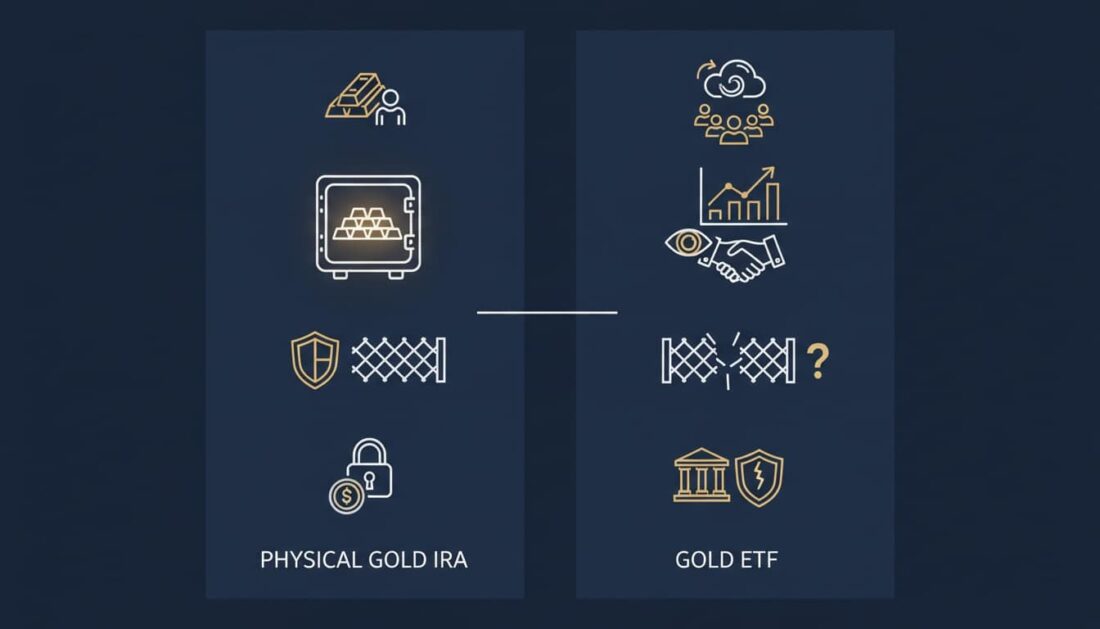
Some people considering Gold IRAs wonder whether a gold ETF might be simpler.
Both provide exposure to gold prices—but they work very differently.
How Gold ETFs Actually Work
A gold exchange-traded fund trades on stock exchanges like any other stock.
When you buy shares of a gold ETF like SPDR Gold Trust (GLD) or iShares Gold Trust (IAU), you’re purchasing fractional ownership in a fund that holds gold.
You never own physical gold. The fund owns it (or claims to), and you own shares in the fund.
This structure offers convenience. You can buy and sell instantly during market hours. There’s no storage to arrange, no depository to select, and no coins to verify.
For short-term trading or basic price exposure, ETFs are efficient.
The Counterparty Risk Question
But ETFs carry counterparty risk that physical gold doesn’t.
When you own an ETF share, you’re trusting multiple parties: the fund manager to operate honestly, the custodian bank to actually hold the gold, the sub-custodian arrangements, the banking system, the electronic markets.
If any of these fail, your ownership claim could be compromised.
Some gold ETF prospectuses contain language that should give pause. Buried in the legal fine print are statements about what happens if gold is lost or stolen—specifically, that the responsible party may not have sufficient resources to cover the trust’s claim.
Physical gold in an IRA eliminates most of this chain.
You own actual metal in a vault. No fund manager stands between you and your gold. No electronic system needs to function for your ownership to remain valid.
Why Some Customers Choose Physical Gold
Many people choose Gold IRAs specifically because they want to step outside the paper-based financial system—at least partially.
Consider the scenarios that often prompt interest in physical gold: concerns about inflation eroding dollar purchasing power, worries about banking instability, questions about what happens during economic disruption.
In these scenarios, the last thing you want is an asset that depends on the very systems you’re trying to protect against.
Physical gold in secure storage represents genuine ownership of a tangible asset. During a financial crisis—when banking systems might be stressed or temporarily unavailable—your gold remains yours, sitting in a vault, unaffected by what’s happening in electronic markets.
| Factor | Gold ETF | Physical Gold IRA |
|---|---|---|
| Ownership | Shares in a fund | Actual metal in a vault |
| Counterparty risk | Multiple parties involved | Minimal—you own the metal |
| Liquidity | Instant trading during market hours | Requires sale through dealer |
| Crisis protection | Depends on financial system functioning | Independent of financial system |
| Storage concerns | None—fund handles it | Requires approved depository |
| Ongoing fees | Annual expense ratio | Storage and custodial fees |
The choice depends on what you’re trying to accomplish.
Regulatory Resources and What to Do If Something Goes Wrong

Federal and state regulators have stepped up efforts to combat precious metals fraud.
Knowing these resources helps you both verify companies upfront and report problems if they occur.
Key Regulatory Warnings to Review
The CFTC has published specific warnings about precious metals fraud, including “Lies Versus Facts: The Truth Behind Gold and Silver IRA Scams.”
Key points from CFTC guidance:
- Precious metals dealers are not regulated at the federal level
- Most dealers are salespeople, not licensed financial professionals
- Common lies include claims about “secret tax loopholes” and urgent economic collapse
- Legitimate bullion premiums are typically 5-10%, not 40-200%
The CFTC and FINRA jointly issued “10 Things to Ask Before Buying Physical Gold, Silver, or Other Metals” as a resource for prospective customers.
How to Report Suspected Fraud
If you believe you’ve been victimized by precious metals fraud, multiple agencies can help:
- CFTC: File a complaint at cftc.gov/complaint or call 866-FON-CFTC (866-366-2382)
- SEC: Report securities fraud at sec.gov
- FINRA: Use the Securities Helpline for Seniors at 844-574-3577
- State Attorney General: Your state’s office handles consumer protection complaints
- Better Business Bureau: File a complaint to create a public record
Documentation matters. Keep copies of all communications, contracts, account statements, and marketing materials. This evidence supports investigations and potential recovery efforts.
What Recent Enforcement Actions Tell Us
Regulators have secured significant judgments against fraudulent precious metals dealers in recent years.
In 2024, a federal court ordered Red Rock Secured (now operating as American Coin Co.) to pay over $56 million in restitution and penalties. The company had charged markups of 100-130% while telling customers they paid only 1-5%. Over 950 customers lost money in the scheme—which specifically targeted retirement account holders.
The SEC and CFTC worked together on this case.
These enforcement actions demonstrate that accountability is possible—though recovery after fraud is never certain. That’s why due diligence before purchasing matters far more than regulatory action after the fact.
Frequently Asked Questions
Are Gold IRAs safe in 2026?
Gold IRAs are safe when structured correctly through legitimate custodians and IRS-approved depositories.
The physical gold itself is historically stable. The risk comes from the industry’s bad actors—dealers who overcharge, storage schemes that violate IRS rules, and companies that disappear with customer funds.
Safety depends on choosing transparent dealers, avoiding home storage schemes, and verifying that all parties follow IRS guidelines. With proper structure, a Gold IRA provides genuine ownership of tangible assets held in secure storage.
What are the biggest Gold IRA scams to avoid?
The most damaging scams include home storage IRA schemes (which violate IRS rules and trigger massive tax penalties), numismatic coin overcharges with 40-200% markups, hidden fees not disclosed upfront, and bait-and-switch tactics where dealers advertise low-premium bullion but steer customers toward overpriced “exclusive” coins.
The CFTC has documented over $500 million in fraudulent precious metals sales over the past decade.
Can I store Gold IRA metals at home?
No. The IRS requires that Gold IRA metals be held by an approved bank or nonbank trustee in an IRS-approved depository.
Storing IRA gold at home is treated as a taxable distribution. This triggers income taxes at your marginal rate plus a 10% early withdrawal penalty if you’re under 59½. One couple faced over $300,000 in taxes and penalties for home storage violations.
If any company tells you home storage is legal for IRA metals, consider that a major red flag.
What markups are reasonable for Gold IRA coins?
Standard bullion coins like American Gold Eagles typically carry premiums of 5-10% over spot price under normal market conditions.
Markups exceeding 20% for common bullion products should raise concerns. Some fraudulent dealers have been caught charging 100-130% markups while claiming they charged only 1-5%.
Always compare the quoted price to current spot prices—and get quotes from multiple dealers before committing.
How do I verify a Gold IRA company is legitimate?
Check the Better Business Bureau for ratings, complaints, and how long the company has been in business. Look for membership in industry organizations like the Industry Council for Tangible Assets.
Request complete fee disclosures in writing before committing. Verify they work with IRS-approved custodians and depositories. Ask for specific names and confirm them independently.
Avoid companies that use high-pressure sales tactics or make promises that sound too good to be true.
What’s the difference between a Gold IRA custodian and a dealer?
A custodian is an IRS-approved financial institution that administers your self-directed IRA, handles reporting, and ensures regulatory compliance.
A dealer sells you the physical gold.
These should be separate entities. If the dealer also controls custody, your metals could be at risk if that company faces financial trouble. Proper structure means your gold is held independently in a secure depository—protected even if the dealer goes out of business.
What happens to my Gold IRA if the dealer goes bankrupt?
In a properly structured Gold IRA, your metals are held by an independent custodian at an IRS-approved depository—not by the dealer.
If the dealer goes bankrupt, your physical gold remains safe because you own it outright. The custodian maintains records of your holdings. The depository provides insurance coverage.
This separation of roles is precisely why proper structure matters.
Should I choose a Gold IRA or a gold ETF?
Gold ETFs offer price exposure and trading convenience but carry counterparty risk—you’re trusting fund managers, custodians, and the broader financial system.
Physical gold in an IRA eliminates counterparty risk because you own actual metal held in a vault. Many people choose Gold IRAs specifically because they want tangible ownership outside paper-based financial systems.
The choice depends on whether you prioritize trading convenience or direct ownership. For retirement-focused customers concerned about systemic risk, physical gold often makes more sense.
What You Can Do From Here

Gold IRAs can be a legitimate way to hold physical precious metals within a tax-advantaged retirement account.
The gold itself has maintained value for millennia. The question is whether the people and companies involved in your specific arrangement operate honestly and follow IRS guidelines.
The safeguards that matter most are structural: an independent custodian, an IRS-approved depository, transparent pricing, and clear separation between the dealer who sells you gold and the parties who hold it on your behalf.
Due diligence before you buy is far more effective than regulatory action after something goes wrong.
Verify companies through the BBB. Request written fee disclosures. Ask direct questions about custodian and depository arrangements. Take your time—any company pressuring you to decide immediately isn’t acting in your interest.
Precious metals may appreciate, depreciate, or remain unchanged in value. Consult your CPA or tax professional for guidance specific to your situation. But with proper structure and a legitimate provider, a Gold IRA can serve its intended purpose: holding tangible assets in secure storage, fully under your ownership.
Ready to Talk Through Your Options?
If you’re thinking “this all makes sense, but I don’t have time to figure it out on my own”—you’re not alone.
Most customers we work with felt the same way before they realized how straightforward the process can be with the right guidance.
That’s why we offer a complimentary consultation to walk you through your options—including our No Fee Precious Metals IRA, which covers custodial fees for the lifetime of the account on qualified purchases. (Subject to minimum purchase requirements; ask your representative for details.)
We’ll show you exactly:
- How the No Fee IRA works and whether you qualify
- The difference between U.S.-minted coins and foreign alternatives
- What to expect from the purchasing and delivery process
- How to roll over or transfer existing retirement funds
- What ongoing support looks like after your purchase
Learn About the No Fee IRA — no obligation, just actionable insights you can use whether you work with us or not.
Your retirement is too important to leave to chance. Take the time to verify any company before you commit—and if Brighton earns your trust through transparency and service, we’ll be here to help at every stage of ownership.