
Here’s a question we hear all the time: Does it really matter where my gold was minted?
The short answer? Yes—but probably not for the reasons you’d think.
Both U.S.-minted gold and foreign gold can qualify for a precious metals IRA. Canadian Maple Leafs, Austrian Philharmonics, Australian Kangaroos—they all meet IRS purity standards.
So does the American Gold Eagle. And here’s where it gets interesting: the Eagle is actually less pure than those foreign coins. Yet the IRS gives it a special pass.
That exception trips up a lot of first-time owners. We’ll explain exactly how it works.
The real differences come down to a few key factors—liquidity when it’s time to sell, premiums you’ll pay going in, durability over time, and that unique IRS provision we just mentioned.
Here’s what you need to know right now: The IRS requires gold in an IRA to be at least 99.5% pure—except for U.S. legal tender coins like the American Gold Eagle. That coin is only 91.67% pure (22-karat), yet it’s explicitly approved under IRC Section 408(m)(3).
This is often called the “22K Exception.” It’s one of the first things to understand when choosing IRS-approved gold coins for your retirement.
If you’re focused on domestic recognition and easy resale, U.S.-minted products offer clear advantages. If you’re looking to maximize gold per dollar and don’t mind foreign mints, those options make sense too.
This guide walks through everything—IRS rules, purity differences, liquidity, premiums, and storage—so you can decide what fits your situation.
Understanding IRS Rules for Gold IRA Eligibility
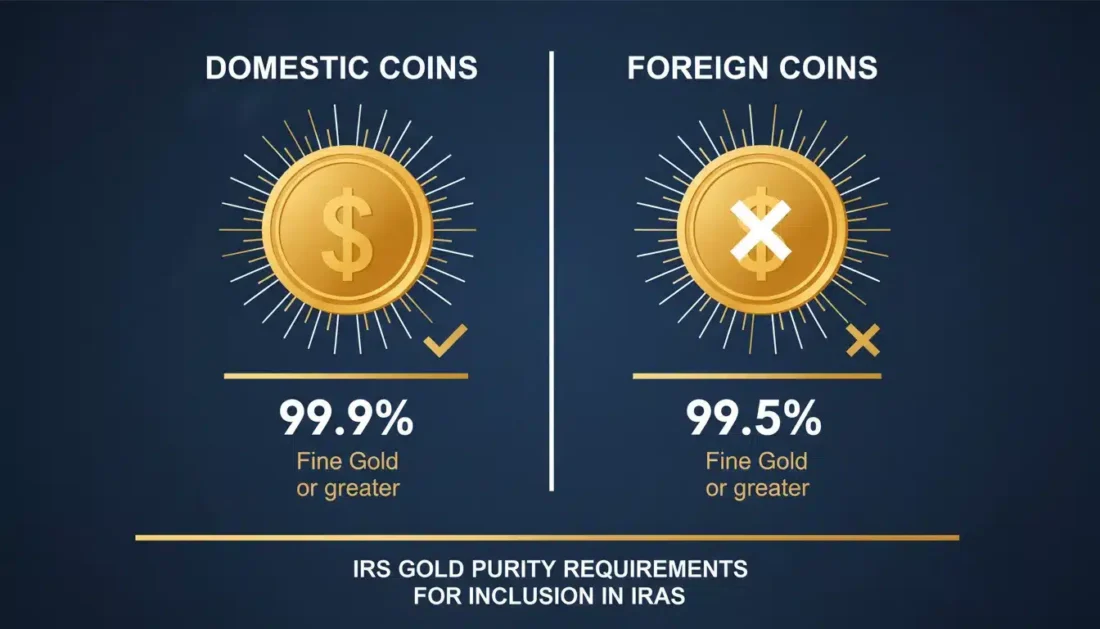
Before we compare specific coins, let’s look at the IRS rules that determine what can—and can’t—go into a precious metals IRA.
The rules aren’t complicated. But they do have a few wrinkles that catch people off guard.
The 99.5% Purity Standard
Under IRC Section 408(m)(3), gold held in an IRA must be at least .995 fine—that’s 99.5% pure.
Silver has a higher bar at 99.9%. Platinum and palladium require 99.95%.
Most foreign bullion coins exceed these thresholds easily. The Canadian Maple Leaf is 99.99% pure. Same with the Austrian Philharmonic and Australian Kangaroo.
But here’s where things get interesting.
The 22K Exception for American Gold Eagles
The American Gold Eagle doesn’t meet that 99.5% standard. It’s 91.67% pure—22-karat gold mixed with copper and silver for durability.
So why does the IRS allow it?
Because the American Gold Eagle is U.S. legal tender, minted under 31 USC Section 5112. The IRS carved out a specific exception for coins described in that statute—including the Gold Eagle, Silver Eagle, and Platinum Eagle.
This exception doesn’t apply to collectible or graded versions. Only bullion-grade coins in uncirculated condition qualify.
What Doesn’t Qualify
Not all gold makes the cut. The IRS explicitly prohibits:
- Collectible coins—regardless of gold content
- Graded or slabbed coins like MS70 or proof sets
- Jewelry, art, or decorative gold
- Coins that don’t meet purity standards and aren’t U.S. legal tender
- Any gold stored at home or in a personal safe deposit box
Here’s why this matters: If you place non-eligible gold in your IRA, the IRS treats it as a taxable distribution. That means income tax—plus a potential 10% penalty if you’re under 59½.
The rules are straightforward once you know them. They’re also unforgiving if you get them wrong.
Comparing Purity and Composition
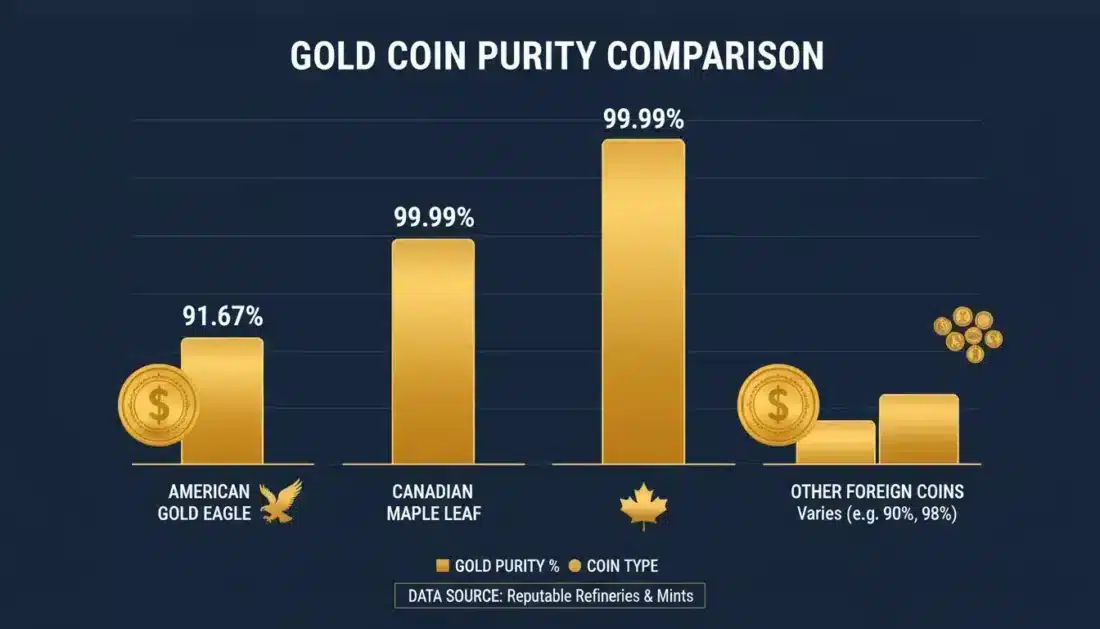
Purity is usually the first thing people look at when comparing domestic and foreign gold. It’s a reasonable starting point—but it doesn’t tell the whole story.
Here’s the key: Both types of coins contain the same amount of pure gold. The difference is what else is in there.
How 22-Karat and 24-Karat Coins Differ
The American Gold Eagle is 22-karat. That means 91.67% of its weight is gold. The remaining 8.33% is copper (5.33%) and silver (3%).
Why the alloy? Durability.
That mix makes the coin harder—more resistant to scratches, dings, and surface wear. If you’re handling coins or storing them long-term without protective cases, that toughness matters.
The Canadian Maple Leaf takes a different approach. It’s 24-karat—99.99% pure gold. Softer, more prone to marks, and requires more careful handling.
Here’s what a lot of people don’t realize: A 1 oz American Gold Eagle and a 1 oz Canadian Maple Leaf both contain exactly one troy ounce of pure gold.
The Eagle just weighs a bit more (1.0909 oz total) because of the alloy. Same gold content—different total weight.
Purity Comparison at a Glance
| Coin | Purity | Gold Content (1 oz) | Total Weight | Alloy |
|---|---|---|---|---|
| American Gold Eagle | 91.67% (22K) | 1.0000 oz | 1.0909 oz | Copper, Silver |
| American Gold Buffalo | 99.99% (24K) | 1.0000 oz | 1.0000 oz | None |
| Canadian Maple Leaf | 99.99% (24K) | 1.0000 oz | 1.0000 oz | None |
| Austrian Philharmonic | 99.99% (24K) | 1.0000 oz | 1.0000 oz | None |
| Australian Kangaroo | 99.99% (24K) | 1.0000 oz | 1.0000 oz | None |
Does Purity Really Matter?
Some owners love the “pure gold” appeal of 24-karat coins. There’s a certain prestige to holding the highest purity available.
But purity alone doesn’t determine value.
The American Gold Eagle’s 22-karat composition was a deliberate design choice. The U.S. Mint wanted a coin that could handle real-world use without losing its visual appeal—something built for circulation and long-term ownership.
For owners focused purely on gold content, both options deliver the same ounce. The question is whether you value durability or maximum purity.
Liquidity and Resale: What Happens When You Sell

Liquidity matters when it’s time to sell. And in the precious metals world, not all gold coins sell equally fast—or at the same price.
Understanding this now helps you plan for the exit, not just the entry.
Why American Gold Eagles Sell Quickly in the U.S.
In the United States, the American Gold Eagle is the most recognized gold bullion coin. Period.
Dealers know it. Coin shops know it. Private purchasers know it. There’s no second-guessing when someone walks in with an Eagle.
That instant recognition translates to tighter spreads—the gap between what a dealer pays and what they sell for. Tight spreads mean more money in your pocket when you liquidate.
American Eagles often command slightly higher buyback prices from U.S. dealers compared to foreign coins. The premium you pay going in tends to hold its value going out.
Foreign Coins in the Domestic Market
Canadian Maple Leafs are the second-most liquid gold coin in the United States. Their global reputation for purity makes them easy to sell almost anywhere.
But in the domestic market, they may trade at slightly wider spreads. Why? Less demand from American purchasers who specifically want “American gold.”
That said, the difference is usually marginal. Both coins sell quickly to reputable dealers. And when gold prices are climbing, that gap narrows even further.
How They Compare
| Factor | American Gold Eagle | Canadian Maple Leaf | Other Foreign Coins |
|---|---|---|---|
| U.S. Dealer Recognition | Highest | High | Moderate to High |
| Typical Buyback Spread | Tightest | Slightly wider | Varies by dealer |
| International Demand | Strong | Strongest | Varies by coin |
| Speed of Sale | Fastest in U.S. | Fast | Generally fast |
| Premium Retention | Strong | Moderate | Varies |
What About Selling Internationally?
If you—or your beneficiaries—might sell outside the United States, the Canadian Maple Leaf has an edge.
Its 24-karat purity is the global standard. In Asian and European markets, 22-karat gold is less common. The Royal Canadian Mint’s reputation and security features (including Bullion DNA verification) make Maple Leafs highly desirable worldwide.
For those building a legacy that might cross borders, comparing gold and silver acquisitions with global liquidity in mind makes sense.
Premiums: What You’ll Pay Above Spot
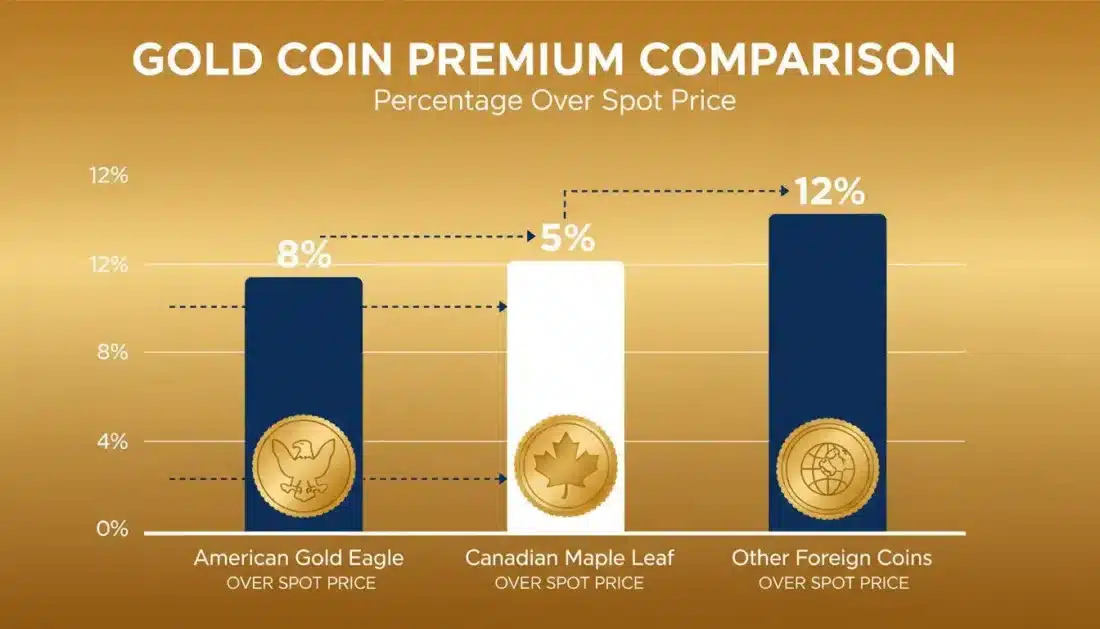
Premiums are what you pay above the spot price of gold. They’re unavoidable—but they vary depending on which coin you choose.
Understanding this helps you get more gold for your dollar.
Why American Eagles Cost More
American Gold Eagles typically carry premiums 25-40% higher than Canadian Maple Leafs at comparable volumes.
Why the difference?
- Strong domestic demand creates competition
- U.S. Mint production sometimes lags behind what the market wants
- The 22-karat alloy costs slightly more to manufacture
- Dealers price in the expected resale premium
During supply crunches—like 2020-2021—Eagle premiums spiked to 8-12% above spot. Maple Leaf premiums stayed closer to 3-5%.
Foreign Coins and Lower Entry Costs
If you want to acquire the most gold for your budget, foreign coins often make sense.
Canadian Maple Leafs, Austrian Philharmonics, and Australian Kangaroos regularly trade at lower premiums than American Eagles. On a $50,000 acquisition, that difference could mean $500-$1,500 in savings.
The trade-off? You may recover slightly less of that premium when selling domestically.
Premium Comparison
| Coin | Typical Premium Over Spot | Premium During Shortages | Buyback Premium Retention |
|---|---|---|---|
| American Gold Eagle | 4-6% | 8-12% | Strong |
| Canadian Maple Leaf | 2.5-4% | 3-5% | Moderate |
| Austrian Philharmonic | 2.5-4% | 3-5% | Moderate |
| Australian Kangaroo | 3-5% | 4-6% | Moderate |
Buying in Volume Reduces Premiums
Here’s something worth knowing: Premiums drop when you buy more.
Purchasing tubes of 10 or 20 coins—or monster boxes of 500—reduces per-coin costs significantly. This applies to both domestic and foreign gold.
If you’re rolling over retirement funds to gold, volume pricing can make a real difference in your total holdings.
Security Features and Counterfeit Protection

Counterfeiting is a real concern in the precious metals market. Both U.S. and foreign mints have responded—but they’ve taken different approaches.
American Gold Eagle Security
The U.S. Mint relies on precise specifications and traditional anti-counterfeiting measures:
- Exact weight, diameter, and thickness tolerances
- Reeded edges with specific groove counts
- Detailed design elements that are difficult to replicate
- Legal tender status—counterfeiting is a federal crime
The 2021 Type 2 redesign added enhanced security features. The U.S. Mint doesn’t disclose all the specifics publicly.
Canadian Maple Leaf Security
The Royal Canadian Mint has taken a more technology-forward approach:
- Bullion DNA—digital authentication with encrypted images of each coin
- Radial lines creating a unique light-diffraction pattern
- Micro-engraved laser marks visible under magnification
- MintShield technology to reduce surface marks
These features make authentication straightforward for dealers. They also give purchasers peace of mind when buying on the secondary market.
Which Is Better?
Both mints produce highly secure coins that are difficult to counterfeit.
The key is purchasing from reputable dealers who verify authenticity before sale. For owners holding coins in an IRS-approved depository, both options offer solid protection—the depository handles verification.
If you’re buying from secondary markets and want visible, verifiable security features, the Maple Leaf’s technology provides added confidence.
Storage and Custodian Requirements

Gold in an IRA can’t sit in your home safe. It can’t go in a personal bank deposit box either. The IRS requires storage in an approved depository under a qualified trustee’s custody.
This applies equally to U.S.-minted and foreign gold.
What the IRS Requires
Under IRC Section 408(m), IRA gold must remain in the “physical possession” of a bank or IRS-approved non-bank trustee.
Courts have interpreted this strictly. The custodian must have actual control over the metal—not just paperwork saying they do.
Storing IRA gold at home—even through an LLC structure—has been ruled a taxable distribution by the Tax Court. The penalties are steep: income tax on the full value, plus a 10% early withdrawal penalty if you’re under 59½.
Choosing a Depository
Most IRA custodians work with established depositories that specialize in precious metals. Here’s what to look for:
- IRS approval and LBMA accreditation
- Segregated vs. non-segregated storage options
- Insurance coverage and security measures
- Geographic location and accessibility
- Fee structure and annual costs
Segregated storage means your specific coins are kept separate from other customers’ holdings. Non-segregated storage holds equivalent value—but not your exact coins.
What Storage Costs
Depository fees typically run $100-$300 annually for accounts under $100,000. Larger holdings often get sliding-scale pricing.
These fees are the same whether you hold U.S. or foreign gold. Some custodians charge slightly more for coins versus bars due to handling complexity—but the difference is usually minimal.
For those comparing gold IRAs versus direct purchases, storage costs are an important part of the total picture.
IRA Contribution Limits and Rollover Rules

Whether you choose U.S. or foreign gold, the same contribution and rollover rules apply. Understanding these limits helps you plan ahead.
2026 Contribution Limits
The IRS has set these limits for 2026:
| Account Type | Standard Limit | Catch-Up (50+) | Total (50+) |
|---|---|---|---|
| Traditional/Roth IRA | $7,500 | $1,100 | $8,600 |
| 401(k) | $24,500 | $8,000 | $32,500 |
| 401(k) Super Catch-Up (60-63) | $24,500 | $11,250 | $35,750 |
These limits apply to annual contributions only. They don’t restrict rollovers or transfers from existing retirement accounts.
Rollovers vs. Transfers
Most people funding a precious metals IRA use rollovers or transfers—not annual contributions.
What’s the difference?
A direct transfer moves funds from one custodian to another without you touching the money. This is the cleanest approach—no tax implications, no deadlines to worry about.
A rollover gives you temporary possession of the funds (typically 60 days) to redeposit into the new account. Miss the deadline, and the IRS treats it as a taxable distribution.
For most customers, direct transfers are simpler and safer. The process for precious metals transactions is straightforward once you understand how it works.
No Cap on Rollover Amounts
Here’s something important: There’s no limit on how much you can roll over from an existing 401(k), TSP, or traditional IRA.
If you have $500,000 in a traditional IRA, you can move all of it—or any portion—into a precious metals IRA without hitting contribution limits.
This flexibility makes rollovers the primary funding mechanism for most Gold IRA customers.
Making the Decision: Which Approach Fits Your Situation?

So which should you choose—American Gold Eagles or foreign bullion like Canadian Maple Leafs?
The honest answer: It depends on what matters most to you.
When U.S.-Minted Gold Makes Sense
Consider acquiring U.S.-minted gold coins if:
- You plan to sell domestically and want maximum recognition
- You value durability and don’t want to worry about handling marks
- You prefer the backing and guarantee of the U.S. Mint
- Premium retention at resale matters more than initial cost savings
- You appreciate the coin’s American heritage and design
The American Gold Eagle remains the most recognized gold coin in the United States. For customers focused on domestic liquidity and easy resale, it’s a natural choice.
When Foreign Gold Makes Sense
Consider foreign coins like the Canadian Maple Leaf if:
- You want to maximize gold content per dollar
- You—or your beneficiaries—might sell internationally
- You prefer the highest purity available (99.99%)
- Lower premiums and entry costs are a priority
- You value advanced security features like Bullion DNA
Foreign coins are equally IRA-eligible. They’re a cost-effective way to build precious metals holdings.
A Balanced Approach
Many experienced owners hold both.
They acquire American Gold Eagles for domestic liquidity and Canadian Maple Leafs for cost efficiency and global recognition. This balanced approach provides flexibility—you’re not locked into one market or one set of assumptions about where you’ll eventually sell.
What matters most is understanding the trade-offs and making a decision that aligns with your goals.
Frequently Asked Questions
Are foreign gold coins IRS-approved for my Gold IRA?
Yes—many foreign gold coins qualify for Gold IRAs, as long as they meet the 99.5% purity requirement.
Popular approved options include the Canadian Gold Maple Leaf (99.99% pure), Austrian Gold Philharmonic (99.99% pure), and Australian Gold Kangaroo (99.99% pure).
The key is meeting the fineness threshold under IRC Section 408(m)(3). Coins from government mints that hit this standard are generally eligible.
Some foreign coins don’t qualify—like the South African Krugerrand, which is 91.67% pure but isn’t U.S. legal tender. Always verify eligibility with your custodian before purchasing.
Why does the American Gold Eagle have a lower purity than the Canadian Maple Leaf?
The American Gold Eagle uses a 22-karat composition—91.67% gold with copper and silver alloys—for durability. This design goes back to the Gold Bullion Coin Act of 1985.
The U.S. Mint wanted a coin that could handle regular handling without showing wear. The alloy makes it harder and more scratch-resistant than pure gold.
Here’s what matters: The coin still contains exactly one troy ounce of pure gold. It just weighs a bit more (1.0909 oz total) because of the alloy.
The Canadian Maple Leaf uses 24-karat gold (99.99% pure). It’s softer and more prone to surface marks—but offers the highest purity commercially available.
Do U.S. gold coins have higher premiums than foreign bullion?
Yes. American Gold Eagles typically carry premiums 25-40% higher than Canadian Maple Leafs.
This reflects strong domestic recognition, government backing, and consistent demand in the U.S. market.
During supply shortages, the gap can widen. In 2020-2021, Eagle premiums hit 8-12% over spot while Maple Leaf premiums stayed around 3-5%.
The upside? That higher premium often holds its value when you sell domestically. Many U.S. dealers pay more for Eagles because their customers specifically want them.
Which gold coin is easiest to sell back in the United States?
The American Gold Eagle. Its widespread recognition and strong demand create tight dealer spreads and fast transactions.
Every major precious metals dealer, most coin shops, and many pawn shops instantly recognize the Eagle. That familiarity means quicker sales and competitive offers.
Canadian Maple Leafs are a close second—highly liquid and widely traded. Other foreign coins may require dealers with more specialized knowledge, though reputable dealers handle them routinely.
What is the 22K Exception for American Gold Eagles?
The 22K Exception is the IRS provision allowing American Gold Eagles into IRAs despite not meeting the standard 99.5% purity requirement.
Under IRC Section 408(m)(3), the IRS exempts U.S. legal tender coins minted under 31 USC Section 5112. That includes the American Gold Eagle at 91.67% purity.
Why the exception? The coin is guaranteed by the U.S. government and contains exactly one troy ounce of pure gold—regardless of its karat rating.
This exception also covers American Silver Eagles and American Platinum Eagles.
Are gold bars from foreign refiners like PAMP Suisse safe for my retirement account?
Yes. Gold bars from reputable foreign refiners—PAMP Suisse, Valcambi, Credit Suisse—are IRA-eligible when they meet the 99.5% purity requirement and come from refiners accredited by LBMA, COMEX, or NYMEX.
The bars must be stored with an IRS-approved custodian and depository. Proper documentation is essential—assay certificates or original sealed packaging from the refiner.
The key is working with a reputable dealer who can verify authenticity and compliance before delivery to your depository.
Taking the Next Step
Choosing between U.S.-minted gold and foreign alternatives isn’t about finding the “best” option.
It’s about finding the right fit for your situation.
Both paths lead to the same destination: physical gold held in a tax-advantaged retirement account—tangible protection outside the traditional financial system.
The American Gold Eagle offers domestic recognition, durability, and the backing of the U.S. Mint. The Canadian Maple Leaf offers maximum purity, lower premiums, and global liquidity.
Many owners hold both. That’s a perfectly reasonable approach.
What matters most is taking action—moving from research to implementation while it still makes sense for your goals.
Ready to explore your options?
If you’re thinking “this all makes sense, but I don’t have time to figure it out on my own,” you’re not alone. Most customers we work with felt the same way before they realized how straightforward the process can be with the right guidance.
That’s why we offer a complimentary consultation to walk you through your options—including our No Fee Precious Metals IRA, which covers custodial fees for the lifetime of the account on qualified purchases.
We’ll show you exactly:
- How the No Fee IRA works and whether you qualify
- The difference between U.S.-minted coins and foreign alternatives
- What to expect from the purchasing and delivery process
- How to roll over or transfer existing retirement funds
- What ongoing support looks like after your purchase
Learn About the No Fee IRA—no obligation, just actionable insights you can use whether you work with us or not.
Comparing domestic and foreign gold coins doesn’t have to feel overwhelming. With clarity on the trade-offs and a clear sense of your goals, the decision becomes straightforward.