
Here’s a surprise most people don’t expect when they research Gold IRAs: the advertised fees aren’t the full picture.
You’ll see “$50 setup fee” and “$150 annual maintenance” splashed across websites. Those numbers are real. But they’re just the beginning.
The true cost of owning a Precious Metals IRA in 2026 depends on three categories of fees—and one of them rarely gets mentioned upfront. We’re talking about custodial costs, storage fees, and something called the “dealer spread.” When you add them up, most account holders pay between $200 and $600 per year in administrative costs alone. That doesn’t include what you pay above the metal’s spot price when you make a purchase.
So what should you actually expect to pay? And how can you avoid the hidden costs that add up over time?
This breakdown covers every fee you’ll encounter—the ones companies advertise, the ones they bury in the fine print, and the strategies that can help you keep more of your money working for you.
Why Gold IRA Fees Are Different from Traditional IRAs

A traditional IRA held through a brokerage often costs next to nothing. Maybe you pay a small mutual fund expense ratio or the occasional trading commission. That’s it.
A Precious Metals IRA works differently.
Why the Cost Structure Changes
The IRS treats gold and silver as “collectibles” under Internal Revenue Code Section 408(m). To hold physical metals in a retirement account legally, you need an approved custodian. You also need secure vault storage at an IRS-approved depository.
Those requirements create costs a standard IRA doesn’t have.
The Three Cost Categories
Every Precious Metals IRA includes three types of fees:
- Custodial costs — Paid to the company managing your account paperwork, IRS compliance, and reporting
- Storage costs — Paid to the depository vault where your metals are physically secured
- Metal acquisition costs — The premium you pay above the spot price when purchasing gold or silver
The first two categories are straightforward. You’ll see them on fee schedules. The third—acquisition costs—is where many people get caught off guard.
What Custodial Fees Actually Cover

Custodians are the administrative backbone of your account. They handle the paperwork that keeps your IRA compliant with federal tax law.
This isn’t optional. The IRS requires that all IRA accounts—including self-directed accounts holding precious metals—be maintained by an approved custodian.
What You’re Paying For
Custodial fees cover several responsibilities:
- Recordkeeping — Tracking every purchase, sale, and distribution in your account
- IRS reporting — Filing annual statements (Form 5498, Form 1099-R when applicable)
- Transaction facilitation — Coordinating purchases, sales, and rollovers with dealers and depositories
- Account administration — Maintaining account status, processing contributions, handling correspondence
Typical Fee Ranges in 2026
Custodial costs typically break into two categories:
| Fee Type | Typical Range | When Paid |
|---|---|---|
| Account Setup | $50–$150 | One-time |
| Annual Maintenance | $75–$300 | Yearly |
| Wire Transfer | $25–$50 | Per transaction |
| Transaction/Trade | $25–$50 | Per purchase or sale |
Some custodians charge flat-rate fees regardless of account size. Others use a sliding scale that increases as your account value grows. For larger accounts, flat-rate structures tend to be more favorable.
Storage Fees Explained
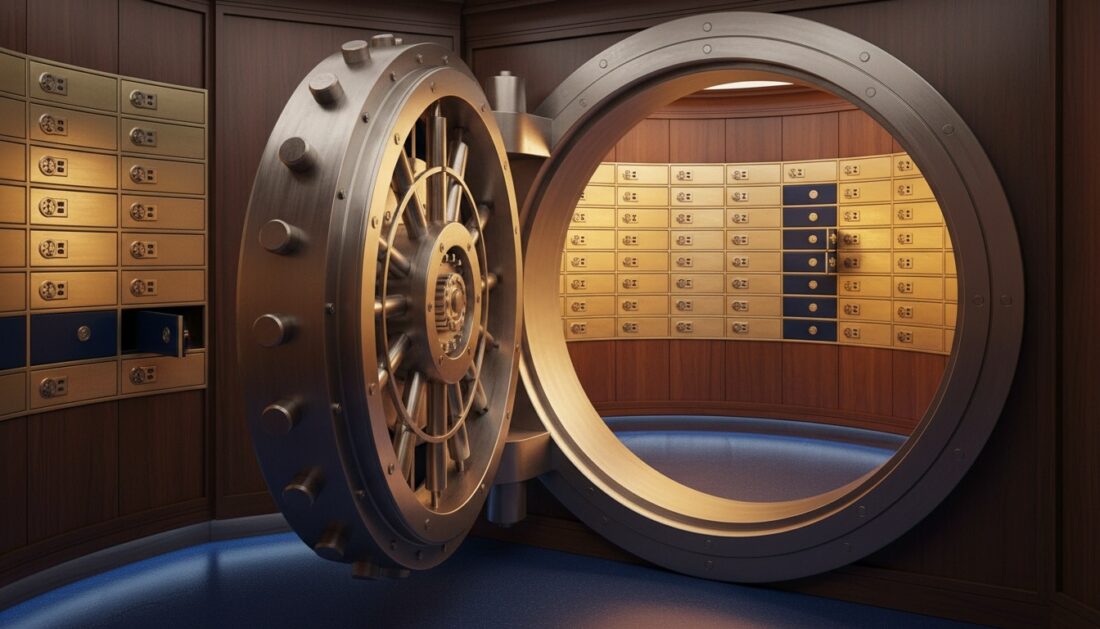
Physical gold held in an IRA can’t sit in your home safe. It can’t go in a bank safe deposit box. The IRS requires that metals be held by an approved depository—a specialized facility with security systems, insurance coverage, and third-party auditing.
Why Home Storage Isn’t Allowed
Some advertisements promote “home storage Gold IRAs” as a way to avoid depository fees. This isn’t compliant with IRS rules.
The McNulty v. Commissioner case demonstrated what happens when someone stores IRA metals at home. The court ordered the Rhode Island couple to pay over $270,000 in taxes on roughly $730,000 in IRA assets—plus penalties exceeding $50,000.
The IRS considers home storage a distribution. That means immediate taxes, plus a 10% early withdrawal penalty if you’re under 59½.
Segregated vs. Commingled Storage
Depositories offer two storage options:
Segregated storage keeps your metals in a dedicated compartment, separate from other customers’ holdings. Your specific coins or bars are labeled and stored individually. When you take a distribution, you receive the exact items you purchased.
Commingled storage pools your metals with those belonging to other account holders. You own a specific quantity of gold or silver, but not specific serial-numbered items. When you take a distribution, you receive items of equivalent type and value—though not necessarily the exact pieces you originally purchased.
| Storage Type | Annual Cost Range | What You Get |
|---|---|---|
| Segregated | $150–$300 | Your exact items, individually stored |
| Commingled | $100–$175 | Equivalent items, stored in shared space |
Commingled storage costs less because depositories can use space more efficiently. Segregated storage costs more but offers certainty about exactly which metals you own.
The Dealer Spread: The Fee Nobody Talks About

Here’s where it gets interesting.
Most articles about Gold IRA fees focus on the $50 setup fee or the $150 annual maintenance. Those are real costs—but they’re not where the significant money goes.
The dealer spread is the difference between what you pay to buy gold and what you’d receive if you sold it back immediately.
How It Works
When you purchase gold, you pay the “ask” price—what the dealer is willing to sell for. When you sell gold, you receive the “bid” price—what the dealer is willing to pay.
The gap between those two numbers is the spread.
Here’s an example: Say the spot price of gold is $3,300 per ounce. A dealer might sell you a one-ounce Gold American Eagle for $3,450 (4.5% above spot). If you sold it back immediately, they might offer $3,200 (3% below spot).
That’s a 7.5% round-trip spread. On a $100,000 purchase, you’d need gold to appreciate by $7,500 just to break even.
Industry Spread Ranges
Spreads vary based on several factors:
| Product Type | Typical Spread Range |
|---|---|
| Standard bullion bars | 2%–5% |
| U.S.-minted coins (Eagles, Buffalos) | 3%–6% |
| Specialty or proof coins | 10%–20%+ |
| Rare or collectible coins | 20%–50%+ |
The most actively traded products—Gold American Eagles, Canadian Maple Leafs, and standard bars—typically carry the tightest spreads. That’s because they have high liquidity and established markets.
Proof coins and numismatic items carry much higher markups. While they may have collectible appeal, those premiums rarely hold when it’s time to sell.
Total Cost of Ownership: Running the Numbers

What does all this add up to in practice?
Let’s say you open a $50,000 Precious Metals IRA. Here’s what a typical first year might look like:
| Cost Category | Amount | Notes |
|---|---|---|
| Account Setup | $50 | One-time |
| Annual Maintenance | $125 | Custodian fee |
| Storage (Commingled) | $125 | Depository fee |
| Wire Transfer | $30 | Initial funding |
| Dealer Spread (5% avg) | $2,500 | On $50,000 purchase |
| Year 1 Total | $2,830 | |
| Year 2+ Annual | $250 | Maintenance + storage only |
That $2,500 spread isn’t a “fee” in the traditional sense—it’s built into the purchase price. But it’s money you need gold to earn back before you’re in positive territory.
For Larger Accounts
The math shifts for larger accounts. Fixed custodial and storage fees become a smaller percentage of your total holdings.
On a $200,000 account with the same fee structure:
| Cost Category | Amount | As % of Account |
|---|---|---|
| Annual Fees (Maintenance + Storage) | $250 | 0.125% |
| Dealer Spread (5% on initial purchase) | $10,000 | 5% (one-time) |
This is why many in the industry suggest a minimum of $25,000–$50,000 before opening a Precious Metals IRA. Below that threshold, fixed annual fees represent a larger drag on returns.
How Brighton’s No Fee IRA Changes the Math

Some companies have restructured their fee models to eliminate ongoing custodial costs for qualified accounts.
Brighton Enterprises offers a No Fee Precious Metals IRA that covers custodian fees for the lifetime of the account on qualifying purchases. (Subject to minimum purchase requirements; ask your representative for details.) That removes the $75–$300 annual maintenance fee many account holders pay year after year.
What This Means Over Time
Consider the difference over a 15-year holding period:
| Fee Structure | Annual Custodial | 15-Year Custodial Cost |
|---|---|---|
| Industry Average | $150/year | $2,250 |
| No Fee IRA (Qualified) | $0/year | $0 |
| Savings | $2,250 |
Storage fees still apply—those are paid to the depository, not the dealer. But eliminating custodial costs removes a significant portion of annual expenses.
Understanding “Qualified Accounts”
Not every account qualifies for fee waivers. Specifics vary by provider, so it’s worth asking directly:
- What’s the minimum purchase to qualify?
- Does the waiver cover all custodial fees, or just certain ones?
- Are there conditions that could end the fee waiver?
A conversation with Brighton’s team can clarify exactly how the No Fee structure applies to your situation. There’s no obligation—just clarity.
Red Flags and Hidden Costs to Watch For

Not every fee structure is straightforward. Here are patterns worth watching for:
Numismatic Coin Pressure
Some companies steer customers toward proof coins, rare coins, or collectibles with 20%–50% markups. The pitch often involves “numismatic appreciation” or “collector value.”
Here’s the reality: those premiums rarely hold at resale. When it’s time to liquidate, most buyers care about metal content—not collector appeal. You might sell a $5,000 proof coin for $3,000 in metal value.
Stick with standard IRA-approved bullion products. High-premium “collectible” coins often carry markups that eat into your potential growth.
Sliding-Scale Fees
Some custodians charge fees based on account value rather than flat rates. On a small account, this might look attractive. But as your holdings grow, so do your fees.
A 0.5% annual fee on a $300,000 account means $1,500 per year—far more than typical flat-rate structures.
Liquidation Penalties
Check the buyback terms before you open an account. Some dealers charge additional fees to sell metals back to them. Others offer no buyback at all, leaving you to find your own buyer.
Reputable dealers offer competitive buyback at current market prices with transparent terms.
Excessive Transaction Fees
If you plan to make regular purchases or rebalance periodically, watch for transaction fees. At $50 per trade, frequent adjustments can add up quickly.
How to Minimize Your Gold IRA Costs

Several strategies can help keep more of your money working in metals rather than going to fees:
Choose Flat-Rate Fee Structures
For larger accounts, flat-rate custodial fees beat percentage-based models. A $250 annual fee is the same whether your account holds $50,000 or $500,000.
Consider Commingled Storage
If you don’t need the exact coins you purchased—if you’re focused on metal value rather than specific serial numbers—commingled storage saves $50–$150 per year over segregated options.
Both storage types offer IRS compliance, insurance, and security. The difference is personal preference, not safety.
Stick with High-Liquidity Products
Gold American Eagles, Canadian Maple Leafs, and standard bars have the tightest spreads and strongest resale markets. Specialty products might look interesting, but the premiums rarely pay off.
Fund Adequately from the Start
Fixed annual fees represent a smaller percentage on larger accounts. If you’re going to open a Precious Metals IRA, consider consolidating retirement funds to minimize the fee-to-asset ratio.
For those rolling over a 401(k) or existing IRA, this often makes sense as a first step.
Ask About Fee Waivers
Don’t assume the published fee schedule is final. Some companies—including Brighton—offer reduced or waived fees on qualified accounts. A brief conversation can reveal options that aren’t always advertised.
Do the Fees Make a Gold IRA Worth It?

This is the real question behind the fee discussion: Does the cost structure make sense for your situation?
The Honest Answer
A Precious Metals IRA costs more to maintain than a standard brokerage IRA. There’s no way around that fact.
But cost is only one variable. The other side of the equation involves what you’re trying to accomplish.
What You’re Actually Paying For
When you pay Gold IRA fees, you’re paying for:
- Physical ownership — Not a paper claim, not a derivative, not someone else’s promise. Actual metal stored in a vault with your name on it.
- Custody compliance — The administrative infrastructure that keeps your account legal and tax-advantaged.
- Secure storage — Insurance, security systems, and third-party audits protecting your holdings.
- Tangibility — Something that exists outside the digital financial system.
Whether these benefits justify the costs depends entirely on why you’re considering a Precious Metals IRA in the first place.
When the Fees Make Less Sense
For those seeking paper exposure to gold prices rather than physical ownership, an ETF will be cheaper. You’ll pay a small expense ratio, no storage fees, and no dealer spreads.
But you won’t own physical metal. You’ll own shares in a fund that owns metal. That distinction matters to some people more than others.
When the Fees Make More Sense
For those who want actual gold in a retirement account—metal they could eventually take physical possession of—the IRA structure provides a legal, tax-advantaged framework to do that.
The fees are the cost of that framework.
If your goal is hedging against inflation, holding tangible assets outside the paper financial system, or leaving physical wealth to heirs, the fee structure serves a purpose beyond administrative cost.
FAQ: Common Questions About Gold IRA Costs
Can I Store My Gold at Home to Avoid Storage Fees?
No. The IRS requires that precious metals in an IRA be held by an approved custodian at an IRS-approved depository. Storing IRA metals at home is treated as a distribution, triggering immediate taxes and a 10% early withdrawal penalty if you’re under 59½. A U.S. Tax Court case confirmed this, with the account holders owing over $320,000 in taxes and penalties.
Are Gold IRA Fees Tax-Deductible?
Since the Tax Cuts and Jobs Act of 2017, IRA custodial and storage fees are generally not tax-deductible for individuals. However, many custodians allow you to pay fees from your IRA balance rather than out-of-pocket. This reduces your account value but may be simpler for some. Always confirm with your tax professional for guidance specific to your situation.
What’s the Difference Between Segregated and Commingled Storage?
Segregated storage keeps your metals in a dedicated space, separate from other customers’ holdings. You receive your exact items when you take a distribution. Commingled storage pools your metals with others—you own a quantity, but not specific serial-numbered items. Commingled is less expensive; segregated offers more personalized control.
How Much Do Dealers Mark Up Gold Above Spot Price?
Markups vary by product. Standard bullion bars typically carry 2%–5% premiums. Popular coins like Gold American Eagles run 3%–6% above spot. Proof or collectible coins can carry 10%–50%+ markups. The spread represents a cost you need the metal to recover before you’re in positive territory.
Is There a Minimum Account Size for a Gold IRA?
Minimums vary by company, ranging from $5,000 to $50,000 or more. However, fixed annual fees have a bigger impact on smaller accounts. Many suggest $25,000–$50,000 as a practical threshold where the fee-to-asset ratio becomes reasonable.
What Happens If My Custodian Goes Out of Business?
Your metals are held separately at an IRS-approved depository, not by the custodian. If a custodian closes, your metals remain at the depository while you transfer administration to another custodian. Choose custodians with established track records and strong regulatory standing.
Can I Take Physical Possession of My Gold?
Not while it’s in the IRA. Taking possession before retirement age counts as a distribution, triggering taxes and potential penalties. However, once you reach 59½, you may choose an in-kind distribution—receiving the physical metals directly. At that point, it becomes personally owned gold, no longer an IRA asset.
How Do I Compare Gold IRA Companies on Fees?
Request a complete fee schedule in writing from each company you’re considering. Compare setup fees, annual maintenance, storage costs, and transaction fees. Also ask about the typical spread on products you’re considering—this often exceeds the administrative fees. And ask about buyback terms for when it’s time to liquidate.
The Bottom Line: What Should You Expect to Pay?

A realistic annual cost for a Precious Metals IRA in 2026 runs between $200 and $400 for account maintenance and storage—assuming a reputable provider with competitive fees.
The larger cost comes at purchase time. A 3%–6% dealer spread on a $50,000 acquisition means $1,500–$3,000 that metals need to appreciate before you break even.
This doesn’t mean a Precious Metals IRA is expensive in absolute terms. It means understanding the full picture before you open an account.
The key questions to ask:
- What are the total annual fees (custodial + storage)?
- What spread do you typically charge on the products I’m considering?
- Are there any fee waivers or reduced structures for qualified accounts?
- What are the buyback terms when I’m ready to sell?
A reputable company will answer these clearly—no hedging, no pressure.
Next Steps: Getting Clear Answers
Brighton Enterprises offers a No Fee Precious Metals IRA that eliminates custodian fees for the lifetime of the account on qualified purchases. That changes the long-term math compared to paying $150–$300 annually.
If you’re researching options—or just want straight answers about what you’d actually pay—a conversation with Brighton’s team can help. No pressure. No obligation. Just the information you need to make a clear decision.
→ Request a free consultation to learn how the No Fee IRA could work for your situation.
Or explore more resources to keep building your understanding:
- Gold IRA Transfers and Rollovers
- The Gold American Eagle
- Best Gold Coins to Buy
- Brighton Enterprises Market Recap
Precious metals may appreciate, depreciate, or remain unchanged in value. Past performance is not indicative of future results. Brighton Enterprises does not provide financial, legal, or tax advice. Consult your CPA or tax professional for guidance specific to your situation.