
Here’s a surprise most people don’t expect: that “Gold IRA” you’ve been hearing about? It’s not limited to gold.
Yes, you can add silver to a Gold IRA. The name’s a bit misleading—it’s really a Precious Metals IRA that can hold gold, silver, platinum, and palladium. As long as each metal meets IRS purity requirements, you’re good to go.
Here’s the short version: silver must be at least .999 fine (99.9% pure) to qualify. Products like the American Silver Eagle, Canadian Silver Maple Leaf, and certain silver bars from accredited refiners all meet this standard.
Many customers we work with are surprised to learn they’re not limited to gold.
They assumed their retirement account was restricted to a single metal. It isn’t.
Adding silver to an existing precious metals account is straightforward. You’ll work with your custodian to purchase IRS-approved silver products, which are then shipped directly to an approved depository. Your gold and silver can even be stored in the same vault.
But here’s what most people really want to know: Should I add silver? What are the actual benefits? And what do I need to watch out for?
That’s what this guide covers. We’ll walk through the 2026 IRS rules, the specific silver products that qualify, how storage works, and the strategic reasons customers choose to hold both metals in the same account.
Understanding the “Gold IRA” Terminology

The phrase “Gold IRA” has become industry shorthand—but it doesn’t tell the whole story.
What you’re actually opening is a self-directed Individual Retirement Account that allows you to hold physical precious metals. The IRS permits four metals in these accounts: gold, silver, platinum, and palladium.
Why the Confusion Exists
Gold gets most of the attention because it’s the flagship precious metal.
It’s what people think of first when they hear “precious metals.” Marketing follows demand, so most companies lead with gold in their messaging.
But the IRS doesn’t require you to choose just one metal.
You can hold gold coins alongside silver bars. You can own platinum and palladium in the same account. The rules are about purity and custody—not about limiting your options.
What This Means for Your Account
If you already have a Gold IRA, you likely have the infrastructure in place to add silver.
Your existing custodian almost certainly supports silver purchases. Your depository can store both metals.
The only thing that changes is the specific products you purchase—and potentially your storage fees, since silver takes up more physical space than gold for the same dollar value.
Think of it this way: your account is the vehicle. Gold, silver, platinum, and palladium are different passengers that vehicle can carry.
You’re not locked into one.
2026 IRS Rules for Silver in a Precious Metals IRA
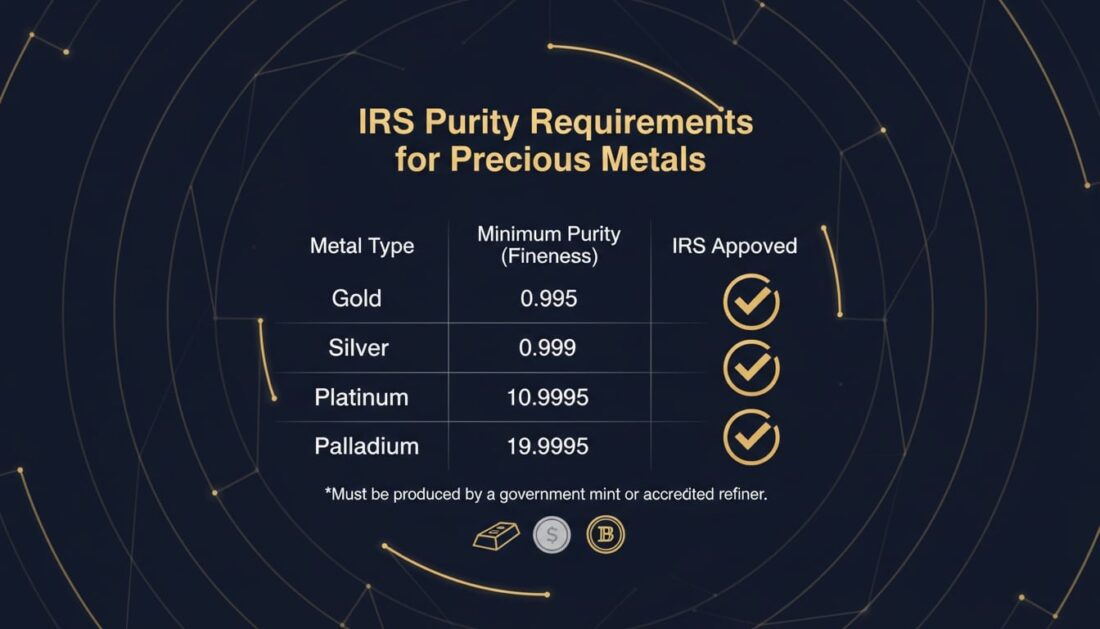
The IRS maintains strict requirements for silver held in retirement accounts.
These rules exist to ensure you’re holding bullion-grade metal—not collectibles or numismatic items.
The .999 Fineness Standard
Silver must be at least .999 fine to qualify for IRA inclusion.
That’s 99.9% pure silver.
This requirement applies to bars, rounds, and most coins. It’s the same purity standard used by major global exchanges and refiners.
The requirement isn’t arbitrary. It ensures the silver you hold has clear, measurable value based on its metal content—not subjective factors like rarity or collector appeal.
Approved Silver Products
The IRS approves specific categories of silver products. Here’s what qualifies:
- American Silver Eagle — The flagship U.S. Mint silver coin. Contains one troy ounce of .999 fine silver. Explicitly approved by the IRS and one of the most liquid silver products in the world.
- Canadian Silver Maple Leaf — Produced by the Royal Canadian Mint. Contains one troy ounce of .9999 fine silver—even purer than the U.S. requirement.
- Austrian Silver Philharmonic — One of Europe’s most popular silver coins. Contains one troy ounce of .999 fine silver.
- Australian Silver Kangaroo — Produced by the Perth Mint. Contains one troy ounce of .9999 fine silver.
- Silver bars and rounds — Must be .999+ fine and produced by a NYMEX/COMEX-approved refiner or manufacturer that’s ISO 9001 certified. Examples include bars from Sunshine Mint, Ohio Precious Metals, and the Royal Canadian Mint.
For a deeper look at options, see our guide on the best silver coins to buy.
What Doesn’t Qualify
Not everything made of silver can go into your IRA.
The IRS excludes:
- Collectible coins — Numismatic items valued for rarity rather than metal content
- Pre-1965 U.S. silver coins — Often called “junk silver,” these don’t meet purity requirements
- Most proof coins — While some proof versions of American Eagles qualify, many proof and commemorative coins don’t
- Sterling silver — At .925 purity, it falls below the .999 threshold
- Silver jewelry or silverware — Regardless of purity
The key distinction: the IRS wants standard bullion, not collectibles.
If a product’s value depends significantly on factors beyond its metal content, it probably doesn’t qualify.
| Metal | Minimum Purity | Notable Exception |
|---|---|---|
| Gold | 99.5% (.995 fine) | American Gold Eagle (91.67% pure, explicitly approved) |
| Silver | 99.9% (.999 fine) | None |
| Platinum | 99.95% (.9995 fine) | None |
| Palladium | 99.95% (.9995 fine) | None |
Why Customers Add Silver to Their Gold Holdings

Gold and silver behave differently in the market.
Many customers choose to hold both because each metal offers distinct characteristics. But what makes silver different—and why does it matter for your retirement picture?
Why This Matters Now: Silver’s Industrial Demand Story
Unlike gold, silver has massive industrial applications.
It’s not just a monetary metal—it’s a critical component in modern technology.
Solar energy is the big driver. Silver paste is essential in photovoltaic cells. According to the Silver Institute, solar applications now account for approximately 29% of total industrial silver demand—up from just 11% a decade ago.
With global solar capacity expected to grow at 17% annually through 2030, this demand isn’t slowing down.
Electric vehicles add another layer. EVs use significantly more silver than traditional internal combustion vehicles—for battery connections, electrical systems, and charging infrastructure.
Electronics and AI round out the picture. Data centers, 5G networks, and the physical infrastructure supporting artificial intelligence all require silver’s superior electrical conductivity.
What does this mean for someone holding silver in a retirement account?
It means silver has a demand floor that gold doesn’t have. When the global economy is growing and manufacturing is expanding, silver benefits from both its monetary appeal and its industrial necessity.
The Gold-to-Silver Ratio
One tool customers use when deciding how much silver to hold is the gold-to-silver ratio—the number of silver ounces needed to purchase one ounce of gold.
As of early 2026, the ratio sits around 59:1 to 60:1.
Historically, the ratio has averaged between 50:1 and 80:1 over the past century—though it’s been as low as 30:1 and as high as 100:1 during extreme market conditions.
Here’s how some customers use this information:
- When the ratio is high (say, above 80:1), silver may be undervalued relative to gold. Some customers shift more toward silver.
- When the ratio is low (below 50:1), gold may offer better relative value. Some customers shift toward gold.
This isn’t a perfect indicator—nothing is.
But it provides a framework for thinking about the relative pricing of the two metals. For more on how these metals compare, see our gold vs. silver comparison guide.
Different Volatility Profiles
Silver tends to be more volatile than gold.
It swings harder in both directions.
During precious metals bull markets, silver often outperforms gold on a percentage basis. During corrections, it can fall faster.
Does that make silver the better choice? Not necessarily.
Some customers view this volatility as opportunity. Others prefer gold’s relative stability. Many choose to hold both—capturing gold’s steadiness while maintaining exposure to silver’s potential upside.
That’s the real question—and it depends on what you’re trying to accomplish.
| Characteristic | Gold | Silver |
|---|---|---|
| Primary use | Monetary/store of value | Industrial + monetary |
| Volatility | Lower | Higher |
| Industrial demand | ~10% of supply | ~50%+ of supply |
| Price per ounce (2026) | ~$4,300–$4,500 | ~$70–$75 |
| Storage space needed | Less | More (per dollar value) |
| IRA purity requirement | 99.5% | 99.9% |
How to Add Silver to Your Existing Precious Metals IRA
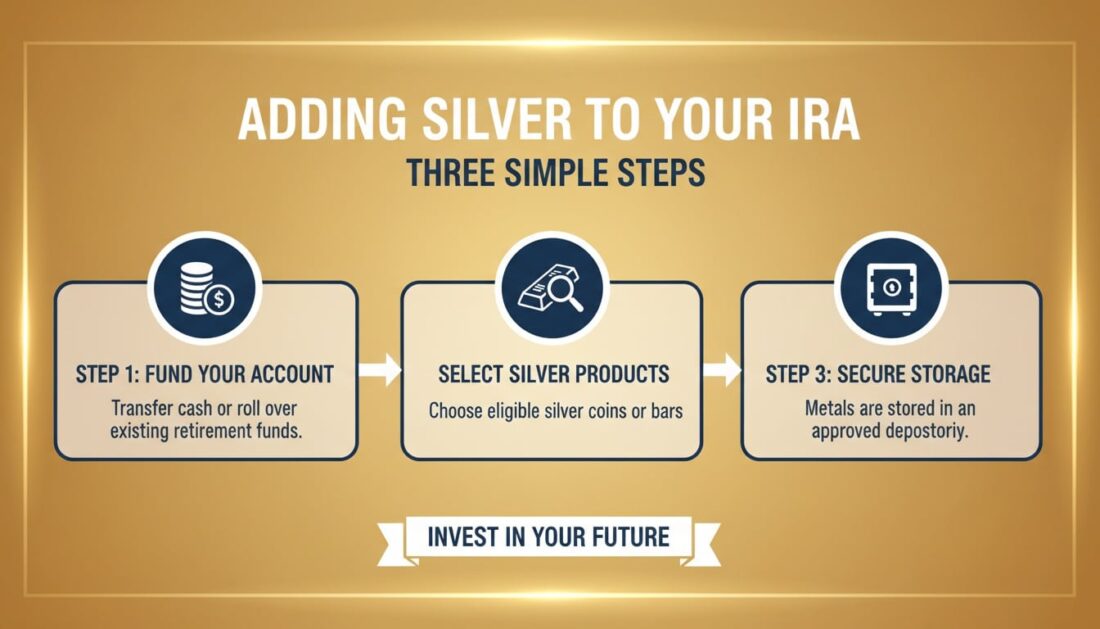
If you already have a Precious Metals IRA with gold, adding silver is straightforward.
If you’re starting from scratch, the process is similar—just with an additional account setup step.
What You Can Do: The 3-Step Process
Here’s how it works:
Step 1: Identify Available Funds
You’ll need funds in your self-directed IRA to purchase silver. These can come from:
- Existing IRA cash balance — If you have uninvested cash in your account, you can use it immediately
- New contributions — For 2026, the IRA contribution limit is $7,500 (or $8,600 if you’re 50 or older)
- Rollover from another account — You can roll over funds from a 401(k) or another IRA into your precious metals account
- Selling existing metals — You can sell some gold holdings and use the proceeds to purchase silver
For rollovers, a direct rollover is typically the cleanest approach.
The funds move directly from your existing account to your precious metals custodian without you taking possession. This avoids the 60-day deadline and potential complications of an indirect rollover.
Step 2: Select Your Silver Products
Work with your dealer to choose IRS-approved silver products. Most customers focus on:
- American Silver Eagles — The most liquid and widely recognized option. Easy to buy, easy to sell.
- Canadian Silver Maple Leafs — Slightly higher purity at .9999 fine. Also highly liquid.
- Silver bars — Available in various sizes from 1 oz to 100 oz. Lower premiums per ounce than coins, but potentially less liquid.
Coins like American Eagles carry slightly higher premiums but offer maximum liquidity and recognition. Bars offer lower premiums but may be harder to sell in smaller quantities.
Step 3: Complete the Purchase and Shipment
Once you’ve selected your products, your custodian facilitates the purchase. Here’s the typical flow:
- You authorize the purchase
- Funds are sent from your IRA to the dealer
- The dealer ships the silver directly to an IRS-approved depository
- The depository confirms receipt and updates your account holdings
Important: You never take personal possession of IRA metals.
The silver must go directly from the dealer to the depository. If you take possession, the IRS treats it as a distribution—triggering taxes and potential penalties.
Storage Options: What to Know About Holding Silver
Silver presents a unique storage consideration: it takes up significantly more physical space than gold for the same dollar value.
At current prices, roughly $75,000 worth of silver weighs about 1,000 troy ounces—over 68 pounds.
That same dollar amount in gold? Less than 17 ounces—about 1.2 pounds.
This matters because depository fees are sometimes calculated based on the physical space your metals occupy, not just their dollar value.
Segregated vs. Commingled Storage
You’ll typically choose between two storage methods:
Segregated storage keeps your metals physically separate from other customers’ holdings.
Your silver bars and coins are stored in a dedicated space with your name on them. When you take delivery, you receive the exact items you purchased.
Segregated storage generally costs more—typically $150 to $300 annually—but provides additional peace of mind and clear ownership.
Commingled (non-segregated) storage pools your metals with other customers’ holdings of the same type.
The depository tracks your ownership by quantity, but you may not receive the exact same bars or coins upon liquidation.
Commingled storage is less expensive—typically $100 to $250 annually—and still fully IRS-compliant.
Both options are insured and secure. The choice comes down to your preference and how much the “same exact items” aspect matters to you.
Storage Fee Structures
Depository fees vary, but common structures include:
- Flat annual fee — A set dollar amount regardless of holdings (common for smaller accounts)
- Percentage-based fee — Typically 0.5% to 1% of your holdings’ value annually
- Tiered structure — Different rates at different account value thresholds
For silver specifically, some depositories charge based on the physical volume of your holdings—which can make silver storage proportionally more expensive than gold storage.
Ask your custodian about fee structures before making large silver purchases. Understanding the math helps you evaluate the true cost of holding silver in your IRA.
| Storage Type | Typical Annual Cost | Your Metals |
|---|---|---|
| Segregated | $150–$300 | Stored separately, exact items returned |
| Commingled | $100–$250 | Pooled with others, equivalent value returned |
The 2026 Contribution Limits and How They Apply

If you’re adding to your precious metals holdings through annual contributions, here’s what you can contribute in 2026.
Standard IRA Contribution Limits
- Under age 50: $7,500 maximum
- Age 50 and older: $8,600 maximum (includes $1,100 catch-up contribution)
These limits apply to the total of all your traditional and Roth IRA contributions combined.
If you have both a regular IRA and a precious metals IRA, the $7,500 or $8,600 cap covers both.
401(k) and Workplace Plan Limits
If you’re still working and contributing to a 401(k), 403(b), or similar plan, those limits are separate—and higher:
- Under age 50: $24,500 maximum
- Age 50–59 or 64+: $32,500 maximum (includes $8,000 catch-up)
- Age 60–63: $35,750 maximum (includes special $11,250 catch-up under SECURE 2.0)
You can contribute to both a workplace plan and an IRA in the same year, though income limits may affect the deductibility of traditional IRA contributions if you’re covered by a workplace plan.
Rollovers Are Different
Here’s something important: rollover amounts don’t count against contribution limits.
If you’re moving $100,000 from a 401(k) into a precious metals IRA, that’s a rollover—not a contribution. There’s no cap on how much you can roll over.
That’s how many customers fund their precious metals holdings: they perform a 401(k) rollover and use those funds to purchase gold and silver.
For more on deciding between an IRA and direct purchases, see our Gold IRA vs. Physical Gold comparison.
Silver Price Dynamics: What’s Driving the Market in 2026
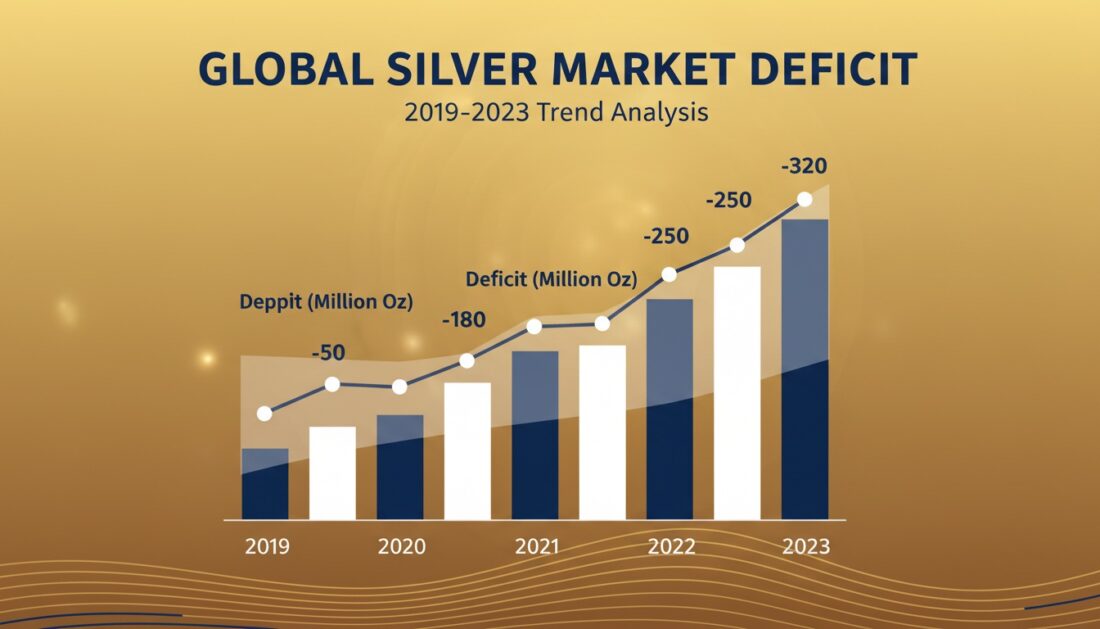
Silver has experienced significant price appreciation in recent years.
Understanding the drivers helps you make informed decisions about adding it to your holdings.
Why This Matters Now: The Supply Deficit Reality
The silver market has been in a structural supply deficit for five consecutive years.
According to data from the Silver Institute, global silver demand has consistently exceeded supply—with a cumulative deficit of nearly 820 million ounces from 2021 through 2025.
Why does this matter?
Unlike gold—which is primarily held and recycled—silver gets consumed. Industrial applications destroy it. Solar panels, electronics, and medical devices use silver in ways that make recovery difficult or uneconomical.
Mine supply hasn’t kept pace. Global silver production has remained essentially flat at around 813 million ounces annually.
Here’s the key point: about 71% of silver is produced as a byproduct of gold, copper, lead, and zinc mining. That means higher silver prices don’t necessarily incentivize more silver production.
Industrial Demand Growth
The green energy transition has fundamentally changed silver’s demand profile:
- Solar photovoltaics — Record installations globally, with silver paste essential to cell efficiency
- Electric vehicles — Growing adoption increases silver demand for electrical systems and charging infrastructure
- 5G and AI infrastructure — Data centers and communications networks require silver’s superior conductivity
According to the Silver Institute’s December 2025 report, silver industrial fabrication is forecast to exceed 700 million ounces—a new record.
This structural demand provides a floor that didn’t exist a decade ago.
Price Forecasts and Reality Checks
Major financial institutions have issued bullish silver forecasts.
J.P. Morgan projects silver averaging $56/oz in 2026, with potential to reach $58/oz by Q4. Some analysts see even higher targets.
Here’s what we always tell customers: forecasts are educated guesses, not guarantees.
Precious metals may appreciate, depreciate, or remain unchanged depending on countless factors—economic conditions, monetary policy, industrial demand, and market sentiment.
The value of holding physical silver isn’t about predicting prices.
It’s about owning a tangible asset with real-world utility and a track record stretching back thousands of years.
Common Questions About Combining Gold and Silver

Before making decisions, most customers want clarity on the practical details.
Here are the questions we hear most often.
“Can I Hold Gold and Silver in the Same Vault?”
Yes.
Most IRS-approved depositories can store multiple metals in the same facility. If you choose segregated storage, your gold and silver will be stored separately but in the same overall facility.
If you choose commingled storage, they’re pooled with other customers’ metals of the same type.
“Which Should I Buy More Of—Gold or Silver?”
There’s no universal answer. It depends on your goals, risk tolerance, and perspective on the metals.
Some customers prefer gold’s stability and use silver as a smaller “high-upside” position. Others believe silver is undervalued relative to gold and weight their holdings accordingly.
Many simply split their purchases—adding both metals proportionally over time.
It comes down to what role you want each metal to play in your overall picture.
“What If I Want to Take Physical Delivery Later?”
You can take an in-kind distribution once you reach age 59½.
This means receiving your actual metal rather than selling it and receiving cash.
With silver, there’s a practical consideration: volume. A substantial silver position means receiving a lot of physical metal.
Some customers prefer to take delivery of gold—smaller and easier to handle—and sell their silver within the IRA.
Either approach works. It’s about what makes sense for your situation.
“Are There Any Tax Differences Between Gold and Silver IRAs?”
No. The tax treatment is identical.
Both traditional and Roth IRA rules apply the same way regardless of which metals you hold.
Traditional IRA: Contributions may be tax-deductible. Growth is tax-deferred. Distributions are taxed as ordinary income.
Roth IRA: Contributions are made with after-tax dollars. Growth is tax-free. Qualified distributions are tax-free.
The metal type doesn’t change these rules. What matters is the account structure.
For a broader look at the tradeoffs, see our guide on Gold IRA pros and cons.
Frequently Asked Questions
What is the IRS purity requirement for silver in an IRA?
The IRS requires silver held in an IRA to be at least .999 fine (99.9% pure).
This applies to silver bars, rounds, and most coins. The American Silver Eagle is a popular choice that meets this requirement with its .999 fine silver content.
Can I have gold and silver in the same IRA account?
Yes.
A Precious Metals IRA—often called a Gold IRA—can hold gold, silver, platinum, and palladium, as long as each metal meets IRS purity requirements. You can hold multiple metals in the same self-directed account and even store them in the same depository vault.
Is the American Silver Eagle allowed in a Gold IRA?
Yes.
The American Silver Eagle is explicitly approved for inclusion in a Precious Metals IRA. It contains one troy ounce of .999 fine silver and is produced by the U.S. Mint, making it one of the most liquid and widely recognized IRA-approved silver products available.
Why should I add silver if I already own gold?
Silver offers different characteristics than gold.
It has significant industrial demand—especially from solar energy, electric vehicles, and electronics—which can drive price appreciation. Silver also tends to be more volatile, potentially offering greater upside during precious metals bull markets.
Many customers add silver to capture both gold’s stability and silver’s growth potential.
What are the storage fees for silver versus gold in an IRA?
Storage fees typically range from $100 to $300 annually, depending on whether you choose segregated or commingled storage.
Silver requires more physical space than gold for the same dollar value, which can affect storage costs for larger silver positions. Segregated storage (your metals kept separately) costs more than commingled storage (your metals pooled with others’).
How do I roll over a 401(k) into a gold and silver account?
Request a direct rollover from your 401(k) administrator to a self-directed IRA custodian who specializes in precious metals.
Once the funds arrive, you can purchase IRS-approved gold and silver products. The metals are then shipped directly to an approved depository.
A direct rollover avoids the 60-day deadline and potential tax complications of an indirect rollover.
Can I take physical delivery of my silver at retirement age?
Yes.
Once you reach age 59½, you can take distributions from your Precious Metals IRA. You have the option to receive your silver as physical metal (in-kind distribution) or sell it and receive cash.
Either way, the distribution is taxed as ordinary income for traditional IRAs. Required minimum distributions begin at age 73.
What happens if silver prices drop after I add it to my IRA?
Like any tangible asset, silver may appreciate, depreciate, or remain unchanged in value depending on market conditions.
Many customers view silver as a long-term position and aren’t concerned with short-term price fluctuations.
The key is understanding that physical silver represents ownership of a real asset—regardless of temporary price movements, you still own the metal.
Making the Decision: Is Silver Right for Your Precious Metals IRA?

Adding silver to your Gold IRA isn’t complicated.
The IRS allows it. The logistics are straightforward. The question is whether it makes sense for your specific situation.
The Takeaway
Here’s what to consider:
Silver makes sense if you:
- Want exposure to industrial demand growth (solar, EVs, electronics)
- Are comfortable with higher volatility in exchange for potentially higher returns
- Believe the gold-to-silver ratio suggests silver is undervalued
- Want to own more physical metal for the same dollar amount
Gold alone might be sufficient if you:
- Prioritize stability over growth potential
- Prefer lower storage costs relative to dollar value
- Want maximum liquidity and recognition
- Are primarily focused on wealth preservation rather than appreciation
Most customers we work with end up holding both metals in some proportion.
The specific allocation varies based on individual circumstances, market views, and personal preference.
The important thing is making an informed decision—not being surprised by rules, fees, or storage logistics after the fact. That’s how you get clarity and control over your retirement picture.
Conclusion
You can absolutely add silver to your Gold IRA.
The rules are clear: silver must be .999 fine, it must be stored in an IRS-approved depository, and you can’t take personal possession while it’s in your IRA.
The strategic question—whether you should add silver—depends on what you’re trying to accomplish.
Silver offers different characteristics than gold: more industrial demand, more volatility, more physical metal per dollar. For many customers, that combination makes it a valuable addition to their precious metals holdings.
If you’re considering adding silver, start by understanding your current custodian’s capabilities and fee structure. Review the approved products. Think about how much exposure you want relative to your gold holdings.
And if you have questions, ask them. This isn’t a decision that needs to be rushed.
We’re here to help at every stage of ownership—whether you’re just getting started or looking to expand what you already hold.
Ready to Explore Your Options?
If you’re thinking “this all makes sense, but I don’t have time to figure it out on my own,” you’re not alone.
Most customers we work with felt the same way before they realized how straightforward the process can be with the right guidance.
That’s why we offer a complimentary consultation to walk you through your options—including our No Fee Precious Metals IRA, which covers custodial fees for the lifetime of the account on qualified purchases.
We’ll show you exactly:
- How the No Fee IRA works and whether you qualify
- The difference between U.S.-minted coins and foreign alternatives
- What to expect from the purchasing and delivery process
- How to roll over or transfer existing retirement funds
- What ongoing support looks like after your purchase
Learn About the No Fee IRA—no obligation, just actionable insights you can use whether you work with us or not.
Your retirement savings represent decades of work. Understanding how silver can fit into your precious metals strategy—and getting the peace of mind that comes with a clear plan—is worth a conversation.