
If you’ve been wondering how a Gold IRA actually works—and whether it makes sense for your retirement—you’re not alone. It’s one of the most common questions we hear.
Here’s the short version: a Gold IRA lets you hold physical precious metals—like gold and silver coins or bars—inside a tax-advantaged retirement account. Instead of paper assets like stocks or mutual funds, you own real, tangible metal that’s stored in an IRS-approved depository on your behalf.
The process comes down to three steps: Open, Fund, Purchase. That’s it.
You open a self-directed IRA with a custodian that permits precious metals. You fund it through a rollover or contribution. Then you purchase IRS-approved gold. The metal ships directly to a secure depository—not to your home—and stays there until you take a distribution.
Sound complicated? It’s not.
For many Americans approaching retirement—or already enjoying it—a Gold IRA offers something that traditional retirement accounts don’t: direct ownership of a physical asset that’s held its value for thousands of years. It’s not about speculation or timing the market. It’s about holding something real in a world where paper promises can change overnight.
Here’s what’s interesting. Central banks around the world seem to agree. According to the World Gold Council, central bank gold purchases exceeded 1,000 tonnes for the third consecutive year in 2024. And 95% of surveyed institutions expect global gold reserves to keep rising.
When the institutions that print money are buying gold at historic rates, it raises a question worth considering: what do they know that most retirement savers don’t?
This guide walks you through exactly how a Gold IRA works in 2026—the IRS rules, the setup process, storage requirements, and what to expect after your purchase. Whether you’re rolling over a 401(k), considering a partial allocation, or just researching your options, you’ll have the clarity you need to make a confident decision.
What Is a Gold IRA—and Why Does It Exist?

A Gold IRA is a self-directed Individual Retirement Account that holds physical precious metals instead of—or alongside—paper-based assets. It operates under the same tax rules as traditional or Roth IRAs, but with one critical difference: you own actual gold, silver, platinum, or palladium that exists in physical form.
The concept isn’t new. Congress authorized precious metals in IRAs through the Taxpayer Relief Act of 1997, recognizing that Americans should have options beyond Wall Street when it comes to retirement savings.
So why are more people paying attention now?
How Gold IRAs Differ from Traditional IRAs
Traditional IRAs typically hold stocks, bonds, mutual funds, and other securities. Your account balance rises and falls based on market performance, earnings reports, and economic conditions you can’t control.
A Gold IRA holds physical metal. Your account value reflects the weight and purity of the gold you own—priced against the global spot market. You’re not holding a promise or a share of something. You’re holding the actual thing.
Here’s what that looks like in practice:
- Traditional IRA — Holds paper assets through a brokerage. You own shares or fund units. Value depends on market performance and counterparty reliability.
- Gold IRA — Holds physical metal through a self-directed custodian. You own coins or bars stored in a depository. Value depends on the weight, purity, and market price of the metal itself.
Both offer tax advantages. Both have contribution limits and distribution rules. The difference? What you’re actually holding.
Why Physical Gold Appeals to Retirement Savers
The appeal comes down to what physical gold represents: a tangible asset that doesn’t depend on any company’s performance, any government’s fiscal policy, or any financial institution’s solvency.
Consider the math on the dollar’s purchasing power. According to the Bureau of Labor Statistics, cumulative inflation since 2020 has exceeded 25%. A dollar today buys roughly what 80 cents bought five years ago.
For someone with retirement savings denominated entirely in dollars, that’s not just an abstract statistic—it’s a direct erosion of future purchasing power.
Gold doesn’t generate dividends or interest. It doesn’t grow earnings or expand market share. But it also doesn’t get diluted when more currency enters circulation. For savers who’ve watched their dollars buy less each year, that’s precisely the point.
The Federal Reserve Bank of St. Louis tracks the purchasing power of the consumer dollar going back to 1913. The trend line tells a clear story: the dollar steadily loses value over time. Physical gold, by contrast, has maintained purchasing power across generations.
Does that mean gold is “better” than dollars? Not necessarily. But it does mean they serve different purposes—and having both gives you options.
The Three-Step Process: Open, Fund, Purchase

Setting up a Gold IRA is more straightforward than most people expect. The process follows three sequential steps, and most customers complete everything within one to three weeks.
Let’s break it down.
Step 1: Open a Self-Directed IRA
A Gold IRA requires a self-directed IRA custodian—one that specifically permits physical precious metals. Traditional brokerage firms like Fidelity or Schwab typically don’t offer this option because they focus on paper assets.
Self-directed custodians specialize in alternative assets. They handle the paperwork, maintain IRS compliance, and coordinate with depositories where your metal will be stored.
Opening the account takes about 15-30 minutes. You’ll provide standard information: name, address, Social Security number, beneficiary designation. The custodian assigns you an account number and confirms your account type—traditional, Roth, SEP, or SIMPLE IRA.
What should you look for in a custodian?
- IRS approval — The custodian must be a bank, federally insured credit union, savings and loan association, or entity approved by the IRS to act as a nonbank trustee
- Transparent fee structure — Understand setup fees, annual administration fees, and storage fees before committing
- Experience with precious metals — Custodians who specialize in Gold IRAs understand the unique requirements and can guide you through the process
- Depository partnerships — Quality custodians work with established, insured depositories like Delaware Depository or Brink’s
Step 2: Fund Your Account
Once your account is open, you need to fund it. There are three primary methods—and one is far more common than the others.
Rollover from an existing retirement account. This is how most Gold IRAs get funded. You can roll over funds from a 401(k), 403(b), TSP, traditional IRA, or other qualified plan.
If you’re executing a penalty-free 401(k) rollover, a direct rollover is the safest approach—funds move directly from your old custodian to your new one without you ever touching the money. No taxes withheld. No 60-day deadline to worry about.
Transfer from another IRA. If you already have a traditional or Roth IRA, you can transfer funds to your new self-directed IRA. Transfers are trustee-to-trustee and don’t trigger taxes or penalties.
New contribution. You can contribute directly to your Gold IRA up to the annual IRS limits. For 2025, that’s $7,000—or $8,000 if you’re 50 or older—according to IRS Publication 590-A.
Here’s something that surprises many people: rollover amounts don’t count against annual contribution limits. You could roll over $100,000 from an old 401(k) and still make your full annual contribution on top of that.
| Funding Method | Tax Implications | Time to Complete |
|---|---|---|
| Direct Rollover | No taxes or penalties if done correctly | 1-3 weeks |
| Indirect Rollover | 20% withheld; must redeposit within 60 days | Faster but riskier |
| IRA Transfer | No taxes or penalties | 1-2 weeks |
| New Contribution | Tax-deductible (traditional) or after-tax (Roth) | Immediate once funds clear |
Step 3: Purchase IRS-Approved Precious Metals
With funds in your account, you can purchase gold. But not just any gold—the IRS has specific requirements about what qualifies. More on that in the next section.
Your custodian or precious metals dealer will present options that meet IRS standards. You’ll choose the products, confirm the purchase price, and authorize the transaction. The dealer ships the metal directly to your designated depository.
At Brighton, we walk customers through every option and explain the trade-offs between different products. Whether you’re drawn to American Gold Eagles for their U.S. Mint backing or Gold Buffalos for their higher purity, the choice is yours. We’re here to provide clarity—not to push you toward one product over another.
The entire purchase typically settles within a few business days. Once complete, your depository confirms receipt and your custodian updates your account to reflect the holdings.
That’s it. Three steps. Most people have it done in under three weeks.
IRS Rules: What Gold Qualifies for Your IRA
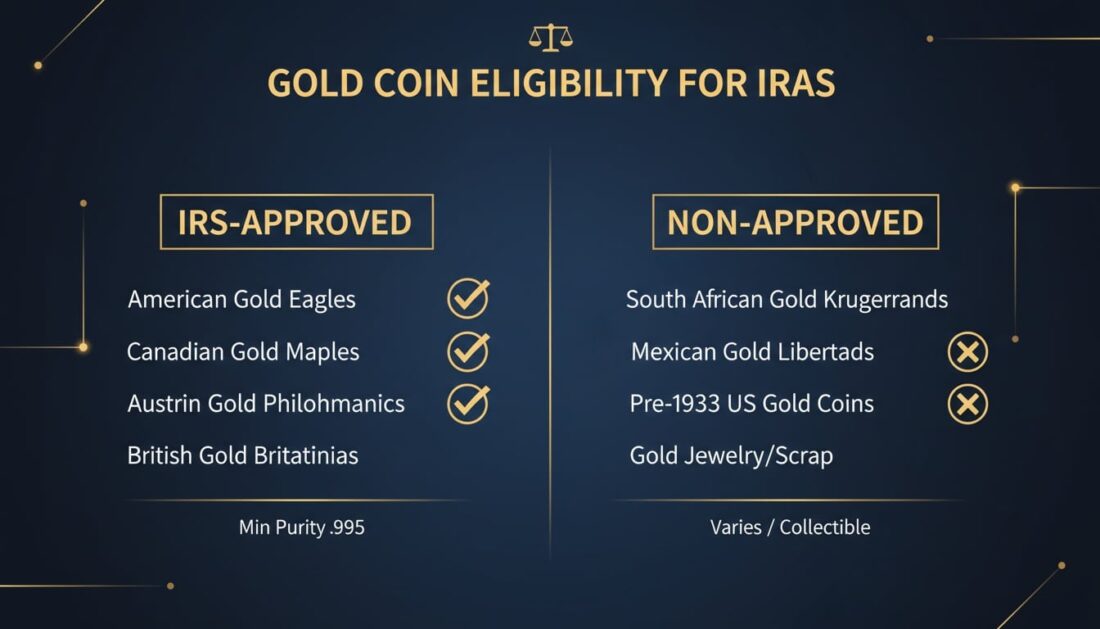
Here’s something that trips people up: the IRS doesn’t allow just any gold in a retirement account.
Section 408(m) of the Internal Revenue Code specifically addresses what precious metals qualify—and what doesn’t. Get it wrong, and you could face immediate taxes and penalties.
The core rule? Gold must meet a minimum fineness of .995 (99.5% pure) and be produced by a national government mint or an accredited private refiner. Collectibles, rare coins, and numismatic items are prohibited regardless of their gold content.
Approved Gold Products
These gold coins and bars meet IRS requirements for IRA inclusion:
- American Gold Eagle — Here’s the interesting part: this coin is actually only 91.67% pure (22 karat), which normally wouldn’t qualify. But Congress specifically authorized it by statute because it’s a U.S. legal tender coin backed by the U.S. Mint. It’s the most popular choice among Gold IRA customers—and for good reason.
- American Gold Buffalo — The first 24-karat gold coin minted by the U.S. Mint (99.99% pure). Strong global recognition and meets all purity requirements without needing a special exception.
- Canadian Gold Maple Leaf — One of the world’s most traded gold coins (99.99% pure). Highly liquid with strong international demand.
- Austrian Gold Philharmonic — Popular in both European and U.S. markets (99.99% pure). Backed by the Austrian Mint.
- Australian Gold Kangaroo — Produced by the Perth Mint (99.99% pure). Features annually changing designs while maintaining IRS compliance.
Gold bars are also IRA-eligible if they meet the .995 purity standard and come from an accredited refiner. Common examples include bars from PAMP Suisse, Credit Suisse, and the Royal Canadian Mint.
For a deeper look at choosing IRS-approved gold coins, we’ve published a detailed comparison of the most popular options for purchasers.
What’s NOT Allowed
The IRS classifies certain precious metals as “collectibles”—and collectibles trigger immediate tax consequences if held in an IRA.
Prohibited items include:
- Graded or slabbed coins (MS70, PF70, etc.) — These are priced based on numismatic value rather than metal content
- Rare or antique coins — Value depends on scarcity and collector demand, not gold content
- Pre-1933 U.S. gold coins — Generally considered collectibles under IRS rules
- Commemorative coins — Unless they’re bullion versions that meet purity standards
- Foreign coins that don’t meet purity requirements — Some older Britannias, for example, are only 91.67% pure and don’t qualify
- Gold jewelry, art, or decorative items — Never IRA-eligible regardless of gold content
What happens if you purchase prohibited metals with IRA funds? The IRS treats it as a distribution. That means immediate income taxes—plus a 10% early withdrawal penalty if you’re under 59½.
It’s an expensive mistake. And it’s completely avoidable if you stick with approved products.
| Product Type | IRS Status | Why |
|---|---|---|
| American Gold Eagle | Approved | Statutory exception for U.S. legal tender |
| American Gold Buffalo | Approved | 99.99% pure, U.S. Mint |
| Canadian Maple Leaf | Approved | 99.99% pure, government mint |
| Pre-1933 Gold Coin | Prohibited | Classified as collectible |
| Graded MS70 Eagle | Prohibited | Numismatic premium disqualifies it |
| Gold Jewelry | Prohibited | Not IRA-eligible bullion |
Storage Requirements: Where Your Gold Actually Lives

One of the most common questions we hear: “Can I store my Gold IRA at home?”
The answer is no—and it’s not optional.
The IRS requires that all precious metals held in an IRA remain in the “physical possession” of a qualified trustee. That means an IRS-approved depository. Not your home safe. Not a bank safe deposit box you control. And not through a personal LLC.
Why Home Storage Doesn’t Work
Some companies have marketed “home storage IRAs” or “checkbook control” structures that claim to let you keep your IRA gold at home. The IRS has consistently ruled against these arrangements.
In 2021, the Tax Court addressed this directly in McNulty v. Commissioner. The court ruled that precious metals stored personally were treated as distributed from the IRA—triggering income taxes, penalties, and disqualification of the account’s tax-advantaged status.
The risk isn’t theoretical. If you store IRA metals at home and the IRS audits your account, you could face:
- Immediate taxation on the full value of the metals
- 10% early withdrawal penalty if you’re under 59½
- Potential disqualification of your entire IRA
- Interest and penalties on unpaid taxes
Why does the rule exist? Physical gold is portable, durable, and liquid. Without third-party custody requirements, the IRS couldn’t verify whether metals remained in the IRA or were being used personally.
It’s a strict rule—but it’s there for a reason.
How Approved Depositories Work
IRS-approved depositories are specialized facilities designed for high-security storage of precious metals. The most commonly used include Delaware Depository, Brink’s Global Services, and International Depository Services.
What do these facilities provide?
- 24/7 security monitoring — Armed guards, surveillance systems, motion detection, and access controls
- Full insurance coverage — Protection against theft, damage, and loss (typically Lloyd’s of London policies)
- Regular audits — Independent verification of inventory and holdings
- Segregated or allocated storage options — Your metals can be stored separately from others’ holdings
You’ll choose between two storage arrangements:
Segregated storage means your specific coins and bars are stored separately—labeled and identified as yours. When you take a distribution, you receive the exact items you purchased. This option typically costs more but provides peace of mind about exactly what you own.
Non-segregated (commingled) storage means your metals are pooled with like items from other customers. You own a specific quantity of gold, but not specific serialized items. This option costs less but means you’ll receive equivalent—not identical—products upon distribution.
Both methods are IRS-compliant. The choice comes down to preference and cost.
| Storage Type | Description | Typical Annual Cost | Best For |
|---|---|---|---|
| Segregated | Your specific items stored separately | $150-$300+ | Customers who want exact items returned |
| Non-Segregated | Pooled with similar items | $75-$150 | Customers prioritizing lower costs |
Understanding Gold IRA Costs
Let’s talk about costs—because understanding them upfront prevents surprises and helps you make an informed decision.
Gold IRAs involve fees that traditional IRAs don’t. But here’s the thing: not all fee structures are created equal.
Typical Fee Categories
Most Gold IRA providers charge some combination of these fees:
- Setup or account opening fee — A one-time charge to establish your self-directed IRA. Ranges from $0 to $100 depending on the custodian.
- Annual custodian/administration fee — Covers account maintenance, IRS reporting, and record-keeping. Typically $75-$300 per year.
- Storage fee — Paid to the depository for secure storage of your metals. Usually calculated as a flat fee ($100-$300) or a percentage of holdings (0.5%-1.0% annually).
- Transaction or trading fees — Some custodians charge per transaction when you buy or sell metals. May be a flat fee or percentage.
- Wire transfer fees — Charged when funds are moved electronically. Typically $25-$50 per transfer.
Over a 20-year retirement, these fees add up. That’s why it pays to understand them before you commit.
Why This Matters Now: Brighton’s No-Fee IRA
Brighton offers something different: a no-fee IRA for the lifetime of the account on qualified purchases.
Here’s what that means in practice. Most Gold IRA companies charge ongoing custodial and administration fees year after year. Over two decades, those fees can total thousands of dollars—money that would otherwise remain in your account, working for you.
Our no-fee structure eliminates those recurring costs on qualified purchases. You keep more of what you’ve saved.
This isn’t a promotional gimmick with hidden charges elsewhere. We’ve structured our business to earn revenue from the metals themselves—not from nickel-and-diming customers with annual fees.
There’s no promotional period. No expiration. The fee elimination lasts as long as you maintain the account.
Dealer Premiums Explained
Beyond custodian and storage fees, you’ll pay a premium when purchasing gold—the difference between the spot price and the actual purchase price.
Every gold dealer charges a premium. It covers minting costs, distribution, dealer margin, and market demand for specific products. Premiums vary by product:
- Gold bars typically carry the lowest premiums (2-5% over spot)
- Common bullion coins like American Eagles carry moderate premiums (5-8% over spot)
- Limited mintage or high-demand coins can carry higher premiums (10%+ over spot)
When comparing dealers, don’t just look at the quoted price. Ask about total cost including shipping, insurance, and any transaction fees. A lower quoted price sometimes comes with higher fees elsewhere.
The premium you pay at purchase affects your breakeven point. If you buy gold at a 5% premium, the spot price needs to rise 5% before you’re “even.”
That’s why we emphasize that Gold IRAs are long-term holdings—not short-term trades. The value comes from holding something tangible over years and decades, not from flipping it next month.
Rollovers and Transfers: Moving Your Existing Retirement Funds

Most Gold IRAs are funded through rollovers from existing retirement accounts—401(k)s, 403(b)s, traditional IRAs, or TSP accounts.
The process moves your money without triggering taxes—as long as you follow the rules.
Direct vs. Indirect Rollovers
There are two rollover methods, but one is clearly better than the other.
Direct rollover (recommended): Your current plan administrator sends funds directly to your Gold IRA custodian. You never touch the money. No taxes are withheld, no 60-day deadline to worry about, no risk of missing a step.
This is the method we recommend for every customer. It’s cleaner, safer, and eliminates potential complications.
Indirect rollover (not recommended): Your current plan sends you a check. You then have 60 days to deposit the full original amount into your new Gold IRA.
Here’s the catch—your plan withholds 20% for taxes. If you received $100,000 but only got a check for $80,000, you still need to deposit the full $100,000 within 60 days. That means coming up with $20,000 from personal funds. You’ll get the withheld amount back as a tax refund—but only after you file.
Miss the 60-day window? The entire amount becomes a taxable distribution. If you’re under 59½, add a 10% early withdrawal penalty on top.
Why take that risk when a direct rollover avoids it entirely?
| Rollover Type | Money Flow | Tax Withholding | Deadline | Risk Level |
|---|---|---|---|---|
| Direct | Custodian to custodian | None | None | Low |
| Indirect | To you, then to custodian | 20% withheld | 60 days | High |
What Accounts Qualify for Rollover
You can roll over funds from nearly any qualified retirement account:
- 401(k) — Including Roth 401(k) accounts
- 403(b) — Common for teachers, nonprofit employees
- TSP (Thrift Savings Plan) — For federal employees and military
- 457(b) — Government and some nonprofit plans
- Traditional IRA — Including SEP and SIMPLE IRAs
- Pension plans — If they allow lump-sum distributions
For detailed guidance on the 401(k) process specifically, our article on rolling over your 401(k) to a Gold IRA without penalty covers every step.
Important note for current employees: Some employer plans don’t allow rollovers while you’re still employed. You may need to wait until you leave the company, reach a certain age, or qualify for an “in-service distribution.” Check your plan documents or contact your HR department to confirm your options.
How Long Does the Process Take?
Plan for one to three weeks from start to finish. Here’s a typical timeline:
Days 1-3: Open your Gold IRA account and submit rollover paperwork
Days 4-10: Your current plan administrator processes the distribution and sends funds
Days 11-14: Funds arrive at your new custodian and clear
Days 15-21: You select and purchase your precious metals; dealer ships to depository
Some plans move faster. Others—especially large 401(k) plans with bureaucratic processes—take longer. The Thrift Savings Plan, for example, requires a one-week waiting period after you submit your rollover destination before processing.
Don’t panic if things take a few weeks. Follow up if you haven’t heard anything after 10 business days. And remember—we’re here to help you navigate the process at every stage of ownership.
Gold IRA vs. Physical Gold: Which Approach Fits You?
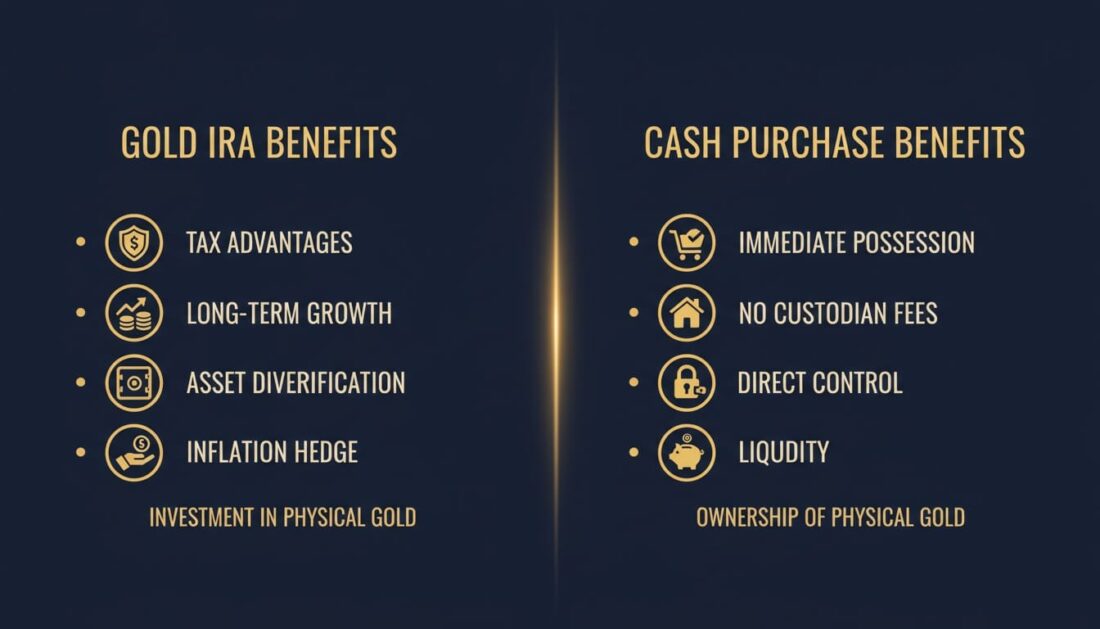
A Gold IRA isn’t the only way to own physical gold. You can also make cash purchases and take direct delivery—or store metal in a private vault outside of any retirement account.
Both approaches have merit. The right choice depends on your goals, timeline, and how you want to access your gold.
So which makes sense for you?
When a Gold IRA Makes Sense
A Gold IRA works well if you’re:
- Using existing retirement funds — Rollovers let you move 401(k) or IRA money into gold without triggering current-year taxes
- Focused on long-term retirement savings — Tax-deferred (traditional) or tax-free (Roth) growth over decades amplifies returns
- Comfortable with depository storage — You don’t need physical possession before retirement
- Maximizing tax advantages — Contributions may be deductible; gains grow tax-advantaged until distribution
The tax benefits are significant. In a traditional Gold IRA, you defer taxes until withdrawal. In a Roth Gold IRA, qualified withdrawals are completely tax-free—including any appreciation in the gold’s value.
That’s a powerful advantage over decades.
When Cash Purchases Make Sense
Direct purchases with immediate delivery fit better if you’re:
- Using after-tax money — No retirement funds involved, no IRS restrictions
- Wanting physical possession now — The gold arrives at your door, stored however you choose
- Building generational wealth — Easier to transfer physical metal to heirs outside the IRA system
- Prioritizing liquidity and access — No custodian permissions or distribution rules to navigate
Some customers do both—maintaining a Gold IRA for retirement while holding physical gold outside the system for immediate access and estate planning flexibility.
We’ve published a comprehensive comparison at Gold IRA vs. Physical Gold: Should I Use an IRA or Buy Directly? that breaks down the trade-offs in detail.
| Factor | Gold IRA | Cash Purchase |
|---|---|---|
| Tax Treatment | Tax-deferred or tax-free growth | Capital gains tax on sale |
| Funding Source | Retirement funds (rollovers) or new contributions | After-tax money |
| Storage | IRS-approved depository required | Your choice (home, safe, vault) |
| Access | Distribution rules apply | Immediate access |
| Annual Costs | Custodian and storage fees | None (if stored at home) |
| Estate Planning | Subject to IRA inheritance rules | More flexible transfer options |
What Happens After You Buy: Ongoing Ownership

Once your Gold IRA is funded and your metals are secured in the depository, you might wonder: now what?
Owning gold in an IRA is largely a hands-off experience. But there are a few things to understand about ongoing ownership, reporting, and eventual distributions.
Annual Reporting and Fair Market Value
Your custodian handles IRS reporting on your behalf. Each year, they’ll file Form 5498 reporting the fair market value (FMV) of your IRA as of December 31st.
For precious metals, determining FMV is straightforward—unlike real estate or private placements, gold trades on well-established global markets with clear pricing. Your custodian uses the spot price plus any applicable premium to calculate the value.
You’ll receive an annual statement showing:
- The types and quantities of metals you hold
- The fair market value of your holdings
- Any transactions during the year
- Your designated beneficiaries
Some customers use tools like FairMarketValue.gold to track their holdings between statements. Brighton also publishes a weekly Gold Market Recap that covers current market trends and pricing movements—so you’re never in the dark about what’s happening.
What You Can Do: Understanding Required Minimum Distributions (RMDs)
If you have a traditional Gold IRA, you’ll eventually face Required Minimum Distributions.
Under the SECURE 2.0 Act, RMDs now begin at age 73 for those born between 1951 and 1959. For those born in 1960 or later, RMDs begin at age 75.
How do RMDs work with physical gold? You have two options:
Sell metal and take cash. Your custodian sells enough gold to cover your RMD amount, then distributes cash to you. This is the most common approach.
Take an in-kind distribution. You receive actual physical gold to satisfy your RMD. The fair market value of the metal counts as your distribution amount, and you take possession of the coins or bars. This option lets you keep the gold outside the IRA while meeting your obligation.
The RMD amount is calculated by dividing your December 31st account balance by a life expectancy factor from IRS tables. Miss an RMD, and you’ll face a penalty—though SECURE 2.0 reduced it from 50% to 25% (and to 10% if corrected within two years).
Here’s something important: Roth Gold IRAs have no RMDs during the owner’s lifetime. That’s one of their biggest advantages for those who can afford to contribute after-tax dollars.
Adding to Your Holdings Over Time
Your Gold IRA doesn’t have to be a one-time purchase. Many customers add to their holdings gradually:
- Making annual contributions up to IRS limits
- Rolling over additional funds from other retirement accounts
- Dollar-cost averaging through regular purchases
Some customers start with a partial rollover—moving 10-20% of their retirement savings into gold—then add more over time as they become comfortable with the process.
There’s no “right” allocation. Financial professionals often suggest that precious metals make up 5-20% of a balanced retirement strategy, but the appropriate amount depends on your individual situation, risk tolerance, and goals.
What matters is that you have options—and that you understand them.
Common Concerns—and Straight Answers

Every prospective Gold IRA customer has questions—and some have concerns based on things they’ve heard or read. Let’s address the most common ones directly.
“Isn’t Gold Too Volatile for Retirement?”
Gold prices do fluctuate. In 2024, gold reached record highs above $2,700 per ounce before pulling back. Day-to-day and month-to-month movements happen.
But here’s the thing: zoom out.
Gold has maintained purchasing power across decades and centuries. The question isn’t whether gold will be worth more next month—it’s whether gold will hold value over a 10, 20, or 30-year retirement horizon.
Compare that to the dollar. BLS data shows cumulative inflation exceeding 25% since 2020 alone. The dollar is virtually guaranteed to lose purchasing power over time. Gold isn’t guaranteed to gain—but it has historically preserved value when measured against the things people actually buy.
Gold IRAs aren’t designed for short-term trading. They’re designed for long-term peace of mind.
“What if Gold Prices Drop After I Buy?”
They might. Anyone being honest with you will tell you that. Gold has experienced significant corrections even during long-term bull markets.
But consider the context. You’re not buying gold hoping to flip it next year. You’re holding it as part of a retirement strategy spanning decades. Short-term price movements matter less when your time horizon is measured in years.
Most customers who regret buying gold regret the timing more than the decision. Those who bought in 2011 at peak prices watched gold decline for years—but those who held through 2024 saw their holdings recover and then some.
The goal isn’t to time the market. It’s to own something tangible that doesn’t depend on paper promises.
“Are Gold IRAs a Scam?”
Gold IRAs themselves are completely legitimate. They’re authorized by federal law, regulated by the IRS, and used by hundreds of thousands of Americans.
That said, the industry has its share of bad actors. High-pressure sales tactics, misleading claims, and bait-and-switch pricing exist. That’s why due diligence matters:
- Check the Better Business Bureau — Look for A+ ratings and minimal complaints
- Verify fee structures in writing — Legitimate companies provide clear, documented pricing
- Be wary of “too good to be true” offers — Extremely low premiums often come with hidden costs
- Avoid companies that push rare coins — Numismatic products carry huge markups and don’t belong in an IRA
- Ask about buyback policies — Reputable dealers will repurchase metals at fair market prices
Brighton has served customers for years with a focus on transparency, education, and long-term relationships. We don’t use high-pressure tactics because we don’t need to—the value of what we offer speaks for itself.
Our concierge service means you’re not just another number. We’re here before, during, and after your purchase—providing support at every stage of ownership.
Frequently Asked Questions
Can I store my Gold IRA metals at home?
No. IRS regulations require that all precious metals held in an IRA be stored in an approved depository. Home storage—even in a personal safe or through an LLC—violates federal rules and can disqualify your entire account, triggering income taxes and potential penalties.
The IRS addressed this directly in tax court rulings. Physical possession by the account owner constitutes a distribution. If you’re under 59½, you’ll also face a 10% early withdrawal penalty on top of ordinary income taxes.
What types of gold coins are allowed in an IRA?
IRS-approved gold coins must meet a minimum fineness of .995 (99.5% pure). The primary exception is the American Gold Eagle, which is allowed despite being 91.67% pure because it’s a U.S. legal tender bullion coin backed by the U.S. Mint.
Other approved options include the American Gold Buffalo (99.99% pure), Canadian Gold Maple Leaf, Austrian Gold Philharmonic, and Australian Gold Kangaroo. All must be produced by government mints or accredited refiners. Collectibles, graded coins, and numismatic items are prohibited.
For a complete breakdown, our article on the Gold American Eagle covers what makes it the most popular choice for Gold IRAs.
How long does a 401(k) to Gold IRA rollover take?
Most direct rollovers complete within one to three weeks. The timeline depends on how quickly your current plan administrator processes the distribution and how fast your new Gold IRA custodian receives and clears the funds.
Indirect rollovers can be faster but carry significantly more risk. You have exactly 60 days to redeposit funds, and your current plan withholds 20% for taxes—meaning you need to make up that difference from personal funds.
Is there a tax penalty for moving my retirement into gold?
Not with a direct rollover. When funds move directly from your existing retirement account to your Gold IRA custodian—without you touching the money—there’s no tax withholding or penalty.
With an indirect rollover, your plan withholds 20% for taxes, and you must redeposit the full original amount within 60 days. Miss that deadline, and the distribution becomes taxable. If you’re under 59½, add a 10% early withdrawal penalty.
What is the no-fee IRA for life offer?
Brighton’s no-fee IRA for life covers custodial fees for the lifetime of your account on qualified purchases. Unlike most Gold IRA providers who charge annual custodian and administration fees, this offer eliminates those ongoing costs—letting more of your retirement savings work for you over time.
There’s no promotional period or expiration. The fee elimination lasts as long as you maintain the account.
How is physical gold valued in my IRA account?
Your Gold IRA custodian reports the fair market value of your holdings annually to the IRS on Form 5498. Unlike hard-to-value alternative assets, precious metals are straightforward to price because they trade on well-established global markets.
The value is typically based on the spot price plus any applicable premium as of December 31st each year. You’ll receive a statement showing the quantity, type, and value of metals in your account.
What happens to my Gold IRA when I reach RMD age?
Once you reach age 73 (or 75 if born in 1960 or later), you must begin taking Required Minimum Distributions from your Gold IRA just like any traditional IRA. The amount is calculated based on your account balance and IRS life expectancy tables.
You can satisfy RMDs by selling enough metal to take a cash distribution or by taking an in-kind distribution where you receive physical delivery of the gold itself. Roth Gold IRAs have no RMDs during the owner’s lifetime.
Can I add gold I already own to my IRA?
No. IRS rules prohibit contributing existing gold from your personal collection to an IRA. All precious metals purchases must be made directly through your IRA custodian using IRA funds.
Contributing personal gold would be considered a prohibited transaction, which could disqualify your entire account. If you want gold in your IRA, it needs to be purchased fresh through the proper channels.
The Takeaway
A Gold IRA offers something increasingly rare in today’s financial system: direct ownership of a tangible asset that doesn’t depend on any institution’s balance sheet, any government’s fiscal policy, or any algorithm’s trading decision.
For retirement-aged Americans who’ve spent decades building their savings, that independence matters. When central banks are buying gold at record rates—over 1,000 tonnes annually for three consecutive years—it suggests that the institutions managing global currencies see value in holding something physical.
Gold won’t generate dividends. It won’t triple overnight. But it also won’t disappear in a market crash, get diluted by monetary policy, or depend on corporate earnings you can’t control.
The process is simpler than most people expect: open an account, fund it through rollover or contribution, purchase IRS-approved metals. Most customers complete everything within a few weeks.
What matters most is understanding your options before you decide—and having someone in your corner who can answer your questions without pressure.
If you’re thinking “this all makes sense, but I don’t have time to figure it out on my own,” you’re not alone. Most customers we work with felt the same way before they realized how straightforward the process can be with the right guidance.
That’s why we offer a complimentary consultation to walk you through your options—including our No Fee Precious Metals IRA, which covers custodial fees for the lifetime of the account on qualified purchases.
We’ll show you exactly:
- How the No Fee IRA works and whether you qualify
- The difference between U.S.-minted coins and foreign alternatives
- What to expect from the purchasing and delivery process
- How to roll over or transfer existing retirement funds
- What ongoing support looks like after your purchase
Learn About the No Fee IRA — no obligation, just actionable insights you can use whether you work with us or not.
Your retirement savings represent years of hard work. The decision about how to protect them deserves careful thought—not pressure, not hype, just clear information and the time to decide what’s right for you.